Category: Carrer Growth and Counseling

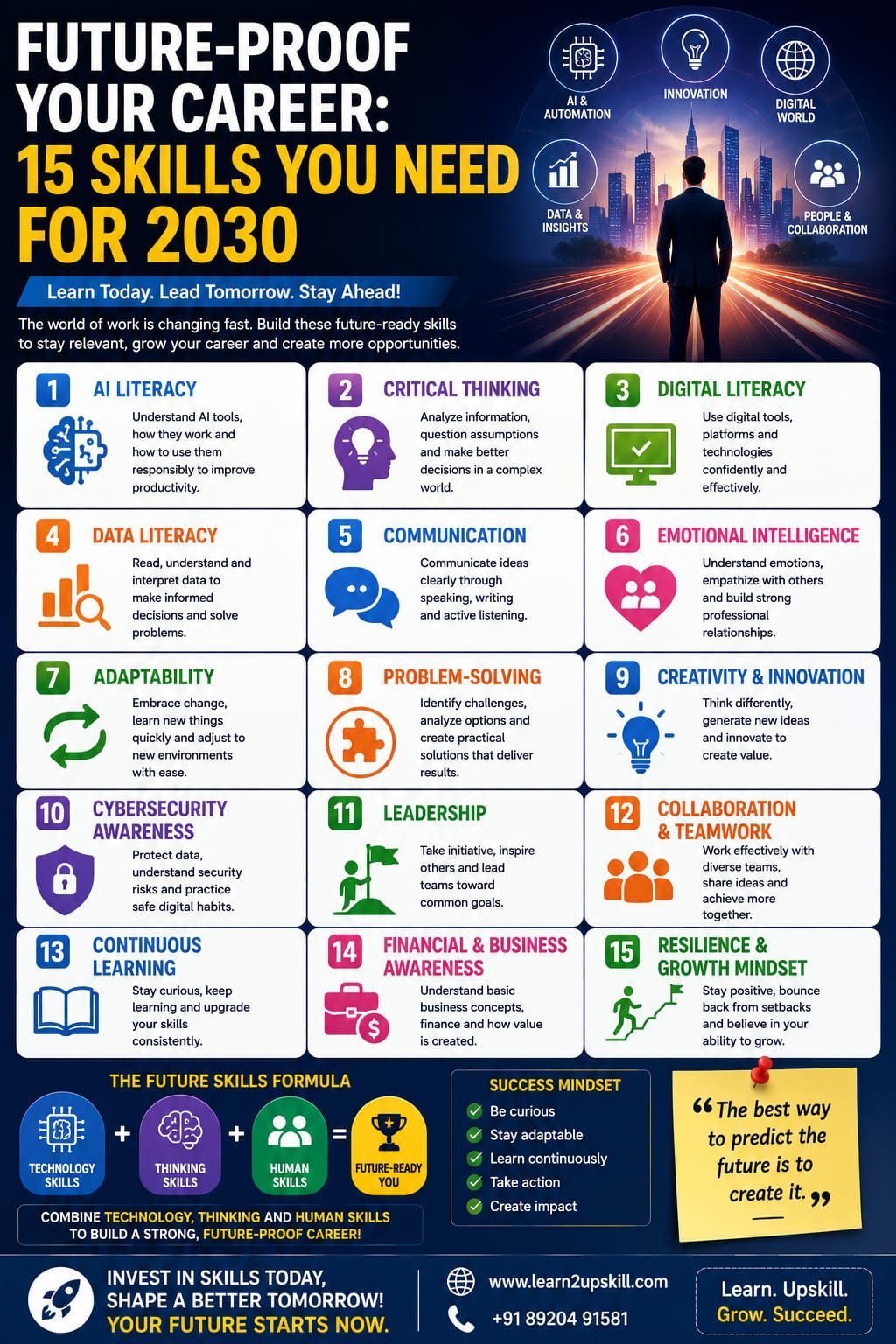
  • Future-Proof Your Career: 15 Skills You Need for 2030

    Future-Proof Your Career: 15 Skills You Need for 2030

    Future-Proof Your Career: 15 Skills You Need for 2030

    Description: Discover the 15 essential skills you need for 2030 to future-proof your career. Learn about AI, digital literacy, communication, critical thinking, leadership and other future-ready skills.

    Suggested URL Slug:

    “/future-proof-your-career-skills-you-need-2030/”


    —

    Future-Proof Your Career: 15 Skills You Need for 2030

    The world of work is changing faster than ever.

    Artificial Intelligence is transforming industries.

    Automation is changing job responsibilities.

    New technologies are creating entirely new career opportunities.

    At the same time, many traditional skills are evolving.

    This creates an important question for students and professionals:

    «Are your current skills preparing you for the future—or only helping you succeed today?»

    The truth is that no one can predict every job that will exist in 2030.

    However, we can prepare for the direction in which the workplace is moving.

    The professionals who will remain valuable are unlikely to be those who simply learn one skill and stop.

    They will be the people who can:

    – Learn continuously

    – Adapt to change

    – Work with technology

    – Think critically

    – Communicate effectively

    – Solve complex problems

    Future-proofing your career does not mean guaranteeing that your job will never change.

    It means developing the ability to adapt when change happens.

    This article explores 15 essential skills you should develop for 2030 to build a stronger, more future-ready career.

    —

    What Does It Mean to Future-Proof Your Career?

    Future-proofing your career means preparing yourself for changes in:

    – Technology

    – Jobs

    – Industries

    – Business models

    – Workplace expectations

    It means becoming someone who can learn new skills when required.

    Instead of saying:

    «”I already know enough.”»

    A future-ready professional says:

    «”What do I need to learn next?”»

    This mindset may be one of the most valuable career advantages of the future.

    —

    Why Skills Will Matter More Than Ever

    In the past, people often learned a profession and followed a relatively predictable career path.

    Today, careers can change much faster.

    New technologies can:

    – Create new jobs

    – Change existing jobs

    – Automate repetitive tasks

    – Increase demand for new skills

    This means education and learning should not end after school or college.

    The future workplace will increasingly reward:

    «Continuous Learning + Adaptability + Practical Skills»

    —

    1. Artificial Intelligence (AI) Literacy 🤖

    AI literacy will be one of the most important future skills.

    You don’t necessarily need to become an AI engineer.

    But professionals in many industries should understand:

    – What AI can do

    – What AI cannot do

    – How to use AI tools responsibly

    – How to write effective prompts

    – How to verify AI-generated information

    AI literacy can help professionals work more efficiently.

    However, responsible use is essential.

    The goal should be:

    «Use AI to improve your work—not to stop thinking.»

    —

    1. Critical Thinking 🧠

    As AI generates more information, the ability to evaluate information becomes increasingly valuable.

    Critical thinkers ask:

    – Is this accurate?

    – What evidence supports this?

    – What assumptions are being made?

    – What information is missing?

    – Are there alternative explanations?

    AI may provide answers quickly.

    Critical thinking helps you decide whether those answers should be trusted.

    —

    1. Digital Literacy 💻

    Digital literacy is no longer optional in most careers.

    Future professionals should be comfortable using:

    – Digital collaboration tools

    – Cloud platforms

    – Productivity software

    – Online communication systems

    – Data and information tools

    You don’t need to master every technology.

    But you should be comfortable learning new digital tools.

    —

    1. Data Literacy 📊

    Organizations increasingly use data to make decisions.

    Professionals who can understand basic data concepts may have a significant advantage.

    Data literacy includes:

    – Understanding charts

    – Reading reports

    – Identifying trends

    – Asking questions about data

    – Making informed decisions

    You don’t have to become a data scientist.

    But understanding data can make you a better professional in almost any field.

    —

    1. Communication Skills 💬

    Technology is changing—but communication remains essential.

    Future professionals will need to:

    – Explain ideas

    – Write professionally

    – Present information

    – Collaborate with teams

    – Communicate with clients

    The ability to explain complex ideas simply will become especially valuable.

    Remember:

    «Having a great idea is important. Being able to communicate it is equally important.»

    —

    1. Emotional Intelligence ❤️

    Technology can process information.

    But workplaces are still made of people.

    Emotional intelligence includes:

    – Self-awareness

    – Empathy

    – Understanding emotions

    – Managing reactions

    – Building relationships

    Professionals with emotional intelligence can often communicate and collaborate more effectively.

    —

    1. Adaptability 🔄

    One of the biggest future skills is the ability to adapt.

    New tools.

    New responsibilities.

    New industries.

    New ways of working.

    Instead of fearing every change, future-ready professionals learn how to respond.

    Adaptability means:

    – Being open to learning

    – Trying new approaches

    – Recovering from setbacks

    – Adjusting to change

    The future may belong less to those who know everything and more to those who can learn anything necessary.

    —

    1. Problem-Solving 🔍

    AI can suggest solutions.

    But humans are often responsible for identifying the right problem.

    Strong problem-solvers can:

    – Understand challenges

    – Analyze causes

    – Explore options

    – Evaluate solutions

    – Take appropriate action

    Problem-solving becomes especially valuable when situations are complex and unclear.

    —

    1. Creativity and Innovation 💡

    AI can generate ideas quickly.

    But human creativity remains important.

    Creativity is not limited to artists or designers.

    Professionals use creativity to:

    – Solve problems

    – Improve processes

    – Develop strategies

    – Create new ideas

    The ability to think differently can create new opportunities.

    —

    1. Cybersecurity Awareness 🔐

    As work becomes increasingly digital, cybersecurity awareness is essential.

    Every employee should understand basic practices such as:

    – Recognizing phishing attempts

    – Protecting passwords

    – Handling information responsibly

    – Avoiding suspicious links

    Cybersecurity is no longer only the responsibility of IT teams.

    Human mistakes can create major security risks.

    —

    1. Leadership Skills 👥

    Leadership is not only for managers.

    Leadership skills can include:

    – Taking responsibility

    – Making decisions

    – Supporting others

    – Communicating clearly

    – Solving problems

    Future organizations will need people who can take initiative.

    You can develop leadership skills at any stage of your career.

    —

    1. Collaboration and Teamwork 🤝

    The future of work will continue to involve collaboration.

    Teams may include:

    – Employees

    – Remote workers

    – International colleagues

    – Technology specialists

    – AI systems

    Successful professionals will need to work effectively with people from different backgrounds and disciplines.

    Good collaboration requires:

    – Respect

    – Communication

    – Listening

    – Accountability

    —

    1. Continuous Learning 📚

    Perhaps the most important future skill is the ability to keep learning.

    The half-life of skills is becoming shorter in many industries.

    This means you should regularly ask:

    «What skills will I need next?»

    Continuous learners:

    – Take courses

    – Read

    – Practice

    – Follow industry developments

    – Learn from experience

    Your ability to learn may become more valuable than any single skill you currently have.

    —

    1. Financial and Business Awareness 💼

    Even professionals outside finance can benefit from understanding basic business concepts.

    Future-ready professionals should understand:

    – Revenue

    – Costs

    – Profit

    – Customers

    – Business goals

    Understanding how your organization creates value can help you make better decisions.

    —

    1. Resilience and Growth Mindset 🌱

    Careers involve challenges.

    You may experience:

    – Rejections

    – Failed projects

    – Job changes

    – Career transitions

    Resilience helps you recover and continue.

    A growth mindset encourages you to see challenges as opportunities to learn.

    Instead of saying:

    «”I can’t do this.”»

    Try:

    «”I can’t do this yet.”»

    That small word can change your approach to learning.

    —

    The Future Skills Formula

    The strongest professionals of 2030 may combine three categories of skills:

    🤖 Technology Skills

    – AI literacy

    – Digital literacy

    – Data literacy

    – Cybersecurity awareness


    🧠 Thinking Skills

    – Critical thinking

    – Problem-solving

    – Creativity


    🤝 Human Skills

    – Communication

    – Emotional intelligence

    – Leadership

    – Collaboration


    Together:

    «Technology + Thinking + Human Skills = Future-Ready Professional»

    —

    Which Skills Should Students Focus On First?

    Students may feel overwhelmed by a list of 15 skills.

    You don’t need to learn everything at once.

    Start with a strong foundation.

    Focus first on:

    1. Communication
    2. Digital Literacy
    3. Critical Thinking
    4. AI Literacy
    5. Problem-Solving

    Then continue building specialized skills related to your career.

    —

    Which Skills Should Working Professionals Focus On?

    Working professionals should begin by asking:

    «Which parts of my job are changing?»

    Then identify:

    – Skills becoming more important

    – Technologies affecting your industry

    – Skills your organization needs

    A good approach is to combine:

    Your Current Professional Expertise

    with

    Future-Focused Skills

    For example:

    Finance + AI + Data Skills

    Marketing + Analytics + AI

    HR + Digital Tools + Communication

    Business + Data + Leadership

    —

    How to Build Future-Ready Skills

    Step 1: Identify Your Career Goal

    Where do you want to be in the future?

    —

    Step 2: Identify Skill Gaps

    What skills do you currently lack?

    —

    Step 3: Create a Learning Plan

    Choose one or two skills at a time.

    —

    Step 4: Learn Through Practice

    Don’t only watch videos.

    Apply what you learn.

    —

    Step 5: Build Projects

    Projects demonstrate practical skills.

    —

    Step 6: Keep Updating Your Knowledge

    Make learning a regular habit.

    —

    A Simple 12-Month Future Skills Plan

    You can create a personal learning journey.

    Months 1–2

    Improve communication and digital skills.

    Months 3–4

    Learn AI tools relevant to your career.

    Months 5–6

    Develop data literacy and analytical thinking.

    Months 7–8

    Work on a practical project.

    Months 9–10

    Develop leadership and collaboration skills.

    Months 11–12

    Review your progress and identify the next skills to learn.

    The goal is not to learn everything.

    The goal is to keep moving forward.

    —

    Common Mistakes to Avoid

    ❌ Learning Only One Skill

    Career growth often requires a combination of skills.

    —

    ❌ Ignoring Technology

    Even non-technical professionals need digital awareness.

    —

    ❌ Learning Without Practicing

    Knowledge becomes valuable when you can apply it.

    —

    ❌ Collecting Certificates Without Building Skills

    Certificates can be useful—but practical ability matters.

    —

    ❌ Waiting Until Your Job Changes

    Start preparing before you are forced to change.

    —

    ❌ Ignoring Human Skills

    Technology is important, but communication and collaboration remain essential.

    —

    Frequently Asked Questions

    What are the most important skills for 2030?

    Important future skills include AI literacy, critical thinking, digital literacy, data literacy, communication, emotional intelligence, adaptability and problem-solving.


    How can I future-proof my career?

    Focus on continuous learning, develop digital and AI skills, strengthen human skills and stay informed about changes in your industry.


    Will AI replace jobs by 2030?

    AI is expected to change many jobs and automate some tasks, while also creating new roles and changing skill requirements. The best strategy is to develop the ability to work effectively alongside new technologies.


    Is communication still important in the future?

    Yes. Communication remains important because professionals need to collaborate, explain ideas and build relationships.


    Should I learn AI even if I am not in a technical career?

    Basic AI literacy can be useful across many professions. The specific tools and knowledge you need will depend on your career.

    —

    Conclusion

    Nobody knows exactly what the workplace will look like in 2030.

    But one thing is clear:

    Change will continue.

    The best way to prepare is not to predict every future job.

    It is to become adaptable enough to learn and grow with change.

    Develop your:

    🤖 Technology Skills

    🧠 Thinking Skills

    🤝 Human Skills

    And most importantly:

    📚 Never stop learning.

    Your future career may require skills you haven’t even heard of yet.

    But if you know how to learn, adapt, communicate and solve problems, you will be better prepared for whatever comes next.

    Remember:

    «Don’t prepare for one job. Prepare for a future of continuous change and opportunity.»

    —

    🚀 Future-Proof Your Career With Learn2Upskill

    The future belongs to people who are ready to learn, adapt and grow.

    Build practical, career-focused skills in:

    – Artificial Intelligence

    – Data and Analytics

    – Digital Skills

    – Communication

    – Leadership

    – Business

    – Professional Development

    with Learn2Upskill.

    🌐 www.coral-kudu-326218.hostingersite.com

    📞 Contact Us: +91 89204 91581

    Learn. Upskill. Grow. Succeed.

    —
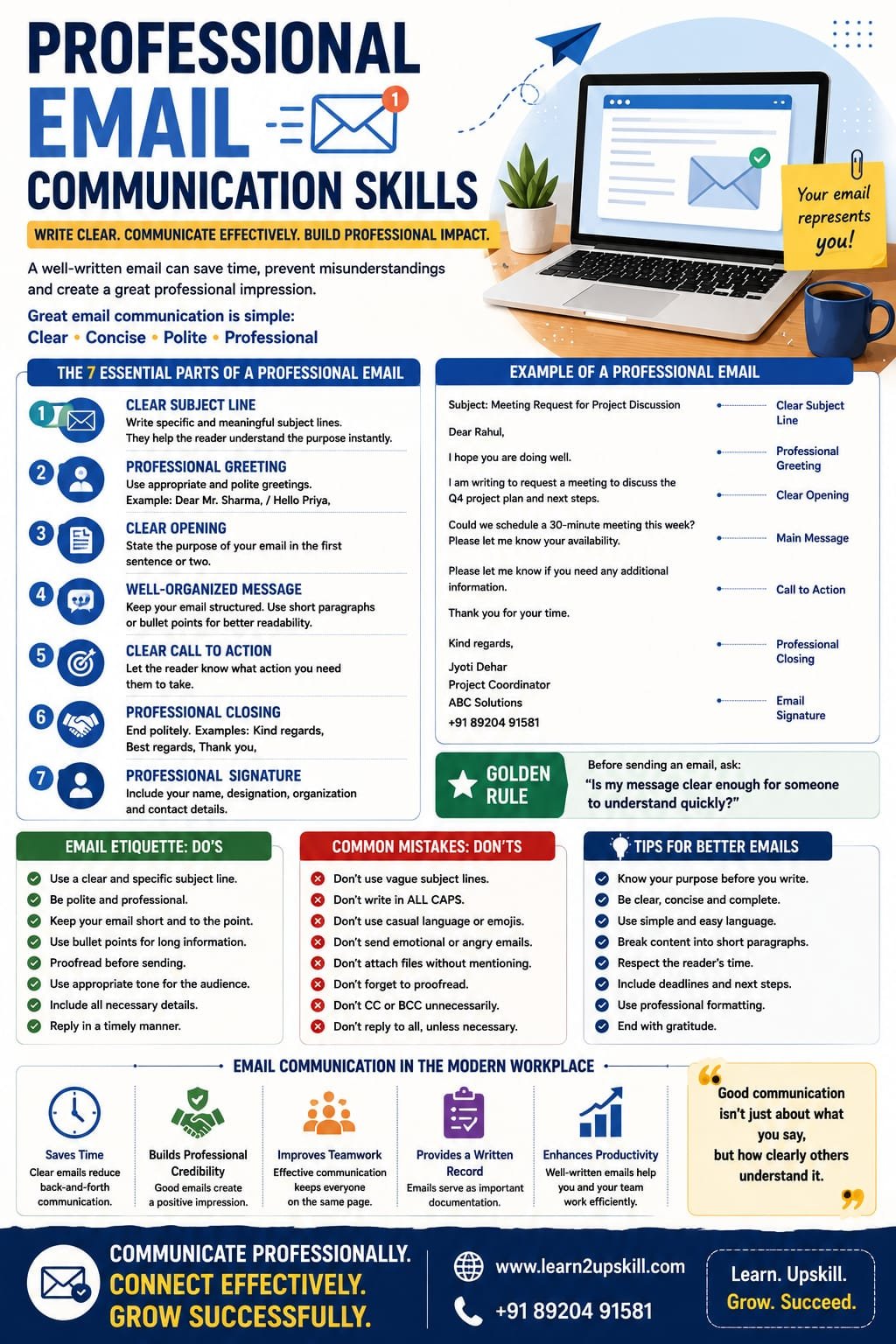
  • Professional Email Communication Skills: How to Write Clear, Effective and Professional Emails

    Professional Email Communication Skills: How to Write Clear, Effective and Professional Emails

    Professional Email Communication Skills: How to Write Clear, Effective and Professional Emails

    Description: Learn essential professional email communication skills. Discover how to write clear, polite and effective emails with proper subject lines, structure, tone and workplace email etiquette.

    Suggested URL Slug:

    “/professional-email-communication-skills/”

    —

    Professional Email Communication Skills: How to Write Clear, Effective and Professional Emails

    Email remains one of the most important communication tools in the professional world.

    Every day, employees send emails to:

    – Managers

    – Colleagues

    – Clients

    – Customers

    – Recruiters

    – Business partners

    – Teams


    A well-written email can save time, prevent misunderstandings and create a professional impression.

    A poorly written email can do the opposite.

    It may confuse the reader, sound rude without intention, create unnecessary back-and-forth communication or even affect your professional image.

    This is why professional email communication skills are essential for students, freshers and working professionals.

    Writing a professional email is not about using complicated English or making every message extremely formal.

    It is about being:

    «Clear + Concise + Polite + Professional»

    In this guide, you will learn how to write better professional emails, understand proper workplace email etiquette and develop communication skills that can help you throughout your career.

    —

    Why Are Professional Email Communication Skills Important?

    Email communication plays an important role in modern workplaces.

    A professional email can help you:

    Communicate Clearly

    The reader should understand your message without confusion.

    Save Time

    A clear email reduces unnecessary follow-up messages.

    Build Professional Credibility

    Well-written communication creates a positive professional impression.

    Avoid Misunderstandings

    Clear language helps prevent incorrect assumptions.

    Create a Written Record

    Emails can provide documentation of discussions, requests and decisions.

    In many situations, your email represents you before the recipient meets you personally.

    That is why professional email writing matters.

    —

    The 7 Essential Parts of a Professional Email

    A strong professional email usually includes the following elements:

    1. A Clear Subject Line


    The subject line tells the reader what your email is about.

    A vague subject line such as:

    ❌ Hello

    ❌ Important

    ❌ Urgent

    does not provide enough information.

    Instead, write something specific.

    ✅ Meeting Request: Project Discussion

    ✅ Leave Request for 15 September

    ✅ Follow-Up: Marketing Report Submission

    A good subject line should be:

    – Clear

    – Specific

    – Relevant

    —

    1. A Professional Greeting

    Begin your email politely.

    Examples include:

    Formal:

    Dear Mr. Sharma,

    Dear Ms. Gupta,

    Professional and Neutral:

    Hello Rahul,

    Hi Priya,

    The appropriate greeting depends on your relationship and workplace culture.

    Avoid overly casual greetings in formal professional situations.

    —

    1. A Clear Opening

    The first sentence should explain why you are writing.

    For example:

    «I am writing to request your feedback on the project report.»

    Or:

    «I would like to follow up regarding our discussion from yesterday’s meeting.»

    This helps the reader immediately understand the purpose of the email.

    —

    1. A Well-Organized Message

    Keep your email structured.

    If your message is long, divide it into short paragraphs or use bullet points.

    For example:

    Please find the key updates below:

    – The report has been completed.

    – The presentation is ready for review.

    – Feedback is requested by Friday.

    This is easier to read than one large paragraph.

    —

    1. A Clear Call to Action

    The recipient should understand what you need them to do.

    For example:

    «Please review the document and share your feedback by Friday.»

    Or:

    «Could you please confirm whether you are available for the meeting?»

    Avoid ending an email without making the next step clear.

    —

    1. A Professional Closing

    Common professional closings include:

    – Kind regards,

    – Best regards,

    – Regards,

    – Thank you,

    Follow this with your name.

    For example:

    Kind regards,

    Jyoti

    —

    1. A Professional Signature

    Your signature may include:

    – Your name

    – Your job title

    – Organization

    – Contact information

    Keep it simple and professional.

    —

    The Golden Rule of Professional Email Writing

    Before sending an email, ask:

    «Is my message clear enough for someone to understand quickly?»

    A professional email does not need to be long.

    In fact, unnecessary length can make communication less effective.

    Try to communicate the right information using the fewest words necessary.

    —

    How to Write a Professional Email Step by Step

    Here is a simple process.

    Step 1: Know Your Purpose

    Before writing, ask:

    Why am I sending this email?

    Your purpose might be:

    – Requesting information

    – Providing an update

    – Asking for approval

    – Following up

    – Scheduling a meeting

    Once you know the purpose, writing becomes easier.

    —

    Step 2: Write a Clear Subject Line

    Make the topic easy to understand.

    —

    Step 3: Start Politely

    Use an appropriate greeting.

    —

    Step 4: Explain Your Main Point

    State the purpose early.

    Don’t make the reader search for the important information.

    —

    Step 5: Add Important Details

    Include only relevant information.

    Ask yourself:

    «Does the recipient need this information?»

    If not, consider removing it.

    —

    Step 6: Explain the Next Step

    Tell the reader what action is needed.

    —

    Step 7: Proofread Before Sending

    Check:

    – Spelling

    – Grammar

    – Names

    – Dates

    – Attachments

    – Tone

    A quick review can prevent embarrassing mistakes.

    —

    Professional Email Tone: Why It Matters

    Tone is the attitude your message communicates.

    The challenge with emails is that people cannot hear your voice or see your facial expressions.

    A short message may sound rude even if that was not your intention.

    For example:

    «Send me the report.»

    This may sound demanding.

    A more professional version could be:

    «Could you please send me the report when you have a chance?»

    Or, if there is a deadline:

    «Could you please send me the report by 4 PM today? Thank you.»

    The message is still clear—but the tone is more professional.

    —

    Common Professional Email Mistakes to Avoid

    ❌ Writing Without a Subject Line

    Always include a useful subject.

    —

    ❌ Using Very Casual Language

    Avoid workplace emails that sound like informal text messages.

    —

    ❌ Writing Extremely Long Emails

    Long emails can hide important information.

    Use short paragraphs and bullet points.

    —

    ❌ Sending Emails While Angry

    Never write an emotional response and immediately press send.

    Pause.

    Read it again later.

    Focus on facts and solutions.

    —

    ❌ Using Too Many Capital Letters

    WRITING IN ALL CAPITAL LETTERS can appear aggressive or like shouting.

    Use normal formatting.

    —

    ❌ Forgetting Attachments

    If you mention an attachment, check that it is actually attached before sending.

    —

    ❌ Sending Without Proofreading

    Small mistakes can affect clarity and professionalism.

    —

    CC and BCC: What Employees Should Know

    Understanding CC and BCC is part of professional email etiquette.

    CC (Carbon Copy)

    Use CC when someone should be informed about the email but is not necessarily the main person expected to respond.


    BCC (Blind Carbon Copy)

    BCC hides recipient email addresses from other recipients.


    Use it carefully and appropriately.

    Always consider your organization’s policies when using CC and BCC.

    —

    How to Write Emails to Your Manager

    When writing to your manager:

    Be Clear

    State your purpose.

    Be Respectful

    Use a professional tone.

    Be Concise

    Avoid unnecessary details.

    Be Specific

    Include important dates and information.

    Example:

    Subject: Request for Feedback on Project Report


    Hello [Name],

    I have completed the project report and would appreciate your feedback before the final submission.

    Please let me know if you would like any changes or additional information.

    Kind regards,

    [Your Name]

    —

    How to Write Emails to Clients and Customers

    Client communication requires additional attention.

    Your emails should be:

    – Professional

    – Polite

    – Clear

    – Helpful

    – Accurate

    Avoid technical language that the client may not understand.

    Focus on solving the problem.

    For example:

    Instead of:

    «This issue occurred because the system failed during processing.»

    You could write:

    «We apologize for the issue. Our team is reviewing the situation and working to resolve it. We will share an update as soon as possible.»

    Professional communication should provide clarity and reassurance.

    —

    The Importance of Active Listening in Email Communication

    Email communication is not only about sending messages.

    It is also about understanding what others are asking.

    Before replying, carefully read the email.

    Ask yourself:

    – What is the main question?

    – What information does the person need?

    – Have I answered all important points?

    A common mistake is replying quickly but answering only part of the question.

    Taking a few extra moments to understand the message can improve communication quality.

    —

    Professional Email Communication in Remote Work

    Remote and hybrid work have made digital communication even more important.

    When working remotely, people may not have the opportunity to quickly clarify information face-to-face.

    This means emails should be especially clear.

    Include:

    – Context

    – Important details

    – Deadlines

    – Required actions

    Instead of writing:

    «Can you complete this soon?»

    Write:

    «Could you please complete the report by Thursday, 3 PM?»

    Specific communication reduces confusion.

    —

    Email Communication and Emotional Intelligence

    Emotional intelligence can improve professional email communication.

    Before sending an email, consider:

    How might the reader interpret this message?

    Does my tone sound respectful?

    Am I reacting emotionally?

    Should I wait before responding?

    For example, if you receive a frustrating email, avoid responding immediately while angry.

    A short pause can help you write a calmer and more constructive response.

    Remember:

    «A professional email should solve problems—not create new ones.»

    —

    How AI Is Changing Professional Email Communication

    AI tools are increasingly helping professionals with email writing.

    AI can assist with:

    – Drafting messages

    – Improving grammar

    – Changing tone

    – Summarizing long emails

    – Creating professional responses


    However, employees should use AI responsibly.

    Before using AI for workplace communication:

    – Avoid sharing confidential information unnecessarily.

    – Follow your organization’s AI policies.

    – Review the final email carefully.

    – Make sure the message is accurate.

    AI can help create a draft.

    But the professional sending the email remains responsible for the final message.

    —

    10 Quick Tips for Better Professional Emails

    1. Write a clear subject line.
    2. Start with an appropriate greeting.
    3. State your purpose early.
    4. Keep paragraphs short.
    5. Use bullet points for important information.
    6. Maintain a polite and professional tone.
    7. Clearly explain the required action.
    8. Check names, dates and attachments.
    9. Avoid emotional replies.
    10. Proofread before sending.

    These simple habits can dramatically improve your workplace communication.

    —

    A Simple Professional Email Template

    Subject: [Clear Topic]

    Hello [Name],

    I hope you are doing well.

    I am writing regarding [briefly explain the purpose].

    [Include the important information.]

    Please let me know [clearly explain the required action or next step].

    Thank you.

    Kind regards,

    [Your Name]

    —

    Frequently Asked Questions

    What are professional email communication skills?

    Professional email communication skills involve writing clear, polite, structured and effective emails for workplace and business communication.


    How can I make my emails sound more professional?

    Use a clear subject line, professional greeting, concise language, respectful tone and a clear closing.


    How long should a professional email be?

    There is no fixed length, but professional emails should include the necessary information without unnecessary details.


    Should I use emojis in professional emails?

    This depends on workplace culture and your relationship with the recipient. In formal communication, it is generally safer to use them carefully or avoid them.


    How do I avoid sounding rude in an email?

    Use polite language, provide context and reread your email before sending.


    Can AI write professional emails?

    AI can help create drafts and improve writing, but the sender should review the content for accuracy, tone and confidentiality.

    —

    Conclusion

    Professional email communication is a skill that can influence your academic and career success.

    A good email does not need complicated language.

    It needs:

    «Clarity. Professionalism. Respect.»

    Every email you send contributes to your professional image.

    By improving your email communication skills, you can:

    – Reduce misunderstandings

    – Save time

    – Build stronger professional relationships

    – Communicate more confidently

    – Create a positive impression


    Before sending your next email, remember:

    Clear Subject.

    Clear Message.

    Professional Tone.

    Clear Next Step.

    Proofread Before Sending.

    Small improvements can make a big difference.

    Because in the professional world:

    «Good communication is not just about what you say—it is about how clearly others understand it.»

    —

    📧 Build Strong Professional Communication Skills With Learn2Upskill

    Effective communication is one of the most valuable skills for students and professionals.

    Develop practical skills in professional communication, business communication, presentation, workplace etiquette and career development with Learn2Upskill.


    🌐 www.coral-kudu-326218.hostingersite.com

    📞 Contact Us: +91 89204 91581

    Learn. Upskill. Grow. Succeed.

    —
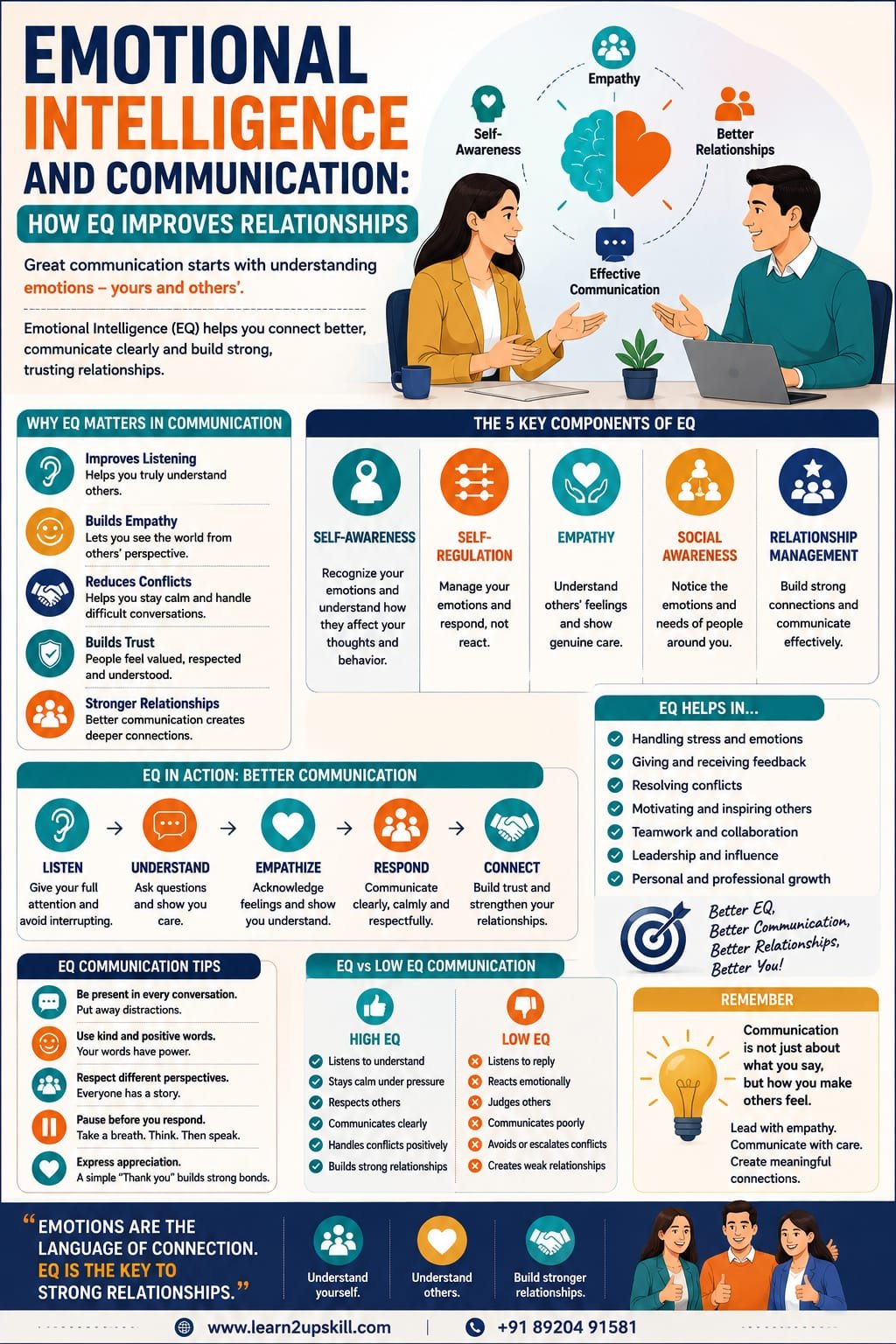
  • Emotional Intelligence and Communication: How EQ Improves Relationships

    Emotional Intelligence and Communication: How EQ Improves Relationships

    Emotional Intelligence and Communication: How EQ Improves Relationships

    Description: Discover how emotional intelligence improves communication and relationships. Learn the key components of EQ, practical communication skills and ways to build stronger personal and professional relationships.

    Suggested URL Slug:

    “/emotional-intelligence-and-communication/”


    —

    Emotional Intelligence and Communication: How EQ Improves Relationships

    Have you ever had a conversation where the words seemed perfectly normal, but something still went wrong?

    Perhaps someone misunderstood your tone.

    Maybe you reacted emotionally and later wished you had responded differently.

    Or perhaps the other person wasn’t really listening to what you were trying to say.

    This is where emotional intelligence, often called EQ, plays an important role.

    Communication is not only about choosing the right words.

    It is also about understanding emotions—your own emotions and the emotions of the people around you.

    A person may have excellent technical knowledge and strong professional qualifications, but if they cannot manage emotions, listen to others or communicate with empathy, building strong relationships can become difficult.

    In today’s workplace, where teams collaborate across departments, cultures and digital platforms, emotional intelligence has become an essential skill.


    The good news?

    Emotional intelligence can be developed and improved with practice.


    In this guide, we’ll explore the connection between emotional intelligence and communication, understand how EQ improves relationships and learn practical ways to become a more emotionally intelligent communicator.

    —

    What Is Emotional Intelligence?

    Emotional intelligence is the ability to recognize, understand and manage emotions effectively.

    It also involves understanding the emotions of other people and responding appropriately.

    In simple words:

    «EQ is the ability to be aware of emotions and use that awareness to communicate and interact more effectively.»


    Emotional intelligence can help you:

    – Understand your reactions

    – Manage stress

    – Communicate calmly

    – Listen with empathy

    – Handle disagreements

    – Build trust

    – Give and receive feedback

    – Develop stronger relationships


    EQ does not mean hiding your emotions.

    It means understanding them and responding thoughtfully.

    For example, feeling angry is a normal human emotion.

    But sending an angry email immediately may not be the best response.

    An emotionally intelligent person may:


    1. Recognize their anger.
    2. Pause before reacting.
    3. Understand why they are upset.
    4. Choose a constructive response.

    That is emotional intelligence in action.

    —

    Why Emotional Intelligence Matters in Communication

    Every conversation has two levels.

    The Information Level

    What is being said?

    The Emotional Level

    How is it being said, and how is the other person feeling?

    Consider this simple sentence:

    «”That’s fine.”»

    Depending on the situation, tone and facial expression, it could mean:

    – Genuine agreement

    – Disappointment

    – Frustration

    – Anger

    – Indifference


    Words alone do not always communicate the complete message.

    Emotionally intelligent communicators pay attention to both the words and the emotional context.

    They ask themselves:

    – What am I feeling?

    – Why am I reacting this way?

    – How might the other person feel?

    – What is the best way to respond?

    This awareness can significantly improve communication.

    —

    The Key Components of Emotional Intelligence

    A useful way to understand EQ is through several important skills.

    1. Self-Awareness

    Self-awareness means understanding your own emotions.


    Ask yourself:

    – What am I feeling right now?

    – Why am I feeling this way?

    – How is my mood affecting my communication?


    For example, imagine you had a stressful morning.

    A colleague asks you a simple question.

    You respond sharply.

    The colleague may not know anything about your stressful morning.

    Self-awareness helps you recognize:

    «”I’m stressed, and my stress is affecting how I’m speaking.”»

    Once you recognize this, you can manage your response better.

    —

    1. Self-Regulation

    Self-regulation means managing your emotional reactions.

    This doesn’t mean pretending that you don’t have emotions.

    It means avoiding impulsive reactions.

    Example:

    You receive an email that frustrates you.

    Your first instinct may be to write an angry reply.

    Instead:

    – Pause.

    – Read the email again.

    – Take a few minutes.

    – Focus on the facts.

    – Write a professional response.

    That pause can prevent unnecessary conflict.

    —

    1. Empathy

    Empathy is the ability to understand another person’s perspective or feelings.

    Empathy does not necessarily mean agreeing with someone.

    You can understand someone’s feelings without agreeing with their decision.

    For example:

    «”I understand why this situation has been frustrating for you.”»

    This statement does not mean:

    «”You are completely right.”»

    It simply shows that you are willing to understand the other person’s experience.

    Empathy can make communication feel more respectful and human.

    —

    1. Social Awareness

    Social awareness involves understanding the people and environment around you.

    This can include noticing:

    – Group dynamics

    – Emotional atmosphere

    – Communication styles

    – Reactions from others


    For example, during a meeting, an emotionally aware professional may notice that a team member has been trying to speak but has repeatedly been interrupted.

    They might say:

    «”I’d also like to hear what Priya thinks about this.”»

    This helps create a more inclusive conversation.

    —

    1. Relationship Management

    Relationship management involves using emotional intelligence to build and maintain positive relationships.

    It includes:

    – Communication

    – Trust

    – Collaboration

    – Conflict management

    – Feedback

    – Respect


    Strong relationships do not mean avoiding every disagreement.

    They mean handling disagreements constructively.

    —

    How Emotional Intelligence Improves Communication

    1. EQ Helps You Listen Better

    Emotionally intelligent people understand that communication is not just about speaking.

    It is also about listening.

    Active listening involves:

    – Paying attention

    – Avoiding unnecessary interruptions

    – Asking questions

    – Clarifying information

    – Responding thoughtfully

    Instead of immediately thinking about what you want to say next, focus on understanding the other person.


    Try asking:

    «”Can you explain that a little more?”»

    or:

    «”So, if I understand correctly, you’re saying that…”»

    These simple phrases can improve understanding.

    —

    1. EQ Helps You Control Emotional Reactions

    We all experience frustration.

    We all feel stressed sometimes.


    The difference is how we respond.

    Imagine a colleague criticizes your work.

    An emotional reaction might be:

    «”You don’t understand how difficult this project was!”»

    An emotionally intelligent response might be:

    «”I appreciate the feedback. Can you help me understand which areas you think need improvement?”»

    The second response creates an opportunity for learning.

    —


    1. EQ Helps You Communicate With Empathy

    Empathy can transform conversations.

    Imagine an employee is struggling to meet a deadline.

    A manager could say:

    «”You missed the deadline again.”»


    Or:

    «”I noticed the deadline was missed. Is there something affecting your ability to complete the work?”»

    The second question encourages discussion.

    This does not mean ignoring performance problems.

    It means addressing them while treating people with respect.


    —

    1. EQ Helps Reduce Misunderstandings

    Many communication problems happen because people make assumptions.

    Someone sends a short message:

    «”Call me.”»

    You immediately assume:

    «”Something is wrong.”»

    But perhaps they simply want to discuss a routine matter.

    Emotionally intelligent communicators avoid jumping to conclusions.

    They ask for clarification.

    —

    1. EQ Helps You Give Better Feedback

    Feedback can be difficult.

    Poor feedback attacks the person.

    Helpful feedback focuses on the work or behavior.


    Instead of:

    «”You’re terrible at presentations.”»

    Try:

    «”Your main points were strong, but slowing down during the financial section could make the presentation easier for the audience to follow.”»

    The second example is:

    – Specific

    – Respectful

    – Actionable

    That’s more likely to lead to improvement.

    —

    Emotional Intelligence and Relationships

    Relationships are built through repeated interactions.

    Every conversation can either strengthen or weaken trust.

    EQ helps improve relationships by encouraging:

    Trust

    People are more likely to trust communicators who are consistent and respectful.

    Understanding

    Listening and empathy help people feel understood.

    Respect

    Emotional intelligence encourages thoughtful communication.

    Better Conflict Management

    EQ helps people focus on solutions instead of personal attacks.

    Stronger Collaboration

    Teams work better when people communicate openly and respectfully.

    —

    Emotional Intelligence in the Workplace

    EQ is especially important in professional environments.


    Employees work with people who may have:

    – Different personalities

    – Different communication styles

    – Different experiences

    – Different cultural backgrounds

    – Different opinions


    A workplace cannot function effectively if everyone expects others to think and communicate in exactly the same way.

    Emotional intelligence helps professionals adapt.

    For example, one colleague may prefer direct communication.

    Another may prefer more detailed explanations.

    A good communicator learns to understand different styles.

    —

    How EQ Helps Leaders Communicate Better

    Leadership is closely connected to communication.

    A leader needs to:

    – Explain goals

    – Give feedback

    – Handle conflict

    – Make decisions

    – Motivate teams

    – Build trust

    A leader with high emotional intelligence can better understand how their communication affects others.

    For example, during a difficult period, employees may feel uncertain.

    A leader who ignores those emotions may create additional anxiety.

    An emotionally intelligent leader communicates clearly while acknowledging concerns.

    For example:

    «”I understand that there are questions about the changes happening in the organization. I will share the information available to me and keep the team updated as we learn more.”»


    This type of communication is honest and respectful.

    —

    Emotional Intelligence and Difficult Conversations

    Difficult conversations are part of life and work.

    You may need to discuss:

    – Poor performance

    – Missed deadlines

    – Disagreements

    – Customer complaints

    – Salary expectations

    – Personal boundaries


    EQ can help you approach these conversations more effectively.

    A Simple Formula:

    Pause → Listen → Understand → Respond

    Pause

    Don’t react immediately.

    Listen

    Allow the other person to explain.

    Understand

    Try to understand the facts and emotions.

    Respond

    Choose your words carefully.

    This approach can prevent many unnecessary arguments.

    —

    Emotional Intelligence in Digital Communication

    EQ is not only important during face-to-face conversations.


    It matters in:

    – Emails

    – Workplace chats

    – Video meetings

    – Social media

    – Online collaboration


    Written communication can easily be misunderstood because people cannot always see facial expressions or hear tone.

    Before sending an important message, ask:

    – Could this sound rude?

    – Is my tone clear?

    – Am I reacting emotionally?

    – Should I wait before replying?


    A five-minute pause can sometimes save hours of unnecessary conflict.

    —

    How to Improve Your Emotional Intelligence

    The good news is that EQ can be developed.

    Here are some practical strategies.

    1. Practice Self-Reflection

    At the end of the day, ask:

    – What situations affected my emotions?

    – How did I respond?

    – Could I have responded differently?

    You don’t need to judge yourself.

    The goal is awareness.

    —

    1. Learn to Pause

    When emotions are strong, don’t rush to respond.

    Take a breath.

    Think.

    Then respond.

    —

    1. Listen More Carefully

    Focus on understanding instead of preparing your next answer.

    —

    1. Ask Questions

    Don’t assume you know what another person is thinking.

    Ask:

    «”Can you help me understand your perspective?”»

    —

    1. Practice Empathy

    Try to see situations from another person’s point of view.

    Ask:

    «”What might this situation feel like for them?”»

    —

    1. Ask for Feedback

    Ask trusted colleagues or friends:

    «”How do I communicate when I’m stressed?”»

    Their answer may help you discover blind spots.

    —

    Common Emotional Intelligence Mistakes

    ❌ Reacting Immediately

    Strong emotions can lead to poor decisions.

    Pause first.

    —

    ❌ Assuming You Know What Others Feel


    You cannot always know.

    Ask questions instead.

    —

    ❌ Avoiding Every Difficult Conversation

    Avoiding problems doesn’t usually solve them.

    Learn to communicate respectfully.

    —

    ❌ Taking Everything Personally

    Not every disagreement is a personal attack.

    Focus on the facts.

    —

    ❌ Ignoring Your Own Emotions

    Understanding emotions is the first step toward managing them.

    —

    A Simple EQ Communication Framework

    Before responding to an emotional situation, remember:

    STOP

    S — Stop

    Don’t react immediately.

    T — Think

    What is happening?

    O — Observe

    What am I feeling? What might the other person be feeling?

    P — Proceed

    Choose a thoughtful response.

    This simple technique can be useful at work and in personal relationships.

    —

    Emotional Intelligence for Students and Freshers

    EQ is also important before entering the workplace.

    Students and freshers can develop emotional intelligence through:

    – Group projects

    – Presentations

    – Team activities

    – Debates

    – Internships

    – Volunteer work

    – Feedback sessions


    Learning to work with different people is an important professional skill.

    Technical knowledge may help you perform tasks.

    Emotional intelligence can help you work effectively with people.

    —

    Emotional Intelligence in the AI Era

    Artificial intelligence is becoming increasingly common in the workplace.

    AI can:

    – Analyze information

    – Generate content

    – Automate tasks

    – Process data


    But human relationships still require:

    – Empathy

    – Trust

    – Judgment

    – Emotional awareness

    – Understanding


    AI can help write a message.

    But humans must decide:

    Should this message be sent?

    Is the tone appropriate?

    How will the recipient feel?

    Is this the right time for this conversation?

    This is why emotional intelligence remains a valuable human skill.

    The future workplace will increasingly need professionals who combine:

    «Technology Skills + Communication Skills + Emotional Intelligence»

    —

    Frequently Asked Questions

    What is emotional intelligence in communication?

    Emotional intelligence in communication means understanding and managing your own emotions while recognizing and responding appropriately to the emotions of others.


    How does emotional intelligence improve relationships?

    EQ can improve relationships by encouraging empathy, active listening, respectful communication, trust and better conflict management.


    Can emotional intelligence be improved?

    Yes. Emotional intelligence can be developed through self-awareness, reflection, active listening, empathy and feedback.


    Why is EQ important in the workplace?

    EQ helps professionals communicate effectively, collaborate with others, handle disagreements, give feedback and build stronger working relationships.


    What is the difference between IQ and EQ?

    IQ generally relates to cognitive abilities and problem-solving, while EQ focuses on understanding and managing emotions and interpersonal relationships. Both can be valuable in different situations.


    How does emotional intelligence help with conflict?

    EQ helps people pause before reacting, understand different perspectives, manage emotions and focus on solutions.

    —

    Conclusion

    Effective communication is about much more than speaking clearly.

    It requires emotional awareness.

    It requires listening.

    It requires empathy.

    And it requires the ability to manage your reactions.

    Emotional intelligence helps us understand an important truth:

    «People may forget the exact words you used, but the way your communication made them feel can influence the relationship that follows.»

    By developing your EQ, you can become a better:

    – Communicator

    – Team member

    – Leader

    – Listener

    – Problem-solver

    Start with one simple habit today.

    Before reacting emotionally:

    Pause. Think. Listen. Respond.

    Small changes in emotional awareness can lead to stronger communication—and stronger relationships.

    —

    🌟 Build Stronger Professional Skills With Learn2Upskill

    The future workplace needs professionals with both technical skills and human skills.

    Develop your communication, emotional intelligence, leadership and career-ready skills with Learn2Upskill.

    🌐 www.coral-kudu-326218.hostingersite.com

    📞 Contact Us: +91 89204 91581

    Learn. Upskill. Grow. Succeed.

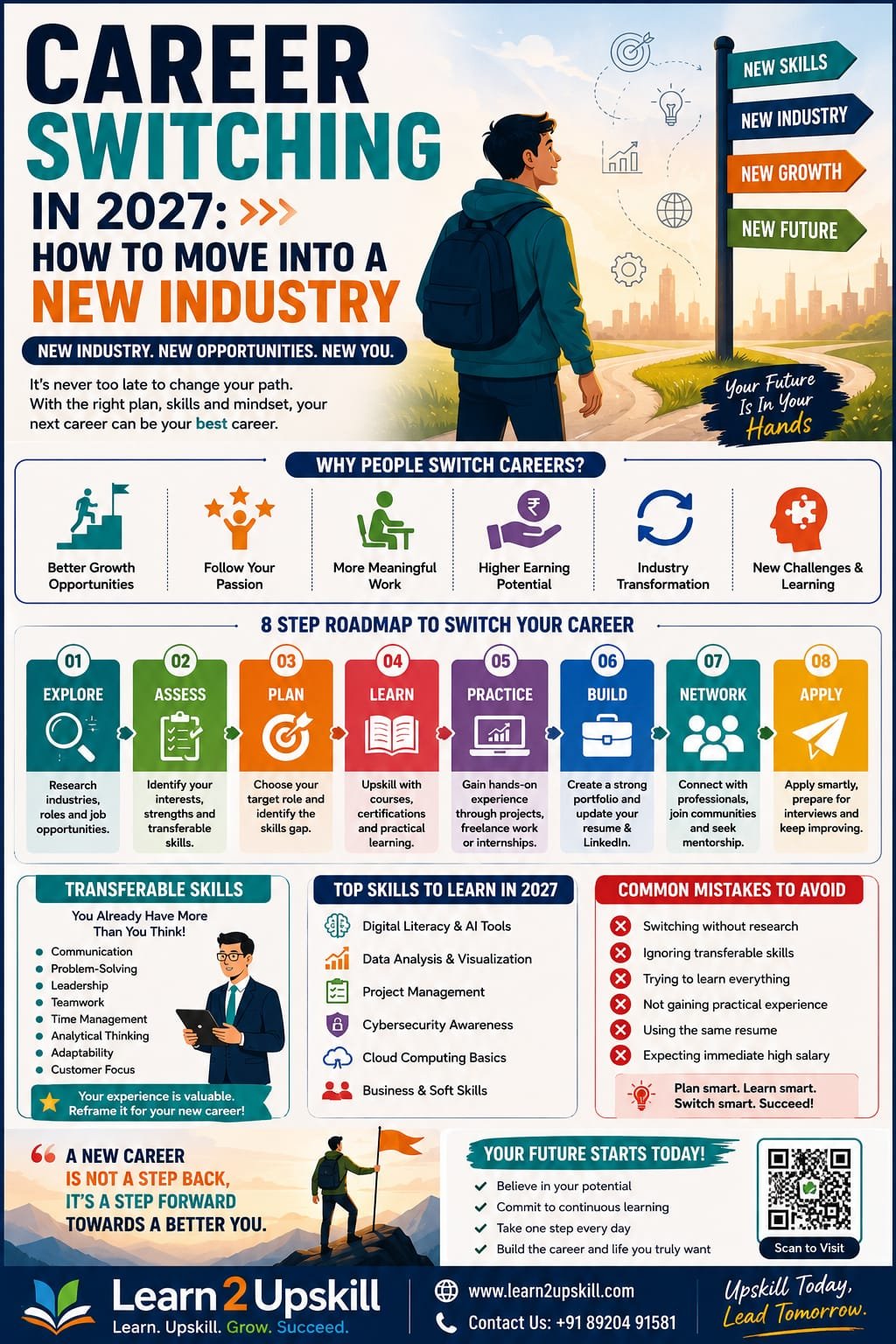
  • Career Switching in 2027: How to Move Into a New Industry

    Career Switching in 2027: How to Move Into a New Industry

    Career Switching in 2027: How to Move Into a New Industry

    Planning a career switch in 2027? Learn how to change industries successfully, identify transferable skills, gain new qualifications, build experience and prepare for a new career.

    Suggested URL Slug:

    “/career-switching-in-2027-how-to-move-into-a-new-industry/”

    —

    Career Switching in 2027: How to Move Into a New Industry

    Changing careers is no longer as unusual as it once was.

    In the past, many people chose one profession and expected to remain in the same industry for most of their working lives. Today, the world of work is changing much faster. New technologies are transforming industries, artificial intelligence is changing job roles, businesses are creating new types of positions, and professionals are increasingly looking for careers that offer better opportunities, flexibility and long-term growth.

    As we move towards 2027, career switching is likely to become an increasingly important part of professional development.

    You may be thinking:

    – Should I change my career?

    – Can I move into a completely different industry?

    – Do I need another degree?

    – How can I get a job without experience in the new field?

    – Am I too late to start again?

    – Which skills should I learn before switching careers?

    The good news is that a successful career switch does not always mean starting from zero.

    You already have experience.

    You already have skills.

    The key is learning how to identify your transferable skills, develop the right new capabilities and position yourself effectively for a different industry.

    This guide will help you understand how to plan and successfully manage a career transition in 2027.

    —

    What Does Career Switching Mean?

    Career switching means moving from your current career, profession or industry into a different professional field.

    For example:

    – A teacher moving into corporate training

    – A customer service professional moving into HR

    – An accountant moving into financial analysis

    – A sales professional moving into digital marketing

    – An IT professional moving into cybersecurity

    – A finance professional moving into data analytics

    – A journalist moving into content marketing

    – An administrative professional moving into project management

    Some career changes are closely related to your previous work.

    Others may involve moving into a completely new industry.

    The important thing to remember is this:

    «A career switch does not mean your previous experience becomes useless.»

    Many of your existing skills can be valuable in your next career.

    —

    Why Are More Professionals Considering Career Changes?

    There are many reasons why professionals decide to switch careers.

    1. Technology Is Changing Jobs

    Artificial intelligence, automation and digital transformation are changing how businesses operate.

    Some jobs are evolving.

    Some tasks are becoming automated.

    At the same time, completely new opportunities are being created.

    Professionals who continue learning and adapting may find new career paths opening up.

    —

    1. People Want Better Career Opportunities

    Sometimes a person enjoys their work but sees limited opportunities for growth.

    A career switch may offer:

    – Better job opportunities

    – Higher earning potential

    – More flexibility

    – Greater career growth

    – New learning opportunities

    – More interesting work

    —

    1. Professionals Want New Challenges

    Doing the same type of work for many years can sometimes lead to boredom or a lack of motivation.

    Learning something new can provide fresh challenges and renewed professional energy.

    —

    1. Skills Are Becoming More Transferable

    Many modern careers require similar core abilities.

    For example:

    – Communication

    – Problem-solving

    – Critical thinking

    – Data analysis

    – Digital skills

    – Project management

    – Collaboration

    – Adaptability

    These skills can often be transferred between industries.

    —

    How to Know If It’s Time to Change Your Career

    A difficult week at work does not necessarily mean you should change your entire career.

    Before making a major decision, take time to understand what you really want.

    Ask yourself:

    Do I dislike my job or my entire industry?

    Sometimes the problem is your current company, manager or work environment—not your profession.

    Do I want better growth opportunities?

    If your current industry has limited opportunities, exploring a related field may make sense.

    What type of work interests me?

    Think about the activities you genuinely enjoy.

    What skills do I want to use?

    Your ideal career should make use of your strengths while giving you opportunities to develop new ones.

    Where do I see myself in five years?

    This question can help you identify whether your current career is moving in the right direction.

    —

    Step 1: Choose Your New Career Direction

    The first step in a successful career switch is choosing a realistic direction.

    Don’t simply choose an industry because it is popular on social media.

    Research the career carefully.

    Consider:

    – Job opportunities

    – Required skills

    – Entry-level requirements

    – Long-term growth

    – Your interests

    – Your existing experience

    – Your financial situation

    For example, if you want to move into data analytics, learn about:

    – Excel

    – SQL

    – Data visualization

    – Power BI

    – Statistics

    – Business analysis

    – AI tools for data analysis

    You don’t necessarily need to learn everything at once.

    Start by understanding what employers expect.

    —

    Step 2: Identify Your Transferable Skills

    This is one of the most important steps in career switching.

    Transferable skills are abilities you can take from one career and use in another.

    For example, a teacher may have:

    – Presentation skills

    – Communication skills

    – Training skills

    – Planning skills

    – Leadership skills

    These abilities could be valuable in:

    – Corporate training

    – Learning and development

    – HR

    – Content development

    – Education technology

    Similarly, a sales professional may have:

    – Communication

    – Negotiation

    – Customer relationship management

    – Presentation

    – Problem-solving

    These skills could transfer to:

    – Marketing

    – Business development

    – Customer success

    – Account management

    – Consulting

    Create a list of everything you already know how to do.

    You may discover that you are much closer to your new career than you think.

    —

    Step 3: Identify Your Skills Gap

    Once you know where you want to go, compare your current skills with the skills required for your target career.

    Ask:

    What do I already know?

    What do I need to learn?

    For example, imagine you are moving from finance into data analytics.

    You may already understand:

    – Business processes

    – Financial data

    – Reporting

    – Problem-solving

    But you may need to develop:

    – Advanced Excel

    – SQL

    – Power BI

    – Data visualization

    – Basic Python

    – AI-assisted data analysis

    This is called your skills gap.

    The goal is to close that gap through focused learning.

    —

    Step 4: Upskill and Reskill Strategically

    One of the biggest mistakes career changers make is trying to learn everything.

    You don’t need 25 certificates.

    You need the right skills for your target role.

    Create a focused learning plan.

    For example:

    Month 1

    Learn the fundamentals of your new industry.

    Month 2

    Develop essential technical or professional skills.

    Month 3

    Practice through projects.

    Month 4

    Build a portfolio and update your professional profile.

    Month 5

    Start networking and applying for opportunities.

    The exact timeline will depend on your career goals, but having a structured plan can make the transition feel more manageable.

    —

    Step 5: Gain Experience Before You Get the Job

    One of the biggest challenges career changers face is:

    «”How can I get experience if nobody gives me a job?”»

    The answer is to create experience wherever possible.

    You can gain relevant experience through:

    – Personal projects

    – Freelance work

    – Volunteer opportunities

    – Internships

    – Case studies

    – Online projects

    – Simulations

    – Portfolio work

    For example, if you want to become a data analyst, you can analyze publicly available datasets and create dashboards.

    If you want to move into digital marketing, you can create sample campaigns and analyze marketing strategies.

    If you want to become a project manager, you can demonstrate how you planned and managed a project.

    Experience does not always have to come from a traditional full-time job.

    —

    Step 6: Build a Strong Portfolio

    A portfolio can be especially valuable when switching careers.

    Your portfolio shows employers:

    «”I may be new to this industry, but I can demonstrate my abilities.”»

    Depending on your career, your portfolio could include:

    – Projects

    – Case studies

    – Reports

    – Dashboards

    – Presentations

    – Marketing campaigns

    – Writing samples

    – Business analyses

    – Websites

    – Certifications

    Focus on quality rather than quantity.

    Three strong projects can be more valuable than twenty incomplete ones.

    —

    Step 7: Update Your Resume for Your New Career

    Do not simply send your old resume to employers in a new industry.

    Your resume should reflect your new career direction.

    Highlight:

    – Transferable skills

    – Relevant projects

    – New certifications

    – Industry-related learning

    – Achievements

    – Relevant experience

    For example, instead of only writing your previous job title, explain the skills you used.

    Traditional approach:

    Sales Executive

    Better career-transition approach:

    Sales Executive

    – Analyzed customer requirements and business needs

    – Prepared presentations and proposals

    – Managed client relationships

    – Used data to identify sales opportunities

    – Collaborated with cross-functional teams

    Now, if you are applying for a business analyst or customer success role, your transferable experience becomes easier to understand.

    —

    Step 8: Rewrite Your LinkedIn Profile

    Your LinkedIn profile should also reflect where you are going—not only where you have been.

    Your headline could include your new professional direction.

    For example:

    Finance Professional | Learning Data Analytics | Excel, SQL & Power BI

    As you gain experience, your profile can evolve.

    Share useful content related to your target industry.

    You can post about:

    – What you are learning

    – Projects you have completed

    – Industry insights

    – Professional achievements

    – Lessons from your career transition

    This can help demonstrate genuine interest and professional development.

    —

    Step 9: Network With People in Your Target Industry

    Networking is not simply asking strangers for jobs.

    It is about learning from people.

    Connect with:

    – Professionals in your target field

    – Recruiters

    – Industry experts

    – Alumni

    – Career communities

    – Professional groups

    Ask thoughtful questions such as:

    – What skills are most important in this field?

    – What challenges do beginners face?

    – What would you recommend learning first?

    – How did you enter this industry?

    The information you gain can help you make better career decisions.

    —

    Step 10: Prepare Your Career Change Story

    During interviews, employers will probably ask:

    «”Why are you changing careers?”»

    This question is important.

    Your answer should be positive and professional.

    Avoid saying:

    «”I hated my previous job.”»

    Instead, focus on your future.

    For example:

    «”My previous role helped me develop strong business and communication skills. Over time, I became increasingly interested in data analysis and how organizations use data to make decisions. I started developing skills in Excel, SQL and Power BI and completed several practical projects. Now I am ready to apply my previous professional experience and new analytical skills in a data-focused role.”»

    This answer shows:

    – Professional maturity

    – Clear motivation

    – Relevant preparation

    – Career direction

    —

    Common Career Switching Mistakes to Avoid

    ❌ Changing Careers Without Research

    Don’t choose a career only because someone online says it pays well.

    Research the actual work.

    —

    ❌ Trying to Learn Everything

    Focus on the skills required for your target role.

    —

    ❌ Ignoring Transferable Skills

    Your previous career has given you valuable experience.

    Use it.

    —

    ❌ Waiting Until You Feel Completely Ready

    You may never feel 100% ready.

    Start applying when you have developed a realistic foundation.

    —

    ❌ Applying With the Same Resume Everywhere

    Customize your resume for your target role.

    —

    ❌ Expecting an Immediate Salary Increase

    Some career transitions may involve starting at a different level.

    Think about long-term growth as well as short-term income.

    —

    Career Switching in the AI Era

    As we prepare for 2027, professionals should understand that AI is becoming part of many industries.

    This doesn’t mean everyone needs to become an AI engineer.

    However, professionals in many fields can benefit from learning:

    – How AI tools work

    – How to use AI responsibly

    – Prompting and communication with AI tools

    – AI-assisted productivity

    – Data literacy

    – Critical thinking

    – Digital skills

    The strongest professionals may increasingly combine:

    Industry Knowledge + Technical Skills + AI Literacy + Human Skills

    For example:

    A marketer who understands AI.

    A finance professional who understands data.

    An HR professional who understands digital tools.

    A business professional who understands automation.

    This combination can create new career opportunities.

    —

    A Simple Career Switching Plan for 2027

    Here is a practical roadmap.

    Phase 1: Explore

    Research industries and identify possible career paths.

    Phase 2: Assess

    Identify your transferable skills and skills gaps.

    Phase 3: Learn

    Develop the essential skills for your new career.

    Phase 4: Practice

    Complete projects and gain practical experience.

    Phase 5: Build

    Create a portfolio, resume and LinkedIn profile.

    Phase 6: Connect

    Network with professionals in your target industry.

    Phase 7: Apply

    Start applying strategically for relevant opportunities.

    Phase 8: Improve

    Learn from interviews, feedback and experience.

    Career switching is a process—not a single decision.

    —

    Frequently Asked Questions

    Is 2027 a good time to change careers?

    The right time depends on your personal situation, financial responsibilities, career goals and preparation. However, professionals who continuously develop relevant skills can position themselves more effectively for changing opportunities.


    Can I change careers without going back to university?

    In many fields, yes. Depending on the career, practical skills, certifications, projects and experience may help demonstrate your capabilities. Some professions, however, require formal qualifications or licenses.


    How long does a career change take?

    A career transition can take several months or longer depending on the industry, your existing skills and the amount of preparation required.


    Am I too old to change careers?

    There is no universal age limit for career change. Your experience can provide valuable transferable skills, professional maturity and industry knowledge.


    What are transferable skills?

    Transferable skills are abilities that can be useful across different jobs and industries, such as communication, leadership, problem-solving, project management and teamwork.


    Should I quit my current job before changing careers?


    This depends on your financial situation and personal circumstances. Many professionals choose to upskill and prepare for a new career while continuing in their current role.


    —

    Conclusion

    Career switching can feel challenging because it involves uncertainty.

    You may worry about starting again.

    You may worry about competition.

    You may worry about whether employers will accept your previous experience.

    But remember:

    «You are not starting from zero. You are starting with experience.»

    Your previous career has helped you develop knowledge, professional habits and transferable skills.

    The key is to combine that experience with the new skills required for your future.

    As we move towards 2027, adaptability and continuous learning will remain essential for career growth.

    Research your target industry.

    Identify your transferable skills.

    Close your skills gap.

    Build practical experience.

    Create a strong professional profile.

    And take the first step.

    A successful career change does not happen overnight.

    But with the right strategy and consistent effort, you can move towards a career that offers new opportunities, growth and professional satisfaction.

    Your career journey does not have to follow one straight line.

    Sometimes, changing direction can be the beginning of your next great opportunity.

    —

    🚀 Prepare for Your Next Career With Learn2Upskill

    Thinking about changing your career or learning new professional skills?

    Build practical, career-ready skills and prepare yourself for the changing world of work with Learn2Upskill.

    🌐 www.coral-kudu-326218.hostingersite.com

    📞 Contact Us: +91 89204 91581

    Learn. Upskill. Grow. Succeed.

    —
    🔗 Recommended Internal Links for Learn2Upskill

    For stronger SEO and internal linking, connect this article with related blogs such as:

    – The Top Skills Employers Are Looking for in 2026

    – How AI Is Changing Jobs—and How to Prepare Your Career

    – The Best Skills to Add to Your Resume

    – How Freshers Can Stay Competitive in the AI Job Market

    – 10 Effective Communication Skills Every Professional Needs

    – Critical Thinking in the AI Era

    – How to Build a Strong Resume With No Work Experience

    – How to Build a Professional LinkedIn Profile

    – AI for Non-Tech Professionals: How Anyone Can Start Using AI

    Suggested Featured Image Alt Text:

    “Career switching in 2027 guide for moving into a new industry”

    Suggested Image Caption:

    “Build new skills, use your transferable experience and confidently prepare for a successful career transition.”

    Suggested CTA:

    Ready to prepare for your next career opportunity? Visit www.coral-kudu-326218.hostingersite.com or contact us at +91 89204 91581.

  • The First Job Is Already Being Decided in College

    The First Job Is Already Being Decided in College

    The First Job Is Already Being Decided in College

    Your degree may take four years. Your employability takes four years too.

    Imagine two students entering college on the same day.

    Both are intelligent.

    Both attend the same number of classes.

    Both eventually receive a degree.

    Both graduate in the same year.

    But when the first job opportunity arrives, something unexpected happens.

    One student says:

    «“I have a degree.”»

    The other says:

    «“I have a degree. Here are the skills I’ve built, the projects I’ve completed, the internships I’ve done and the problems I’ve learned to solve.”»

    Who has the stronger career story?

    That difference is becoming increasingly important in today’s employment market.

    Because your first job usually isn’t something you suddenly start preparing for during your final semester.

    It is being built quietly throughout college.

    —

    The Biggest College Mistake Students Make

    For many students, college becomes:

    Attend lectures → complete assignments → pass exams → graduate → start job hunting.

    And then, during the final year:

    «“I need a job. What should I put on my resume?”»

    That’s when the panic begins.

    No meaningful internship.

    No strong projects.

    Few practical skills.

    Limited professional network.

    No portfolio.

    Little interview experience.


    And suddenly, the student realises:

    The degree is almost complete. But the career preparation hasn’t started.

    This is avoidable.

    The better approach is:

    «Don’t wait until graduation to become job-ready. Use college to become job-ready.»

    —

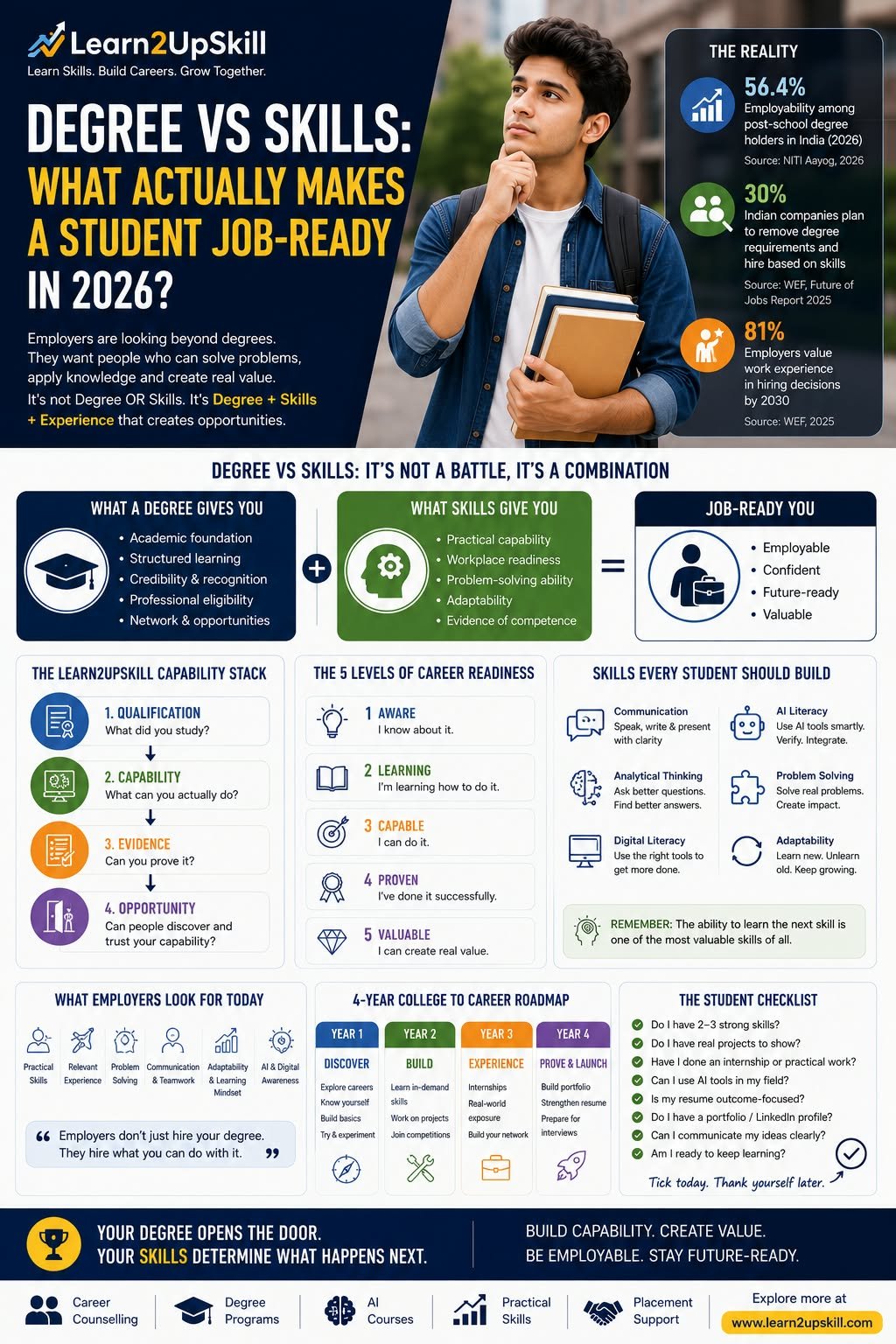
    The Degree Still Matters — But It Is Only One Part of the Story

    Let’s be clear.

    This isn’t an argument against degrees.

    Degrees matter.

    They can provide:

    – academic foundations

    – structured learning

    – recognised qualifications

    – professional networks

    – access to certain careers

    – opportunities for higher education

    – exposure to different subjects and ideas

    But the employment market is increasingly asking another question:

    «“What can you actually do?”»

    Recent NITI Aayog analysis shows that graduate employability in India has improved over time, while also highlighting continuing room for improvement in areas such as pedagogy, practical learning and industry exposure.

    The World Economic Forum’s analysis of India’s future workforce also points toward increasing skills-based hiring, with employers looking at diverse talent pools and, in some cases, reducing degree requirements for emerging roles.

    The message isn’t:

    Degrees don’t matter.

    The message is:

    «Degrees and demonstrable capability increasingly need to work together.»

    —

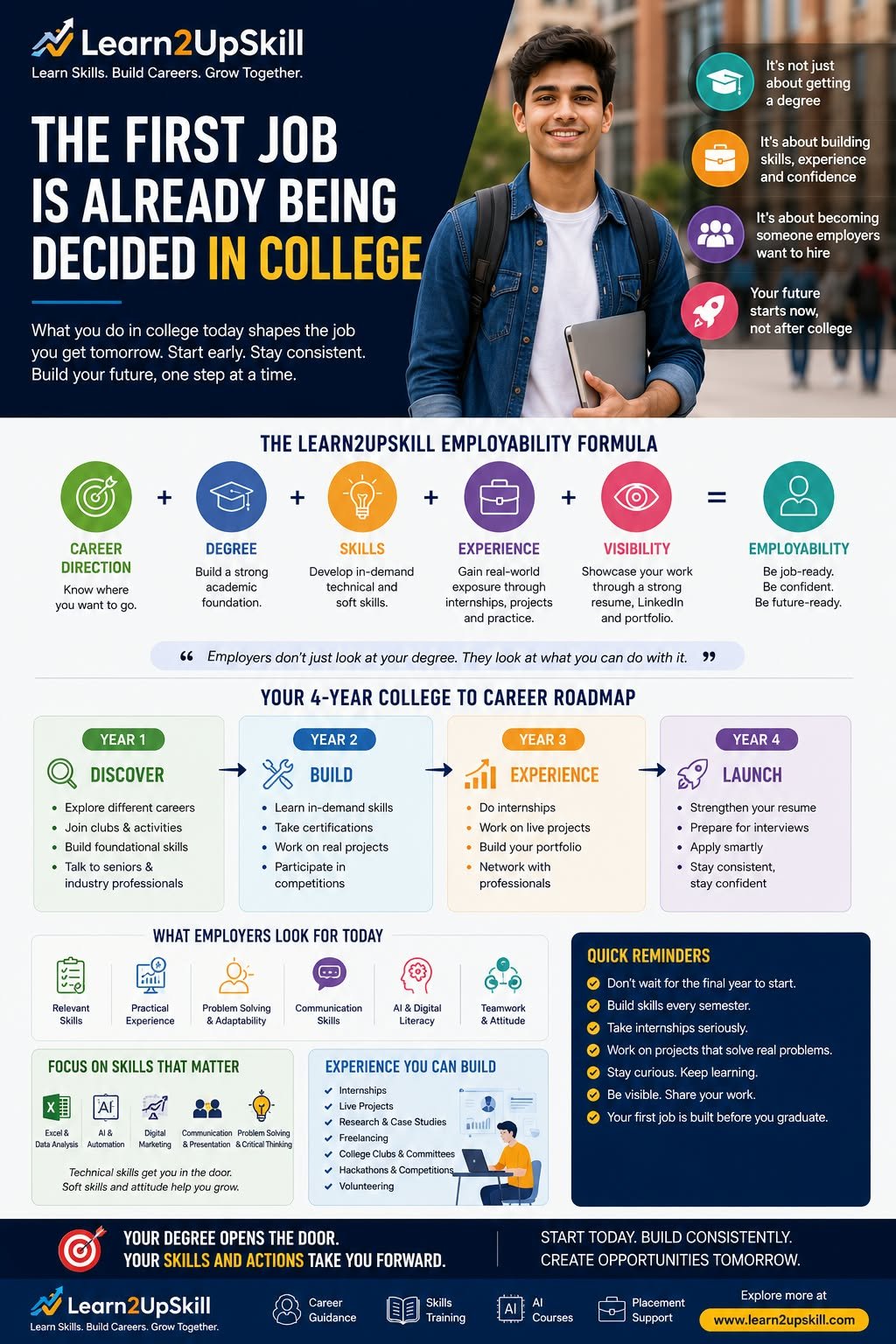
    The Learn2UpSkill Employability Formula

    We introduced our career equation in our previous guide:

    Career Direction + Degree + Skills + Experience + Visibility = Employability

    Now let’s take it one step further.

    For college students:

    Learn → Build → Experience → Demonstrate → Connect → Launch

    That’s the journey we want students to follow.

    —

    Year 1: Don’t Rush to Specialise — Explore

    The first year is not about having everything figured out.

    It is about discovering possibilities.

    A student might think:

    «“I’m doing BBA, so I must become a manager.”»

    Not necessarily.

    A BBA student could eventually explore:

    – marketing

    – sales

    – business analytics

    – consulting

    – HR

    – operations

    – entrepreneurship

    – product management

    – finance

    – customer success

    Similarly, a computer science student might discover interests in:

    – software development

    – cybersecurity

    – data

    – AI

    – product

    – cloud

    – technology consulting

    – entrepreneurship

    The first year should create exposure.

    Your Year 1 mission:

    Discover what interests you.

    Try different things.

    Attend workshops.

    Talk to professionals.

    Explore industries.

    Take small courses.

    Participate in competitions.

    Experiment.

    You don’t need a final answer.

    You need better questions.

    —

    Year 2: Start Building

    This is where students should move from:

    “I know about it.”

    to:

    “I can do it.”

    Suppose you are interested in marketing.

    Don’t simply read about digital marketing.

    Try creating a campaign.

    Interested in data?

    Analyse a dataset.

    Interested in coding?

    Build something.

    Interested in finance?

    Create a financial model.

    Interested in design?


    Build a portfolio.

    Interested in content?

    Create and publish.

    Interested in AI?

    Use AI to solve a real problem.

    The objective is simple:

    «Turn knowledge into evidence.»

    —

    Year 3: Get Real Experience

    This is where internships become extremely valuable.

    An internship isn’t simply something you add to your resume.

    It is an opportunity to discover:

    What does the real workplace actually look like?

    You learn:

    – how teams work

    – how deadlines work

    – how managers think

    – how meetings work

    – how customers behave

    – how problems are solved

    – how communication works

    – how much theory translates into practice

    – where your own skills are still weak

    And sometimes the most valuable discovery is:

    «“I thought I wanted this career. Now I know I don’t.”»

    That’s not failure.

    That’s information.

    Better to discover it during college than after spending five years in the wrong career.

    —

    Year 4: Don’t Just Apply — Position Yourself

    By the final year, your goal should not be:

    «“I need a job.”»

    It should be:

    «“I know what I can offer, and I can demonstrate it.”»

    Your career assets should include:

    Resume

    Clear, focused and evidence-based.

    LinkedIn

    A professional identity rather than an empty profile.

    Portfolio

    Evidence of your work.

    Projects

    Real examples of your capabilities.

    Internships

    Practical experience.

    Skills

    Relevant to your target roles.

    Interview preparation

    Ability to communicate what you know.

    Network

    People who know what you are interested in and what you can do.

    That is a very different graduate from someone who simply has a degree certificate.

    —

    The Certificate Problem

    Let’s imagine two resumes.

    Resume A

    B.Com

    CGPA: 7.8

    Completed several academic assignments.

    Completed online certification in Excel.

    Resume B

    B.Com

    CGPA: 7.8

    Built a sales-analysis dashboard using Excel.

    Completed a finance internship.

    Created a market-analysis project.

    Presented findings to a college entrepreneurship group.

    Built a professional LinkedIn profile.

    Completed an AI productivity course.

    Which resume gives an employer more to discuss?

    The degree is identical.

    The evidence is not.

    —

    Skills Are Becoming the Bridge Between Education and Employment

    India’s employment landscape is changing.

    The World Economic Forum’s Future of Jobs research identifies AI and big data, networks and cybersecurity, and technological literacy among the fastest-growing skill areas globally, alongside human capabilities such as creative thinking, resilience, flexibility, analytical thinking and lifelong learning.

    For India specifically, employers are expecting strong technological change and increasing demand for roles connected with big data, AI and machine learning, and security. The same research also points to growing use of skills-based hiring.

    This doesn’t mean every student needs to become a programmer.

    It means students need to understand:

    «What skills will make me more valuable in the profession I choose?»

    —

    The AI Question Every Student Should Ask

    Don’t ask only:

    «“Will AI take my job?”»

    Ask:

    «“How can AI help me become better at my job?”»

    Consider a marketing student.

    Traditional skill:

    Digital marketing

    Future-ready combination:

    Digital marketing + analytics + AI + creativity + communication

    A finance student:

    Finance + Excel + data + AI + business judgement

    An HR student:

    HR + analytics + AI tools + communication + people skills

    A designer:

    Design + AI-assisted creation + storytelling + user understanding

    A teacher:

    Subject expertise + AI + digital learning + communication

    A business student:

    Business fundamentals + analytics + AI + presentation + problem-solving

    The future is not necessarily:

    Human OR AI.

    It increasingly looks like:

    Human + Domain Knowledge + AI + Judgement

    Recent industry reporting on India’s BFSI sector similarly describes AI as changing the skills required for roles rather than simply eliminating them, with domain expertise and human judgement remaining important.

    —

    Don’t Collect Courses. Build Capability.

    This is another trap.

    Students sometimes collect certificates.

    One certificate.

    Then another.

    Then another.

    Then:

    «“I have 12 certifications.”»

    But ask:

    What can you actually do?

    Five certificates with no application may be less useful than one skill demonstrated through a meaningful project.

    Instead of asking:

    «“How many courses have I completed?”»

    ask:

    «“What capability have I developed?”»

    And then:

    «“What evidence can I show?”»

    That is a much stronger approach.

    —

    The 70-20-10 Student Learning Mindset

    Here’s a simple way students can think about learning.

    70% — Application

    Projects.

    Practice.

    Real-world assignments.

    Experiments.

    20% — Exposure

    Mentors.

    Professionals.

    Internships.

    Networking.

    Industry events.

    10% — Formal Learning

    Courses.

    Certifications.

    Structured academic learning.

    The exact percentages aren’t a scientific rule.

    The point is:

    «Learning becomes more powerful when knowledge is applied and connected to experience.»

    —

    Your College Resume Should Start Before Your Final Year

    Don’t open your resume for the first time in Year 4.

    Start building your professional story from Year 1.

    Year 1

    Interests + activities + foundational skills

    Year 2

    Projects + certifications + competitions

    Year 3

    Internships + stronger projects + professional exposure

    Year 4

    Achievements + experience + portfolio + targeted applications

    By graduation, your resume should feel like the result of four years of development.

    Not four weeks of panic.

    —

    Build a Portfolio, Not Just a Resume

    A resume says:

    «“I can do this.”»

    A portfolio can say:

    «“Here is what I actually did.”»

    For different students, a portfolio might contain:

    Data student

    Dashboards, analyses and case studies.

    Marketing student

    Campaigns, content and performance analysis.

    Developer

    Applications, websites and GitHub projects.

    Designer

    Design work and case studies.

    Finance student

    Models, analysis and research.

    Content creator

    Published work and campaigns.

    Business student

    Business plans, market research and presentations.

    Your portfolio doesn’t have to be perfect.

    It has to be real.

    —

    Networking Is Not Asking People for Jobs

    Many students misunderstand networking.

    Networking isn’t:

    «“Sir, please give me a job.”»

    It is:

    «“I’m interested in data analytics and I’m trying to understand the industry. Could you share how you started your career?”»

    That’s a much better conversation.

    Connect with:

    – alumni

    – professors

    – industry professionals

    – internship supervisors

    – founders

    – recruiters

    – mentors

    – people working in careers you’re exploring

    Build relationships before you need something.

    —

    The First Job Is Also a Learning Decision

    Students sometimes choose their first job only by salary.

    Salary matters.

    But it shouldn’t be the only variable.

    Consider:

    What will I learn?

    Who will I learn from?

    What problems will I solve?

    What technology will I use?

    What industry exposure will I receive?

    Will I get mentorship?

    Will I have opportunities to grow?

    Does this role strengthen my future profile?

    Your first job is not merely your first salary.

    It can become:

    «The first chapter of your professional identity.»

    —

    A ₹5,000 Difference Can Sometimes Matter Less Than a Learning Difference

    Imagine:

    Job A: ₹5 lakh package, repetitive work, little learning.

    Job B: ₹4.5 lakh package, strong mentorship, meaningful projects, better exposure.

    The right choice depends on the individual and circumstances, but students should understand the broader equation.

    Your first few years can create:

    Skills → Experience → Reputation → Network → Better Opportunities

    So don’t only ask:

    «“What will I earn today?”»

    Ask:

    «“What will I become capable of tomorrow?”»

    —

    What Employers Should See When They See Your Resume

    Ideally, your resume should answer five questions quickly:

    1. What did you study?

    Your degree.

    1. What can you do?

    Your skills.

    1. Have you actually done it?

    Projects and experience.

    1. Can you communicate it?

    Your presentation and interview ability.

    1. Why should we remember you?

    Your achievements, unique experiences or strong professional story.

    That’s employability.

    —

    The Learn2UpSkill College-to-Career Roadmap

    Here’s the roadmap every student can save.

    YEAR 1 — DISCOVER

    Explore careers.

    Understand yourself.

    Build foundational skills.

    Start professional exposure.

    —

    YEAR 2 — BUILD

    Build capabilities.

    Take relevant courses.

    Create projects.

    Develop digital and AI literacy.

    —

    YEAR 3 — EXPERIENCE

    Get real-world exposure.

    Intern.

    Volunteer.

    Freelance.

    Work on industry projects.

    Build your network.

    —

    YEAR 4 — LAUNCH

    Become career-ready.

    Strengthen your resume.

    Build your portfolio.

    Prepare for interviews.

    Apply strategically.

    Build professional relationships.

    —

    The “Am I Job-Ready?” Test

    Before graduation, ask yourself:

    Skills

    Can I demonstrate at least 2–3 meaningful professional skills?

    Projects

    Can I show actual work?

    Experience

    Have I worked in a real or simulated professional environment?

    AI

    Do I understand how AI can support my profession?

    Communication

    Can I explain my ideas clearly?

    Resume

    Does my resume demonstrate outcomes rather than simply activities?

    Portfolio

    Can an employer see examples of my work?

    Interviews

    Can I confidently explain what I know and what I have done?

    Network

    Do I know people working in the field I want to enter?

    If most answers are “no,” don’t panic.

    That’s not a verdict.

    It’s a roadmap.

    You still have time to build.

    —

    For Parents: Don’t Ask Only About Marks

    Marks matter.

    Academic performance matters.

    But ask other questions too.

    Instead of only:

    «“What did you score?”»

    also ask:

    «“What did you learn?”»

    «“What did you build?”»

    «“What career are you exploring?”»

    «“What skills are you developing?”»

    «“Did you speak to anyone working in that industry?”»

    «“What did your internship teach you?”»

    These questions can shift a student’s focus from marks alone to capability.

    —

    For Students: Stop Waiting to Feel Ready

    You may think:

    «“I’ll start next semester.”»

    Then:

    «“I’ll start next year.”»

    Then:

    «“I’ll do an internship in final year.”»

    Then:

    «“I’ll learn AI after graduation.”»

    Then suddenly:

    Graduation.

    Don’t wait for the perfect time.

    Start small.

    One project.

    One skill.

    One internship application.

    One professional conversation.

    One useful course.

    One portfolio piece.

    One improvement at a time.

    Careers are rarely built in one dramatic moment.

    They are built through small decisions repeated for years.

    —

    The New Definition of a Graduate

    Perhaps the definition of a graduate needs to change.

    A graduate shouldn’t simply be someone who says:

    «“I completed my degree.”»

    A career-ready graduate should be able to say:

    «“I understand my direction.

    I have a strong academic foundation.

    I have relevant skills.

    I have applied them.

    I have experienced the workplace.

    I can demonstrate what I can do.

    And I know how to keep learning.”»

    That is a much stronger starting point.

    —

    Your First Job Doesn’t Begin When You Apply

    It begins much earlier.

    It begins when you decide to take your education seriously.

    It begins when you stop thinking only about marks and start thinking about capability.

    It begins when you build your first project.

    It begins when you take your first internship.

    It begins when you learn how AI can improve your profession.

    It begins when you speak to someone already doing the work.

    It begins when you put your first meaningful achievement on your resume.

    And eventually, it becomes:

    your first job.

    —

    The Learn2UpSkill Career Principle

    We believe students shouldn’t wait until graduation to ask:

    «“What can I do?”»

    They should start asking that question from the beginning of college.

    Because the future belongs not simply to people who know more.

    It increasingly belongs to people who can:

    Learn → Apply → Adapt → Create → Communicate → Grow

    Your degree matters.

    Your skills matter.

    Your experience matters.

    Your ability to adapt matters.

    And your willingness to keep learning may matter most of all.

    Don’t wait for graduation to become career-ready.

    Start building your career while you’re building your degree.

    Learn Skills. Build Careers. Grow Together.

    Explore Learn2UpSkill’s career guidance, practical skill-development programmes, AI learning and career-focused opportunities to start building a stronger path from education to employment.

    —

    Frequently Asked Questions

    When should college students start preparing for their first job?

    Ideally, preparation should begin from the first year. The focus can evolve from exploration in Year 1 to skills and projects in Year 2, internships and experience in Year 3, and focused job preparation in Year 4.

    Is a degree enough to get a job?

    A degree can provide an important academic foundation, but employment also depends on relevant skills, practical experience, communication, problem-solving, adaptability and the ability to demonstrate capability.

    What skills should students learn during college?

    The right skills depend on the student’s career direction. Useful areas can include communication, digital literacy, AI literacy, Excel, data skills, presentation, problem-solving, teamwork and profession-specific technical skills.

    Should students learn AI during college?

    AI literacy is becoming increasingly useful across professions. Students don’t necessarily need to become AI engineers; they should understand how AI can support and enhance the work they want to do.

    Are internships really important for students?

    Internships can provide valuable exposure to workplace expectations, professional communication, teamwork and real-world problem-solving. They can also help students test whether a career path suits them.

    What is more important: skills or a degree?

    It is not an either-or choice. A degree can provide the foundation, while relevant skills and experience help students apply that foundation. The strongest approach is to build both.

    How can a student become job-ready before graduation?

    Start by identifying a career direction, building relevant skills, completing projects, gaining internships or practical experience, developing a professional network, strengthening a resume and portfolio, and practising interviews.

    —


    Suggested URL:

    “/how-to-become-job-ready-before-graduation/”

    Suggested category:

    Career Guidance / Employability

    Suggested tags:

    Career Planning, Employability Skills, College Students, Internships, AI Skills, Career Development, Job Readiness

  • Untitled post 27341

    Degree vs Skills: What Actually Makes a Student Job-Ready in 2026?

    The answer isn’t “degree or skills.” It’s what you can do with both.

    Imagine this.

    Two students walk into the same interview.

    Both have respectable degrees.

    Both have similar marks.

    Both have completed their college education.

    The interviewer asks:

    «“Tell me something you have actually built, solved or improved.”»

    Student A starts talking about subjects studied.

    Student B opens a laptop.

    «“Here is the dashboard I built.”»

    «“Here is the marketing campaign I worked on.”»

    «“Here is the analysis I completed.”»

    «“Here is the project I built during my internship.”»

    Suddenly, the conversation changes.

    The question is no longer:

    “What did you study?”

    It becomes:

    «“What can you do?”»

    And that may be one of the most important questions for students entering the workforce in 2026.

    —

    The Degree vs Skills Debate Is Asking the Wrong Question

    For years, the debate has sounded like this:

    Team Degree

    «“Without a degree, you won’t get anywhere.”»

    Team Skills

    «“Degrees don’t matter anymore. Skills are everything.”»

    Both statements are incomplete.

    A degree can provide:

    – academic foundation

    – structured learning

    – credibility

    – professional eligibility

    – exposure

    – networks

    – opportunities for higher education

    Skills can provide:

    – practical capability

    – adaptability

    – workplace readiness

    – problem-solving ability

    – productivity

    – evidence of competence

    So the real question isn’t:

    Degree OR Skills?

    It is:

    Degree + Skills + Experience = Stronger Employability

    And that distinction matters.

    —

    The Reality Behind the Numbers

    India’s employability story is improving, but there is still a gap between education and workplace readiness.

    A 2026 NITI Aayog working paper reports that employability among post-school degree holders—including polytechnic graduates—rose from 47.3% in 2019 to 56.4% in 2026. The same analysis notes scope for improving pedagogy, practical learning and industry exposure.

    That number tells us something important.

    Millions of students are earning qualifications.

    But qualification and employability are not the same thing.

    And that is precisely where skills become important.

    —

    The Hiring World Is Changing Too

    The shift isn’t happening only inside classrooms.

    Employers are changing how they look for talent.

    The World Economic Forum’s Future of Jobs Report 2025 says 81% of businesses expect work experience to remain a hiring assessment mechanism through 2030, while 48% expect to use skills assessments. University degrees remain important, but the report also describes growing recognition of skills-first hiring.

    For India specifically, the WEF reports that 30% of companies expect removing degree requirements and using skills-based hiring to help address talent needs, compared with 19% globally. It also identifies Big Data Specialists, AI and Machine Learning Specialists, and Security Management Specialists among India’s fastest-growing roles.

    LinkedIn’s 2025 skills-based hiring research likewise found that applying skills-first approaches can substantially expand the potential talent pool in India.

    So something important is happening.

    The hiring conversation is slowly moving from:

    «“Where did you study?”»

    toward:

    «“What can you contribute?”»

    Not everywhere.

    Not for every profession.

    But enough to matter.

    —

    Here’s the Career Mistake We Need to Stop Making

    Students are often told:

    «“Get good marks.”»

    Then:

    «“Get into a good college.”»

    Then:

    «“Get your degree.”»

    Then:

    «“You’ll get a good job.”»

    But there is a missing middle.

    What happens between the degree and the job?

    That’s where employability is built.

    Think of it as a bridge.

    One side:

    Education

    Other side:

    Employment

    The bridge:

    Skills + Experience + Projects + Communication + Adaptability + Visibility

    Without the bridge, students may find themselves standing on one side with a qualification and wondering why the other side feels so far away.

    —

    The Learn2UpSkill “Capability Stack”

    Here’s a framework I want students to remember.

    Qualification → Capability → Evidence → Opportunity

    1. Qualification

    What did you study?

    Your degree, diploma or formal education.

    1. Capability

    What can you actually do?

    Your technical and professional skills.

    1. Evidence

    Can you prove it?

    Projects, internships, portfolio, achievements and real-world work.

    1. Opportunity

    Can someone discover and trust your capability?

    Resume, LinkedIn, networking, interviews and professional visibility.

    This is the journey from:

    «“I have a degree.”»

    to:

    «“I can create value.”»

    —

    Your Degree Is the Map. Skills Are the Ability to Travel.

    Here’s another way to think about it.

    A degree is like a map.

    It gives you:

    – direction

    – concepts

    – frameworks

    – foundational knowledge

    But a map doesn’t move you forward.

    You still need:

    skills

    practice

    experience

    judgement

    adaptability

    Think of a student studying finance.

    The degree may teach:

    – accounting

    – economics

    – financial management

    – taxation

    – business concepts

    Excellent.

    Now add:

    – Excel

    – data analysis

    – financial modelling

    – AI tools

    – presentation

    – business communication

    Then add:

    – internship

    – project

    – portfolio

    Now the student has something much more powerful.

    Academic knowledge + practical capability.

    —

    The “Certificate Collector” Trap

    This deserves a warning.

    A student completes:

    Certificate 1

    Then:

    Certificate 2

    Then:

    Certificate 3

    Then:

    Certificate 7

    And proudly says:

    «“I have seven certifications.”»

    But the interviewer asks:

    «“What have you done with those skills?”»

    Silence.

    Certificates can be useful.

    They can demonstrate structured learning.

    But a certificate should be the beginning of application, not the end.

    Instead of asking:

    «“How many certificates do I have?”»

    ask:

    «“What can I demonstrate because I completed them?”»

    One strong project can sometimes tell a better story than several certificates sitting unused on a resume.

    —

    The 5 Levels of Career Readiness

    Let’s make this simple.

    LEVEL 1 — AWARE

    “I know about it.”

    You understand the concept.

    —

    LEVEL 2 — LEARNING

    “I’m learning how to do it.”

    You are building the skill.

    —

    LEVEL 3 — CAPABLE

    “I can do it.”

    You can complete tasks independently.

    —

    LEVEL 4 — PROVEN

    “I’ve done it successfully.”

    You have projects, internships or outcomes demonstrating the skill.

    —

    LEVEL 5 — VALUABLE

    “I can use it to solve a real problem.”

    This is where employability becomes powerful.

    The journey isn’t:

    Degree → Job

    It is:

    Learn → Practise → Apply → Prove → Create Value

    —

    So What Skills Should Students Actually Build?

    Not every student needs the same skills.

    That’s important.

    A student shouldn’t blindly collect whatever skill is trending on social media.

    Instead:

    Start with the career direction.

    Then identify the skills that support it.

    But several broad capabilities are becoming increasingly useful across professions.

    —

    1. Communication

    You can be technically brilliant.

    If you cannot explain your thinking, your value may remain invisible.

    Students should practise:

    – speaking

    – writing

    – presentations

    – professional email

    – storytelling

    – active listening

    – explaining complex ideas simply

    Communication isn’t just an HR skill.

    It is a career multiplier.

    —

    1. Analytical Thinking

    Employers don’t only need people who can follow instructions.

    They need people who can ask:

    «“What is actually happening here?”»

    and:

    «“Why?”»

    and:

    «“What should we do next?”»

    Analytical thinking is valuable across:

    – finance

    – marketing

    – technology

    – operations

    – HR

    – consulting

    – healthcare

    – entrepreneurship

    —

    1. Digital Literacy

    Every profession is becoming more digital.

    Students should understand the tools relevant to their field.

    That might include:

    – spreadsheets

    – collaboration platforms

    – data tools

    – presentation tools

    – digital marketing platforms

    – analytics

    – cloud tools

    – automation

    You don’t need to know everything.

    You need to know what matters for your career.

    —

    1. AI Literacy

    This is becoming impossible to ignore.

    But AI literacy doesn’t mean:

    «“I know how to ask ChatGPT questions.”»

    It means understanding:

    – how AI works at a practical level

    – where it can help

    – where it can fail

    – how to verify outputs

    – how to use AI responsibly

    – how to integrate AI into workflows

    – how to combine AI with professional judgement

    The goal isn’t:

    AI instead of your profession.

    It is:

    AI + your profession

    —

    1. Problem-Solving

    This may be one of the most valuable skills of all.

    Companies don’t hire people simply because they know things.

    They hire people who can help solve problems.

    A student should practise asking:

    «What is the problem?»

    «What is causing it?»

    «What information do I need?»

    «What options exist?»

    «What would I recommend?»

    «How would I measure the result?»

    That is the beginning of professional thinking.

    —

    1. Adaptability

    The job you enter in 2030 may not look exactly like the job described today.

    Technology changes.

    Industries change.

    Business models change.

    Customer behaviour changes.

    The people who remain employable are often those who can keep learning.

    The WEF continues to highlight resilience, flexibility, creative thinking and lifelong learning alongside technological capabilities as important workplace skills.

    So perhaps one of the most valuable skills is:

    «The ability to learn the next skill.»

    —

    The AI + Human Advantage

    There is a dangerous misunderstanding about AI.

    Some students think:

    «“AI will replace me.”»

    Others think:

    «“AI is just a tool. I don’t need to worry about it.”»

    Both can be problematic.

    The stronger mindset is:

    «“I will become good at my profession and learn how AI can make me better at it.”»

    Imagine:

    Accountant + AI

    Faster analysis and reporting.

    Marketer + AI

    Faster research, ideation and experimentation.

    HR professional + AI

    More efficient information processing and workflow support.

    Data analyst + AI

    Faster exploration and interpretation.

    Designer + AI

    Faster ideation and iteration.

    Entrepreneur + AI

    More leverage with limited resources.

    The winning combination may increasingly be:

    Domain Expertise + AI Literacy + Human Judgement

    —

    Don’t Become “AI Guy” Without Becoming Good at Something

    This is important.

    A student tells an interviewer:

    «“I know ChatGPT, Gemini, Copilot and several AI tools.”»

    The interviewer asks:

    «“Excellent. What can you do with them?”»

    That’s the real question.

    AI is not a profession by itself for everyone.

    It is increasingly becoming a capability layer across professions.

    So don’t just learn:

    AI tools.

    Learn:

    AI + Marketing

    AI + Finance

    AI + HR

    AI + Data

    AI + Education

    AI + Design

    AI + Operations

    That’s where the opportunity becomes more meaningful.

    —

    The Project Test

    Here’s a simple test for students.

    Suppose you say:

    «“I know digital marketing.”»

    Can you build a campaign?

    Suppose you say:

    «“I know Excel.”»

    Can you analyse a business dataset?

    Suppose you say:

    «“I know AI.”»

    Can you improve a real workflow?

    Suppose you say:

    «“I know Python.”»

    Can you build something useful?

    Suppose you say:

    «“I know finance.”»

    Can you analyse a company’s financial performance?

    If the answer is yes:

    you are moving from knowledge to capability.

    —

    Build “Proof of Skill”

    This is one of the biggest changes students can make.

    For every important skill, ask:

    What is my proof?

    Excel

    Build a dashboard.

    Digital Marketing

    Run a campaign.

    Data Analytics

    Analyse data and present insights.

    Coding

    Build an application.

    Design

    Create a portfolio.

    AI

    Automate or improve a workflow.

    Communication

    Present something publicly.

    Business

    Build a business case.

    Now your resume becomes much stronger.

    Because you aren’t merely saying:

    «“I know this.”»

    You’re saying:

    «“Here is what I did.”»

    —

    What Should a Student Do During College?

    Here’s the Learn2UpSkill Capability Calendar.

    Year 1 — DISCOVER

    Explore careers.

    Identify interests.

    Learn digital fundamentals.

    Improve communication.

    Try different areas.

    —

    Year 2 — BUILD

    Choose 2–3 relevant skills.

    Complete meaningful projects.

    Learn AI relevant to your field.

    Participate in competitions.

    —

    Year 3 — EXPERIENCE

    Intern.

    Freelance.

    Volunteer.

    Work on real-world projects.

    Build your network.

    —

    Year 4 — PROVE

    Strengthen your resume.

    Build your portfolio.

    Practise interviews.

    Create professional visibility.

    Target relevant opportunities.

    —

    What Should Parents Tell Their Children?

    Not:

    «“Just get a good degree.”»

    Instead:

    «“Get a good education—and learn how to use it.”»

    Not:

    «“Just get good marks.”»

    Instead:

    «“Get good marks and build useful capabilities.”»

    Not:

    «“Do what everyone else is doing.”»

    Instead:

    «“Understand where your strengths and opportunities intersect.”»

    And perhaps most importantly:

    «“Don’t be afraid to experiment.”»

    A student who discovers the wrong career direction during college has gained valuable information.

    A professional who discovers it ten years later may face a much harder transition.

    —

    What Employers Should See

    Imagine your future resume.

    Instead of:

    BBA — XYZ University

    Certificate — Digital Marketing

    Certificate — AI

    Certificate — Excel

    Try:

    BBA — XYZ University

    Digital Marketing: Planned and executed a student-led campaign.

    Analytics: Built an Excel dashboard analysing campaign performance.

    AI: Designed an AI-assisted content workflow that reduced repetitive research work.

    Experience: Marketing internship with XYZ company.

    Portfolio: Three projects demonstrating campaign, analytics and AI-assisted workflows.

    Same degree.

    Completely different story.

    —

    The New Career Currency

    For decades, one of the strongest signals was:

    Degree.

    Today, degree still matters.

    But the career conversation is increasingly adding:

    Skills

    Experience

    Evidence

    Adaptability

    AI literacy

    Problem-solving

    Communication

    So perhaps the new career currency isn’t one thing.

    It’s a combination.

    Knowledge + Capability + Evidence + Adaptability

    That is what makes someone increasingly valuable.

    —

    The Most Important Question Students Should Ask

    Not:

    «“What salary will I get?”»

    Not:

    «“Which course is trending?”»

    Not:

    «“Which college is famous?”»

    Not even:

    «“Which degree has the highest scope?”»

    Start with:

    “What problems do I want to become good at solving?”

    That question changes everything.

    Because careers are ultimately built around problems.

    Businesses have problems.

    Customers have problems.

    Society has problems.

    Technology creates problems—and opportunities.

    The people who can understand problems, learn quickly and create useful solutions will continue to have opportunities.

    —

    The Learn2UpSkill 4-Part Career Test

    Before graduation, every student should be able to answer:

    1. WHAT DO I KNOW?

    My academic foundation.

    1. WHAT CAN I DO?

    My practical skills.

    1. WHAT HAVE I DONE?

    My projects and experience.

    1. WHAT VALUE CAN I CREATE?

    My ability to solve real problems.

    If you can answer all four confidently, you are moving toward genuine employability.

    —

    Degree vs Skills: The Final Answer

    So, which is more important?

    Degree or skills?

    The answer is:

    Neither one is enough by itself for most students.

    A degree can give you the foundation.

    Skills help you apply it.

    Experience teaches you how the real world works.

    Projects create evidence.

    AI literacy gives you another layer of leverage.

    Communication helps you make your value visible.

    Adaptability helps you stay relevant.

    And continuous learning keeps the whole system moving.

    So don’t choose between:

    Degree OR Skills.

    Build:

    Degree + Skills + Experience + AI + Evidence

    That is a much stronger career equation.

    —

    Don’t Graduate With a Question Mark

    Imagine your final day of college.

    You receive your degree.

    You take the photographs.

    You celebrate with your family.

    And then Monday arrives.

    The world asks:

    «“So, what can you do?”»

    Your degree is one answer.

    But it shouldn’t be your only answer.

    You should be able to say:

    «“I can analyse.”»

    «“I can communicate.”»

    «“I can build.”»

    «“I can solve.”»

    «“I can use AI responsibly.”»

    «“I have experience.”»

    «“Here is my work.”»

    «“And I’m ready to keep learning.”»

    That’s what job readiness looks like.

    —

    Your Degree Opens the Door. Your Capability Determines What Happens Next.

    A degree matters.

    Never underestimate it.

    But don’t stop there.

    Build skills.

    Get experience.

    Create projects.

    Learn AI.

    Develop communication.

    Build your professional identity.

    Stay curious.

    Keep upgrading.

    Because the goal of education shouldn’t simply be:

    «“I have a qualification.”»

    The bigger goal is:

    «“I am capable.”»

    And that’s the difference between graduating and becoming career-ready.

    Learn Skills. Build Careers. Grow Together.

    At Learn2UpSkill, we believe students should not have to choose between education and employability.

    The future belongs to people who can learn, apply, adapt and grow.

    Start building that future today.

    —

    Frequently Asked Questions

    Is a degree more important than skills?

    A degree and skills serve different purposes. A degree can provide academic foundation and credentials, while skills demonstrate practical capability. For many careers, combining both provides a stronger foundation.

    Can skills replace a degree?

    In some roles and industries, skills-first hiring is expanding. However, many professions still require formal qualifications, and degrees remain important for numerous career paths. Students should understand the requirements of their target profession rather than assume one approach works everywhere.

    What are the most important employability skills for students?

    Useful employability skills can include communication, analytical thinking, problem-solving, digital literacy, AI literacy, teamwork, adaptability and profession-specific technical skills.

    How can students become job-ready before graduation?

    Students can build job readiness by developing relevant skills, completing projects, gaining internships, learning AI tools relevant to their profession, building portfolios, networking and practising interviews.

    Are certificates enough to get a job?

    Certificates can demonstrate learning, but they are stronger when supported by practical application and evidence. Employers may want to understand what you can actually do with the knowledge.


    Should every college student learn AI?

    AI literacy is becoming increasingly useful across many professions. Students do not necessarily need to become AI engineers, but understanding how AI can support their chosen field can be valuable.


    What is skills-based hiring?

    Skills-based hiring is an approach where employers place greater emphasis on candidates’ demonstrated abilities and competencies rather than relying exclusively on formal qualifications or traditional career signals.

    —


    Suggested URL:

    “/degree-vs-skills-job-ready-students/”


  • How to Prepare for a Layoff Before It Happens: A Practical Career Survival Guide

    How to Prepare for a Layoff Before It Happens: A Practical Career Survival Guide

    How to Prepare for a Layoff Before It Happens: A Practical Career Survival Guide

    How to Prepare for a Layoff Before It Happens | Career Guide

    Meta Description: Worried about layoffs? Learn how to prepare before a layoff happens by protecting your finances, updating your resume, building skills, networking, and planning your next career move.

    Suggested URL Slug: “/how-to-prepare-for-a-layoff-before-it-happens/”

    —

    How to Prepare for a Layoff Before It Happens

    Nobody wants to think about losing their job.

    But when a company starts experiencing financial pressure, restructuring, automation, mergers, or changing business priorities, layoffs can become a possibility.

    The worst time to start preparing for a job loss is after you receive your termination notice.

    By then, you may be dealing with financial pressure, emotional stress, a busy job search, and uncertainty about what to do next.

    A better approach is to prepare quietly while you are still employed.

    This doesn’t mean assuming that you will be laid off.

    It means making sure that if your situation changes, you’re ready to respond.

    Preparing for a potential layoff involves much more than updating your resume. You need to think about your finances, professional network, skills, employment documents, personal brand, mental well-being, and future career direction.

    Here’s a practical step-by-step guide.

    —

    1. Don’t Panic—Prepare Strategically

    If you notice signs that your company may be under pressure, your first reaction might be fear.

    Avoid making decisions based purely on rumors.

    Instead, ask yourself:

    «“If my job disappeared tomorrow, what would I need?”»

    You would probably need:

    – Financial savings

    – An updated resume

    – Professional contacts

    – Current skills

    – Interview preparation

    – Job-market knowledge

    – Employment documents

    – A clear career direction

    Start working on these areas gradually.

    Preparation doesn’t mean you expect the worst.

    It means you’re reducing the impact if the worst happens.

    —

    1. Build an Emergency Fund

    Financial preparation is one of the most important parts of layoff planning.

    Calculate your essential monthly expenses.

    Include:

    – Rent or home loan

    – Food

    – Utilities

    – Education

    – Insurance

    – Transportation

    – Loan payments

    – Other essential household expenses

    Then determine how long your existing savings could cover those costs if your income stopped.

    If possible, gradually build an emergency fund.

    Even small monthly contributions can make a difference over time.

    Why does this matter?

    Financial breathing room gives you more flexibility.

    Instead of accepting the first job available because you urgently need money, you may have more time to find a role that matches your skills and career goals.

    —

    1. Review Your Monthly Spending

    If you suspect your company is going through financial difficulties, review your spending.

    Separate expenses into:

    Essential

    Things you genuinely need.

    Optional

    Things you could temporarily reduce.

    Look at:

    – Subscriptions

    – Shopping

    – Dining out

    – Entertainment

    – Travel

    – Unnecessary upgrades

    – Impulse purchases

    You don’t need to stop enjoying life.

    The objective is simply to create more financial flexibility.

    Think of it as creating a career safety net.

    —

    1. Update Your Resume Now

    Don’t wait for a layoff announcement.

    Your achievements are freshest while you’re still working.

    Update your resume with:

    – Recent projects

    – Promotions

    – Certifications

    – New skills

    – Leadership responsibilities

    – Major achievements

    – Measurable results

    Avoid making your resume just a list of duties.

    Instead of:

    «Responsible for preparing monthly reports.»

    Write:

    «Automated monthly reporting using Excel, reducing manual reporting time and improving reporting efficiency.»

    Numbers make achievements stronger whenever they’re accurate and appropriate to share.

    —

    1. Create a Master List of Your Achievements

    Your resume has limited space.

    Create a separate private document containing your career achievements.

    Include:

    – Projects completed

    – Problems solved

    – Awards

    – Positive feedback

    – Major clients or projects

    – Process improvements

    – Revenue impact

    – Cost savings

    – Team leadership

    – Certifications

    – New technologies learned

    This document can become your personal career evidence bank.

    When you need to update your resume or prepare for an interview, you’ll have the information ready.

    —

    1. Update Your LinkedIn Profile

    Don’t wait until you’re unemployed to update LinkedIn.

    Review:

    – Headline

    – About section

    – Experience

    – Skills

    – Certifications

    – Projects

    – Profile photo

    Make it clear what you do and what you’re good at.

    For example:

    «Business Analyst | Excel | SQL | Power BI | Data-Driven Business Insights»

    is much more informative than:

    «Experienced Professional»

    Your online professional profile should support your career goals.

    —

    1. Strengthen Your Professional Network

    Networking is one of the strongest forms of career protection.

    But networking shouldn’t begin only when you need a job.

    Stay connected with:

    – Former colleagues

    – Former managers

    – College classmates

    – Clients

    – Recruiters

    – Mentors

    – Industry professionals

    Send occasional messages.

    Congratulate people on promotions.

    Share useful industry information.

    Attend professional events.

    Participate in relevant online communities.

    When you eventually need help, you’ll already have relationships in place.

    —

    1. Don’t Announce That You’re Looking for a Job Too Early

    If you’re still employed, there’s no need to publicly announce:

    «“I’m looking for a new job because I think my company is going to lay me off.”»

    That can create unnecessary problems.

    Instead, quietly explore the job market.

    You can:

    – Research companies

    – Update your resume

    – Connect with recruiters

    – Monitor job postings

    – Attend networking events

    – Improve your LinkedIn profile

    Preparation can happen privately and professionally.

    —

    1. Understand the Skills Employers Are Looking For

    One of the best ways to prepare for a possible career transition is to understand what employers currently want.

    Look at job descriptions for the roles you would consider.

    Create two lists:

    Skills you already have

    For example:

    – Excel

    – Communication

    – Project coordination

    – Customer management

    – Reporting

    Skills employers increasingly request

    For example:

    – Power BI

    – SQL

    – AI tools

    – Data analytics

    – Automation

    – Digital marketing


    Then identify the gap.

    This gives you a clear learning roadmap.

    —

    1. Upskill Before You Need to

    Don’t wait until you’re unemployed to start learning.

    Use your current income and stability to invest in your skills.

    Depending on your career, you might consider:

    Business & Analytics

    – Advanced Excel

    – Power BI

    – SQL

    – Data visualization

    – Business analysis

    Marketing

    – SEO

    – Google Ads

    – Analytics

    – Social media

    – AI marketing

    Finance

    – Financial modelling

    – Advanced Excel

    – Data analytics

    – Power BI

    – AI for finance

    Technology

    – AI

    – Cloud computing

    – Cybersecurity

    – Automation

    – Programming

    You don’t need ten certifications.

    Choose skills that are relevant to your desired next role.

    —

    1. Learn How AI Is Changing Your Industry

    AI is increasingly becoming part of everyday business operations.

    Instead of only asking:

    «“Will AI replace my job?”»

    also ask:

    «“How can I use AI to become better at my job?”»

    Depending on your profession, AI can help with:

    – Research

    – Data analysis

    – Writing

    – Reporting

    – Presentations

    – Customer service

    – Marketing

    – Automation

    – Administrative work

    The goal isn’t to become an AI expert overnight.

    It’s to understand how AI can improve your productivity and complement your existing expertise.

    Always follow your employer’s policies regarding approved AI tools and confidential information.

    —

    1. Build Transferable Skills

    Job titles can change.

    Industries can change.

    Companies can disappear.

    Transferable skills can help you move between roles.

    Examples include:

    – Communication

    – Problem-solving

    – Leadership

    – Data analysis

    – Project management

    – Customer management

    – Presentation skills

    – Business writing

    – Negotiation

    – Technology skills

    Ask yourself:

    «“If I couldn’t get the exact same job somewhere else, what other roles could I perform?”»

    The answer will reveal your transferable skills.

    —

    1. Keep Your Professional Certifications Current

    If your industry values certifications or professional training, review whether yours are still relevant.

    You don’t need to collect certificates simply for the sake of collecting them.

    Prioritize learning that:

    – Matches your target role

    – Builds practical skills

    – Is recognized in your industry

    – Helps you demonstrate competence

    Whenever possible, combine certifications with practical projects.

    Skills + evidence of using those skills is more powerful than a certificate alone.

    —

    1. Build a Portfolio

    A portfolio isn’t just for designers or developers.

    Professionals in many fields can create evidence of their work.

    Examples include:

    Data professionals

    Excel dashboards, Power BI reports, SQL projects.

    Digital marketers

    SEO audits, campaign examples, content strategies.

    Finance professionals

    Financial models and analysis examples using non-confidential or publicly available data.

    Business analysts

    Process maps, business requirements examples, dashboards, case studies.

    Project managers

    Project plans, risk frameworks, process improvement examples.

    Never use confidential company information.

    Instead, create your own examples or use publicly available datasets.

    —

    1. Keep Track of Your Employment Documents

    While you still have access to them, make sure you understand where your legitimate personal employment documents are stored.

    These may include:

    – Employment contract

    – Offer letter

    – Salary documents

    – Payslips

    – Promotion letters

    – Performance reviews

    – Training certificates

    – Benefits information

    – Tax documents

    You may need these later for another employer, financial purposes, or administrative processes.

    However, don’t copy confidential company information or proprietary files.

    —

    1. Understand Your Employment Benefits

    Review your employment contract and benefits information.

    Understand:

    – Notice period

    – Leave policy

    – Insurance

    – Bonus conditions

    – Retirement-related benefits

    – Provident fund procedures, where applicable

    – Stock or equity arrangements, if applicable

    – Final settlement procedures

    If your employer announces a restructuring, read any official documentation carefully.

    Employment rights and benefits vary depending on your location, employment contract, and circumstances.

    If you’re unsure about important legal or financial issues, seek qualified professional advice.

    —

    1. Prepare a Personal Career Budget

    Your career transition may involve costs.

    You might need money for:

    – Training

    – Certifications

    – Internet

    – Transportation

    – Interview travel

    – Professional clothing

    – Resume services

    – Job-search tools

    Include these in your financial planning.

    A small career-development budget can help you continue progressing even during uncertain periods.

    —

    1. Start Researching Potential Employers

    Don’t wait until you’re unemployed to discover which companies are hiring.

    Create a list of potential employers.

    Research:

    – Industry

    – Company size

    – Growth

    – Job openings

    – Required skills

    – Work culture

    – Career opportunities

    – Location

    – Working arrangements

    You don’t need to apply immediately.

    The purpose is to understand your options.

    —

    1. Prepare Your Interview Answers

    Imagine that you received a job interview tomorrow.

    Could you confidently answer:

    «“Tell me about yourself.”»

    «“Why are you looking for a new opportunity?”»

    «“What are your strengths?”»

    «“What are your biggest achievements?”»

    «“Why should we hire you?”»

    Prepare now.

    If a layoff eventually happens, you’ll already have your answers ready.

    —

    1. Protect Your Professional Reputation

    Even if you’re worried about layoffs, continue behaving professionally.

    Keep:

    – Meeting deadlines

    – Communicating clearly

    – Supporting colleagues

    – Completing projects

    – Maintaining relationships

    Avoid:

    – Workplace gossip

    – Angry social media posts

    – Sharing confidential information

    – Blaming management publicly

    – Becoming deliberately disengaged

    Remember that today’s colleague could become tomorrow’s manager, recruiter, client, or referral source.

    Your reputation travels.

    —

    1. Don’t Let Fear Affect Your Performance

    If you’re constantly worried about losing your job, your performance can suffer.

    Try to focus on what you can control.

    You cannot control:

    – Company strategy

    – Economic conditions

    – Management decisions

    – Budget changes

    You can control:

    – Your skills

    – Your attitude

    – Your work quality

    – Your network

    – Your finances

    – Your preparation

    Focus your energy where it can actually make a difference.

    —

    1. Create Three Career Plans

    Don’t have only one plan.

    Create:

    Plan A: Stay

    How can you continue growing if you remain with the company?

    Plan B: Move

    What would you do if your role disappeared?

    Plan C: Pivot

    What if this is the right time to move into another career direction?

    For example:

    Current role: Operations Executive

    Plan B: Business Analyst

    Plan C: Data Analyst

    This doesn’t mean you must change careers.

    It simply means you’re thinking ahead.

    —

    1. Prepare Emotionally

    Financial preparation is important.

    Career preparation is important.

    But emotional preparation matters too.

    If a layoff happens, you may experience:

    – Shock

    – Anger

    – Anxiety

    – Disappointment

    – Loss of confidence

    Understand that these reactions are normal.

    Build a support system before you need it.

    Stay connected with family, friends, mentors, and trusted colleagues.

    If stress becomes overwhelming or significantly affects your daily life, consider speaking with a qualified mental-health professional.

    —

    1. Create a “Ready-to-Go” Career Folder

    A simple folder on your personal device can contain:

    – Updated resume

    – Achievement list

    – Certifications

    – Portfolio links

    – Professional bio

    – LinkedIn profile information

    – Interview notes

    – Target company list

    – Job descriptions for target roles

    Keep only information that you are legally entitled to retain.

    This can save valuable time if you suddenly need to begin a job search.

    —

    1. Build a 30-Day Layoff Preparation Plan

    You don’t need to do everything in one weekend.

    Week 1: Financial Preparation

    – Review expenses.

    – Create a temporary budget.

    – Review savings.

    – Identify unnecessary spending.

    Week 2: Career Preparation

    – Update your resume.

    – Update LinkedIn.

    – Document achievements.

    – Identify target roles.

    Week 3: Skill Preparation

    – Research market demand.

    – Identify one skill gap.

    – Start a relevant course.

    – Build a small practical project.

    Week 4: Network Preparation

    – Reconnect with former colleagues.

    – Contact mentors.

    – Connect with industry professionals.

    – Research potential employers.

    At the end of 30 days, you should feel considerably more prepared.

    —

    What Not to Do When You Suspect a Layoff

    Don’t panic.

    Fear rarely produces good career decisions.

    Don’t spread rumors.

    You could damage relationships and create unnecessary stress.

    Don’t stop performing.

    Continue doing your job professionally.

    Don’t spend recklessly.

    Build financial flexibility.

    Don’t wait until you’re unemployed.

    Preparation works best before a crisis.

    Don’t learn everything at once.

    Focus on relevant skills.

    Don’t burn bridges.

    Professional relationships matter.

    —

    The Most Important Principle: Prepare, Don’t Predict

    You cannot know for certain whether your company will lay off employees.

    Trying to predict exactly what management will do can create unnecessary anxiety.

    Instead, focus on preparation.

    If layoffs don’t happen, your resume is still stronger.

    Your network is still stronger.

    Your skills are still stronger.

    Your finances are still better organized.

    Your career plan is still clearer.

    So there is very little downside to sensible preparation.

    —

    Final Thoughts

    Preparing for a layoff doesn’t mean you’re negative about your employer.

    It means you’re taking responsibility for your career.

    The modern workplace can change quickly. Companies restructure, technologies evolve, industries shift, and business priorities change.

    You can’t control all of those things.

    But you can control how prepared you are.

    Build your emergency fund.

    Update your resume.

    Strengthen your network.

    Learn new skills.

    Understand AI.

    Build transferable skills.

    Protect your professional reputation.

    Prepare your interview answers.

    Create a backup career plan.

    Don’t wait for a layoff announcement before you start thinking about your future.

    The best time to prepare for a career transition is before you need one.

    —

    Quick Layoff Preparation Checklist

    – [ ] Review your monthly expenses.

    – [ ] Build or strengthen an emergency fund.

    – [ ] Update your resume.

    – [ ] Document your achievements.

    – [ ] Refresh your LinkedIn profile.

    – [ ] Strengthen your professional network.

    – [ ] Research target roles.

    – [ ] Research potential employers.

    – [ ] Identify skill gaps.

    – [ ] Learn an in-demand skill.

    – [ ] Understand AI tools relevant to your profession.

    – [ ] Build transferable skills.

    – [ ] Create a portfolio where appropriate.

    – [ ] Organize legitimate employment documents.

    – [ ] Review your employment benefits.

    – [ ] Prepare interview answers.

    – [ ] Create Plan A, Plan B, and Plan C.

    – [ ] Protect your professional reputation.

    – [ ] Maintain your mental well-being.

    —

    Future-Proof Your Career With Learn2upskill

    The workplace is changing quickly. AI, automation, data, and new technologies are creating new opportunities while changing the skills employers need.

    At Learn2upskill, we help students, professionals, job seekers, and career changers develop practical skills for the modern workplace.

    Explore learning opportunities in:

    AI • Excel • Business Analysis • Digital Marketing • Cybersecurity • Data Skills • Professional Development

    Don’t wait for a career crisis to start learning.

    Learn. Upskill. Grow.

    🌐 www.coral-kudu-326218.hostingersite.com

    Contact Us: +91-89204 91581

    —


  • How to Overcome Fear of Public Speaking: 15 Practical Tips That Work

    How to Overcome Fear of Public Speaking: 15 Practical Tips That Work

    How to Overcome Fear of Public Speaking: 15 Practical Tips That Work

    How to Overcome Fear of Public Speaking: 15 Practical Tips

    Meta Description: Afraid of public speaking? Learn 15 practical ways to overcome fear of public speaking, build confidence, speak clearly, manage nervousness, and become a better communicator.

    Suggested URL Slug: “/how-to-overcome-fear-of-public-speaking/”

    —

    How to Overcome Fear of Public Speaking: 15 Practical Tips That Work

    Imagine you’re standing in front of a room full of people.

    Your heart starts beating faster.

    Your hands feel sweaty.

    Your mind suddenly goes blank.

    You know exactly what you want to say—but the words don’t seem to come out.

    If this sounds familiar, you’re not alone.

    Fear of public speaking is a common challenge among students, professionals, entrepreneurs, managers, and even experienced speakers.

    The good news is that public speaking confidence is a skill that can be developed.

    You don’t have to be naturally outgoing.

    You don’t need to become the loudest person in the room.

    And you certainly don’t need to eliminate nervousness completely.

    The goal is to learn how to manage nervousness and communicate effectively despite it.

    Whether you’re preparing for a school presentation, college seminar, job interview, business meeting, client presentation, webinar, or professional speech, these 15 practical tips can help you overcome your fear of public speaking.

    —

    Why Are People Afraid of Public Speaking?

    Before learning how to overcome public-speaking fear, it helps to understand where it comes from.

    Common reasons include:

    – Fear of making mistakes

    – Fear of being judged

    – Lack of preparation

    – Low confidence

    – Previous negative experiences

    – Fear of forgetting what to say

    – Worry about being asked difficult questions

    – Feeling uncomfortable around large audiences

    – Comparing yourself with experienced speakers

    – Perfectionism

    Sometimes the fear isn’t really about speaking.

    It’s about what we think might happen while speaking.

    You may think:

    «“What if everyone notices I’m nervous?”»

    «“What if I forget my speech?”»

    «“What if someone laughs?”»

    «“What if I answer a question incorrectly?”»

    The solution isn’t to convince yourself that nothing can go wrong.

    Instead, prepare yourself to handle what happens.

    —

    1. Know Your Topic Thoroughly

    One of the biggest causes of public-speaking anxiety is uncertainty.

    If you don’t understand your topic, you’ll naturally feel nervous.

    The solution is preparation.

    Before your presentation, understand:

    – The main topic

    – Important facts

    – Key examples

    – Possible questions

    – Your audience

    – The purpose of your presentation

    You don’t need to memorize every sentence.

    You need to understand your subject well enough to explain it naturally.

    Remember:

    Don’t memorize every word. Understand the message.

    When you understand your topic, you’re less likely to panic if you forget a sentence.

    —

    1. Practice Out Loud

    Reading your speech silently isn’t enough.

    You need to hear yourself speak.

    Practice out loud.

    Start by speaking to yourself.

    Then try:

    – A mirror

    – Your phone camera

    – A family member

    – A friend

    – A colleague

    Record yourself and watch the recording.

    Look for:

    – Speaking speed

    – Repeated words

    – Unclear sentences

    – Voice tone

    – Body language

    – Long pauses

    – Nervous gestures

    You may feel uncomfortable watching yourself initially.

    That’s normal.

    The more you practice, the more natural it becomes.

    —

    1. Start Small

    Don’t immediately challenge yourself to speak in front of 500 people.

    Build confidence gradually.

    Try this progression:

    Step 1: Speak to yourself.

    Step 2: Record a two-minute video.

    Step 3: Speak to one friend.

    Step 4: Speak to three or four people.

    Step 5: Present to a small group.

    Step 6: Volunteer for a larger presentation.

    This is similar to building physical fitness.

    You don’t start with the heaviest weight.

    You build strength gradually.

    —

    1. Prepare a Strong Opening

    The first few seconds can feel the most frightening.

    That’s why you should prepare your opening carefully.

    Instead of beginning with:

    «“Hello everyone. Today I’m going to talk about…”»

    try something more engaging.

    For example:

    «“What would happen if AI could do 80% of your daily work?”»

    Now the audience is curious.

    You can also start with:

    – A question

    – A surprising fact

    – A short story

    – A personal experience

    – A powerful statement

    Once you’ve successfully delivered the opening, your confidence often increases.

    —

    1. Don’t Memorize Your Entire Speech

    This is a common mistake.

    You memorize every sentence.

    Then you forget one word.

    Suddenly, you panic.

    Instead, create a simple structure:

    Opening

    What is the topic?

    Main Point 1

    What is the first important idea?

    Main Point 2

    What is the second idea?

    Main Point 3

    What is the third idea?

    Conclusion

    What should the audience remember?

    Use keywords or short notes instead of memorizing paragraphs.

    This allows you to speak naturally.

    —

    1. Practice Your First and Last Lines

    While you shouldn’t memorize the entire speech, it’s useful to know exactly how you want to begin and finish.

    Your opening gives you confidence.

    Your conclusion gives you control.

    For example:

    Opening:

    «“Today I want to show you why communication skills are becoming even more important in the age of AI.”»

    Closing:

    «“Technology can help us communicate faster, but human connection is what makes communication meaningful.”»

    Having these lines ready can make the presentation feel more structured.

    —

    1. Slow Down

    Nervous speakers often speak too quickly.

    When you’re anxious, you may feel that you need to finish as quickly as possible.

    Don’t.

    Slow down.

    Use short pauses between important ideas.

    For example:

    «“AI can generate information…”»

    Pause.

    «“But humans still need to understand what that information means.”»

    A pause can make you sound more confident.

    It also gives your brain time to organize your next thought.

    —

    1. Learn to Control Your Breathing

    Your breathing can influence how you feel before speaking.

    When you’re nervous, your breathing may become faster and shallower.

    Before your presentation, try taking a few slow, comfortable breaths.

    For example:

    Inhale slowly.

    Pause briefly.

    Exhale slowly.

    Repeat several times.

    Don’t treat this as a magic trick that eliminates fear.

    Instead, use it as a way to give yourself a moment to slow down and focus.

    —

    1. Stop Trying to Be Perfect

    Perfectionism can make public-speaking fear much worse.

    You may think:

    «“I must not make a single mistake.”»

    That’s unrealistic.

    Even experienced speakers:

    – Forget words

    – Pause

    – Correct themselves

    – Mispronounce something

    – Lose their place

    – Get unexpected questions

    The audience usually doesn’t expect perfection.

    They want useful information and a speaker who can communicate clearly.

    Your goal should be:

    Clear > Perfect

    —

    1. Focus on the Audience, Not Yourself

    This is one of the most powerful mindset changes.

    Instead of thinking:

    «“Everyone is watching me.”»

    think:

    «“I’m here to help the audience understand something.”»

    Your role is to provide value.

    Ask yourself:

    – What does my audience need to know?

    – What problem am I helping them understand?

    – What should they remember?

    – What action should they take?

    When you focus on helping people rather than judging yourself, anxiety can become easier to manage.

    —

    1. Use Eye Contact Naturally

    You don’t need to stare at one person.

    Instead, look around the room naturally.

    Try the three-point technique:

    Look toward someone on the left.

    Then someone in the center.

    Then someone on the right.

    Continue naturally throughout the presentation.

    If direct eye contact feels uncomfortable initially, look at the area around people’s eyes or eyebrows.

    Over time, genuine eye contact will become easier.

    —

    1. Improve Your Body Language

    Your body communicates even when you’re not speaking.

    Pay attention to:

    – Posture

    – Facial expression

    – Hand gestures

    – Eye contact

    – Movement

    Avoid constantly:

    – Looking at the floor

    – Crossing your arms

    – Playing with your phone

    – Moving unnecessarily

    – Hiding behind the podium

    – Repeatedly touching your hair or face

    You don’t need dramatic gestures.

    Stand comfortably and let your movements support your message.

    —

    1. Prepare for Questions

    Many people aren’t afraid of the presentation itself.

    They’re afraid of the Q&A session afterward.

    The solution is preparation.

    Before your presentation, think of:

    5 questions the audience might ask.

    Then prepare your answers.

    Also remember:

    You don’t have to know everything.

    If someone asks something you don’t know, you can say:

    «“That’s a good question. I don’t have enough information to give you an accurate answer right now, but I’d be happy to look into it.”»

    That’s much better than inventing an answer.

    —

    1. Use AI as Your Public-Speaking Practice Partner

    AI can be extremely useful when you’re preparing to speak.

    You can use tools such as ChatGPT to:

    Generate ideas

    «“Give me five engaging ways to start a presentation about digital marketing.”»

    Practice questions

    «“Act as a difficult audience member and ask me 10 questions about my presentation.”»

    Improve your speech

    «“Make this presentation clearer and more engaging without making it sound overly formal.”»

    Simplify complex information

    «“Explain this topic in simple language for a group of college students.”»

    Practice interviews

    «“Act as an interviewer and ask me questions about my career.”»

    AI can help you prepare.

    But don’t let AI replace your own voice.

    Use AI to prepare. Use your human personality to connect.

    —

    1. Practice Impromptu Speaking

    Not every speaking situation will be planned.

    You may suddenly be asked:

    «“Can you give us your opinion?”»

    «“Can you explain this to the client?”»

    «“What do you think we should do?”»

    This is why impromptu speaking is an important skill.

    Try this exercise:

    Pick a random topic.

    Set a timer for 60 seconds.

    Speak continuously about the topic.

    For example:

    – Your favorite book

    – AI in education

    – Social media

    – Remote work

    – Your career goals

    – A recent project

    Don’t worry about perfection.

    The goal is to train your brain to organize thoughts quickly.

    —

    A Simple 7-Day Public Speaking Confidence Challenge

    If you want to start immediately, try this seven-day challenge.

    Day 1: Speak for 2 Minutes

    Choose any topic and record yourself.

    Day 2: Improve Your Opening

    Create three different opening lines for the same topic.

    Day 3: Practice Body Language

    Record yourself while focusing on posture and eye contact.

    Day 4: Practice Without Notes

    Explain a topic using only three keywords.

    Day 5: Handle Questions

    Ask a friend to challenge you with five questions.

    Day 6: Give a 5-Minute Presentation

    Present a topic from beginning to end.

    Day 7: Review Your Progress

    Watch your Day 1 and Day 6 recordings.

    Look for improvements.

    You’ll probably notice changes in confidence, clarity and delivery.

    —

    Common Public Speaking Mistakes to Avoid

    1. Reading every word from the slides

    Slides should support your speech—not replace it.

    1. Speaking too quickly

    Slow down and pause.

    1. Using too much text

    Keep presentations visually simple.

    1. Avoiding eye contact

    Look at your audience naturally.

    1. Memorizing everything

    Understand your message instead.

    1. Using complicated language

    Simple language is often more powerful.

    1. Ignoring the audience

    Adapt your message to their needs.

    1. Overusing filler words

    Watch words such as:

    – “Um”

    – “Actually”

    – “Basically”

    – “Like”

    – “You know”

    1. Trying to sound like someone else

    Develop your own speaking style.

    1. Not practicing

    Confidence comes from preparation and repetition.

    —

    What If You Still Feel Nervous?

    You may practice several times and still feel nervous.

    That’s okay.

    The goal isn’t necessarily to reach a point where your heart never beats faster before speaking.

    Even experienced speakers can feel nervous before an important presentation.

    The difference is that they have learned:

    “I can feel nervous and still perform well.”

    That’s real confidence.

    Confidence isn’t the absence of fear.

    Confidence is the ability to act despite fear.

    —

    Public Speaking and Career Growth

    Public speaking isn’t just useful for presentations.

    It can influence many areas of your career.

    Strong communication can help you:

    – Perform better in interviews

    – Present ideas to management

    – Lead meetings

    – Speak with clients

    – Deliver training

    – Participate in group discussions

    – Build professional relationships

    – Lead teams

    – Negotiate

    – Build your professional reputation

    In an AI-powered workplace, technical knowledge is important.

    But being able to explain ideas, build trust and influence people remains a valuable human capability.

    That’s why public speaking should be treated as a career skill, not just a classroom skill.

    —

    Public Speaking for Students

    Students can start developing communication skills long before entering the workplace.

    Practice through:

    – Classroom presentations

    – Debates

    – Group discussions

    – School events

    – College seminars

    – Project presentations

    – Competitions

    – Interviews

    Start small.

    You don’t need to become a professional speaker overnight.

    Every presentation is another opportunity to improve.

    —

    Public Speaking for Professionals

    Professionals can practice through everyday workplace situations.

    Volunteer to:

    – Present a project update

    – Explain a report

    – Lead a meeting

    – Train a colleague

    – Present a new idea

    – Speak during team discussions

    Don’t wait until someone gives you a major presentation.

    Use small opportunities to build confidence.

    —

    The Most Important Mindset Shift

    Instead of asking:

    «“How can I stop being afraid of public speaking?”»

    ask:

    «“How can I become comfortable speaking even when I feel nervous?”»

    That’s a much more realistic goal.

    Fear may not disappear completely.

    But with preparation, practice and experience, it can become manageable.

    —

    Final Thoughts

    Fear of public speaking doesn’t have to control your career.

    You don’t have to be born confident.

    You can learn to speak clearly.

    You can learn to organize your thoughts.

    You can learn to control your pace.

    You can learn to handle questions.

    You can learn to use body language.

    And you can learn to manage nervousness.

    Start small.

    Practice consistently.

    Record yourself.

    Use AI as a practice partner.

    Ask for feedback.

    And give yourself permission to make mistakes.

    The next time you stand in front of an audience, remember:

    You don’t need to be perfect.

    You need to be prepared, clear and authentic.

    Your voice has value.

    Learn to use it with confidence.

    Speak with confidence. Communicate with purpose. Grow your career.

    —

    Quick Public Speaking Confidence Checklist

    – [ ] Understand your topic.

    – [ ] Know your audience.

    – [ ] Prepare a clear structure.

    – [ ] Practice out loud.

    – [ ] Record yourself.

    – [ ] Prepare your opening.

    – [ ] Prepare your conclusion.

    – [ ] Don’t memorize every sentence.

    – [ ] Slow down while speaking.

    – [ ] Use comfortable eye contact.

    – [ ] Improve your body language.

    – [ ] Prepare for questions.

    – [ ] Use AI for practice and feedback.

    – [ ] Practice impromptu speaking.

    – [ ] Focus on helping your audience.

    – [ ] Accept that mistakes are normal.

    – [ ] Keep practicing.

    —

    Build Your Communication Skills With Learn2upskill

    Public speaking is a skill—and like any skill, it improves with learning and practice.

    At Learn2upskill, we help students, professionals, job seekers and career changers develop practical skills for the modern workplace.

    Explore learning opportunities in:

    Public Speaking • Communication • AI • Excel • Business Analysis • Digital Marketing • Cybersecurity • Professional Development

    Don’t let fear stop you from sharing your ideas.

    Learn. Upskill. Grow.

    🌐 www.coral-kudu-326218.hostingersite.com

    Contact Us: +91-89204 91581

    —


  • How to Explain a Layoff in a Job Interview

    How to Explain a Layoff in a Job Interview

    How to Explain a Layoff in a Job Interview

    How to Explain a Layoff in a Job Interview: Best Answers

    Meta Description: Learn how to explain a layoff confidently in a job interview, what to say, what to avoid, and how to turn a difficult career transition into a positive professional story.

    Suggested URL Slug: “/how-to-explain-a-layoff-in-a-job-interview/”

    —

    How to Explain a Layoff in a Job Interview

    Being laid off can be difficult enough without worrying about how to explain it to a potential employer.

    One question many job seekers fear is:

    «“Why did you leave your previous company?”»

    Or even more directly:

    «“Why were you laid off?”»

    If you have recently lost your job because of restructuring, downsizing, cost-cutting, or a company-wide workforce reduction, you may worry that recruiters will judge you negatively.

    The good news is that being laid off does not automatically make you a weaker candidate.

    Companies reduce their workforce for many reasons that have nothing to do with an individual’s performance. What matters during an interview is how professionally you explain the situation and how effectively you shift the conversation toward your experience, skills, achievements, and future goals.

    This guide will show you exactly how to talk about a layoff without sounding defensive, negative, or uncomfortable.

    —

    1. First, Understand That a Layoff Is Different From Being Fired

    This distinction is important.

    A layoff generally occurs because the employer eliminates a position or reduces its workforce for business reasons.

    Possible reasons include:

    – Cost reduction

    – Company restructuring

    – Mergers or acquisitions

    – Business downturn

    – Project cancellation

    – Automation

    – Outsourcing

    – Department closure

    – Change in business strategy

    Being fired, on the other hand, is usually connected to an individual’s performance, conduct, or other employment-related reasons.

    If you were laid off as part of a larger workforce reduction, you should communicate that clearly.

    For example:

    «“My position was eliminated as part of a company-wide restructuring.”»

    This immediately provides context.

    —

    1. Don’t Be Ashamed of Being Laid Off

    One of the biggest mistakes candidates make is treating a layoff as something embarrassing.

    It’s not.

    A company decision does not define your professional ability.

    You may have performed well, received positive reviews, completed important projects, and still been affected by a workforce reduction.

    During an interview, your confidence matters.

    Don’t lower your voice or apologize for the layoff.

    Don’t say:

    «“Unfortunately, I lost my job…”»

    Instead, use professional language:

    «“My previous company went through a restructuring, and my role was affected as part of the workforce reduction.”»

    The second version sounds factual and confident.

    —

    1. Keep Your Explanation Short

    You don’t need to tell the interviewer the entire story.

    A good explanation usually contains three parts:

    Part 1: What happened

    Briefly explain the business situation.

    Part 2: Your role

    Clarify that your position was affected by the restructuring or reduction.

    Part 3: What you’re doing now

    Move the conversation toward your skills and future goals.

    For example:

    «“My previous company underwent a restructuring that resulted in a reduction in workforce, and my position was affected. I had a positive experience there and gained strong experience in business analysis, reporting, and stakeholder management. I’m now looking for an opportunity where I can apply those skills and continue growing.”»

    That’s enough.

    —

    1. Use the “Fact → Value → Future” Formula

    One of the easiest ways to answer layoff questions is to follow this structure:

    Fact → Value → Future

    Fact

    Explain what happened.

    «“The company went through a restructuring and my role was eliminated.”»

    Value

    Mention what you accomplished.

    «“During my time there, I managed reporting projects and helped improve operational efficiency.”»

    Future

    Explain what you’re looking for.

    «“I’m now looking for a role where I can use that experience and take on greater responsibility.”»

    This approach prevents the conversation from getting stuck on the layoff.

    —

    1. Sample Answer for a Company-Wide Layoff

    If many employees were affected, you can say:

    «“My previous company went through a broader workforce reduction as part of a restructuring initiative, and my position was among the roles affected. I had a valuable experience there and was able to develop strong skills in project coordination and business operations. I’m now focused on finding a role where I can bring those skills to a growing organization.”»

    Simple. Professional. Forward-looking.

    —

    1. Sample Answer for a Department Closure

    If your department was closed:

    «“The company decided to restructure its operations and eventually closed the department I was working in. As a result, my position was eliminated. It was a challenging transition, but I gained valuable experience in customer management, reporting, and process improvement. I’m now looking for an opportunity where I can continue applying those skills.”»

    —

    1. Sample Answer for a Project-Based Layoff

    Sometimes employees lose their jobs because a major project ends.

    You could say:

    «“My role was connected to a specific project, and when the project was completed and the company restructured its staffing requirements, my position was eliminated. The experience gave me strong exposure to project management, client communication, and problem-solving, and I’m now looking for a longer-term opportunity where I can build on those skills.”»

    —

    1. Sample Answer for a Startup Layoff

    Startups can experience rapid changes in funding, strategy, and staffing.

    You could explain:

    «“The startup went through a restructuring following a change in its business strategy, and several positions, including mine, were eliminated. I gained valuable experience working in a fast-paced environment and taking on multiple responsibilities. I’m now looking to bring that adaptability and experience to my next role.”»

    —

    1. What If the Interviewer Asks, “Was It Performance Related?”

    Don’t become defensive.

    Answer clearly and honestly.

    If the layoff was unrelated to performance, you can say:

    «“No. My position was eliminated as part of a broader workforce reduction that affected multiple employees and teams.”»

    Then move on:

    «“My focus now is on finding a role where I can contribute my experience in…”»

    If performance was a factor, don’t lie.

    Instead, be honest and focus on what you’ve learned and improved.

    —

    1. What If the Interviewer Asks, “How Many People Were Laid Off?”

    You don’t need to provide confidential information.

    If you know the number and it was publicly communicated, you can mention it.

    For example:

    «“It was part of a broader restructuring that affected several teams across the organization.”»

    If you’re unsure:

    «“It affected multiple teams and was part of a larger organizational restructuring.”»

    There’s no need to speculate.

    —

    1. What If They Ask, “Why Didn’t You Find Another Role Within the Company?”

    You can answer professionally:

    «“I explored the available opportunities, but there wasn’t a suitable position aligned with my experience and career direction at that time. I therefore decided to focus on opportunities where I could continue developing my skills.”»

    This shows that you approached the situation thoughtfully.

    —

    1. What If You Were Laid Off More Than Once?

    This can feel particularly uncomfortable.

    But the principle remains the same.

    Don’t create a complicated story.

    Focus on facts and patterns.

    For example:

    «“Two of my previous employers went through significant restructuring during my time there, and my positions were affected. Those experiences gave me a strong understanding of how to adapt to changing business environments. I’ve also used the transitions to strengthen my skills in data analysis and AI-enabled productivity.”»

    Then focus on your current capabilities.

    Multiple layoffs don’t automatically mean you’re a bad employee.

    The interviewer will want to understand the circumstances and whether you’re now ready for the role.

    —

    1. What If You Have a Long Employment Gap After the Layoff?

    Don’t try to hide it.

    Use the time productively if possible.

    You might have:

    – Completed courses

    – Learned new technology

    – Worked on projects

    – Freelanced

    – Consulted

    – Volunteered

    – Taken care of family responsibilities

    – Built a portfolio

    – Prepared for a career change

    For example:

    «“After the layoff, I took some time to reassess my career direction and completed training in Power BI and SQL. I also worked on several data analysis projects to strengthen my practical skills. I’m now ready to return to a full-time role.”»

    This turns an employment gap into a period of development.

    —

    1. Never Blame Your Previous Employer

    This is one of the most important rules.

    You may have valid reasons to be angry.

    But an interview isn’t the right place to express them.

    Avoid statements such as:

    «“My manager didn’t like me.”»

    «“The company was badly managed.”»

    «“They laid off good employees while keeping incompetent people.”»

    «“The CEO made terrible decisions.”»

    Even if you believe these statements are true, they can make you appear negative.

    Instead, use neutral language:

    «“The company underwent significant restructuring.”»

    Professional neutrality is your friend.

    —

    1. Don’t Share Confidential Information

    Avoid discussing:

    – Internal financial information

    – Customer information

    – Confidential strategies

    – Internal emails

    – Employee disputes

    – Private management discussions

    – Trade secrets

    An interviewer may be interested in what happened, but sharing confidential information can create a bigger problem.

    A good rule is:

    «Explain your experience without exposing your former employer’s confidential information.»

    —

    1. Don’t Over-Explain

    Candidates sometimes become nervous and talk too much.

    The interviewer asks:

    «“Why did you leave your previous company?”»

    And the candidate spends ten minutes explaining everything that happened.

    Don’t.

    Give a clear answer and stop.

    Then allow the interviewer to ask follow-up questions.

    A concise explanation often sounds more confident.

    —

    1. Shift the Conversation Toward Your Achievements

    The layoff is only one part of your career story.

    Talk about what you achieved before it happened.

    For example:

    «“During my time there, I managed a portfolio of projects, improved reporting processes, and worked closely with cross-functional teams.”»

    You can then discuss:

    – Leadership

    – Technical skills

    – Business results

    – Projects

    – Problem-solving

    – Customer impact

    – Process improvements

    The interviewer should leave the conversation thinking:

    “This person has valuable experience.”

    —not—

    “This person was laid off.”

    —

    1. Prepare for Follow-Up Questions

    Interviewers may ask:

    “When exactly were you laid off?”

    Answer honestly.

    “How many employees were affected?”

    Provide information only if you know it and can appropriately share it.

    “Was your performance an issue?”

    Answer truthfully and professionally.

    “What did you do after the layoff?”

    Talk about learning, job searching, projects, networking, or other productive activities.

    “Why should we hire you?”

    This is your opportunity to talk about your value.

    Prepare answers in advance so you’re not caught off guard.

    —

    1. Turn the Layoff Into a Learning Story

    A difficult career experience can demonstrate resilience.

    For example:

    «“The experience taught me the importance of staying adaptable and continuously developing my skills. During the transition, I focused on improving my knowledge of AI and data analytics and became more intentional about the type of role I want next.”»

    This shows maturity.

    You’re not pretending the layoff was enjoyable.

    You’re demonstrating that you learned from the experience.

    —

    1. Practice Your Answer Before the Interview

    Don’t wait until the interview to decide what you’re going to say.

    Write down your answer.

    Practice it several times.

    Your answer should sound:

    – Natural

    – Short

    – Honest

    – Professional

    – Positive

    – Forward-looking

    You don’t need to memorize every word.

    Just become comfortable with the story.

    Practice with a friend or record yourself answering:

    «“Why did you leave your previous company?”»

    Listen to your response.

    Do you sound nervous?

    Defensive?

    Angry?

    Too detailed?

    If so, simplify it.

    —

    A Simple Layoff Interview Formula

    Remember this structure:

    1. Explain the situation

    “The company underwent restructuring…”»

    1. Explain the impact

    «“…and my role was eliminated.”»

    1. Highlight your experience

    «“During my time there, I developed strong skills in…”»

    1. Talk about the future

    «“I’m now looking for an opportunity where I can…”»

    That’s it.

    —

    What NOT to Say in an Interview

    Avoid statements such as:

    ❌ “My company was terrible.”

    ❌ “My manager wanted me gone.”

    ❌ “They kept the wrong people.”

    ❌ “I have no idea why they fired me.”

    ❌ “Everyone knows the company is failing.”

    ❌ “I was treated unfairly.”

    ❌ “I just need any job.”

    Instead, keep your language factual and professional.

    —

    How to Answer If You’re Still Emotionally Affected

    Sometimes a layoff is very recent.

    You may still feel disappointed.

    That’s okay.

    You don’t need to pretend everything was wonderful.

    But separate your emotions from your interview answer.

    You can say:

    «“It was certainly an unexpected transition, but I’ve used the time to reassess my goals, strengthen my skills, and focus on finding the right next opportunity.”»

    This acknowledges the challenge without sounding negative.

    —

    Example: Strong 30-Second Answer

    Here’s a simple answer you can adapt:

    «“My previous company went through a restructuring that resulted in a workforce reduction, and my position was affected. I had a positive experience there and developed strong skills in project management, reporting, and stakeholder communication. Since then, I’ve focused on strengthening my skills and exploring opportunities where I can take on greater responsibility. That’s what attracted me to this role.”»

    Notice the structure:

    What happened → What you achieved → What you’re doing now → Why this job.

    That’s exactly where you want the conversation to go.

    —

    Final Thoughts

    Being laid off can feel like a negative mark on your career.

    It doesn’t have to be.

    In an interview, the goal isn’t to hide the layoff.

    The goal is to explain it honestly, briefly, and professionally—and then show the interviewer why you’re still a strong candidate.

    Remember:

    Don’t apologize.

    Don’t blame.

    Don’t overshare.

    Don’t hide the truth.

    Instead:

    Explain.

    Highlight your achievements.

    Show what you learned.

    Talk about your skills.

    Focus on the future.

    A layoff may be one chapter in your career story.

    It doesn’t have to be the headline.

    Your next employer is not only interested in what happened to you.

    They want to know what you can do for them now.

    So prepare your answer, practice your confidence, and walk into the interview ready to talk about the value you can bring.

    Your past job may have ended. Your career hasn’t.

    —

    Quick Checklist Before a Job Interview After a Layoff

    – [ ] Prepare a 30-second explanation of the layoff.

    – [ ] Be honest about what happened.

    – [ ] Avoid blaming your previous employer.

    – [ ] Don’t share confidential information.

    – [ ] Prepare examples of your achievements.

    – [ ] Research the company you’re interviewing with.

    – [ ] Prepare answers to likely follow-up questions.

    – [ ] Explain what you learned during the transition.

    – [ ] Highlight your current skills.

    – [ ] Explain why you want the new role.

    – [ ] Practice your answer aloud.

    – [ ] Keep your explanation positive and future-focused.

    —

    Build Skills for Your Next Career Opportunity

    A career transition can be a good time to strengthen your professional skills.

    At Learn2upskill, we help students, professionals, job seekers, and career changers develop practical skills for today’s workplace.

    Explore learning opportunities in:

    AI • Excel • Business Analysis • Digital Marketing • Cybersecurity • Data Skills • Professional Development

    Don’t let a career setback stop your learning.

    Learn. Upskill. Grow.

    🌐 www.coral-kudu-326218.hostingersite.com

    Contact Us: +91-89204 91581

    —


  • What to Do Immediately After Being Laid Off

    What to Do Immediately After Being Laid Off

    What to Do Immediately After Being Laid Off

    Just been laid off? Learn what to do immediately after losing your job, from reviewing documents and finances to updating your resume, networking, applying for jobs, and planning your next career move.

    —

    What to Do Immediately After Being Laid Off

    Being laid off can feel overwhelming.

    One moment, you have a regular job, income, routine, and professional identity. The next, you are suddenly expected to figure out what comes next.

    You may feel angry, worried, confused, or even relieved. All of these reactions are understandable.

    But after the initial shock, the most important thing is to slow down, understand your situation, and take practical steps.

    A layoff is a major career transition, but it does not have to become a career setback.

    The experience, skills, knowledge, and professional relationships you built in your previous role still belong to you.

    This guide explains what you should do immediately after being laid off—and how to turn an uncertain situation into a structured career recovery plan.

    —

    1. Take a Moment Before Making Major Decisions

    Your first reaction may be emotional.

    You might want to immediately call everyone you know, post about the situation online, or accept the first job opportunity you see.

    Don’t rush.

    Give yourself some time to process what happened.

    You don’t need to solve your entire career on the same day.

    Take a breath, talk to someone you trust, and then start working through the practical steps.

    Your first goal is stability, not speed.

    —

    1. Get the Layoff Details in Writing

    Before leaving the company, make sure you understand exactly what is happening.

    Ask HR or your manager for written information about:

    – Your official last working day

    – Notice period

    – Final salary

    – Severance or separation benefits, if applicable

    – Unused leave

    – Bonus or incentive payments

    – Insurance and other benefits

    – Retirement-related benefits

    – Provident fund procedures, where applicable

    – Stock or equity arrangements, if applicable

    – Company property that must be returned

    – Experience and relieving letters

    – Final settlement procedures

    Don’t rely only on verbal explanations.

    Keep copies of documents that you are legally entitled to retain.

    If you don’t understand a separation document, ask HR for clarification and consider qualified legal or financial advice where necessary.

    Employment rules differ by country, state, contract, and circumstances.

    —

    1. Don’t Sign Something You Don’t Understand

    You may be asked to sign a separation agreement, acknowledgment, settlement document, or other paperwork.

    Read it carefully.

    Pay attention to:

    – Payment terms

    – Notice provisions

    – Confidentiality clauses

    – Non-compete or non-solicitation provisions

    – Benefits

    – Claims or waivers

    – Deadlines

    – Return-of-property requirements

    If you’re unsure about your rights or obligations, get appropriate professional advice before signing.

    A few minutes of careful review can prevent significant problems later.

    —

    1. Secure Your Important Personal Employment Documents

    Before your access to company systems ends, make sure you have legitimate copies of documents you are entitled to keep.

    These may include:

    – Offer letter

    – Employment contract

    – Salary documents

    – Payslips

    – Promotion letters

    – Performance reviews

    – Training certificates

    – Experience letter

    – Tax documents

    – Benefits information

    However, be extremely careful about company information.

    Never take confidential or proprietary company data.

    Do not copy:

    – Customer databases

    – Internal financial information

    – Passwords

    – Confidential presentations

    – Proprietary software

    – Trade secrets

    – Private company documents

    Keep your personal employment records—but respect company confidentiality.

    —

    1. Understand Your Financial Situation

    This should be one of your immediate priorities.

    Your income may have stopped or may stop soon, so calculate how much money you need each month.


    Separate your expenses into two categories.

    Essential expenses

    – Rent or home loan

    – Food

    – Utilities

    – Education

    – Insurance

    – Transportation

    – Loan payments

    – Other essential commitments

    Non-essential expenses

    – Shopping

    – Dining out

    – Entertainment

    – Subscriptions

    – Luxury purchases

    – Unplanned spending

    Temporarily reducing non-essential expenses can give you more financial breathing room.

    The goal isn’t to panic.

    The goal is to understand how long your current financial resources can support you.

    —

    1. Create a Temporary Budget

    Once you understand your expenses, create a realistic short-term budget.

    For example:

    Monthly income: ₹0 or reduced income

    Essential expenses: ₹X

    Available savings: ₹X

    Expected payments: ₹X

    Emergency buffer: ₹X

    This gives you a clearer picture of your situation.


    If you have outstanding loans or major financial commitments, contact the relevant institution if necessary rather than ignoring the problem.

    Financial uncertainty becomes much easier to manage when you know the numbers.

    —

    1. Don’t Hide the Layoff From Everyone

    You don’t need to announce your situation to the entire internet.

    But don’t isolate yourself either.

    Tell people you trust.

    Your family and close friends may provide emotional support.

    Former colleagues may know about job openings.

    Professional contacts may introduce you to recruiters.

    A simple message can be enough:

    «“I’ve recently been affected by a company restructuring and am now exploring opportunities in my field. I’d appreciate it if you could keep me in mind for relevant roles.”»

    You don’t need to sound desperate.

    You need to make people aware that you’re available.

    —

    1. Update Your Resume Immediately

    Don’t wait until you find a job opening.

    Update your resume while your previous role is still fresh in your mind.

    Focus on:

    – Achievements

    – Projects

    – Skills

    – Certifications

    – Responsibilities

    – Measurable results

    For example:

    Instead of:

    «Managed social media accounts.»

    Write:

    «Managed social media campaigns across multiple platforms and improved audience engagement through data-driven content strategies.»

    Instead of:

    «Prepared reports.»

    Write:

    «Automated recurring business reports using Excel, reducing manual reporting time and improving reporting accuracy.»

    Your resume should show what you contributed, not just what your job title was.

    —

    1. Update Your LinkedIn Profile

    Your LinkedIn profile is an important part of your professional identity.

    Review your:

    – Headline

    – About section

    – Experience

    – Skills

    – Certifications

    – Projects

    – Profile photograph

    Make your professional direction clear.

    For example:

    «Business Analyst | Excel | SQL | Power BI | Business Intelligence»

    is more useful than:

    «Open to Work | Looking for a Job»

    If you’re comfortable using LinkedIn’s job-seeking features, make sure your profile communicates the types of opportunities you’re interested in.

    —

    1. Reconnect With Your Professional Network

    Networking should become part of your job search.

    Contact:

    – Former colleagues

    – Former managers

    – College classmates

    – Clients

    – Mentors

    – Industry professionals

    – Recruiters

    Don’t send the exact same generic message to everyone.

    Personalize your conversations.

    For example:

    «“Hi, I hope you’re doing well. I recently completed my role at [company] following a restructuring and I’m exploring opportunities in business analysis. Since you’ve worked in this area, I wanted to reconnect and stay in touch.”»

    Professional relationships can lead to opportunities that never appear on job portals.

    —

    1. Start Searching for Jobs—but Don’t Apply Randomly

    Once your basic preparation is complete, begin your job search.

    But don’t apply to every vacancy you see.

    Identify:

    Your target roles

    For example:

    – Business Analyst

    – Data Analyst

    – Digital Marketing Executive

    – Financial Analyst

    – Project Coordinator

    Your target industries

    Identify industries where your experience is relevant.

    Your target companies

    Create a list of companies where you’d genuinely like to work.

    Then customize your resume and application for relevant positions.

    Quality applications are generally more useful than sending hundreds of generic applications.

    —

    1. Prepare an Answer for “Why Did You Leave Your Last Job?”

    This question can make candidates nervous.

    You don’t need to be embarrassed about a layoff.

    Keep your answer short and professional.

    For example:

    «“My previous company underwent a restructuring that resulted in workforce reductions, and my position was affected. I’m now looking for an opportunity where I can apply my experience in business analysis and continue developing professionally.”»

    Then move the conversation toward your strengths.

    Avoid criticizing your previous employer.

    Don’t blame your manager.

    Don’t share confidential information.

    And don’t spend ten minutes explaining everything that happened.

    State the situation, then focus on the future.

    —

    1. Start Upskilling

    A job search doesn’t mean learning should stop.

    In fact, this may be one of the best times to upgrade your skills.

    Look at job descriptions for your target roles.

    Identify the skills employers repeatedly request.

    Depending on your career, consider learning:

    Business & Analytics

    – Advanced Excel

    – SQL

    – Power BI

    – Data analysis

    – Business intelligence

    Digital Marketing

    – SEO

    – Google Ads

    – Social media marketing

    – Analytics

    – AI marketing tools

    Finance

    – Financial modelling

    – Advanced Excel

    – Power BI

    – Data analytics

    – AI tools for finance

    Technology

    – AI

    – Automation

    – Cloud

    – Cybersecurity

    – Software development

    Don’t try to learn everything.

    Choose one or two relevant skills and build practical knowledge.

    —

    1. Learn How AI Can Help Your Career

    AI is becoming part of everyday work across many industries.

    Instead of simply worrying about whether AI will replace certain tasks, learn how to use it to improve your productivity.

    Depending on your role, AI can help with:

    – Research

    – Data analysis

    – Content creation

    – Presentations

    – Brainstorming

    – Reporting

    – Customer communication

    – Marketing

    – Automation

    – Administrative work


    However, always review AI-generated output and follow the rules of your future employer regarding confidential information and approved tools.

    A professional who understands both their industry and modern AI tools can become more adaptable in a changing job market.

    —

    1. Build a Daily Job-Search Routine

    Job searching without structure can quickly become exhausting.

    Create a daily routine.

    For example:

    Morning

    – Review job openings

    – Submit targeted applications

    Afternoon

    – Skill development

    – Portfolio or project work

    Evening

    – Networking

    – Interview preparation

    Night

    – Disconnect from job searching

    You don’t need to spend 12 hours every day applying for jobs.

    Consistent, focused effort is more sustainable.

    —

    1. Build or Improve Your Professional Portfolio

    A portfolio can help demonstrate your skills, especially if you’re moving into a new role.

    Depending on your profession, you could create:

    – Excel dashboards

    – Power BI reports

    – Data analysis projects

    – Marketing campaigns

    – SEO case studies

    – Writing samples

    – Business presentations

    – Financial models

    – AI productivity examples

    – Project management case studies

    A practical project can sometimes communicate your ability better than a list of certificates.

    —

    1. Ask for Recommendations

    If you had a positive relationship with former managers, colleagues, or clients, consider asking for professional recommendations.

    You can also request LinkedIn recommendations from people familiar with your work.

    A recommendation that describes your:

    – Reliability

    – Problem-solving

    – Leadership

    – Communication

    – Technical skills

    – Teamwork

    can strengthen your professional profile.

    Ask respectfully, and don’t pressure anyone.

    —

    1. Take Care of Your Mental Health

    Being laid off can affect more than your finances.

    It can affect your:

    – Confidence

    – Sleep

    – Motivation

    – Relationships

    – Sense of identity

    Don’t judge yourself for feeling upset.

    Give yourself permission to process the experience.

    Maintain basic routines:

    – Sleep properly

    – Exercise

    – Eat regularly

    – Spend time with supportive people

    – Take breaks from job searching

    – Avoid constantly checking job portals

    If stress becomes overwhelming or seriously interferes with daily life, consider talking with a qualified mental-health professional.

    Taking care of yourself is part of your career recovery.

    —

    1. Don’t Rush Into the Wrong Job

    Financial pressure can make you want to accept the first offer available.

    Sometimes accepting a temporary role is completely reasonable.

    But if you have enough financial flexibility, evaluate opportunities carefully.

    Consider:

    – Salary

    – Role responsibilities

    – Career growth

    – Learning opportunities

    – Work culture

    – Location

    – Working hours

    – Stability

    – Management

    – Long-term career value

    Your next job doesn’t have to be perfect.

    But it should ideally help you move forward.

    —

    1. Create a 30-Day Recovery Plan

    Having a plan can make a difficult period feel more manageable.

    Week 1: Stabilize

    – Understand your separation documents.

    – Review your finances.

    – Update your resume.

    – Update LinkedIn.

    – Collect legitimate employment records.

    Week 2: Prepare

    – Identify target roles.

    – Research companies.

    – Identify skill gaps.

    – Begin learning one relevant skill.

    – Prepare interview answers.

    Week 3: Connect

    – Contact former colleagues.

    – Reach out to recruiters.

    – Ask for referrals.

    – Attend relevant professional events.

    – Build your professional portfolio.

    Week 4: Apply and Improve

    – Submit targeted applications.

    – Practice interviews.

    – Continue upskilling.

    – Track applications.

    – Review your results.

    – Improve your strategy.

    —

    Common Mistakes to Avoid After a Layoff

    1. Panicking

    Don’t make major decisions while overwhelmed.

    1. Spending savings without a plan

    Know your financial runway.

    1. Applying for every job

    Focus on relevant opportunities.

    1. Ignoring skill development

    Use the transition period to become more employable.

    1. Criticizing your former employer publicly

    Protect your professional reputation.

    1. Isolating yourself

    Your network can become an important source of support.

    1. Giving up after a few rejections

    Job searches can take time.

    1. Comparing yourself with former colleagues

    Everyone’s career timeline is different.

    1. Ignoring your mental well-being

    Career recovery requires emotional as well as professional resilience.

    —

    Final Thoughts

    Being laid off can feel like your career has suddenly been put on pause.

    But a pause isn’t the same as an ending.

    Your experience is still valuable.

    Your skills are still valuable.

    Your professional relationships are still valuable.

    And you can continue building new skills and creating new opportunities.

    The most important thing is to move from panic to preparation.

    Take care of your finances.

    Understand your employment documents.

    Update your resume.

    Strengthen your network.

    Improve your LinkedIn profile.

    Learn in-demand skills.

    Prepare for interviews.

    And keep moving forward one step at a time.

    A layoff may have changed your current situation, but it does not have to determine your future.

    Your next opportunity may be closer than you think.

    —

    Quick “What to Do After Being Laid Off” Checklist

    – [ ] Take time to process the situation.

    – [ ] Get layoff details in writing.

    – [ ] Review your employment documents.

    – [ ] Understand your final payments and benefits.

    – [ ] Save legitimate personal employment records.

    – [ ] Review your finances.

    – [ ] Create a temporary budget.

    – [ ] Update your resume.

    – [ ] Update LinkedIn.

    – [ ] Contact your professional network.

    – [ ] Start a targeted job search.

    – [ ] Prepare for interviews.

    – [ ] Identify skill gaps.

    – [ ] Start learning relevant skills.

    – [ ] Build a professional portfolio.

    – [ ] Ask for recommendations.

    – [ ] Maintain a healthy daily routine.

    – [ ] Track your job-search progress.

    —

    Ready to Build Your Next Career Chapter?

    A job loss can be a difficult transition, but it can also be an opportunity to learn something new and strengthen your professional skills.

    At Learn2upskill, we provide practical learning resources for students, professionals, job seekers, and career changers.

    Explore skills in areas such as:

    AI • Excel • Business Analysis • Digital Marketing • Cybersecurity • Data Skills • Professional Development

    Don’t wait for your next job to teach you what you need to know.

    Learn. Upskill. Grow.

    🌐 www.coral-kudu-326218.hostingersite.com

    Contact Us: +91-89204 91581

    –