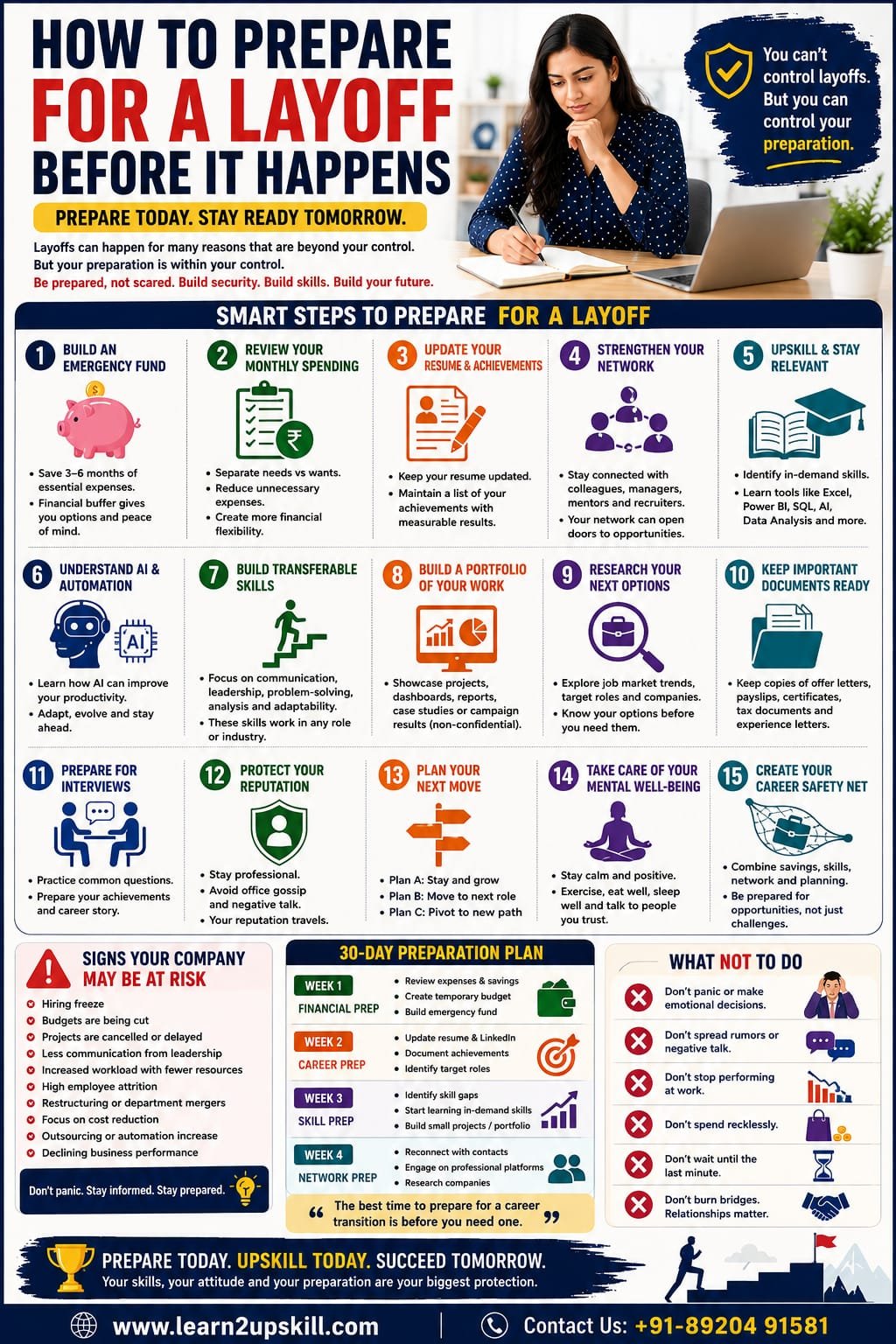
How to Prepare for a Layoff Before It Happens: A Practical Career Survival Guide
How to Prepare for a Layoff Before It Happens | Career Guide
Meta Description: Worried about layoffs? Learn how to prepare before a layoff happens by protecting your finances, updating your resume, building skills, networking, and planning your next career move.
Suggested URL Slug: “/how-to-prepare-for-a-layoff-before-it-happens/”
—
How to Prepare for a Layoff Before It Happens
Nobody wants to think about losing their job.
But when a company starts experiencing financial pressure, restructuring, automation, mergers, or changing business priorities, layoffs can become a possibility.
The worst time to start preparing for a job loss is after you receive your termination notice.
By then, you may be dealing with financial pressure, emotional stress, a busy job search, and uncertainty about what to do next.
A better approach is to prepare quietly while you are still employed.
This doesn’t mean assuming that you will be laid off.
It means making sure that if your situation changes, you’re ready to respond.
Preparing for a potential layoff involves much more than updating your resume. You need to think about your finances, professional network, skills, employment documents, personal brand, mental well-being, and future career direction.
Here’s a practical step-by-step guide.
—
- Don’t Panic—Prepare Strategically
If you notice signs that your company may be under pressure, your first reaction might be fear.
Avoid making decisions based purely on rumors.
Instead, ask yourself:
«“If my job disappeared tomorrow, what would I need?”»
You would probably need:
– Financial savings
– An updated resume
– Professional contacts
– Current skills
– Interview preparation
– Job-market knowledge
– Employment documents
– A clear career direction
Start working on these areas gradually.
Preparation doesn’t mean you expect the worst.
It means you’re reducing the impact if the worst happens.
—
- Build an Emergency Fund
Financial preparation is one of the most important parts of layoff planning.
Calculate your essential monthly expenses.
Include:
– Rent or home loan
– Food
– Utilities
– Education
– Insurance
– Transportation
– Loan payments
– Other essential household expenses
Then determine how long your existing savings could cover those costs if your income stopped.
If possible, gradually build an emergency fund.
Even small monthly contributions can make a difference over time.
Why does this matter?
Financial breathing room gives you more flexibility.
Instead of accepting the first job available because you urgently need money, you may have more time to find a role that matches your skills and career goals.
—
- Review Your Monthly Spending
If you suspect your company is going through financial difficulties, review your spending.
Separate expenses into:
Essential
Things you genuinely need.
Optional
Things you could temporarily reduce.
Look at:
– Subscriptions
– Shopping
– Dining out
– Entertainment
– Travel
– Unnecessary upgrades
– Impulse purchases
You don’t need to stop enjoying life.
The objective is simply to create more financial flexibility.
Think of it as creating a career safety net.
—
- Update Your Resume Now
Don’t wait for a layoff announcement.
Your achievements are freshest while you’re still working.
Update your resume with:
– Recent projects
– Promotions
– Certifications
– New skills
– Leadership responsibilities
– Major achievements
– Measurable results
Avoid making your resume just a list of duties.
Instead of:
«Responsible for preparing monthly reports.»
Write:
«Automated monthly reporting using Excel, reducing manual reporting time and improving reporting efficiency.»
Numbers make achievements stronger whenever they’re accurate and appropriate to share.
—
- Create a Master List of Your Achievements
Your resume has limited space.
Create a separate private document containing your career achievements.
Include:
– Projects completed
– Problems solved
– Awards
– Positive feedback
– Major clients or projects
– Process improvements
– Revenue impact
– Cost savings
– Team leadership
– Certifications
– New technologies learned
This document can become your personal career evidence bank.
When you need to update your resume or prepare for an interview, you’ll have the information ready.
—
- Update Your LinkedIn Profile
Don’t wait until you’re unemployed to update LinkedIn.
Review:
– Headline
– About section
– Experience
– Skills
– Certifications
– Projects
– Profile photo
Make it clear what you do and what you’re good at.
For example:
«Business Analyst | Excel | SQL | Power BI | Data-Driven Business Insights»
is much more informative than:
«Experienced Professional»
Your online professional profile should support your career goals.
—
- Strengthen Your Professional Network
Networking is one of the strongest forms of career protection.
But networking shouldn’t begin only when you need a job.
Stay connected with:
– Former colleagues
– Former managers
– College classmates
– Clients
– Recruiters
– Mentors
– Industry professionals
Send occasional messages.
Congratulate people on promotions.
Share useful industry information.
Attend professional events.
Participate in relevant online communities.
When you eventually need help, you’ll already have relationships in place.
—
- Don’t Announce That You’re Looking for a Job Too Early
If you’re still employed, there’s no need to publicly announce:
«“I’m looking for a new job because I think my company is going to lay me off.”»
That can create unnecessary problems.
Instead, quietly explore the job market.
You can:
– Research companies
– Update your resume
– Connect with recruiters
– Monitor job postings
– Attend networking events
– Improve your LinkedIn profile
Preparation can happen privately and professionally.
—
- Understand the Skills Employers Are Looking For
One of the best ways to prepare for a possible career transition is to understand what employers currently want.
Look at job descriptions for the roles you would consider.
Create two lists:
Skills you already have
For example:
– Excel
– Communication
– Project coordination
– Customer management
– Reporting
Skills employers increasingly request
For example:
– Power BI
– SQL
– AI tools
– Data analytics
– Automation
– Digital marketing
Then identify the gap.
This gives you a clear learning roadmap.
—
- Upskill Before You Need to
Don’t wait until you’re unemployed to start learning.
Use your current income and stability to invest in your skills.
Depending on your career, you might consider:
Business & Analytics
– Advanced Excel
– Power BI
– SQL
– Data visualization
– Business analysis
Marketing
– SEO
– Google Ads
– Analytics
– Social media
– AI marketing
Finance
– Financial modelling
– Advanced Excel
– Data analytics
– Power BI
– AI for finance
Technology
– AI
– Cloud computing
– Cybersecurity
– Automation
– Programming
You don’t need ten certifications.
Choose skills that are relevant to your desired next role.
—
- Learn How AI Is Changing Your Industry
AI is increasingly becoming part of everyday business operations.
Instead of only asking:
«“Will AI replace my job?”»
also ask:
«“How can I use AI to become better at my job?”»
Depending on your profession, AI can help with:
– Research
– Data analysis
– Writing
– Reporting
– Presentations
– Customer service
– Marketing
– Automation
– Administrative work
The goal isn’t to become an AI expert overnight.
It’s to understand how AI can improve your productivity and complement your existing expertise.
Always follow your employer’s policies regarding approved AI tools and confidential information.
—
- Build Transferable Skills
Job titles can change.
Industries can change.
Companies can disappear.
Transferable skills can help you move between roles.
Examples include:
– Communication
– Problem-solving
– Leadership
– Data analysis
– Project management
– Customer management
– Presentation skills
– Business writing
– Negotiation
– Technology skills
Ask yourself:
«“If I couldn’t get the exact same job somewhere else, what other roles could I perform?”»
The answer will reveal your transferable skills.
—
- Keep Your Professional Certifications Current
If your industry values certifications or professional training, review whether yours are still relevant.
You don’t need to collect certificates simply for the sake of collecting them.
Prioritize learning that:
– Matches your target role
– Builds practical skills
– Is recognized in your industry
– Helps you demonstrate competence
Whenever possible, combine certifications with practical projects.
Skills + evidence of using those skills is more powerful than a certificate alone.
—
- Build a Portfolio
A portfolio isn’t just for designers or developers.
Professionals in many fields can create evidence of their work.
Examples include:
Data professionals
Excel dashboards, Power BI reports, SQL projects.
Digital marketers
SEO audits, campaign examples, content strategies.
Finance professionals
Financial models and analysis examples using non-confidential or publicly available data.
Business analysts
Process maps, business requirements examples, dashboards, case studies.
Project managers
Project plans, risk frameworks, process improvement examples.
Never use confidential company information.
Instead, create your own examples or use publicly available datasets.
—
- Keep Track of Your Employment Documents
While you still have access to them, make sure you understand where your legitimate personal employment documents are stored.
These may include:
– Employment contract
– Offer letter
– Salary documents
– Payslips
– Promotion letters
– Performance reviews
– Training certificates
– Benefits information
– Tax documents
You may need these later for another employer, financial purposes, or administrative processes.
However, don’t copy confidential company information or proprietary files.
—
- Understand Your Employment Benefits
Review your employment contract and benefits information.
Understand:
– Notice period
– Leave policy
– Insurance
– Bonus conditions
– Retirement-related benefits
– Provident fund procedures, where applicable
– Stock or equity arrangements, if applicable
– Final settlement procedures
If your employer announces a restructuring, read any official documentation carefully.
Employment rights and benefits vary depending on your location, employment contract, and circumstances.
If you’re unsure about important legal or financial issues, seek qualified professional advice.
—
- Prepare a Personal Career Budget
Your career transition may involve costs.
You might need money for:
– Training
– Certifications
– Internet
– Transportation
– Interview travel
– Professional clothing
– Resume services
– Job-search tools
Include these in your financial planning.
A small career-development budget can help you continue progressing even during uncertain periods.
—
- Start Researching Potential Employers
Don’t wait until you’re unemployed to discover which companies are hiring.
Create a list of potential employers.
Research:
– Industry
– Company size
– Growth
– Job openings
– Required skills
– Work culture
– Career opportunities
– Location
– Working arrangements
You don’t need to apply immediately.
The purpose is to understand your options.
—
- Prepare Your Interview Answers
Imagine that you received a job interview tomorrow.
Could you confidently answer:
«“Tell me about yourself.”»
«“Why are you looking for a new opportunity?”»
«“What are your strengths?”»
«“What are your biggest achievements?”»
«“Why should we hire you?”»
Prepare now.
If a layoff eventually happens, you’ll already have your answers ready.
—
- Protect Your Professional Reputation
Even if you’re worried about layoffs, continue behaving professionally.
Keep:
– Meeting deadlines
– Communicating clearly
– Supporting colleagues
– Completing projects
– Maintaining relationships
Avoid:
– Workplace gossip
– Angry social media posts
– Sharing confidential information
– Blaming management publicly
– Becoming deliberately disengaged
Remember that today’s colleague could become tomorrow’s manager, recruiter, client, or referral source.
Your reputation travels.
—
- Don’t Let Fear Affect Your Performance
If you’re constantly worried about losing your job, your performance can suffer.
Try to focus on what you can control.
You cannot control:
– Company strategy
– Economic conditions
– Management decisions
– Budget changes
You can control:
– Your skills
– Your attitude
– Your work quality
– Your network
– Your finances
– Your preparation
Focus your energy where it can actually make a difference.
—
- Create Three Career Plans
Don’t have only one plan.
Create:
Plan A: Stay
How can you continue growing if you remain with the company?
Plan B: Move
What would you do if your role disappeared?
Plan C: Pivot
What if this is the right time to move into another career direction?
For example:
Current role: Operations Executive
Plan B: Business Analyst
Plan C: Data Analyst
This doesn’t mean you must change careers.
It simply means you’re thinking ahead.
—
- Prepare Emotionally
Financial preparation is important.
Career preparation is important.
But emotional preparation matters too.
If a layoff happens, you may experience:
– Shock
– Anger
– Anxiety
– Disappointment
– Loss of confidence
Understand that these reactions are normal.
Build a support system before you need it.
Stay connected with family, friends, mentors, and trusted colleagues.
If stress becomes overwhelming or significantly affects your daily life, consider speaking with a qualified mental-health professional.
—
- Create a “Ready-to-Go” Career Folder
A simple folder on your personal device can contain:
– Updated resume
– Achievement list
– Certifications
– Portfolio links
– Professional bio
– LinkedIn profile information
– Interview notes
– Target company list
– Job descriptions for target roles
Keep only information that you are legally entitled to retain.
This can save valuable time if you suddenly need to begin a job search.
—
- Build a 30-Day Layoff Preparation Plan
You don’t need to do everything in one weekend.
Week 1: Financial Preparation
– Review expenses.
– Create a temporary budget.
– Review savings.
– Identify unnecessary spending.
Week 2: Career Preparation
– Update your resume.
– Update LinkedIn.
– Document achievements.
– Identify target roles.
Week 3: Skill Preparation
– Research market demand.
– Identify one skill gap.
– Start a relevant course.
– Build a small practical project.
Week 4: Network Preparation
– Reconnect with former colleagues.
– Contact mentors.
– Connect with industry professionals.
– Research potential employers.
At the end of 30 days, you should feel considerably more prepared.
—
What Not to Do When You Suspect a Layoff
Don’t panic.
Fear rarely produces good career decisions.
Don’t spread rumors.
You could damage relationships and create unnecessary stress.
Don’t stop performing.
Continue doing your job professionally.
Don’t spend recklessly.
Build financial flexibility.
Don’t wait until you’re unemployed.
Preparation works best before a crisis.
Don’t learn everything at once.
Focus on relevant skills.
Don’t burn bridges.
Professional relationships matter.
—
The Most Important Principle: Prepare, Don’t Predict
You cannot know for certain whether your company will lay off employees.
Trying to predict exactly what management will do can create unnecessary anxiety.
Instead, focus on preparation.
If layoffs don’t happen, your resume is still stronger.
Your network is still stronger.
Your skills are still stronger.
Your finances are still better organized.
Your career plan is still clearer.
So there is very little downside to sensible preparation.
—
Final Thoughts
Preparing for a layoff doesn’t mean you’re negative about your employer.
It means you’re taking responsibility for your career.
The modern workplace can change quickly. Companies restructure, technologies evolve, industries shift, and business priorities change.
You can’t control all of those things.
But you can control how prepared you are.
Build your emergency fund.
Update your resume.
Strengthen your network.
Learn new skills.
Understand AI.
Build transferable skills.
Protect your professional reputation.
Prepare your interview answers.
Create a backup career plan.
Don’t wait for a layoff announcement before you start thinking about your future.
The best time to prepare for a career transition is before you need one.
—
Quick Layoff Preparation Checklist
– [ ] Review your monthly expenses.
– [ ] Build or strengthen an emergency fund.
– [ ] Update your resume.
– [ ] Document your achievements.
– [ ] Refresh your LinkedIn profile.
– [ ] Strengthen your professional network.
– [ ] Research target roles.
– [ ] Research potential employers.
– [ ] Identify skill gaps.
– [ ] Learn an in-demand skill.
– [ ] Understand AI tools relevant to your profession.
– [ ] Build transferable skills.
– [ ] Create a portfolio where appropriate.
– [ ] Organize legitimate employment documents.
– [ ] Review your employment benefits.
– [ ] Prepare interview answers.
– [ ] Create Plan A, Plan B, and Plan C.
– [ ] Protect your professional reputation.
– [ ] Maintain your mental well-being.
—
Future-Proof Your Career With Learn2upskill
The workplace is changing quickly. AI, automation, data, and new technologies are creating new opportunities while changing the skills employers need.
At Learn2upskill, we help students, professionals, job seekers, and career changers develop practical skills for the modern workplace.
Explore learning opportunities in:
AI • Excel • Business Analysis • Digital Marketing • Cybersecurity • Data Skills • Professional Development
Don’t wait for a career crisis to start learning.
Learn. Upskill. Grow.
🌐 www.coral-kudu-326218.hostingersite.com
Contact Us: +91-89204 91581
—
Leave a Reply