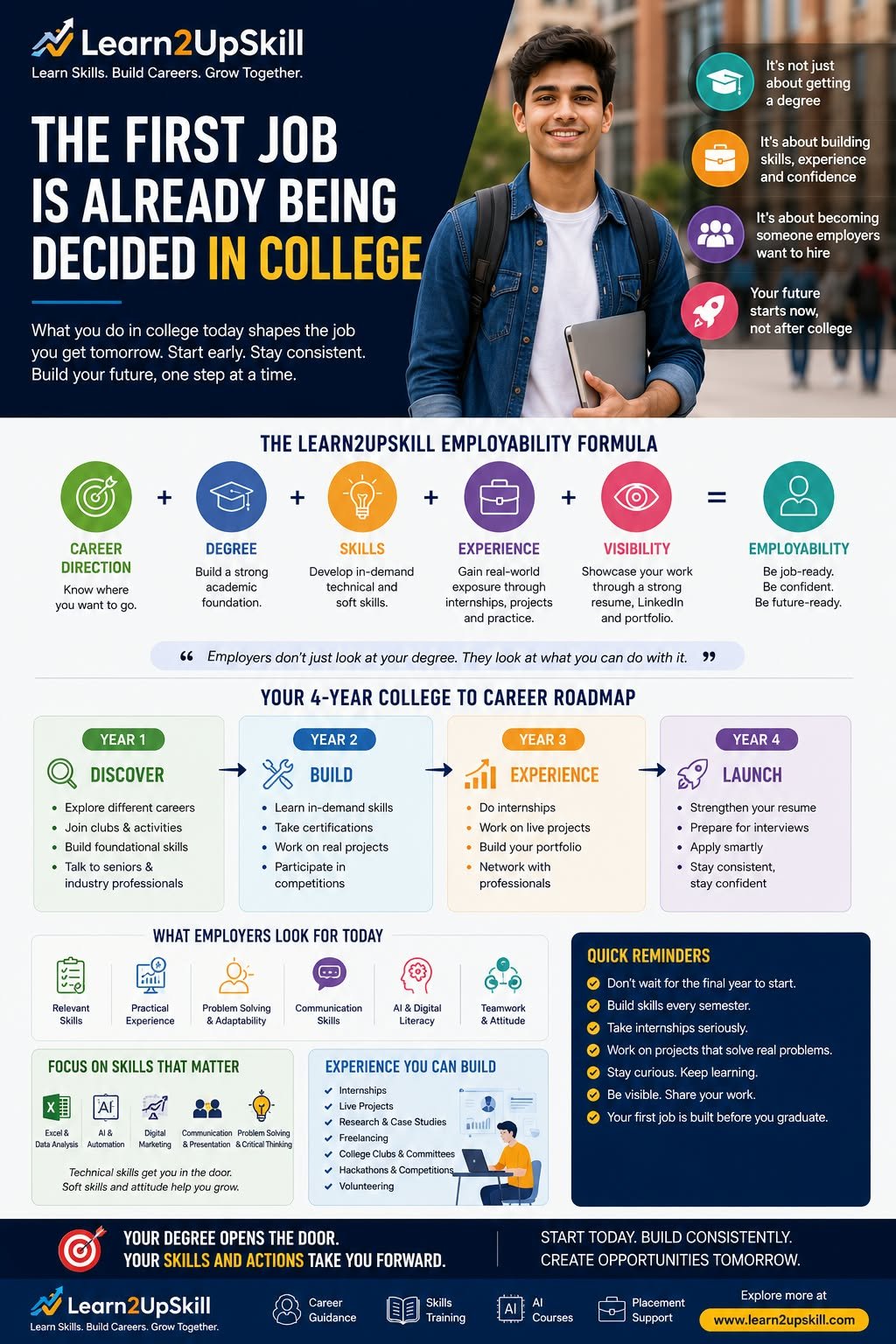
The First Job Is Already Being Decided in College
Your degree may take four years. Your employability takes four years too.
Imagine two students entering college on the same day.
Both are intelligent.
Both attend the same number of classes.
Both eventually receive a degree.
Both graduate in the same year.
But when the first job opportunity arrives, something unexpected happens.
One student says:
«“I have a degree.”»
The other says:
«“I have a degree. Here are the skills I’ve built, the projects I’ve completed, the internships I’ve done and the problems I’ve learned to solve.”»
Who has the stronger career story?
That difference is becoming increasingly important in today’s employment market.
Because your first job usually isn’t something you suddenly start preparing for during your final semester.
It is being built quietly throughout college.
—
The Biggest College Mistake Students Make
For many students, college becomes:
Attend lectures → complete assignments → pass exams → graduate → start job hunting.
And then, during the final year:
«“I need a job. What should I put on my resume?”»
That’s when the panic begins.
No meaningful internship.
No strong projects.
Few practical skills.
Limited professional network.
No portfolio.
Little interview experience.
And suddenly, the student realises:
The degree is almost complete. But the career preparation hasn’t started.
This is avoidable.
The better approach is:
«Don’t wait until graduation to become job-ready. Use college to become job-ready.»
—
The Degree Still Matters — But It Is Only One Part of the Story
Let’s be clear.
This isn’t an argument against degrees.
Degrees matter.
They can provide:
– academic foundations
– structured learning
– recognised qualifications
– professional networks
– access to certain careers
– opportunities for higher education
– exposure to different subjects and ideas
But the employment market is increasingly asking another question:
«“What can you actually do?”»
Recent NITI Aayog analysis shows that graduate employability in India has improved over time, while also highlighting continuing room for improvement in areas such as pedagogy, practical learning and industry exposure.
The World Economic Forum’s analysis of India’s future workforce also points toward increasing skills-based hiring, with employers looking at diverse talent pools and, in some cases, reducing degree requirements for emerging roles.
The message isn’t:
Degrees don’t matter.
The message is:
«Degrees and demonstrable capability increasingly need to work together.»
—
The Learn2UpSkill Employability Formula
We introduced our career equation in our previous guide:
Career Direction + Degree + Skills + Experience + Visibility = Employability
Now let’s take it one step further.
For college students:
Learn → Build → Experience → Demonstrate → Connect → Launch
That’s the journey we want students to follow.
—
Year 1: Don’t Rush to Specialise — Explore
The first year is not about having everything figured out.
It is about discovering possibilities.
A student might think:
«“I’m doing BBA, so I must become a manager.”»
Not necessarily.
A BBA student could eventually explore:
– marketing
– sales
– business analytics
– consulting
– HR
– operations
– entrepreneurship
– product management
– finance
– customer success
Similarly, a computer science student might discover interests in:
– software development
– cybersecurity
– data
– AI
– product
– cloud
– technology consulting
– entrepreneurship
The first year should create exposure.
Your Year 1 mission:
Discover what interests you.
Try different things.
Attend workshops.
Talk to professionals.
Explore industries.
Take small courses.
Participate in competitions.
Experiment.
You don’t need a final answer.
You need better questions.
—
Year 2: Start Building
This is where students should move from:
“I know about it.”
to:
“I can do it.”
Suppose you are interested in marketing.
Don’t simply read about digital marketing.
Try creating a campaign.
Interested in data?
Analyse a dataset.
Interested in coding?
Build something.
Interested in finance?
Create a financial model.
Interested in design?
Build a portfolio.
Interested in content?
Create and publish.
Interested in AI?
Use AI to solve a real problem.
The objective is simple:
«Turn knowledge into evidence.»
—
Year 3: Get Real Experience
This is where internships become extremely valuable.
An internship isn’t simply something you add to your resume.
It is an opportunity to discover:
What does the real workplace actually look like?
You learn:
– how teams work
– how deadlines work
– how managers think
– how meetings work
– how customers behave
– how problems are solved
– how communication works
– how much theory translates into practice
– where your own skills are still weak
And sometimes the most valuable discovery is:
«“I thought I wanted this career. Now I know I don’t.”»
That’s not failure.
That’s information.
Better to discover it during college than after spending five years in the wrong career.
—
Year 4: Don’t Just Apply — Position Yourself
By the final year, your goal should not be:
«“I need a job.”»
It should be:
«“I know what I can offer, and I can demonstrate it.”»
Your career assets should include:
Resume
Clear, focused and evidence-based.
A professional identity rather than an empty profile.
Portfolio
Evidence of your work.
Projects
Real examples of your capabilities.
Internships
Practical experience.
Skills
Relevant to your target roles.
Interview preparation
Ability to communicate what you know.
Network
People who know what you are interested in and what you can do.
That is a very different graduate from someone who simply has a degree certificate.
—
The Certificate Problem
Let’s imagine two resumes.
Resume A
B.Com
CGPA: 7.8
Completed several academic assignments.
Completed online certification in Excel.
Resume B
B.Com
CGPA: 7.8
Built a sales-analysis dashboard using Excel.
Completed a finance internship.
Created a market-analysis project.
Presented findings to a college entrepreneurship group.
Built a professional LinkedIn profile.
Completed an AI productivity course.
Which resume gives an employer more to discuss?
The degree is identical.
The evidence is not.
—
Skills Are Becoming the Bridge Between Education and Employment
India’s employment landscape is changing.
The World Economic Forum’s Future of Jobs research identifies AI and big data, networks and cybersecurity, and technological literacy among the fastest-growing skill areas globally, alongside human capabilities such as creative thinking, resilience, flexibility, analytical thinking and lifelong learning.
For India specifically, employers are expecting strong technological change and increasing demand for roles connected with big data, AI and machine learning, and security. The same research also points to growing use of skills-based hiring.
This doesn’t mean every student needs to become a programmer.
It means students need to understand:
«What skills will make me more valuable in the profession I choose?»
—
The AI Question Every Student Should Ask
Don’t ask only:
«“Will AI take my job?”»
Ask:
«“How can AI help me become better at my job?”»
Consider a marketing student.
Traditional skill:
Digital marketing
Future-ready combination:
Digital marketing + analytics + AI + creativity + communication
A finance student:
Finance + Excel + data + AI + business judgement
An HR student:
HR + analytics + AI tools + communication + people skills
A designer:
Design + AI-assisted creation + storytelling + user understanding
A teacher:
Subject expertise + AI + digital learning + communication
A business student:
Business fundamentals + analytics + AI + presentation + problem-solving
The future is not necessarily:
Human OR AI.
It increasingly looks like:
Human + Domain Knowledge + AI + Judgement
Recent industry reporting on India’s BFSI sector similarly describes AI as changing the skills required for roles rather than simply eliminating them, with domain expertise and human judgement remaining important.
—
Don’t Collect Courses. Build Capability.
This is another trap.
Students sometimes collect certificates.
One certificate.
Then another.
Then another.
Then:
«“I have 12 certifications.”»
But ask:
What can you actually do?
Five certificates with no application may be less useful than one skill demonstrated through a meaningful project.
Instead of asking:
«“How many courses have I completed?”»
ask:
«“What capability have I developed?”»
And then:
«“What evidence can I show?”»
That is a much stronger approach.
—
The 70-20-10 Student Learning Mindset
Here’s a simple way students can think about learning.
70% — Application
Projects.
Practice.
Real-world assignments.
Experiments.
20% — Exposure
Mentors.
Professionals.
Internships.
Networking.
Industry events.
10% — Formal Learning
Courses.
Certifications.
Structured academic learning.
The exact percentages aren’t a scientific rule.
The point is:
«Learning becomes more powerful when knowledge is applied and connected to experience.»
—
Your College Resume Should Start Before Your Final Year
Don’t open your resume for the first time in Year 4.
Start building your professional story from Year 1.
Year 1
Interests + activities + foundational skills
Year 2
Projects + certifications + competitions
Year 3
Internships + stronger projects + professional exposure
Year 4
Achievements + experience + portfolio + targeted applications
By graduation, your resume should feel like the result of four years of development.
Not four weeks of panic.
—
Build a Portfolio, Not Just a Resume
A resume says:
«“I can do this.”»
A portfolio can say:
«“Here is what I actually did.”»
For different students, a portfolio might contain:
Data student
Dashboards, analyses and case studies.
Marketing student
Campaigns, content and performance analysis.
Developer
Applications, websites and GitHub projects.
Designer
Design work and case studies.
Finance student
Models, analysis and research.
Content creator
Published work and campaigns.
Business student
Business plans, market research and presentations.
Your portfolio doesn’t have to be perfect.
It has to be real.
—
Networking Is Not Asking People for Jobs
Many students misunderstand networking.
Networking isn’t:
«“Sir, please give me a job.”»
It is:
«“I’m interested in data analytics and I’m trying to understand the industry. Could you share how you started your career?”»
That’s a much better conversation.
Connect with:
– alumni
– professors
– industry professionals
– internship supervisors
– founders
– recruiters
– mentors
– people working in careers you’re exploring
Build relationships before you need something.
—
The First Job Is Also a Learning Decision
Students sometimes choose their first job only by salary.
Salary matters.
But it shouldn’t be the only variable.
Consider:
What will I learn?
Who will I learn from?
What problems will I solve?
What technology will I use?
What industry exposure will I receive?
Will I get mentorship?
Will I have opportunities to grow?
Does this role strengthen my future profile?
Your first job is not merely your first salary.
It can become:
«The first chapter of your professional identity.»
—
A ₹5,000 Difference Can Sometimes Matter Less Than a Learning Difference
Imagine:
Job A: ₹5 lakh package, repetitive work, little learning.
Job B: ₹4.5 lakh package, strong mentorship, meaningful projects, better exposure.
The right choice depends on the individual and circumstances, but students should understand the broader equation.
Your first few years can create:
Skills → Experience → Reputation → Network → Better Opportunities
So don’t only ask:
«“What will I earn today?”»
Ask:
«“What will I become capable of tomorrow?”»
—
What Employers Should See When They See Your Resume
Ideally, your resume should answer five questions quickly:
- What did you study?
Your degree.
- What can you do?
Your skills.
- Have you actually done it?
Projects and experience.
- Can you communicate it?
Your presentation and interview ability.
- Why should we remember you?
Your achievements, unique experiences or strong professional story.
That’s employability.
—
The Learn2UpSkill College-to-Career Roadmap
Here’s the roadmap every student can save.
YEAR 1 — DISCOVER
Explore careers.
Understand yourself.
Build foundational skills.
Start professional exposure.
—
YEAR 2 — BUILD
Build capabilities.
Take relevant courses.
Create projects.
Develop digital and AI literacy.
—
YEAR 3 — EXPERIENCE
Get real-world exposure.
Intern.
Volunteer.
Freelance.
Work on industry projects.
Build your network.
—
YEAR 4 — LAUNCH
Become career-ready.
Strengthen your resume.
Build your portfolio.
Prepare for interviews.
Apply strategically.
Build professional relationships.
—
The “Am I Job-Ready?” Test
Before graduation, ask yourself:
Skills
Can I demonstrate at least 2–3 meaningful professional skills?
Projects
Can I show actual work?
Experience
Have I worked in a real or simulated professional environment?
AI
Do I understand how AI can support my profession?
Communication
Can I explain my ideas clearly?
Resume
Does my resume demonstrate outcomes rather than simply activities?
Portfolio
Can an employer see examples of my work?
Interviews
Can I confidently explain what I know and what I have done?
Network
Do I know people working in the field I want to enter?
If most answers are “no,” don’t panic.
That’s not a verdict.
It’s a roadmap.
You still have time to build.
—
For Parents: Don’t Ask Only About Marks
Marks matter.
Academic performance matters.
But ask other questions too.
Instead of only:
«“What did you score?”»
also ask:
«“What did you learn?”»
«“What did you build?”»
«“What career are you exploring?”»
«“What skills are you developing?”»
«“Did you speak to anyone working in that industry?”»
«“What did your internship teach you?”»
These questions can shift a student’s focus from marks alone to capability.
—
For Students: Stop Waiting to Feel Ready
You may think:
«“I’ll start next semester.”»
Then:
«“I’ll start next year.”»
Then:
«“I’ll do an internship in final year.”»
Then:
«“I’ll learn AI after graduation.”»
Then suddenly:
Graduation.
Don’t wait for the perfect time.
Start small.
One project.
One skill.
One internship application.
One professional conversation.
One useful course.
One portfolio piece.
One improvement at a time.
Careers are rarely built in one dramatic moment.
They are built through small decisions repeated for years.
—
The New Definition of a Graduate
Perhaps the definition of a graduate needs to change.
A graduate shouldn’t simply be someone who says:
«“I completed my degree.”»
A career-ready graduate should be able to say:
«“I understand my direction.
I have a strong academic foundation.
I have relevant skills.
I have applied them.
I have experienced the workplace.
I can demonstrate what I can do.
And I know how to keep learning.”»
That is a much stronger starting point.
—
Your First Job Doesn’t Begin When You Apply
It begins much earlier.
It begins when you decide to take your education seriously.
It begins when you stop thinking only about marks and start thinking about capability.
It begins when you build your first project.
It begins when you take your first internship.
It begins when you learn how AI can improve your profession.
It begins when you speak to someone already doing the work.
It begins when you put your first meaningful achievement on your resume.
And eventually, it becomes:
your first job.
—
The Learn2UpSkill Career Principle
We believe students shouldn’t wait until graduation to ask:
«“What can I do?”»
They should start asking that question from the beginning of college.
Because the future belongs not simply to people who know more.
It increasingly belongs to people who can:
Learn → Apply → Adapt → Create → Communicate → Grow
Your degree matters.
Your skills matter.
Your experience matters.
Your ability to adapt matters.
And your willingness to keep learning may matter most of all.
Don’t wait for graduation to become career-ready.
Start building your career while you’re building your degree.
Learn Skills. Build Careers. Grow Together.
Explore Learn2UpSkill’s career guidance, practical skill-development programmes, AI learning and career-focused opportunities to start building a stronger path from education to employment.
—
Frequently Asked Questions
When should college students start preparing for their first job?
Ideally, preparation should begin from the first year. The focus can evolve from exploration in Year 1 to skills and projects in Year 2, internships and experience in Year 3, and focused job preparation in Year 4.
Is a degree enough to get a job?
A degree can provide an important academic foundation, but employment also depends on relevant skills, practical experience, communication, problem-solving, adaptability and the ability to demonstrate capability.
What skills should students learn during college?
The right skills depend on the student’s career direction. Useful areas can include communication, digital literacy, AI literacy, Excel, data skills, presentation, problem-solving, teamwork and profession-specific technical skills.
Should students learn AI during college?
AI literacy is becoming increasingly useful across professions. Students don’t necessarily need to become AI engineers; they should understand how AI can support and enhance the work they want to do.
Are internships really important for students?
Internships can provide valuable exposure to workplace expectations, professional communication, teamwork and real-world problem-solving. They can also help students test whether a career path suits them.
What is more important: skills or a degree?
It is not an either-or choice. A degree can provide the foundation, while relevant skills and experience help students apply that foundation. The strongest approach is to build both.
How can a student become job-ready before graduation?
Start by identifying a career direction, building relevant skills, completing projects, gaining internships or practical experience, developing a professional network, strengthening a resume and portfolio, and practising interviews.
—
Suggested URL:
“/how-to-become-job-ready-before-graduation/”
Suggested category:
Career Guidance / Employability
Suggested tags:
Career Planning, Employability Skills, College Students, Internships, AI Skills, Career Development, Job Readiness
Leave a Reply