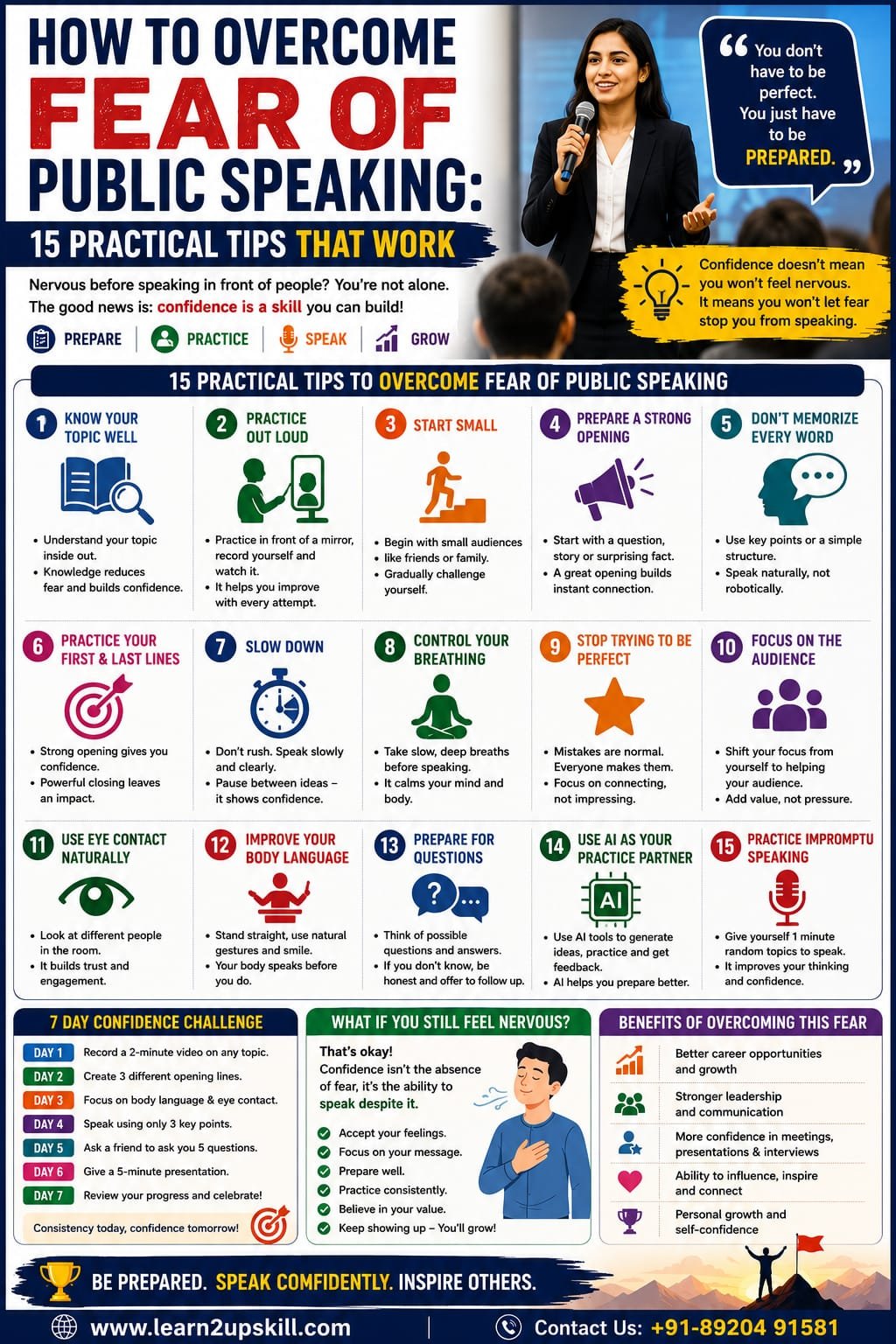
How to Overcome Fear of Public Speaking: 15 Practical Tips That Work
How to Overcome Fear of Public Speaking: 15 Practical Tips
Meta Description: Afraid of public speaking? Learn 15 practical ways to overcome fear of public speaking, build confidence, speak clearly, manage nervousness, and become a better communicator.
Suggested URL Slug: “/how-to-overcome-fear-of-public-speaking/”
—
How to Overcome Fear of Public Speaking: 15 Practical Tips That Work
Imagine you’re standing in front of a room full of people.
Your heart starts beating faster.
Your hands feel sweaty.
Your mind suddenly goes blank.
You know exactly what you want to say—but the words don’t seem to come out.
If this sounds familiar, you’re not alone.
Fear of public speaking is a common challenge among students, professionals, entrepreneurs, managers, and even experienced speakers.
The good news is that public speaking confidence is a skill that can be developed.
You don’t have to be naturally outgoing.
You don’t need to become the loudest person in the room.
And you certainly don’t need to eliminate nervousness completely.
The goal is to learn how to manage nervousness and communicate effectively despite it.
Whether you’re preparing for a school presentation, college seminar, job interview, business meeting, client presentation, webinar, or professional speech, these 15 practical tips can help you overcome your fear of public speaking.
—
Why Are People Afraid of Public Speaking?
Before learning how to overcome public-speaking fear, it helps to understand where it comes from.
Common reasons include:
– Fear of making mistakes
– Fear of being judged
– Lack of preparation
– Low confidence
– Previous negative experiences
– Fear of forgetting what to say
– Worry about being asked difficult questions
– Feeling uncomfortable around large audiences
– Comparing yourself with experienced speakers
– Perfectionism
Sometimes the fear isn’t really about speaking.
It’s about what we think might happen while speaking.
You may think:
«“What if everyone notices I’m nervous?”»
«“What if I forget my speech?”»
«“What if someone laughs?”»
«“What if I answer a question incorrectly?”»
The solution isn’t to convince yourself that nothing can go wrong.
Instead, prepare yourself to handle what happens.
—
- Know Your Topic Thoroughly
One of the biggest causes of public-speaking anxiety is uncertainty.
If you don’t understand your topic, you’ll naturally feel nervous.
The solution is preparation.
Before your presentation, understand:
– The main topic
– Important facts
– Key examples
– Possible questions
– Your audience
– The purpose of your presentation
You don’t need to memorize every sentence.
You need to understand your subject well enough to explain it naturally.
Remember:
Don’t memorize every word. Understand the message.
When you understand your topic, you’re less likely to panic if you forget a sentence.
—
- Practice Out Loud
Reading your speech silently isn’t enough.
You need to hear yourself speak.
Practice out loud.
Start by speaking to yourself.
Then try:
– A mirror
– Your phone camera
– A family member
– A friend
– A colleague
Record yourself and watch the recording.
Look for:
– Speaking speed
– Repeated words
– Unclear sentences
– Voice tone
– Body language
– Long pauses
– Nervous gestures
You may feel uncomfortable watching yourself initially.
That’s normal.
The more you practice, the more natural it becomes.
—
- Start Small
Don’t immediately challenge yourself to speak in front of 500 people.
Build confidence gradually.
Try this progression:
Step 1: Speak to yourself.
Step 2: Record a two-minute video.
Step 3: Speak to one friend.
Step 4: Speak to three or four people.
Step 5: Present to a small group.
Step 6: Volunteer for a larger presentation.
This is similar to building physical fitness.
You don’t start with the heaviest weight.
You build strength gradually.
—
- Prepare a Strong Opening
The first few seconds can feel the most frightening.
That’s why you should prepare your opening carefully.
Instead of beginning with:
«“Hello everyone. Today I’m going to talk about…”»
try something more engaging.
For example:
«“What would happen if AI could do 80% of your daily work?”»
Now the audience is curious.
You can also start with:
– A question
– A surprising fact
– A short story
– A personal experience
– A powerful statement
Once you’ve successfully delivered the opening, your confidence often increases.
—
- Don’t Memorize Your Entire Speech
This is a common mistake.
You memorize every sentence.
Then you forget one word.
Suddenly, you panic.
Instead, create a simple structure:
Opening
What is the topic?
Main Point 1
What is the first important idea?
Main Point 2
What is the second idea?
Main Point 3
What is the third idea?
Conclusion
What should the audience remember?
Use keywords or short notes instead of memorizing paragraphs.
This allows you to speak naturally.
—
- Practice Your First and Last Lines
While you shouldn’t memorize the entire speech, it’s useful to know exactly how you want to begin and finish.
Your opening gives you confidence.
Your conclusion gives you control.
For example:
Opening:
«“Today I want to show you why communication skills are becoming even more important in the age of AI.”»
Closing:
«“Technology can help us communicate faster, but human connection is what makes communication meaningful.”»
Having these lines ready can make the presentation feel more structured.
—
- Slow Down
Nervous speakers often speak too quickly.
When you’re anxious, you may feel that you need to finish as quickly as possible.
Don’t.
Slow down.
Use short pauses between important ideas.
For example:
«“AI can generate information…”»
Pause.
«“But humans still need to understand what that information means.”»
A pause can make you sound more confident.
It also gives your brain time to organize your next thought.
—
- Learn to Control Your Breathing
Your breathing can influence how you feel before speaking.
When you’re nervous, your breathing may become faster and shallower.
Before your presentation, try taking a few slow, comfortable breaths.
For example:
Inhale slowly.
Pause briefly.
Exhale slowly.
Repeat several times.
Don’t treat this as a magic trick that eliminates fear.
Instead, use it as a way to give yourself a moment to slow down and focus.
—
- Stop Trying to Be Perfect
Perfectionism can make public-speaking fear much worse.
You may think:
«“I must not make a single mistake.”»
That’s unrealistic.
Even experienced speakers:
– Forget words
– Pause
– Correct themselves
– Mispronounce something
– Lose their place
– Get unexpected questions
The audience usually doesn’t expect perfection.
They want useful information and a speaker who can communicate clearly.
Your goal should be:
Clear > Perfect
—
- Focus on the Audience, Not Yourself
This is one of the most powerful mindset changes.
Instead of thinking:
«“Everyone is watching me.”»
think:
«“I’m here to help the audience understand something.”»
Your role is to provide value.
Ask yourself:
– What does my audience need to know?
– What problem am I helping them understand?
– What should they remember?
– What action should they take?
When you focus on helping people rather than judging yourself, anxiety can become easier to manage.
—
- Use Eye Contact Naturally
You don’t need to stare at one person.
Instead, look around the room naturally.
Try the three-point technique:
Look toward someone on the left.
Then someone in the center.
Then someone on the right.
Continue naturally throughout the presentation.
If direct eye contact feels uncomfortable initially, look at the area around people’s eyes or eyebrows.
Over time, genuine eye contact will become easier.
—
- Improve Your Body Language
Your body communicates even when you’re not speaking.
Pay attention to:
– Posture
– Facial expression
– Hand gestures
– Eye contact
– Movement
Avoid constantly:
– Looking at the floor
– Crossing your arms
– Playing with your phone
– Moving unnecessarily
– Hiding behind the podium
– Repeatedly touching your hair or face
You don’t need dramatic gestures.
Stand comfortably and let your movements support your message.
—
- Prepare for Questions
Many people aren’t afraid of the presentation itself.
They’re afraid of the Q&A session afterward.
The solution is preparation.
Before your presentation, think of:
5 questions the audience might ask.
Then prepare your answers.
Also remember:
You don’t have to know everything.
If someone asks something you don’t know, you can say:
«“That’s a good question. I don’t have enough information to give you an accurate answer right now, but I’d be happy to look into it.”»
That’s much better than inventing an answer.
—
- Use AI as Your Public-Speaking Practice Partner
AI can be extremely useful when you’re preparing to speak.
You can use tools such as ChatGPT to:
Generate ideas
«“Give me five engaging ways to start a presentation about digital marketing.”»
Practice questions
«“Act as a difficult audience member and ask me 10 questions about my presentation.”»
Improve your speech
«“Make this presentation clearer and more engaging without making it sound overly formal.”»
Simplify complex information
«“Explain this topic in simple language for a group of college students.”»
Practice interviews
«“Act as an interviewer and ask me questions about my career.”»
AI can help you prepare.
But don’t let AI replace your own voice.
Use AI to prepare. Use your human personality to connect.
—
- Practice Impromptu Speaking
Not every speaking situation will be planned.
You may suddenly be asked:
«“Can you give us your opinion?”»
«“Can you explain this to the client?”»
«“What do you think we should do?”»
This is why impromptu speaking is an important skill.
Try this exercise:
Pick a random topic.
Set a timer for 60 seconds.
Speak continuously about the topic.
For example:
– Your favorite book
– AI in education
– Social media
– Remote work
– Your career goals
– A recent project
Don’t worry about perfection.
The goal is to train your brain to organize thoughts quickly.
—
A Simple 7-Day Public Speaking Confidence Challenge
If you want to start immediately, try this seven-day challenge.
Day 1: Speak for 2 Minutes
Choose any topic and record yourself.
Day 2: Improve Your Opening
Create three different opening lines for the same topic.
Day 3: Practice Body Language
Record yourself while focusing on posture and eye contact.
Day 4: Practice Without Notes
Explain a topic using only three keywords.
Day 5: Handle Questions
Ask a friend to challenge you with five questions.
Day 6: Give a 5-Minute Presentation
Present a topic from beginning to end.
Day 7: Review Your Progress
Watch your Day 1 and Day 6 recordings.
Look for improvements.
You’ll probably notice changes in confidence, clarity and delivery.
—
Common Public Speaking Mistakes to Avoid
- Reading every word from the slides
Slides should support your speech—not replace it.
- Speaking too quickly
Slow down and pause.
- Using too much text
Keep presentations visually simple.
- Avoiding eye contact
Look at your audience naturally.
- Memorizing everything
Understand your message instead.
- Using complicated language
Simple language is often more powerful.
- Ignoring the audience
Adapt your message to their needs.
- Overusing filler words
Watch words such as:
– “Um”
– “Actually”
– “Basically”
– “Like”
– “You know”
- Trying to sound like someone else
Develop your own speaking style.
- Not practicing
Confidence comes from preparation and repetition.
—
What If You Still Feel Nervous?
You may practice several times and still feel nervous.
That’s okay.
The goal isn’t necessarily to reach a point where your heart never beats faster before speaking.
Even experienced speakers can feel nervous before an important presentation.
The difference is that they have learned:
“I can feel nervous and still perform well.”
That’s real confidence.
Confidence isn’t the absence of fear.
Confidence is the ability to act despite fear.
—
Public Speaking and Career Growth
Public speaking isn’t just useful for presentations.
It can influence many areas of your career.
Strong communication can help you:
– Perform better in interviews
– Present ideas to management
– Lead meetings
– Speak with clients
– Deliver training
– Participate in group discussions
– Build professional relationships
– Lead teams
– Negotiate
– Build your professional reputation
In an AI-powered workplace, technical knowledge is important.
But being able to explain ideas, build trust and influence people remains a valuable human capability.
That’s why public speaking should be treated as a career skill, not just a classroom skill.
—
Public Speaking for Students
Students can start developing communication skills long before entering the workplace.
Practice through:
– Classroom presentations
– Debates
– Group discussions
– School events
– College seminars
– Project presentations
– Competitions
– Interviews
Start small.
You don’t need to become a professional speaker overnight.
Every presentation is another opportunity to improve.
—
Public Speaking for Professionals
Professionals can practice through everyday workplace situations.
Volunteer to:
– Present a project update
– Explain a report
– Lead a meeting
– Train a colleague
– Present a new idea
– Speak during team discussions
Don’t wait until someone gives you a major presentation.
Use small opportunities to build confidence.
—
The Most Important Mindset Shift
Instead of asking:
«“How can I stop being afraid of public speaking?”»
ask:
«“How can I become comfortable speaking even when I feel nervous?”»
That’s a much more realistic goal.
Fear may not disappear completely.
But with preparation, practice and experience, it can become manageable.
—
Final Thoughts
Fear of public speaking doesn’t have to control your career.
You don’t have to be born confident.
You can learn to speak clearly.
You can learn to organize your thoughts.
You can learn to control your pace.
You can learn to handle questions.
You can learn to use body language.
And you can learn to manage nervousness.
Start small.
Practice consistently.
Record yourself.
Use AI as a practice partner.
Ask for feedback.
And give yourself permission to make mistakes.
The next time you stand in front of an audience, remember:
You don’t need to be perfect.
You need to be prepared, clear and authentic.
Your voice has value.
Learn to use it with confidence.
Speak with confidence. Communicate with purpose. Grow your career.
—
Quick Public Speaking Confidence Checklist
– [ ] Understand your topic.
– [ ] Know your audience.
– [ ] Prepare a clear structure.
– [ ] Practice out loud.
– [ ] Record yourself.
– [ ] Prepare your opening.
– [ ] Prepare your conclusion.
– [ ] Don’t memorize every sentence.
– [ ] Slow down while speaking.
– [ ] Use comfortable eye contact.
– [ ] Improve your body language.
– [ ] Prepare for questions.
– [ ] Use AI for practice and feedback.
– [ ] Practice impromptu speaking.
– [ ] Focus on helping your audience.
– [ ] Accept that mistakes are normal.
– [ ] Keep practicing.
—
Build Your Communication Skills With Learn2upskill
Public speaking is a skill—and like any skill, it improves with learning and practice.
At Learn2upskill, we help students, professionals, job seekers and career changers develop practical skills for the modern workplace.
Explore learning opportunities in:
Public Speaking • Communication • AI • Excel • Business Analysis • Digital Marketing • Cybersecurity • Professional Development
Don’t let fear stop you from sharing your ideas.
Learn. Upskill. Grow.
🌐 www.coral-kudu-326218.hostingersite.com
Contact Us: +91-89204 91581
—
Leave a Reply