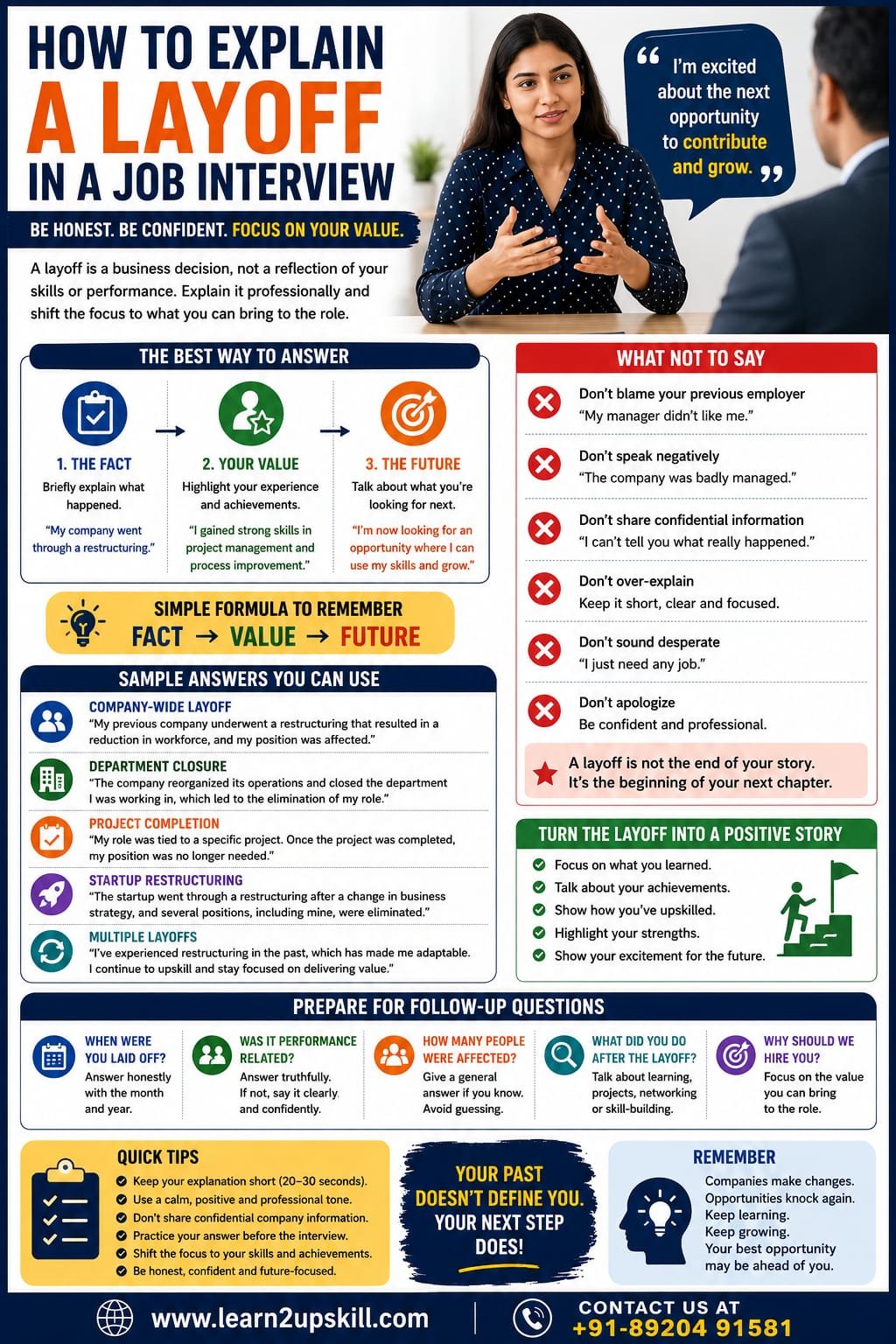
How to Explain a Layoff in a Job Interview
How to Explain a Layoff in a Job Interview: Best Answers
Meta Description: Learn how to explain a layoff confidently in a job interview, what to say, what to avoid, and how to turn a difficult career transition into a positive professional story.
Suggested URL Slug: “/how-to-explain-a-layoff-in-a-job-interview/”
—
How to Explain a Layoff in a Job Interview
Being laid off can be difficult enough without worrying about how to explain it to a potential employer.
One question many job seekers fear is:
«“Why did you leave your previous company?”»
Or even more directly:
«“Why were you laid off?”»
If you have recently lost your job because of restructuring, downsizing, cost-cutting, or a company-wide workforce reduction, you may worry that recruiters will judge you negatively.
The good news is that being laid off does not automatically make you a weaker candidate.
Companies reduce their workforce for many reasons that have nothing to do with an individual’s performance. What matters during an interview is how professionally you explain the situation and how effectively you shift the conversation toward your experience, skills, achievements, and future goals.
This guide will show you exactly how to talk about a layoff without sounding defensive, negative, or uncomfortable.
—
- First, Understand That a Layoff Is Different From Being Fired
This distinction is important.
A layoff generally occurs because the employer eliminates a position or reduces its workforce for business reasons.
Possible reasons include:
– Cost reduction
– Company restructuring
– Mergers or acquisitions
– Business downturn
– Project cancellation
– Automation
– Outsourcing
– Department closure
– Change in business strategy
Being fired, on the other hand, is usually connected to an individual’s performance, conduct, or other employment-related reasons.
If you were laid off as part of a larger workforce reduction, you should communicate that clearly.
For example:
«“My position was eliminated as part of a company-wide restructuring.”»
This immediately provides context.
—
- Don’t Be Ashamed of Being Laid Off
One of the biggest mistakes candidates make is treating a layoff as something embarrassing.
It’s not.
A company decision does not define your professional ability.
You may have performed well, received positive reviews, completed important projects, and still been affected by a workforce reduction.
During an interview, your confidence matters.
Don’t lower your voice or apologize for the layoff.
Don’t say:
«“Unfortunately, I lost my job…”»
Instead, use professional language:
«“My previous company went through a restructuring, and my role was affected as part of the workforce reduction.”»
The second version sounds factual and confident.
—
- Keep Your Explanation Short
You don’t need to tell the interviewer the entire story.
A good explanation usually contains three parts:
Part 1: What happened
Briefly explain the business situation.
Part 2: Your role
Clarify that your position was affected by the restructuring or reduction.
Part 3: What you’re doing now
Move the conversation toward your skills and future goals.
For example:
«“My previous company underwent a restructuring that resulted in a reduction in workforce, and my position was affected. I had a positive experience there and gained strong experience in business analysis, reporting, and stakeholder management. I’m now looking for an opportunity where I can apply those skills and continue growing.”»
That’s enough.
—
- Use the “Fact → Value → Future” Formula
One of the easiest ways to answer layoff questions is to follow this structure:
Fact → Value → Future
Fact
Explain what happened.
«“The company went through a restructuring and my role was eliminated.”»
Value
Mention what you accomplished.
«“During my time there, I managed reporting projects and helped improve operational efficiency.”»
Future
Explain what you’re looking for.
«“I’m now looking for a role where I can use that experience and take on greater responsibility.”»
This approach prevents the conversation from getting stuck on the layoff.
—
- Sample Answer for a Company-Wide Layoff
If many employees were affected, you can say:
«“My previous company went through a broader workforce reduction as part of a restructuring initiative, and my position was among the roles affected. I had a valuable experience there and was able to develop strong skills in project coordination and business operations. I’m now focused on finding a role where I can bring those skills to a growing organization.”»
Simple. Professional. Forward-looking.
—
- Sample Answer for a Department Closure
If your department was closed:
«“The company decided to restructure its operations and eventually closed the department I was working in. As a result, my position was eliminated. It was a challenging transition, but I gained valuable experience in customer management, reporting, and process improvement. I’m now looking for an opportunity where I can continue applying those skills.”»
—
- Sample Answer for a Project-Based Layoff
Sometimes employees lose their jobs because a major project ends.
You could say:
«“My role was connected to a specific project, and when the project was completed and the company restructured its staffing requirements, my position was eliminated. The experience gave me strong exposure to project management, client communication, and problem-solving, and I’m now looking for a longer-term opportunity where I can build on those skills.”»
—
- Sample Answer for a Startup Layoff
Startups can experience rapid changes in funding, strategy, and staffing.
You could explain:
«“The startup went through a restructuring following a change in its business strategy, and several positions, including mine, were eliminated. I gained valuable experience working in a fast-paced environment and taking on multiple responsibilities. I’m now looking to bring that adaptability and experience to my next role.”»
—
- What If the Interviewer Asks, “Was It Performance Related?”
Don’t become defensive.
Answer clearly and honestly.
If the layoff was unrelated to performance, you can say:
«“No. My position was eliminated as part of a broader workforce reduction that affected multiple employees and teams.”»
Then move on:
«“My focus now is on finding a role where I can contribute my experience in…”»
If performance was a factor, don’t lie.
Instead, be honest and focus on what you’ve learned and improved.
—
- What If the Interviewer Asks, “How Many People Were Laid Off?”
You don’t need to provide confidential information.
If you know the number and it was publicly communicated, you can mention it.
For example:
«“It was part of a broader restructuring that affected several teams across the organization.”»
If you’re unsure:
«“It affected multiple teams and was part of a larger organizational restructuring.”»
There’s no need to speculate.
—
- What If They Ask, “Why Didn’t You Find Another Role Within the Company?”
You can answer professionally:
«“I explored the available opportunities, but there wasn’t a suitable position aligned with my experience and career direction at that time. I therefore decided to focus on opportunities where I could continue developing my skills.”»
This shows that you approached the situation thoughtfully.
—
- What If You Were Laid Off More Than Once?
This can feel particularly uncomfortable.
But the principle remains the same.
Don’t create a complicated story.
Focus on facts and patterns.
For example:
«“Two of my previous employers went through significant restructuring during my time there, and my positions were affected. Those experiences gave me a strong understanding of how to adapt to changing business environments. I’ve also used the transitions to strengthen my skills in data analysis and AI-enabled productivity.”»
Then focus on your current capabilities.
Multiple layoffs don’t automatically mean you’re a bad employee.
The interviewer will want to understand the circumstances and whether you’re now ready for the role.
—
- What If You Have a Long Employment Gap After the Layoff?
Don’t try to hide it.
Use the time productively if possible.
You might have:
– Completed courses
– Learned new technology
– Worked on projects
– Freelanced
– Consulted
– Volunteered
– Taken care of family responsibilities
– Built a portfolio
– Prepared for a career change
For example:
«“After the layoff, I took some time to reassess my career direction and completed training in Power BI and SQL. I also worked on several data analysis projects to strengthen my practical skills. I’m now ready to return to a full-time role.”»
This turns an employment gap into a period of development.
—
- Never Blame Your Previous Employer
This is one of the most important rules.
You may have valid reasons to be angry.
But an interview isn’t the right place to express them.
Avoid statements such as:
«“My manager didn’t like me.”»
«“The company was badly managed.”»
«“They laid off good employees while keeping incompetent people.”»
«“The CEO made terrible decisions.”»
Even if you believe these statements are true, they can make you appear negative.
Instead, use neutral language:
«“The company underwent significant restructuring.”»
Professional neutrality is your friend.
—
- Don’t Share Confidential Information
Avoid discussing:
– Internal financial information
– Customer information
– Confidential strategies
– Internal emails
– Employee disputes
– Private management discussions
– Trade secrets
An interviewer may be interested in what happened, but sharing confidential information can create a bigger problem.
A good rule is:
«Explain your experience without exposing your former employer’s confidential information.»
—
- Don’t Over-Explain
Candidates sometimes become nervous and talk too much.
The interviewer asks:
«“Why did you leave your previous company?”»
And the candidate spends ten minutes explaining everything that happened.
Don’t.
Give a clear answer and stop.
Then allow the interviewer to ask follow-up questions.
A concise explanation often sounds more confident.
—
- Shift the Conversation Toward Your Achievements
The layoff is only one part of your career story.
Talk about what you achieved before it happened.
For example:
«“During my time there, I managed a portfolio of projects, improved reporting processes, and worked closely with cross-functional teams.”»
You can then discuss:
– Leadership
– Technical skills
– Business results
– Projects
– Problem-solving
– Customer impact
– Process improvements
The interviewer should leave the conversation thinking:
“This person has valuable experience.”
—not—
“This person was laid off.”
—
- Prepare for Follow-Up Questions
Interviewers may ask:
“When exactly were you laid off?”
Answer honestly.
“How many employees were affected?”
Provide information only if you know it and can appropriately share it.
“Was your performance an issue?”
Answer truthfully and professionally.
“What did you do after the layoff?”
Talk about learning, job searching, projects, networking, or other productive activities.
“Why should we hire you?”
This is your opportunity to talk about your value.
Prepare answers in advance so you’re not caught off guard.
—
- Turn the Layoff Into a Learning Story
A difficult career experience can demonstrate resilience.
For example:
«“The experience taught me the importance of staying adaptable and continuously developing my skills. During the transition, I focused on improving my knowledge of AI and data analytics and became more intentional about the type of role I want next.”»
This shows maturity.
You’re not pretending the layoff was enjoyable.
You’re demonstrating that you learned from the experience.
—
- Practice Your Answer Before the Interview
Don’t wait until the interview to decide what you’re going to say.
Write down your answer.
Practice it several times.
Your answer should sound:
– Natural
– Short
– Honest
– Professional
– Positive
– Forward-looking
You don’t need to memorize every word.
Just become comfortable with the story.
Practice with a friend or record yourself answering:
«“Why did you leave your previous company?”»
Listen to your response.
Do you sound nervous?
Defensive?
Angry?
Too detailed?
If so, simplify it.
—
A Simple Layoff Interview Formula
Remember this structure:
- Explain the situation
“The company underwent restructuring…”»
- Explain the impact
«“…and my role was eliminated.”»
- Highlight your experience
«“During my time there, I developed strong skills in…”»
- Talk about the future
«“I’m now looking for an opportunity where I can…”»
That’s it.
—
What NOT to Say in an Interview
Avoid statements such as:
❌ “My company was terrible.”
❌ “My manager wanted me gone.”
❌ “They kept the wrong people.”
❌ “I have no idea why they fired me.”
❌ “Everyone knows the company is failing.”
❌ “I was treated unfairly.”
❌ “I just need any job.”
Instead, keep your language factual and professional.
—
How to Answer If You’re Still Emotionally Affected
Sometimes a layoff is very recent.
You may still feel disappointed.
That’s okay.
You don’t need to pretend everything was wonderful.
But separate your emotions from your interview answer.
You can say:
«“It was certainly an unexpected transition, but I’ve used the time to reassess my goals, strengthen my skills, and focus on finding the right next opportunity.”»
This acknowledges the challenge without sounding negative.
—
Example: Strong 30-Second Answer
Here’s a simple answer you can adapt:
«“My previous company went through a restructuring that resulted in a workforce reduction, and my position was affected. I had a positive experience there and developed strong skills in project management, reporting, and stakeholder communication. Since then, I’ve focused on strengthening my skills and exploring opportunities where I can take on greater responsibility. That’s what attracted me to this role.”»
Notice the structure:
What happened → What you achieved → What you’re doing now → Why this job.
That’s exactly where you want the conversation to go.
—
Final Thoughts
Being laid off can feel like a negative mark on your career.
It doesn’t have to be.
In an interview, the goal isn’t to hide the layoff.
The goal is to explain it honestly, briefly, and professionally—and then show the interviewer why you’re still a strong candidate.
Remember:
Don’t apologize.
Don’t blame.
Don’t overshare.
Don’t hide the truth.
Instead:
Explain.
Highlight your achievements.
Show what you learned.
Talk about your skills.
Focus on the future.
A layoff may be one chapter in your career story.
It doesn’t have to be the headline.
Your next employer is not only interested in what happened to you.
They want to know what you can do for them now.
So prepare your answer, practice your confidence, and walk into the interview ready to talk about the value you can bring.
Your past job may have ended. Your career hasn’t.
—
Quick Checklist Before a Job Interview After a Layoff
– [ ] Prepare a 30-second explanation of the layoff.
– [ ] Be honest about what happened.
– [ ] Avoid blaming your previous employer.
– [ ] Don’t share confidential information.
– [ ] Prepare examples of your achievements.
– [ ] Research the company you’re interviewing with.
– [ ] Prepare answers to likely follow-up questions.
– [ ] Explain what you learned during the transition.
– [ ] Highlight your current skills.
– [ ] Explain why you want the new role.
– [ ] Practice your answer aloud.
– [ ] Keep your explanation positive and future-focused.
—
Build Skills for Your Next Career Opportunity
A career transition can be a good time to strengthen your professional skills.
At Learn2upskill, we help students, professionals, job seekers, and career changers develop practical skills for today’s workplace.
Explore learning opportunities in:
AI • Excel • Business Analysis • Digital Marketing • Cybersecurity • Data Skills • Professional Development
Don’t let a career setback stop your learning.
Learn. Upskill. Grow.
🌐 www.coral-kudu-326218.hostingersite.com
Contact Us: +91-89204 91581
—
Leave a Reply