Category: Carrer Growth and Counseling

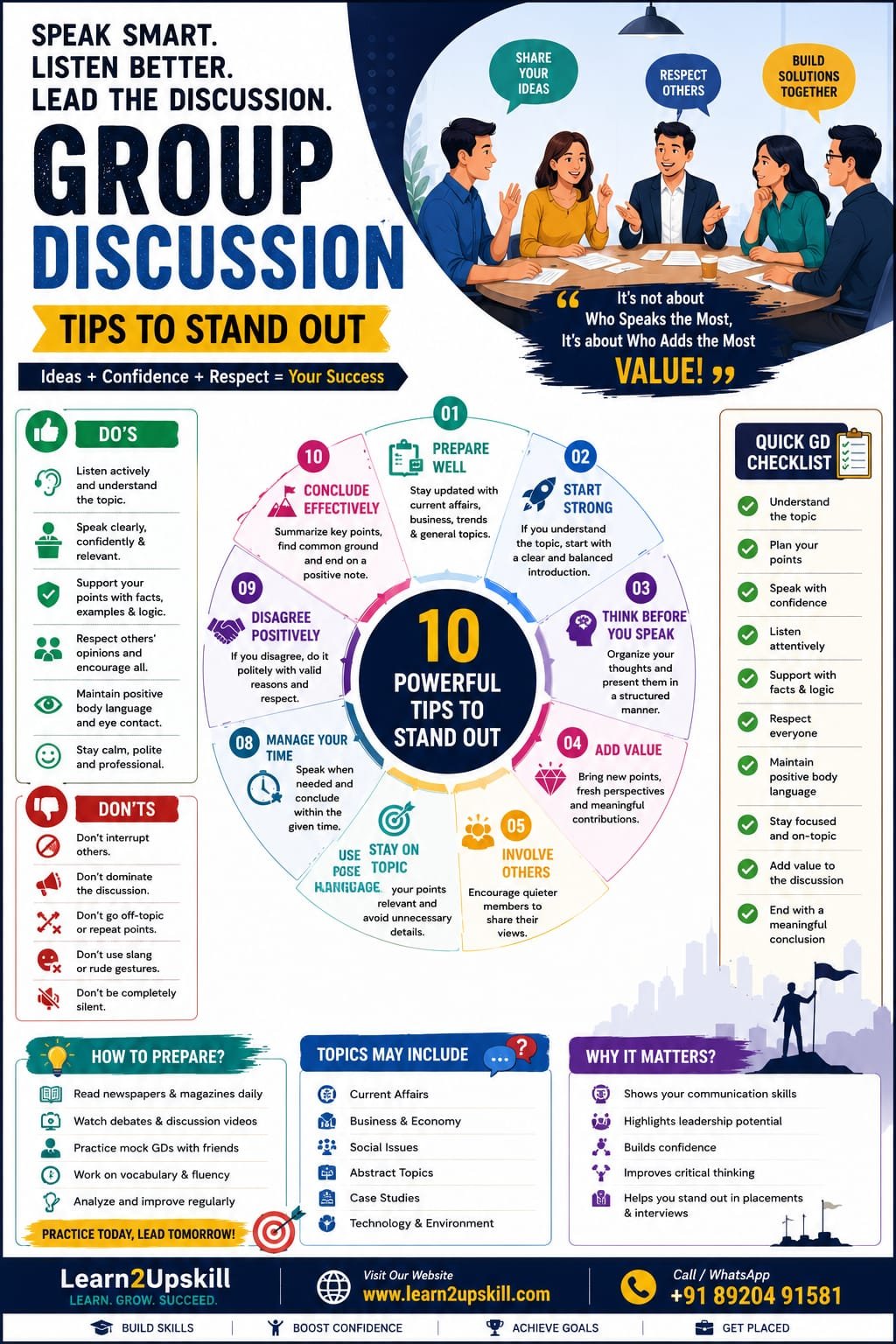
  • Group Discussion Tips to Stand Out

    Group Discussion Tips to Stand Out

    Group Discussion Tips to Stand Out

    Introduction

    Group Discussions (GDs) are a common part of campus placements, job interviews, management admissions, and scholarship selection processes. They help recruiters evaluate not only your knowledge but also your communication skills, confidence, leadership, teamwork, and problem-solving ability.

    Many candidates lose confidence because they think they must speak the most to impress the panel. In reality, recruiters look for candidates who communicate clearly, listen actively, present logical ideas, and contribute positively to the discussion.

    With the right preparation and approach, you can confidently stand out in any Group Discussion.

    At Learn2Upskill, we help students and job seekers build the confidence, communication skills, and professional attitude needed to excel in Group Discussions and interviews.

    —

    What Is a Group Discussion?

    A Group Discussion is a structured conversation where a group of candidates discusses a given topic within a limited time. The purpose is to assess how participants think, communicate, collaborate, and handle different opinions.

    The discussion may be based on current affairs, business topics, social issues, abstract ideas, or case studies.

    —

    Why Are Group Discussions Important?

    Recruiters use Group Discussions to evaluate:

    – Communication skills

    – Leadership qualities

    – Confidence

    – Teamwork

    – Listening ability

    – Critical thinking

    – Problem-solving skills

    – Creativity

    – Decision-making

    – Professional attitude

    A strong GD performance often increases your chances of advancing to the interview stage.

    —

    Qualities Recruiters Look For

    During a Group Discussion, employers observe whether you:

    – Speak confidently.

    – Present logical ideas.

    – Listen to others respectfully.

    – Support your opinions with examples.

    – Encourage teamwork.

    – Stay calm under pressure.

    – Respect different viewpoints.

    – Avoid unnecessary arguments.

    – Demonstrate leadership.

    – Manage time effectively.

    Remember, it is about contributing meaningfully—not dominating the discussion.

    —

    Types of Group Discussion Topics

    You may encounter topics such as:

    Current Affairs

    Examples:

    – Artificial Intelligence in Education

    – Climate Change

    – Digital India

    – Social Media and Society

    Business Topics

    – Startup Culture

    – Remote Work

    – Digital Marketing

    – E-commerce Growth

    Abstract Topics

    – Success

    – Time Is Money

    – Blue Is Better Than Green

    Case Studies

    Candidates analyze a business or real-life problem and suggest solutions.

    Preparing for different topic types improves your confidence.

    —

    How to Prepare Before a Group Discussion

    1. Stay Updated

    Read newspapers, business magazines, and trusted news websites regularly. Understanding current events helps you contribute with relevant examples.

    —

    1. Improve Communication Skills

    Practice speaking clearly and confidently.

    Regular practice makes communication more natural.

    —

    1. Practice with Friends

    Join mock Group Discussions with classmates or mentors.

    Practice is one of the best ways to reduce nervousness.

    —

    1. Organize Your Thoughts

    Before speaking:

    – Understand the topic.

    – Think about key points.

    – Arrange ideas logically.

    – Support your opinion with examples.

    Structured responses are easier to understand.

    —

    Tips to Stand Out in a Group Discussion

    1. Start the Discussion (If You Can)

    If you understand the topic well, begin the discussion with a clear and balanced introduction.

    Starting confidently can create a positive first impression, but only if you have something meaningful to say.

    —

    1. Listen Carefully

    Do not focus only on speaking.

    Listen actively to:

    – Understand others’ viewpoints.

    – Build on good ideas.

    – Avoid repeating points.

    Good listeners often become better speakers.

    —

    1. Speak Clearly and Confidently

    Maintain:

    – Moderate speed

    – Clear pronunciation

    – Confident tone

    – Professional language

    Avoid speaking too softly or too quickly.

    —

    1. Support Your Arguments

    Use:

    – Facts

    – Statistics (when accurate)

    – Real-life examples

    – Logical reasoning

    Strong arguments make your opinions more convincing.

    —

    1. Respect Different Opinions

    Even if you disagree:

    – Stay polite.

    – Avoid personal attacks.

    – Focus on ideas, not individuals.

    Professional behavior leaves a lasting impression.

    —

    1. Encourage Team Participation

    Leadership is not about speaking the most.

    Invite quieter participants by saying things like:

    «”I’d like to hear another perspective on this.”»

    This shows maturity and teamwork.

    —

    1. Maintain Positive Body Language

    Good body language includes:

    – Eye contact

    – Upright posture

    – Natural hand gestures

    – Smiling when appropriate

    – Calm facial expressions

    Positive body language reflects confidence.

    —

    1. Avoid Interrupting Others

    Wait for the right moment before speaking.

    Interrupting repeatedly creates a negative impression.

    —

    1. Stay Relevant

    Speak only about the topic.

    Avoid unnecessary stories or unrelated information.

    Quality matters more than quantity.

    —

    1. Conclude Effectively

    If given the opportunity, summarize the discussion by highlighting the key points and common conclusions without introducing new arguments.

    A good conclusion demonstrates leadership and clarity.

    —

    Common Group Discussion Mistakes

    Avoid these common mistakes:

    – Speaking without understanding the topic

    – Interrupting others

    – Dominating the discussion

    – Remaining completely silent

    – Speaking too fast

    – Giving incorrect facts confidently

    – Using disrespectful language

    – Poor eye contact

    – Negative body language

    – Arguing aggressively

    Avoiding these habits significantly improves your GD performance.

    —

    Body Language Tips

    During the discussion:

    – Sit upright.

    – Maintain eye contact with different participants.

    – Smile naturally.

    – Keep your hands relaxed.

    – Avoid fidgeting.

    – Show interest while others speak.

    Confident body language enhances your overall personality.

    —

    Daily Practice Routine

    To improve your Group Discussion skills:

    – Read news for 20 minutes daily.

    – Watch discussions and debates.

    – Learn five new words every day.

    – Practice speaking in front of a mirror.

    – Join mock Group Discussions.

    – Record yourself and review your performance.

    – Work on pronunciation and clarity.

    Consistency leads to confidence.

    —

    Skills You Develop Through Group Discussions

    Participating regularly improves:

    – Communication skills

    – Leadership

    – Critical thinking

    – Teamwork

    – Confidence

    – Decision-making

    – Public speaking

    – Emotional intelligence

    – Professional etiquette

    These skills are valuable throughout your career.

    —

    Final Checklist Before a Group Discussion

    Before entering the discussion, remember to:

    – ✔ Understand the topic carefully.

    – ✔ Stay calm and confident.

    – ✔ Listen actively.

    – ✔ Speak with clarity.

    – ✔ Respect everyone.

    – ✔ Support your ideas with logic.

    – ✔ Maintain positive body language.

    – ✔ Stay focused on the topic.

    Small habits can make a big difference.

    —

    Conclusion

    A successful Group Discussion is not about speaking the loudest—it is about communicating effectively, thinking logically, listening respectfully, and working collaboratively. With regular practice, current affairs knowledge, and strong communication skills, you can confidently stand out and make a lasting impression on recruiters.

    Every Group Discussion is an opportunity to demonstrate your personality, leadership, and professionalism. Prepare well, believe in yourself, and let your ideas speak with confidence.

    At Learn2Upskill, we help students and job seekers build communication skills, personality development, interview preparation, career readiness, and leadership abilities to achieve success in placements and professional careers.

    —

    Contact Learn2Upskill

    Website: www.coral-kudu-326218.hostingersite.com

    Contact Us: +91-89204 91581

    Learn2Upskill – Learn. Grow. Succeed.
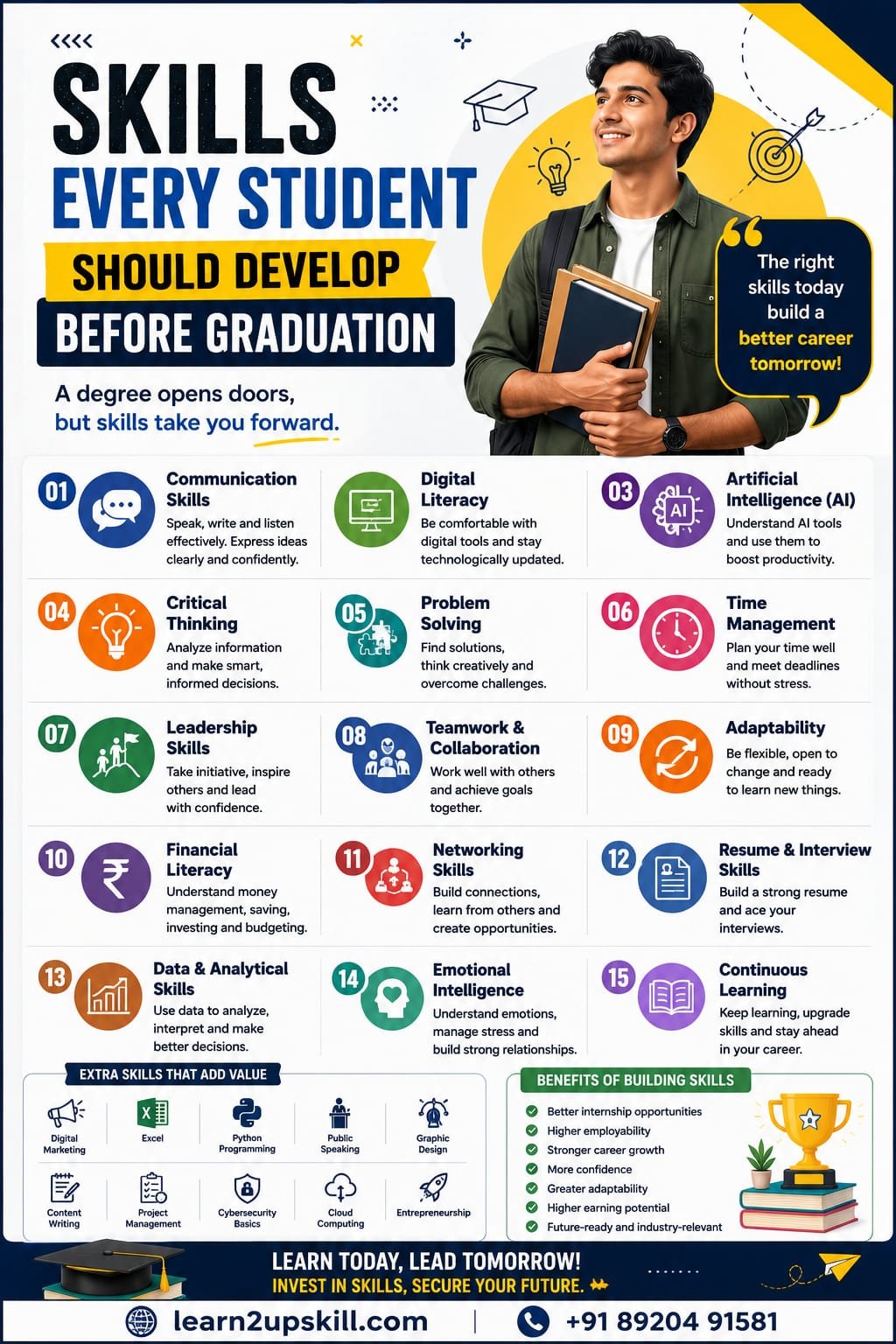
  • Skills Every Student Should Develop Before Graduation: A Complete Guide to Career Success

    Skills Every Student Should Develop Before Graduation: A Complete Guide to Career Success

    Skills Every Student Should Develop Before Graduation: A Complete Guide to Career Success

    Published by: Learn2Upskill

    Website: www.coral-kudu-326218.hostingersite.com

    Contact: +91 89204 91581

    Introduction

    Graduating from college is an exciting milestone, but today’s employers expect more than just a degree. They look for graduates who can communicate effectively, solve problems, adapt to change, and use modern technology with confidence.

    Developing the right skills before graduation can make the transition from classroom to workplace much smoother. Whether you plan to pursue a job, higher education, or entrepreneurship, building these skills early will give you a competitive advantage.

    In this blog, we’ll explore the essential skills every student should develop before graduation to improve employability and prepare for long-term career success.

    —

    Why Skills Matter More Than Ever

    The job market is evolving rapidly due to technology, automation, and Artificial Intelligence (AI). While academic knowledge remains important, employers increasingly value practical skills that help employees contribute from day one.

    Students who combine a strong educational foundation with practical, professional, and digital skills are better positioned to secure internships, job offers, and career growth opportunities.

    —

    1. Communication Skills

    Strong communication is essential in every profession.

    Develop the ability to:

    – Speak confidently

    – Write professional emails

    – Deliver presentations

    – Listen actively

    – Communicate with diverse teams

    Good communication builds confidence and improves workplace relationships.

    —

    1. Digital Literacy

    Every graduate should be comfortable using modern digital tools.

    Learn:

    – Microsoft Word

    – Microsoft Excel

    – Microsoft PowerPoint

    – Google Workspace

    – Online collaboration tools

    – Cloud storage platforms

    Digital literacy is now a basic requirement across industries.

    —

    1. Artificial Intelligence (AI) Skills

    AI is changing the way businesses operate.

    Students should understand:

    – Generative AI tools

    – Prompt writing

    – AI-assisted research

    – AI for productivity

    – Responsible use of AI

    Learning AI can improve efficiency and open doors to future-ready careers.

    —

    1. Critical Thinking

    Employers value people who can analyze situations and make informed decisions.

    Practice:

    – Evaluating information

    – Asking thoughtful questions

    – Comparing solutions

    – Identifying risks

    – Making logical decisions

    Critical thinking helps solve real-world challenges.

    —

    1. Problem-Solving Skills

    Every organization faces challenges.

    Develop the ability to:

    – Identify problems

    – Analyze causes

    – Generate solutions

    – Test ideas

    – Learn from outcomes

    Strong problem-solvers are valuable in every industry.

    —

    1. Time Management

    Managing time effectively helps students balance academics, internships, projects, and personal life.

    Useful habits include:

    – Creating daily schedules

    – Setting priorities

    – Avoiding procrastination

    – Meeting deadlines

    – Reviewing progress regularly

    Time management increases productivity and reduces stress.

    —

    1. Leadership Skills

    Leadership is not limited to managers.

    Students can build leadership by:

    – Leading group projects

    – Organizing events

    – Volunteering

    – Taking initiative

    – Mentoring peers

    Leadership demonstrates responsibility and confidence.

    —

    1. Teamwork and Collaboration

    Most workplaces rely on teamwork.

    Develop skills such as:

    – Respecting different opinions

    – Sharing responsibilities

    – Resolving conflicts

    – Supporting teammates

    – Achieving common goals

    Employers highly value professionals who work well with others.

    —

    1. Adaptability

    Technology and industries continue to change rapidly.

    Adaptable students are willing to:

    – Learn new tools

    – Accept feedback

    – Adjust to change

    – Develop new skills

    – Embrace innovation

    Adaptability is essential for long-term career growth.

    —

    1. Financial Literacy

    Understanding money management is an important life skill.

    Learn:

    – Budgeting

    – Saving

    – Investing basics

    – Taxes

    – Managing expenses

    – Emergency planning

    Financial literacy supports personal and professional stability.

    —

    1. Networking Skills

    Professional networking creates opportunities.

    Students should:

    – Build a professional LinkedIn profile

    – Attend seminars and workshops

    – Connect with mentors

    – Participate in career fairs

    – Join professional communities

    Strong networks often lead to internships and job opportunities.

    —

    1. Resume and Interview Skills

    Before graduation, every student should know how to:

    – Create a professional resume

    – Write an effective cover letter

    – Prepare for interviews

    – Answer common HR questions

    – Showcase projects and achievements

    Preparation increases confidence during recruitment.

    —

    1. Data and Analytical Skills

    Many careers require data-driven decision-making.

    Useful skills include:

    – Microsoft Excel

    – SQL basics

    – Power BI

    – Data visualization

    – Basic statistics

    Analytical skills are valuable in business, finance, marketing, healthcare, and technology.

    —

    1. Emotional Intelligence

    Emotional intelligence helps students succeed both personally and professionally.

    Develop the ability to:

    – Understand emotions

    – Manage stress

    – Show empathy

    – Build positive relationships

    – Handle workplace challenges calmly

    Strong emotional intelligence improves teamwork and leadership.

    —

    1. Continuous Learning Mindset

    Learning shouldn’t stop after graduation.

    Successful professionals:

    – Read books and industry blogs

    – Take online courses

    – Earn certifications

    – Attend webinars

    – Stay updated with industry trends

    Continuous learning keeps your skills relevant.

    —

    Additional Skills That Add Value

    Students can further strengthen their profiles by learning:

    – Digital Marketing

    – Python Programming

    – Public Speaking

    – Graphic Design

    – Video Editing

    – Content Writing

    – Cybersecurity Basics

    – Cloud Computing Fundamentals

    – Project Management

    – Entrepreneurship

    These skills increase career flexibility and job opportunities.

    —

    How to Start Developing These Skills

    – Enroll in online courses.

    – Participate in internships.

    – Join student clubs and organizations.

    – Volunteer for community projects.

    – Build personal projects and portfolios.

    – Practice communication every day.

    – Seek feedback from mentors.

    – Set monthly learning goals.

    Small, consistent efforts create long-term success.

    —

    Benefits of Building Skills Before Graduation

    Students who develop these skills often enjoy:

    – Better internship opportunities

    – Stronger resumes

    – Improved interview performance

    – Higher employability

    – Greater confidence

    – Faster career growth

    – Increased earning potential

    – Better adaptability to workplace changes

    —

    Final Tips for Students

    – Don’t wait until your final semester to prepare.

    – Learn one new skill every few months.

    – Balance academics with practical experience.

    – Stay curious and open to learning.

    – Build a portfolio that showcases your achievements.

    – Invest in your personal and professional development.

    —

    Conclusion

    A degree is an important achievement, but it is your skills that help you stand out in today’s competitive job market. Employers seek graduates who can communicate effectively, solve problems, adapt to change, and use modern technology confidently.


    By developing these essential skills before graduation, you’ll be better prepared to seize opportunities, overcome challenges, and build a successful career.

    Start today, stay consistent, and invest in lifelong learning—your future self will thank you.

    —

    Learn with Learn2Upskill

    At Learn2Upskill, we help students become career-ready through practical, industry-focused training and expert guidance.

    Our programs cover in-demand skills such as Artificial Intelligence (AI), Microsoft Excel, Data Analytics, Digital Marketing, Programming, Communication Skills, Career Development, and much more.

    Whether you’re preparing for your first job or planning your future career, we’re here to help you succeed.

    Website: www.coral-kudu-326218.hostingersite.com

    Contact: +91 89204 91581

    Build the skills employers want. Graduate with confidence. Grow your career with Learn2Upskill.

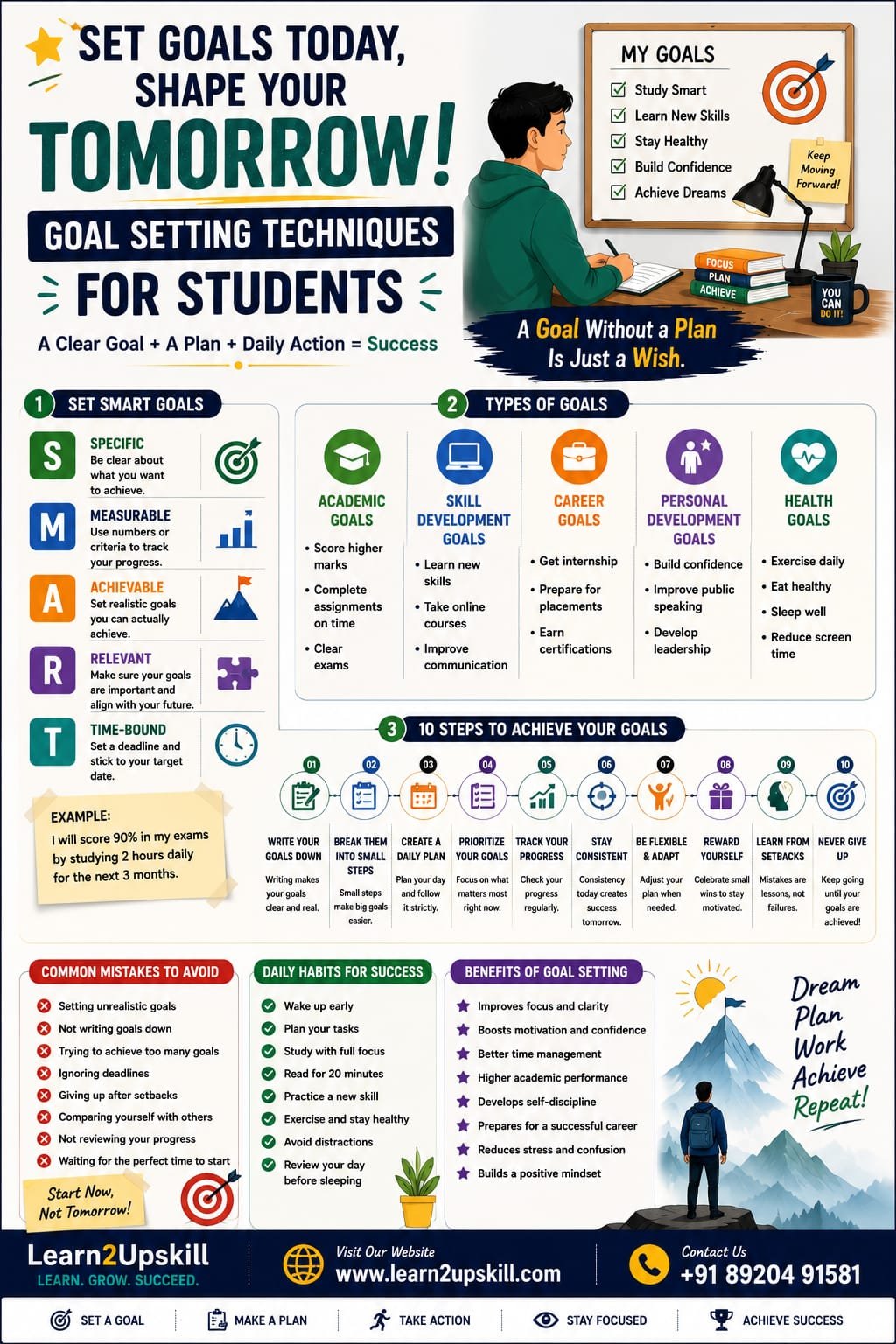
  • Goal Setting Techniques for Students

    Goal Setting Techniques for Students

    Goal Setting Techniques for Students

    Introduction

    Every successful student has one thing in common—they have clear goals. Whether it’s scoring higher marks, learning a new skill, getting into a dream college, or securing a great job, goals provide direction and purpose. Without goals, students often lose focus, waste time, and struggle to stay motivated.

    Goal setting is not just about writing down what you want to achieve. It is about creating a practical plan, staying committed, and taking consistent action. When students set meaningful goals, they become more organized, confident, and prepared to face challenges.

    At Learn2Upskill, we believe that goal setting is one of the most powerful life skills. It helps students stay focused, build discipline, and prepare for long-term academic and career success.

    —

    What Is Goal Setting?

    Goal setting is the process of identifying what you want to achieve and creating a step-by-step plan to reach it. A goal gives you a clear target and motivates you to work consistently toward success.

    Goals can be related to:

    – Academic performance

    – Career planning

    – Skill development

    – Health and fitness

    – Personality development

    – Financial management

    – Personal growth

    Having clear goals makes it easier to prioritize your time and efforts.

    —

    Why Is Goal Setting Important for Students?

    Setting goals helps students:

    – Stay focused on their priorities.

    – Improve academic performance.

    – Develop self-discipline.

    – Increase motivation.

    – Manage time effectively.

    – Build confidence.

    – Reduce stress caused by uncertainty.

    – Track progress and celebrate achievements.

    – Prepare for future careers.

    Students with clear goals are more likely to stay committed to their learning journey.

    —

    Types of Goals Every Student Should Set

    1. Academic Goals

    Examples:

    – Improve mathematics scores.

    – Read one book every month.

    – Complete assignments before deadlines.

    – Score above 90% in examinations.

    —

    1. Skill Development Goals

    Examples:

    – Learn Microsoft Excel.

    – Complete a Digital Marketing course.

    – Improve English communication.

    – Learn Artificial Intelligence (AI) basics.

    – Develop coding skills.

    —

    1. Career Goals

    Examples:

    – Get an internship.

    – Build a professional LinkedIn profile.

    – Prepare for campus placements.

    – Earn industry-recognized certifications.

    —

    1. Personal Development Goals

    Examples:

    – Improve public speaking.

    – Build self-confidence.

    – Develop leadership skills.

    – Practice positive thinking.

    —

    1. Health Goals

    Examples:

    Exercise for 30 minutes daily.

    – Sleep 7–8 hours every night.

    – Eat healthy meals.

    – Reduce excessive screen time.

    Good health supports better learning and productivity.

    —

    Effective Goal Setting Techniques

    1. Set SMART Goals

    One of the most effective methods is the SMART framework. Your goals should be:

    – Specific – Clearly define what you want to achieve.

    – Measurable – Track your progress.

    – Achievable – Set realistic goals.

    – Relevant – Align them with your priorities.

    – Time-bound – Give yourself a deadline.

    Example:

    Instead of saying, “I want better grades,” say, “I will improve my mathematics score from 75% to 90% by the end of this semester by studying one hour every day.”

    —

    1. Write Down Your Goals

    Writing your goals makes them more concrete and keeps you accountable. Keep them in a notebook, planner, or digital app where you can review them regularly.

    —

    1. Break Big Goals into Small Steps

    Large goals can feel overwhelming. Divide them into smaller tasks that you can complete daily or weekly.

    For example:

    Goal: Learn Microsoft Excel.

    Steps:

    – Learn basic formulas.

    – Practice charts.

    – Master Pivot Tables.

    – Build sample dashboards.

    – Complete an online certification.

    Small wins build momentum.

    —

    1. Prioritize Your Goals

    Not all goals are equally important. Focus on what will have the greatest impact on your studies and future career.

    Ask yourself:

    – Which goal is most urgent?

    – Which goal supports my long-term career?

    – What can I start today?

    —

    1. Create a Daily Action Plan

    Your goals should become part of your daily routine.

    Example:

    – Study for one hour.

    – Read for 20 minutes.

    – Practice communication skills.

    – Complete one online lesson.

    – Revise class notes.

    Consistent daily actions lead to long-term success.

    —

    1. Track Your Progress

    Review your progress every week.

    Ask yourself:

    – What did I accomplish?

    – What challenges did I face?

    – What should I improve next week?

    Tracking progress keeps you motivated.

    —

    1. Stay Flexible

    Sometimes circumstances change, and goals may need adjustment. Review your goals regularly and update them when necessary without losing sight of your long-term vision.

    —

    1. Reward Yourself

    Celebrate achievements, even small ones.

    Examples:

    – Take a short break.

    – Watch a favorite movie.

    – Spend time with family or friends.

    – Buy yourself a book.

    Rewards help maintain motivation.

    —

    1. Learn from Failures

    Not every goal will be achieved on the first attempt. Treat setbacks as opportunities to learn and improve.

    Failure is not the end—it is part of the learning process.

    —

    1. Stay Consistent

    Consistency matters more than perfection. Small daily efforts create remarkable long-term results.

    Even 30 minutes of focused learning every day can make a significant difference over time.

    —

    Common Goal Setting Mistakes

    Avoid these mistakes:

    – Setting unrealistic goals

    – Not writing goals down

    – Trying to achieve too many goals at once

    – Ignoring deadlines

    – Giving up after setbacks

    – Comparing yourself with others

    – Not reviewing progress

    – Waiting for the “perfect” time to start

    The best time to begin is today.

    —

    Daily Habits That Help You Achieve Your Goals

    Develop these habits:

    – Wake up early.

    – Plan your day.

    – Read for at least 20 minutes.

    – Practice one new skill regularly.

    – Exercise daily.

    – Stay organized.

    – Limit distractions.

    – Reflect on your progress before sleeping.

    Small habits build extraordinary results.

    —

    Benefits of Goal Setting

    Effective goal setting helps students:

    – Improve academic performance

    – Build self-confidence

    – Develop discipline

    – Manage time efficiently

    – Stay motivated

    – Improve decision-making

    – Reduce stress

    – Prepare for successful careers

    – Develop lifelong learning habits

    Goal setting transforms dreams into achievable plans.

    —

    Conclusion

    Success does not happen by chance—it begins with clear goals and consistent action. Whether you want to excel in academics, build valuable skills, prepare for placements, or grow personally, goal setting provides the direction you need.

    Start with one meaningful goal today, create a practical plan, and take one step at a time. Every small effort brings you closer to achieving your dreams.

    At Learn2Upskill, we are committed to helping students achieve academic excellence and career success through career counselling, personality development, communication skills training, interview preparation, professional grooming, and industry-relevant skill development programs.

    —

    Contact Learn2Upskill

    Website: www.coral-kudu-326218.hostingersite.com

    Contact Us: +91-89204 91581

    Learn2Upskill – Learn. Grow. Succeed.
  • How to Reduce Exam Stress and Anxiety

    How to Reduce Exam Stress and Anxiety

    How to Reduce Exam Stress and Anxiety

    Meta Title: How to Reduce Exam Stress and Anxiety | A Complete Guide for Students & Parents

    Meta Description: Learn practical ways to reduce exam stress and anxiety. Discover proven tips for students and parents to improve focus, confidence, mental well-being, and exam performance.

    Focus Keyword: How to Reduce Exam Stress and Anxiety

    —

    How to Reduce Exam Stress and Anxiety: A Complete Guide for Students & Parents

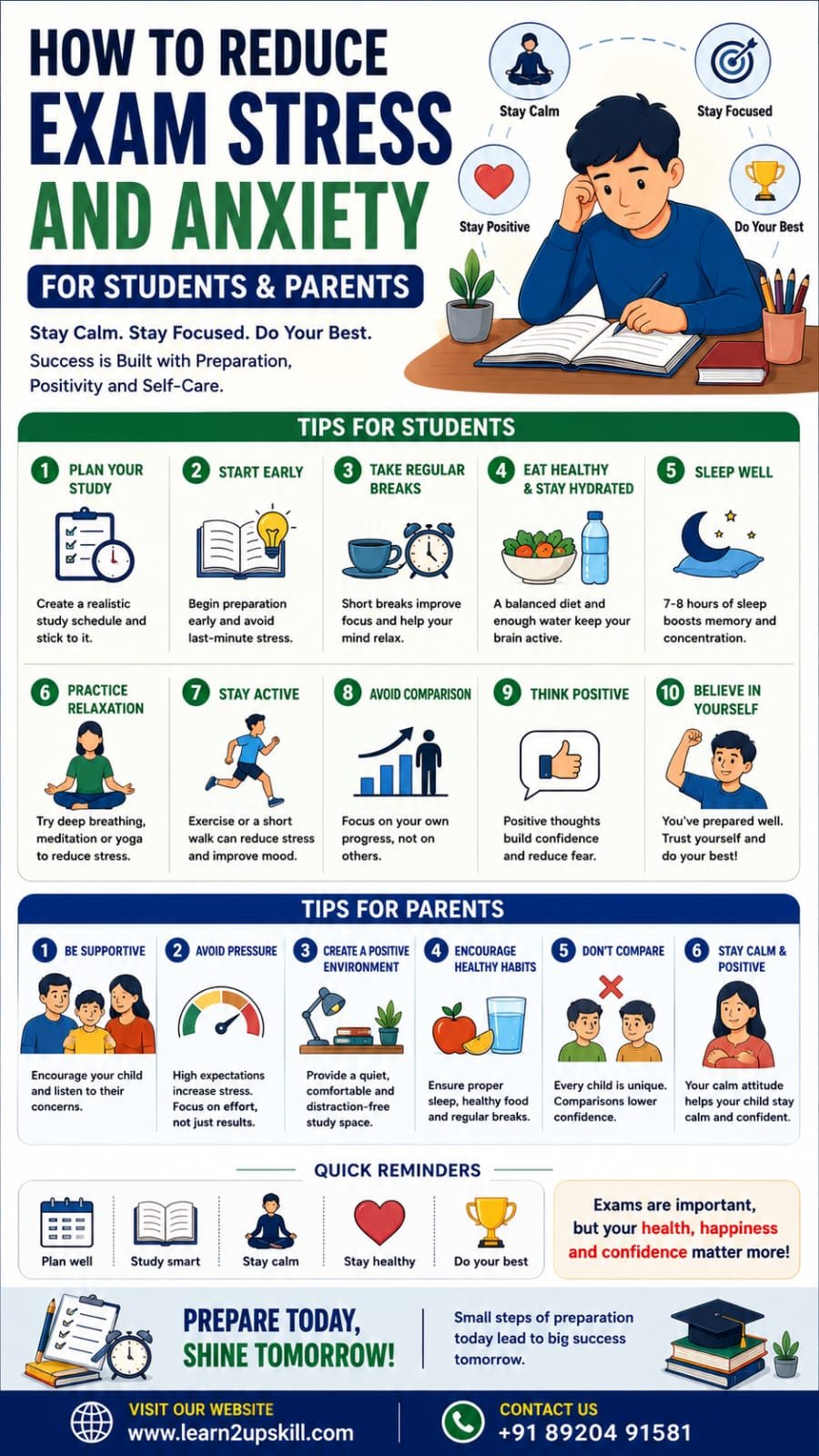
    Examinations are an important part of every student’s academic journey. While a little nervousness before an exam is normal, excessive stress and anxiety can affect concentration, memory, confidence, and overall performance.

    Parents also experience stress during exam season as they want their children to succeed. The good news is that exam stress can be managed with the right habits, emotional support, and a balanced approach to preparation.

    This guide offers practical strategies for both students and parents to reduce exam anxiety, improve focus, and build confidence.

    —

    What Is Exam Stress?

    Exam stress is the physical and emotional pressure students feel before or during examinations.

    It can result from:

    – Fear of failure

    – High expectations

    – Poor preparation

    – Time pressure

    – Lack of confidence

    – Comparison with others

    – Uncertainty about results

    A manageable level of stress can improve alertness, but excessive anxiety can make studying and performing in exams more difficult.

    —

    Common Signs of Exam Stress

    Students may experience:

    Emotional Signs

    – Constant worry

    – Fear of failure

    – Irritability

    – Mood swings

    – Low confidence

    – Feeling overwhelmed

    Physical Signs

    – Headaches

    – Trouble sleeping

    – Fatigue

    – Loss of appetite

    – Rapid heartbeat

    – Stomach discomfort

    Academic Signs

    – Difficulty concentrating

    – Forgetting studied topics

    – Procrastination

    – Lack of motivation

    – Avoiding study sessions

    Recognizing these signs early allows students and parents to take supportive action.

    —

    Why Do Students Feel Exam Anxiety?

    Some common reasons include:

    – Pressure to score high marks

    – Competition with classmates

    – Unrealistic expectations

    – Poor time management

    – Last-minute preparation

    – Fear of disappointing parents or teachers

    – Negative self-talk

    Understanding the cause is the first step toward managing it.

    —

    Tips for Students to Reduce Exam Stress

    1. Create a Realistic Study Plan

    Break your syllabus into manageable sections.

    Instead of studying everything in one day:

    – Divide subjects into daily goals.

    – Set achievable targets.

    – Include revision time.

    – Leave time for breaks.

    Consistency is more effective than cramming.

    —

    1. Start Preparing Early

    Last-minute studying increases anxiety.

    Beginning your preparation weeks in advance gives you more time to understand concepts, revise regularly, and identify areas that need improvement.

    —

    1. Practice Active Learning

    Instead of only reading textbooks:

    – Solve previous years’ papers.

    – Practice mock tests.

    – Create summary notes.

    – Teach concepts to a friend.

    – Use flashcards for quick revision.

    Active learning improves memory and confidence.

    —

    1. Take Regular Breaks

    Studying continuously for long hours can reduce concentration.

    Try studying for focused sessions followed by short breaks to refresh your mind.

    Use breaks to stretch, hydrate, or take a short walk.

    —

    1. Get Enough Sleep


    Sleep is essential for memory and concentration.

    Aim for 7–9 hours of quality sleep each night, especially before an exam.

    Avoid sacrificing sleep for last-minute revision whenever possible.

    —

    1. Eat Healthy

    A balanced diet supports brain function.

    Choose foods such as:

    – Fruits

    – Vegetables

    – Whole grains

    – Nuts

    – Dairy products

    – Protein-rich meals

    Drink enough water throughout the day.

    Limit excessive caffeine and sugary drinks if they make you feel jittery.

    —

    1. Avoid Comparing Yourself

    Every student learns at a different pace.

    Comparing marks, preparation, or study hours with others often increases unnecessary stress.

    Focus on improving your own progress.

    —

    1. Practice Relaxation Techniques

    Simple relaxation methods can help calm your mind.

    Examples include:

    – Deep breathing

    – Gentle stretching

    – Mindfulness

    – Short meditation sessions

    – Listening to calming music during breaks

    —

    1. Stay Physically Active

    Regular physical activity helps reduce stress.

    Even 20–30 minutes of walking, cycling, yoga, or another enjoyable activity can improve mood and concentration.

    —

    1. Maintain a Positive Mindset

    Replace thoughts like:

    “I’ll definitely fail.”

    With:

    “I’ve prepared well, and I’ll do my best.”

    Positive self-talk can help build confidence.

    —

    Tips for Parents to Support Their Child

    1. Avoid Excessive Pressure

    Encourage your child to do their best rather than expecting perfection.

    Celebrate effort as well as achievement.

    —

    1. Listen and Communicate

    Ask open-ended questions such as:

    – How are you feeling about your exams?

    – Is there anything you’re finding difficult?

    – How can I support you?

    Listening without judgment helps children feel understood.

    —

    1. Provide a Positive Study Environment

    Help create a space that is:

    – Quiet

    – Comfortable

    – Well-lit

    – Free from distractions

    A good study environment improves focus.

    —

    1. Encourage Healthy Habits

    Support your child by encouraging:

    – Regular meals

    – Adequate sleep

    – Physical activity

    – Scheduled breaks

    Healthy routines improve both well-being and academic performance.

    —

    1. Avoid Comparisons

    Avoid comparing your child with siblings, relatives, or classmates.

    Every child has different strengths and learning styles.

    —

    1. Recognize Their Effort

    Praise consistency, discipline, and improvement—not just marks.

    Positive encouragement builds confidence.

    —

    1. Stay Calm During Exam Season

    Children often notice their parents’ emotions.

    A calm and supportive attitude can help reduce a student’s anxiety.

    —

    What to Do One Day Before the Exam

    Students should:

    – Revise key concepts.

    – Review summary notes.

    – Prepare exam materials.

    – Sleep on time.

    – Avoid learning completely new topics.

    – Stay hydrated.

    Parents should:

    – Encourage relaxation.

    – Avoid discussing marks or expectations.

    – Ensure the child gets proper rest.

    —

    What to Do on Exam Day

    Students

    – Wake up early.

    – Eat a healthy breakfast.

    – Reach the exam center on time.

    – Read questions carefully.

    – Manage time wisely.

    – Stay calm if you don’t know every answer.

    Parents

    – Offer encouragement.

    – Avoid increasing pressure.

    – Remind your child to do their best.

    – Stay positive regardless of the outcome.

    —

    Common Mistakes to Avoid

    Students

    – Last-minute cramming

    – Skipping meals

    – Staying awake all night

    – Comparing preparation with friends

    – Ignoring breaks

    Parents

    – Unrealistic expectations

    – Frequent criticism

    – Comparing children

    – Focusing only on marks

    – Discussing negative outcomes before exams

    —

    Building Long-Term Confidence

    Confidence grows through:

    – Consistent preparation

    – Regular practice

    – Healthy routines

    – Positive thinking

    – Learning from mistakes

    – Seeking help when needed

    Exams measure knowledge at a point in time—they do not define a student’s worth or future.

    —

    —

    Final Thoughts


    Exam stress is a common part of academic life, but it doesn’t have to take over. With thoughtful preparation, healthy routines, emotional support, and realistic expectations, students can approach exams with greater confidence and resilience.

    Parents play a vital role by encouraging effort, creating a supportive environment, and reminding children that learning is a journey—not just a score on a report card.

    Success isn’t measured only by marks. It is built through consistent learning, personal growth, and the confidence to keep moving forward.

    At Learn2Upskill, we are committed to helping students build not only academic skills but also confidence, career readiness, and lifelong learning habits through practical courses, career guidance, and professional skill development.

    Why Choose Learn2Upskill?

    – Student-focused learning

    – Career guidance and mentoring

    – Practical skill development

    – Microsoft Excel, AI, Power BI & Python training

    – Job-ready programs

    – Expert instructors

    Visit: www.coral-kudu-326218.hostingersite.com

    Contact Us: +91 89204 91581

    Learn with Confidence. Grow with Knowledge. Succeed with Learn2Upskill.

  • How Career Counselling Helps Students Make Better Decisions

    How Career Counselling Helps Students Make Better Decisions

    How Career Counselling Helps Students Make Better Decisions

    Published by: Learn2Upskill

    Website: www.coral-kudu-326218.hostingersite.com

    Contact: +91 89204 91581

    Introduction

    Choosing the right career is one of the biggest decisions a student will ever make. With thousands of courses, careers, certifications, and job opportunities available today, it’s easy to feel confused or overwhelmed.

    Many students choose careers based on family expectations, peer pressure, or limited information. Unfortunately, these decisions can lead to dissatisfaction, wasted time, and missed opportunities.

    This is where career counselling plays a vital role. A professional career counsellor helps students understand their strengths, interests, personality, and career options, enabling them to make informed decisions that align with their goals.

    In this blog, we’ll explore how career counselling benefits students and why it has become more important than ever in today’s fast-changing world.

    —

    What Is Career Counselling?

    Career counselling is a structured process that helps students:

    – Understand their interests and abilities

    – Identify suitable career options

    – Select the right course or stream

    – Set career goals

    – Develop job-ready skills

    – Plan for long-term success

    Career counselling is not about telling students what to do—it’s about helping them make confident, well-informed choices.

    —

    Why Career Counselling Is Important

    Today’s job market is changing rapidly due to technology, automation, and Artificial Intelligence (AI). New careers are emerging while others are evolving.

    Career counselling helps students:

    – Make informed decisions

    – Avoid choosing the wrong career path

    – Save time and money

    – Build confidence

    – Stay prepared for future job opportunities

    —

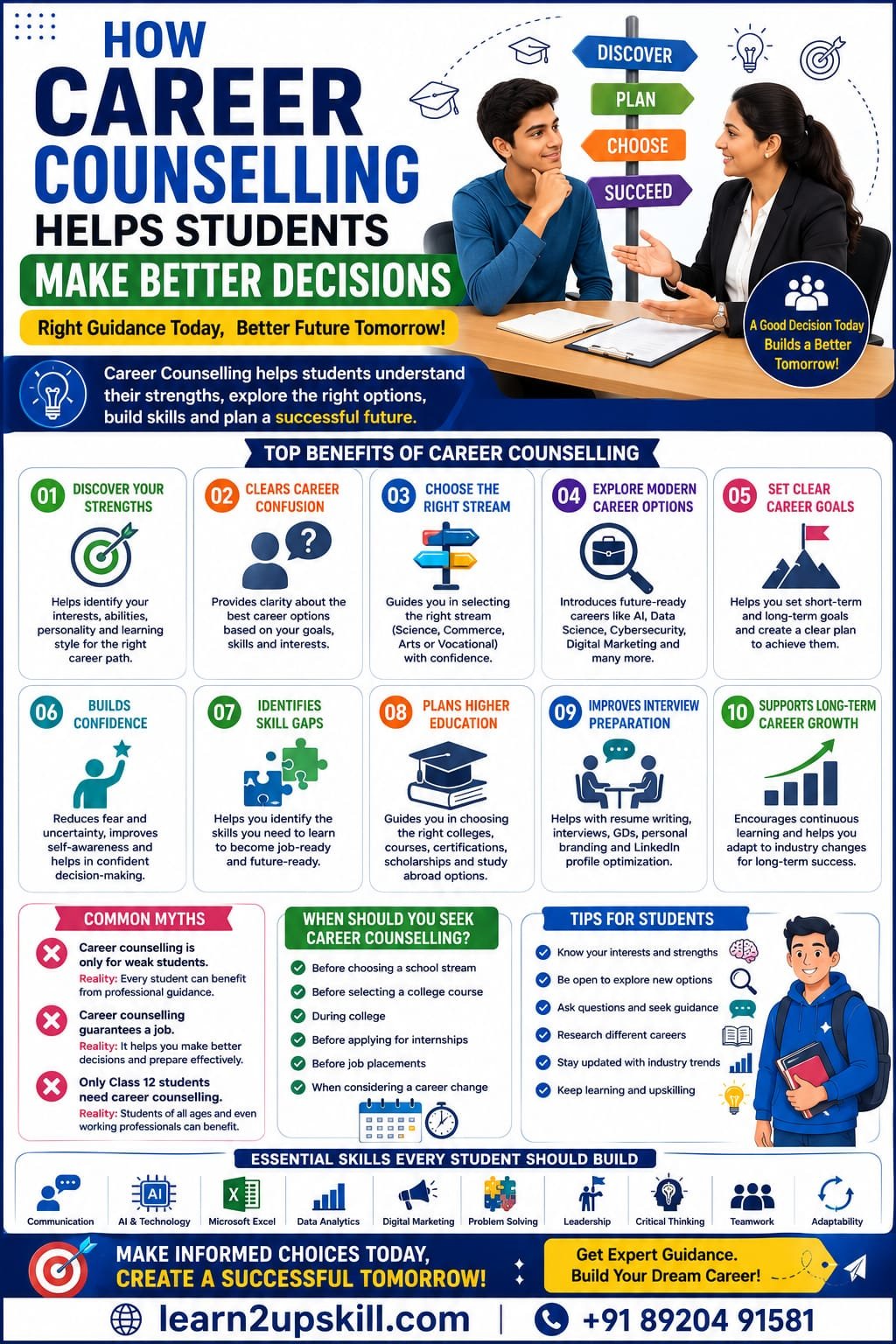
    Benefits of Career Counselling

    1. Helps Students Discover Their Strengths

    Every student has unique talents.

    Career counselling helps identify:

    – Academic strengths

    – Natural abilities

    – Interests

    – Personality traits

    – Learning style

    Understanding yourself is the first step toward choosing the right career.

    —

    1. Clears Career Confusion

    Many students ask questions like:

    – Which course should I choose?

    – Which career has the best future?

    – What skills should I learn?

    – Which industry pays well?

    – Should I study abroad?

    Career counselling provides personalized answers based on your goals and interests.

    —

    1. Helps Choose the Right Stream

    Students often struggle to choose between:

    – Science

    – Commerce

    – Arts/Humanities

    – Vocational Courses

    A counsellor can explain the opportunities available in each stream and help students choose wisely.


    —

    1. Introduces Modern Career Options

    Many students know only about traditional professions such as engineering, medicine, or government jobs.

    Career counselling also introduces exciting careers in:

    – Artificial Intelligence (AI)

    – Data Analytics

    – Cybersecurity

    – Cloud Computing

    – Digital Marketing

    – UI/UX Design

    – Content Creation

    – Business Analytics

    – Animation

    – Entrepreneurship

    This broadens students’ career horizons.

    —

    1. Helps Set Career Goals

    Students learn to create:

    Short-Term Goals

    – Improve communication skills

    – Complete certifications

    – Build a portfolio

    Long-Term Goals

    – Secure a dream job

    – Start a business

    – Become an industry expert

    Goal-setting provides clarity and motivation.

    —

    1. Builds Confidence

    Many students lack confidence when making career decisions.

    Career counselling helps by:

    – Reducing fear and uncertainty

    – Improving self-awareness

    – Encouraging informed decision-making

    – Providing a clear action plan

    Confident students are better prepared for academic and professional success.

    —

    1. Identifies Skill Gaps

    Employers today look beyond degrees.

    Career counselling helps students identify important skills such as:

    – Communication

    – Artificial Intelligence (AI)

    – Microsoft Excel

    – Digital Marketing

    – Data Analytics

    – Coding

    – Leadership

    – Critical Thinking

    – Problem Solving

    – Teamwork

    Students can then focus on learning the skills employers value most.

    —

    1. Helps Plan Higher Education

    Career counsellors guide students on:

    – College selection

    – Degree programs

    – Professional certifications

    – Online learning opportunities

    – Scholarships

    – Study-abroad options

    This ensures students make informed educational choices.

    —

    1. Improves Interview Preparation

    Career counselling often includes guidance on:

    – Resume writing

    – Interview skills

    – Group discussions

    – Personal branding

    – LinkedIn profile optimization

    These skills improve employability.

    —

    1. Supports Long-Term Career Growth

    Career planning doesn’t stop after choosing a course.

    Career counselling encourages lifelong learning, helping students:

    – Adapt to industry changes

    – Learn new technologies

    – Upgrade skills

    – Stay competitive throughout their careers

    —

    Common Career Counselling Myths

    Myth 1: Career counselling is only for weak students.

    Reality: Every student can benefit from professional career guidance.

    Myth 2: Career counselling guarantees a job.

    Reality: It helps students make better decisions and prepare effectively, but success still depends on effort and continuous learning.

    Myth 3: Only Class 12 students need career counselling.

    Reality: Students from middle school, high school, college, and even working professionals can benefit.

    —

    When Should Students Seek Career Counselling?

    The ideal time is:

    – Before choosing a school stream

    – Before selecting a college course

    – During college

    – Before applying for internships

    – Before job placements

    – When considering a career change

    Early guidance can prevent costly mistakes later.

    —

    Tips for Students Before Career Counselling

    – Think about your interests and hobbies.

    – List your strengths and weaknesses.

    – Be open to exploring new career paths.

    – Ask questions without hesitation.

    – Research different industries.

    – Keep an open mind about future opportunities.

    —

    The Future of Career Counselling

    Technology is changing career guidance.

    Modern career counselling may include:

    – AI-powered career assessments

    – Virtual counselling sessions

    – Online aptitude tests

    – Personalized learning plans

    – Industry trend analysis

    – Digital career portfolios

    These tools make career planning more accessible and effective.

    —

    Conclusion

    Career counselling empowers students to make informed, confident decisions about their future. Instead of following the crowd or making choices based on assumptions, students gain clarity about their interests, strengths, and career opportunities.


    Combined with continuous learning and practical skill development, career counselling can lay the foundation for a successful and fulfilling career.


    Remember, the best career decisions are made with knowledge, self-awareness, and proper guidance.

    —

    Learn with Learn2Upskill

    At Learn2Upskill, we believe every student deserves the right guidance to build a successful future.

    We offer career guidance, skill development programs, and industry-focused training in areas such as Artificial Intelligence (AI), Digital Marketing, Microsoft Excel, Data Analytics, Programming, and other in-demand skills.

    Whether you’re choosing your first career path or upgrading your professional skills, we’re here to support your journey.

    Website: www.coral-kudu-326218.hostingersite.com

    Contact: +91 89204 91581

    Choose your career with confidence. Learn the skills that matter. Build your future with Learn2Upskill.

  • Best Time Management Techniques for Students: Study Smarter, Stress Less

    Best Time Management Techniques for Students: Study Smarter, Stress Less

    Best Time Management Techniques for Students: Study Smarter, Stress Less

    Published by: Learn2Upskill

    Website: www.coral-kudu-326218.hostingersite.com

    Contact: +91 89204 91581

    Introduction

    Time is one of the most valuable resources for every student. Whether you’re preparing for board exams, college entrance tests, competitive exams, or balancing academics with extracurricular activities, managing your time effectively can make a huge difference.

    Many students struggle not because they lack intelligence, but because they don’t have a proper plan for using their time. By developing good time management habits, you can improve your grades, reduce stress, and still have time for hobbies, family, and relaxation.

    In this blog, we’ll explore the best time management techniques every student should use to become more productive and successful.

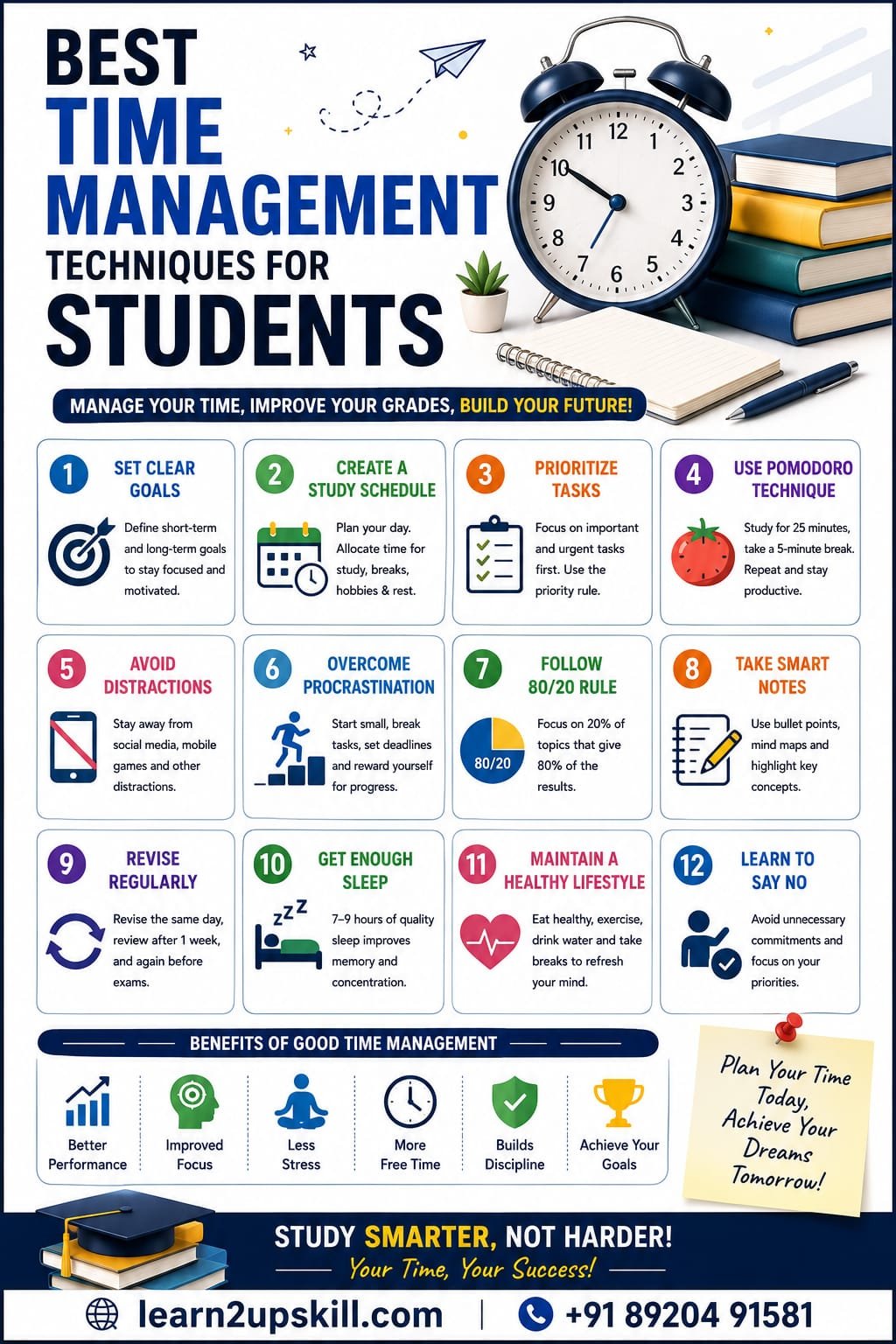
    Why Time Management Is Important

    Effective time management helps students:

    – Complete assignments on time

    – Reduce exam stress

    – Improve concentration

    – Increase productivity

    – Maintain a healthy study-life balance

    – Build self-discipline and confidence

    Students who manage their time well are more likely to achieve their academic and career goals.

    —

    1. Set Clear Goals

    Start by defining what you want to achieve.

    Short-Term Goals

    – Finish today’s homework

    – Revise one chapter

    – Practice 20 math questions

    Long-Term Goals

    – Score above 90%

    – Crack competitive exams

    – Improve English communication

    – Learn a new skill

    Clear goals give your studies direction and purpose.

    —

    1. Create a Daily Study Schedule

    A timetable helps you organize your day effectively.

    Remember to keep your schedule realistic and flexible.

    —

    1. Prioritize Important Tasks

    Not every task has the same importance.

    Focus first on:

    – Upcoming exams

    – Assignments with deadlines

    – Difficult subjects

    – Project work

    Complete high-priority tasks before spending time on less important activities.

    —

    1. Use the Pomodoro Technique

    The Pomodoro Technique is a simple and effective study method.

    – Study for 25 minutes

    – Take a 5-minute break

    – Repeat four times

    – Take a longer 20–30 minute break

    This technique helps maintain focus and prevents mental fatigue.

    —

    1. Avoid Procrastination

    Procrastination is one of the biggest obstacles to success.

    Common reasons include:

    – Fear of failure

    – Lack of motivation

    – Mobile phone distractions

    – Poor planning

    How to overcome it:

    – Start with small tasks.

    – Break large projects into smaller steps.

    – Set deadlines for yourself.

    – Reward yourself after completing tasks.

    —

    1. Eliminate Distractions

    Distractions reduce productivity and waste valuable study time.

    Common distractions:

    – Social media

    – Mobile games

    – TV

    – Notifications

    – Unnecessary internet browsing

    1. Follow the 80/20 Rule

    The Pareto Principle suggests that 20% of your efforts often produce 80% of your results.

    Identify the topics that carry the most marks or require the most attention, and focus on mastering them first.

    —

    1. Take Smart Notes

    Well-organized notes make revision easier.

    Use:

    – Bullet points

    – Mind maps

    – Flowcharts

    – Highlight key formulas and definitions

    – Color coding for important concepts

    Good notes save time during exam preparation.

    —

    1. Revise Regularly

    Revision helps move information into long-term memory.

    A simple revision plan:

    – Revise the same day.

    – Review after one week.

    – Revise again before exams.

    Frequent revision improves retention and confidence.

    —

    1. Get Enough Sleep

    Sleeping less does not mean studying more effectively.

    Aim for 7–9 hours of quality sleep each night. Adequate rest improves memory, concentration, and learning ability.

    —

    1. Maintain a Healthy Lifestyle

    Your brain performs better when your body is healthy.

    – Eat nutritious meals.

    – Drink plenty of water.

    – Exercise regularly.

    – Take short breaks while studying.

    A healthy routine supports better academic performance.

    —

    1. Learn to Say No

    Avoid unnecessary commitments that take time away from your priorities.

    Politely decline activities that interfere with your study schedule and focus on what matters most.

    —

    Useful Time Management Apps

    Students can use these apps to stay organized:

    – Google Calendar

    – Microsoft To Do

    – Notion

    – Todoist

    – Forest

    – Trello

    These tools help you manage tasks, deadlines, and study plans effectively.

    —

    Common Time Management Mistakes

    Avoid these habits:

    – Studying without a plan

    – Multitasking

    – Leaving work until the last minute

    – Ignoring breaks

    – Spending excessive time on social media

    – Not reviewing completed work

    Recognizing these mistakes is the first step toward improving your productivity.

    —

    Benefits of Good Time Management

    Students who manage their time effectively often experience:

    – Better academic performance

    – Reduced stress

    – Improved focus

    – Increased confidence

    – More free time

    – Stronger discipline

    – Better career preparation

    —

    Final Tips for Success

    – Plan your day the night before.

    – Start with the hardest subject.

    – Review your progress weekly.

    – Keep learning consistently.

    – Stay positive and motivated.

    – Celebrate small achievements.

    —

    Conclusion


    Time management is a skill that every student can develop. By planning your day, setting clear goals, avoiding distractions, and staying consistent, you can improve your academic performance while maintaining a healthy balance in life.

    Remember, success isn’t about studying for the longest hours—it’s about making the best use of the time you have. Start applying these techniques today, and you’ll be one step closer to achieving your educational and career goals.

    Learn with Learn2Upskill

    At Learn2Upskill, we help students build practical, career-ready skills through expert guidance, online courses, and professional development resources.

    Website: www.coral-kudu-326218.hostingersite.com

    Contact: +91 89204 91581

    Learn smarter. Manage your time better. Build a brighter future with Learn2Upskill!

  • 21 Daily Habits of Successful Students: Build a Routine for Academic and Career Success

    21 Daily Habits of Successful Students: Build a Routine for Academic and Career Success

    21 Daily Habits of Successful Students: Build a Routine for Academic and Career Success

    Discover 21 daily habits that help successful students improve productivity, learning, confidence, time management, and career readiness. Practical tips for school, college, and competitive exam students.

    Focus Keyword: 21 Daily Habits of Successful Students

    —

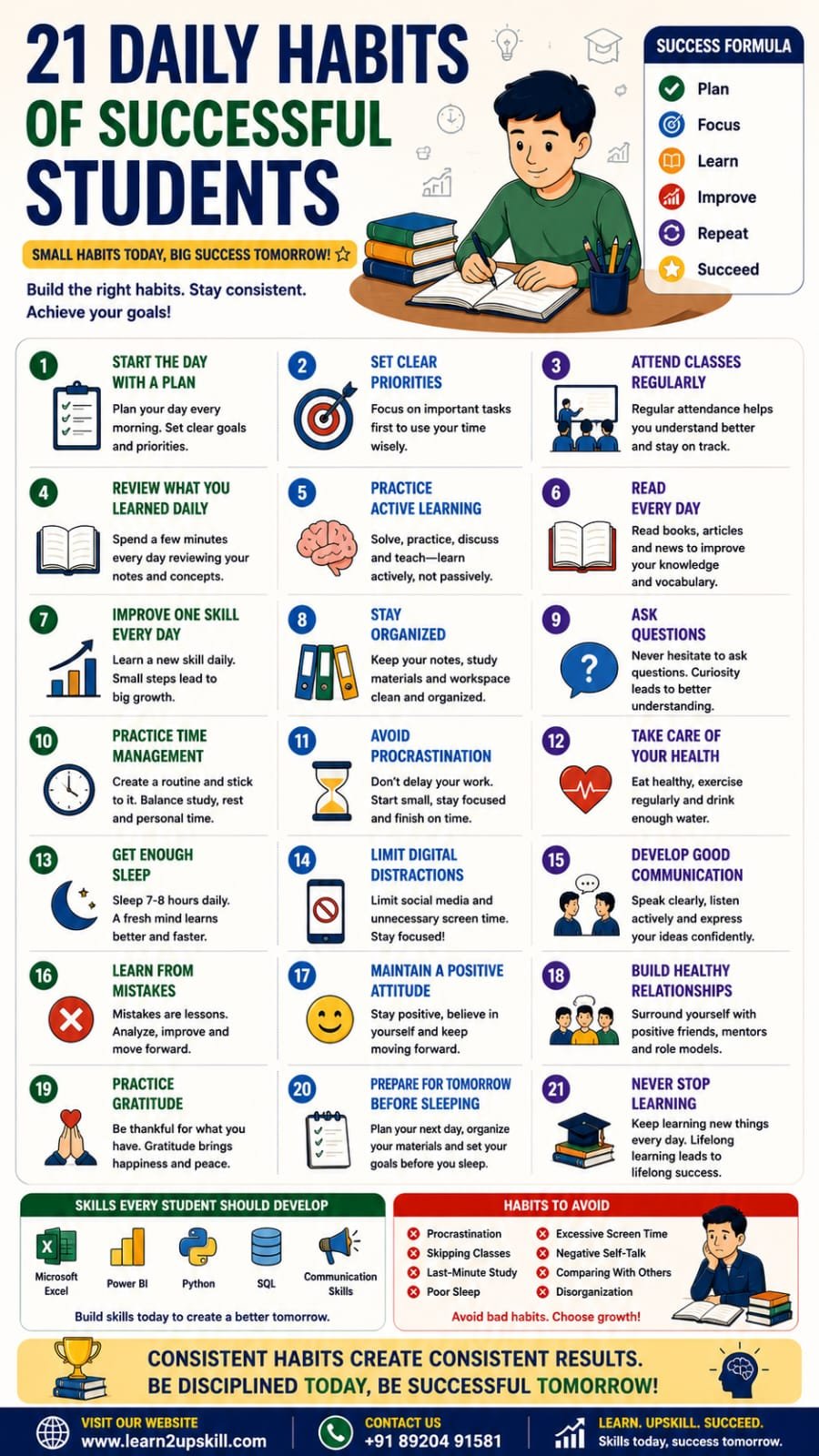
    21 Daily Habits of Successful Students

    Success in academics doesn’t happen overnight. It is built through small, consistent habits practiced every day. While intelligence and talent are important, discipline, consistency, and the willingness to learn often make the biggest difference.

    Successful students don’t necessarily study for the longest hours—they study smart, manage their time well, and continuously improve themselves.

    Whether you’re in school, college, or preparing for competitive exams, these 21 daily habits can help you become more productive, confident, and career-ready.

    —

    Why Daily Habits Matter

    Daily habits help students:

    – Improve concentration

    – Reduce stress

    – Stay organized

    – Build self-confidence

    – Develop discipline

    – Learn more effectively

    – Prepare for future careers

    Small improvements made consistently can lead to significant long-term results.

    —

    1. Start the Day with a Plan

    Spend 5–10 minutes each morning planning your day.

    Write down:

    – Study goals

    – Assignments

    – Revision topics

    – Personal tasks

    A clear plan helps you stay focused and avoid wasting time.

    —

    1. Set Clear Priorities

    Not every task is equally important.

    Complete high-priority work first, especially subjects or assignments with upcoming deadlines.

    —

    1. Attend Classes Regularly

    Whether learning in person or online, regular attendance helps you:

    – Understand concepts better

    – Stay updated

    – Participate in discussions

    – Avoid last-minute confusion

    —

    1. Review What You Learned Daily

    Spend 15–20 minutes reviewing class notes every day.

    Regular revision improves long-term memory and reduces exam pressure.

    —

    1. Practice Active Learning

    Instead of only reading:

    – Solve problems

    – Take quizzes

    – Teach someone else

    – Create mind maps

    – Summarize concepts

    Active learning improves understanding and retention.

    —

    1. Read Every Day

    Develop the habit of reading beyond textbooks.

    Read:

    – Books

    – Articles

    – Industry blogs

    – News

    – Educational content

    Reading expands knowledge and improves communication skills.

    —

    1. Improve One Skill Every Day

    Spend at least 30 minutes learning a practical skill.

    Examples:

    – Microsoft Excel

    – Python

    – Power BI

    – SQL

    – Digital Marketing

    – Graphic Design

    – Communication Skills

    Skill development prepares you for future career opportunities.

    —

    1. Stay Organized

    Keep your:

    – Notes

    – Study materials

    – Files

    – Digital folders

    – Assignments

    well organized.

    An organized environment saves time and reduces stress.

    —

    1. Ask Questions

    Never hesitate to ask questions.

    Curiosity leads to deeper understanding and better learning.

    Remember:

    There are no foolish questions—only missed opportunities to learn.

    —

    1. Practice Time Management

    Allocate dedicated time for:

    – Study

    – Revision

    – Exercise

    – Family

    – Hobbies

    – Rest

    Managing time effectively improves productivity without leading to burnout.

    —

    1. Avoid Procrastination

    Break large tasks into smaller steps.

    Instead of saying:

    I’ll study the whole chapter.”

    Start with:

    “I’ll complete the first three pages.”

    Small actions build momentum.

    —

    1. Take Care of Your Health

    Healthy students learn better.

    Maintain:

    – Balanced nutrition

    – Regular exercise

    – Proper hydration

    – Good posture while studying

    Physical health supports mental performance.

    —

    1. Get Enough Sleep

    Aim for 7–9 hours of quality sleep.

    Adequate rest improves:

    – Memory

    – Focus

    – Mood

    – Decision-making

    Avoid sacrificing sleep for last-minute studying.

    —

    1. Limit Digital Distractions

    Social media, games, and constant notifications can interrupt concentration.

    Consider:

    – Turning off unnecessary notifications

    – Keeping your phone away during study sessions

    – Setting specific times for entertainment

    —

    1. Develop Good Communication Skills

    Practice:

    – Speaking confidently

    – Listening actively

    – Writing clearly

    – Presenting ideas

    Communication is valuable in academics, interviews, and the workplace.

    —

    1. Learn from Mistakes

    Don’t fear mistakes.

    Instead:

    – Analyze what went wrong.

    – Identify areas for improvement.

    – Apply the lessons in the future.

    Mistakes are part of the learning process.

    —

    1. Maintain a Positive Attitude

    Believe in your ability to improve.

    Replace negative thoughts like:

    “I’m not good enough.”

    With:

    “I can improve through practice and effort.”

    A positive mindset encourages persistence.

    —

    1. Build Healthy Relationships

    Successful students surround themselves with:

    – Supportive friends

    – Inspiring teachers

    – Helpful mentors

    – Positive role models

    A strong support system encourages growth.

    —

    1. Practice Gratitude

    Spend a few minutes each day appreciating:

    – Learning opportunities

    – Family support

    – Good health

    – Personal achievements

    Gratitude helps maintain perspective and motivation.

    —

    1. Prepare for Tomorrow Before Sleeping

    Before ending your day:

    – Organize study materials.

    – Pack your bag.

    – Review your schedule.

    – Set goals for the next day.

    Preparation reduces morning stress and improves productivity.

    —

    1. Never Stop Learning

    The most successful students remain curious.

    Keep learning through:

    – Online courses

    – Books

    – Workshops

    – Webinars

    – Educational videos

    – Practical projects

    Learning is a lifelong habit that supports both academic and professional success.

    —

    Final Thoughts

    Success is not built by one extraordinary effort—it is created through ordinary actions repeated consistently. The habits you practice every day shape your future achievements, confidence, and career opportunities.

    Start with one or two habits, stay consistent, and gradually add more to your routine. Over time, these small improvements can lead to significant academic growth, stronger life skills, and greater career readiness.

    At Learn2Upskill, we help students go beyond academics by providing practical training in Microsoft Excel, Power BI, Python, Artificial Intelligence, Data Analytics, Digital Marketing, and other industry-relevant skills that prepare them for real-world success.

    Why Choose Learn2Upskill?

    – Career-focused learning

    – Practical, hands-on projects

    – Industry-relevant courses

    – Expert mentors

    – Skill development for students

    – Job-ready training programs

    Visit: www.coral-kudu-326218.hostingersite.com

    Contact Us: +91 89204 91581

    Build Better Habits Today. Create a Brighter Tomorrow with Learn2Upskill.

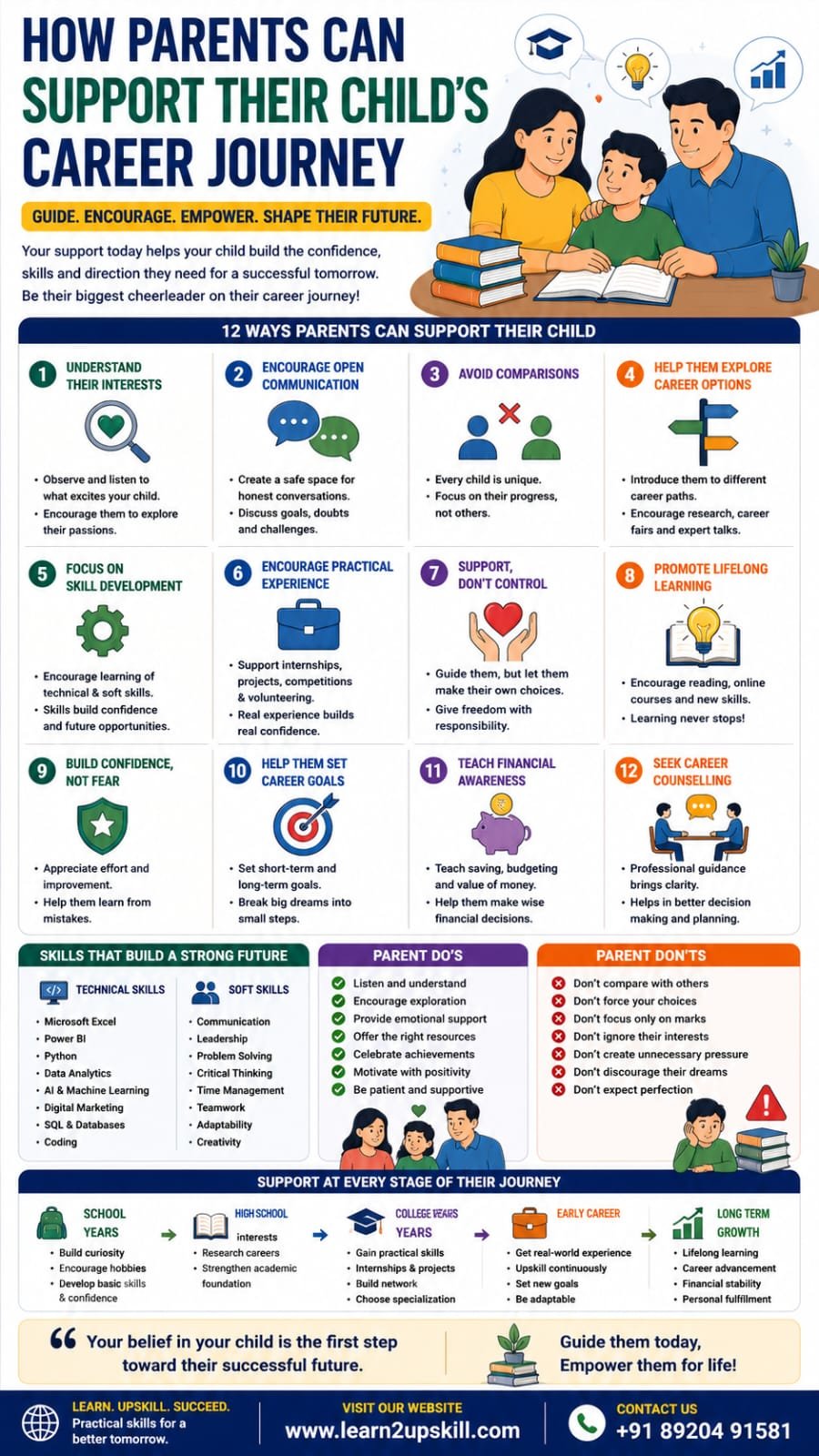
  • How Parents Can Support Their Child’s Career Journey

    How Parents Can Support Their Child’s Career Journey

    How Parents Can Support Their Child’s Career Journey

    Learn how parents can support their child’s career journey through guidance, communication, skill development, and informed career planning without creating unnecessary pressure.

    Focus Keyword: How Parents Can Support Their Child’s Career Journey

    —

    How Parents Can Support Their Child’s Career Journey

    Every parent wants their child to have a bright, successful, and fulfilling future. However, today’s career landscape is more diverse and dynamic than ever before. Traditional professions are now joined by exciting opportunities in Artificial Intelligence, Data Analytics, Cybersecurity, Digital Marketing, Content Creation, UI/UX Design, Cloud Computing, and many other emerging fields.

    With so many choices, students often feel overwhelmed. During this stage, parents play one of the most influential roles in helping children discover their strengths, make informed decisions, and develop confidence in their career path.

    Supporting your child’s career journey isn’t about making decisions for them—it’s about empowering them with guidance, encouragement, and opportunities to grow.

    This guide explains how parents can effectively support their child’s career development while respecting their individuality.

    —

    Why Parents Play a Crucial Role

    Children often look to their parents for advice, reassurance, and motivation.

    Positive parental involvement can help students:

    – Build confidence

    – Explore career options

    – Develop valuable skills

    – Make informed decisions

    – Handle setbacks positively

    – Stay motivated

    – Build long-term career goals

    When parents become supportive mentors rather than decision-makers, children are more likely to succeed.

    —

    Step 1: Understand Your Child’s Interests

    Every child is unique.

    Some enjoy:


    – Mathematics

    – Science

    – Art

    – Technology

    – Writing

    – Sports

    – Business

    – Design

    – Music

    – Problem-solving

    Observe what naturally excites your child instead of assuming that one career fits everyone.

    Ask questions like:

    – What subjects do you enjoy the most?

    – What activities make you feel excited?

    – What kind of problems do you enjoy solving?

    – What do you imagine yourself doing in the future?

    Listening carefully is the first step toward meaningful guidance.

    —

    Step 2: Encourage Open Communication

    Create an environment where your child feels comfortable discussing:

    – Career dreams

    – Doubts

    – Challenges

    – Academic concerns

    – Future goals

    Avoid judging or dismissing their ideas immediately.

    Instead, have regular conversations about possibilities and help them explore options together.

    —

    Step 3: Avoid Comparing Your Child with Others

    Comparison can reduce confidence and increase anxiety.

    Avoid statements such as:

    – “Your cousin already knows what career to choose.”

    – “Your friend scored higher than you.”

    Instead, focus on your child’s personal growth and achievements.

    Every student’s journey is different.

    —

    Step 4: Help Them Explore Career Options

    Many students only know about a few traditional careers.

    Introduce them to emerging fields such as:

    Technology

    – Software Development

    – Data Analytics

    – Artificial Intelligence

    – Cybersecurity

    – Cloud Computing

    Business

    – Marketing

    – Human Resources

    – Business Analysis

    – Entrepreneurship

    Creative Careers

    – Graphic Design

    – UI/UX Design

    – Video Editing

    – Animation

    – Content Creation

    Healthcare

    – Medicine

    – Nursing

    – Physiotherapy

    – Medical Technology

    Encourage research, webinars, workshops, career fairs, and informational interviews.

    —

    Step 5: Focus on Skill Development

    Today’s employers value practical skills as much as academic qualifications.

    Encourage your child to learn:

    Technical Skills

    – Microsoft Excel

    – Power BI

    – Python

    – SQL

    – Artificial Intelligence (AI)

    – Digital Marketing

    – Coding

    – Data Analytics

    Soft Skills

    – Communication

    – Leadership

    – Teamwork

    – Time Management

    – Problem Solving

    – Critical Thinking

    – Adaptability

    Practical skills improve confidence and employability.

    —

    Step 6: Encourage Practical Experience

    Learning extends beyond the classroom.

    Help your child gain experience through:

    – Internships

    – Volunteer work

    – Personal projects

    – Competitions

    – Freelancing

    – Workshops

    – Online certifications

    Real-world experience helps students understand what they enjoy and build stronger resumes.

    —

    Step 7: Support Without Controlling

    Guidance is helpful.

    Control is not.

    Instead of saying:

    “You must become an engineer.”

    Try:

    “Let’s explore different careers together and see what matches your interests and strengths.”

    Children perform better when they feel ownership over their decisions.

    —

    Step 8: Teach the Importance of Lifelong Learning

    The job market changes rapidly.

    Help your child understand that learning doesn’t stop after school or college.

    Encourage:

    – Reading books

    – Taking online courses

    – Learning new software

    – Following industry trends

    – Building new skills regularly

    Continuous learning prepares students for future opportunities.

    —

    Step 9: Build Confidence, Not Fear

    Fear-based motivation may produce short-term results but can reduce long-term confidence.

    Instead:

    – Celebrate effort.

    – Appreciate improvement.

    – Encourage resilience.

    – Treat mistakes as learning opportunities.

    Confidence grows when children feel supported.

    —

    Step 10: Help Them Set Career Goals

    Teach your child how to set achievable goals.

    Short-Term Goals

    – Complete an Excel course.

    – Improve communication skills.

    – Participate in a competition.

    Medium-Term Goals

    – Complete an internship.

    – Build a portfolio.

    – Earn certifications.

    Long-Term Goals

    – Secure a job in a chosen field.

    – Pursue higher education.

    – Start a business.

    Breaking large ambitions into smaller goals makes progress more manageable.

    —

    Step 11: Teach Financial Awareness

    Introduce basic concepts such as:

    – Budgeting

    – Saving

    – Scholarships

    – Education expenses

    – Career investment

    Financial literacy helps students make informed decisions about education and career planning.

    —

    Step 12: Seek Career Counselling When Needed

    Professional career counselling can help students:

    – Identify strengths

    – Explore suitable careers

    – Understand aptitude

    – Set realistic goals

    – Develop career roadmaps

    Counselling complements parental guidance and offers objective insights.

    —

    Common Mistakes Parents Should Avoid

    Avoid:

    – Choosing a career on behalf of your child.

    – Comparing them with others.

    – Focusing only on marks.

    – Ignoring their interests.

    – Discouraging new career options.

    – Expecting perfection.

    – Dismissing creative or unconventional careers without proper research.

    —

    Final Thoughts

    A successful career begins with encouragement, exploration, and continuous learning. As a parent, your role is not to choose your child’s future but to help them discover it with confidence.

    By listening, encouraging skill development, exposing them to different career opportunities, and supporting informed decision-making, you can help your child build a fulfilling and successful career.

    Remember, every child has a unique path. With patience, guidance, and the right opportunities, they can achieve their goals and adapt to the ever-changing world of work.

    At Learn2Upskill, we are dedicated to helping students and parents navigate career decisions through expert guidance and practical training in Microsoft Excel, Data Analytics, Power BI, Python, Artificial Intelligence, Digital Marketing, and other industry-relevant skills.

    Why Choose Learn2Upskill?

    – Personalized career guidance

    – Practical, job-oriented training

    – Industry-expert mentors

    – Hands-on projects

    – Skill-based learning

    – Career-focused programs


    Visit: www.coral-kudu-326218.hostingersite.com

    Contact Us: +91 89204 91581

    Support Their Dreams Today. Shape Their Success Tomorrow.