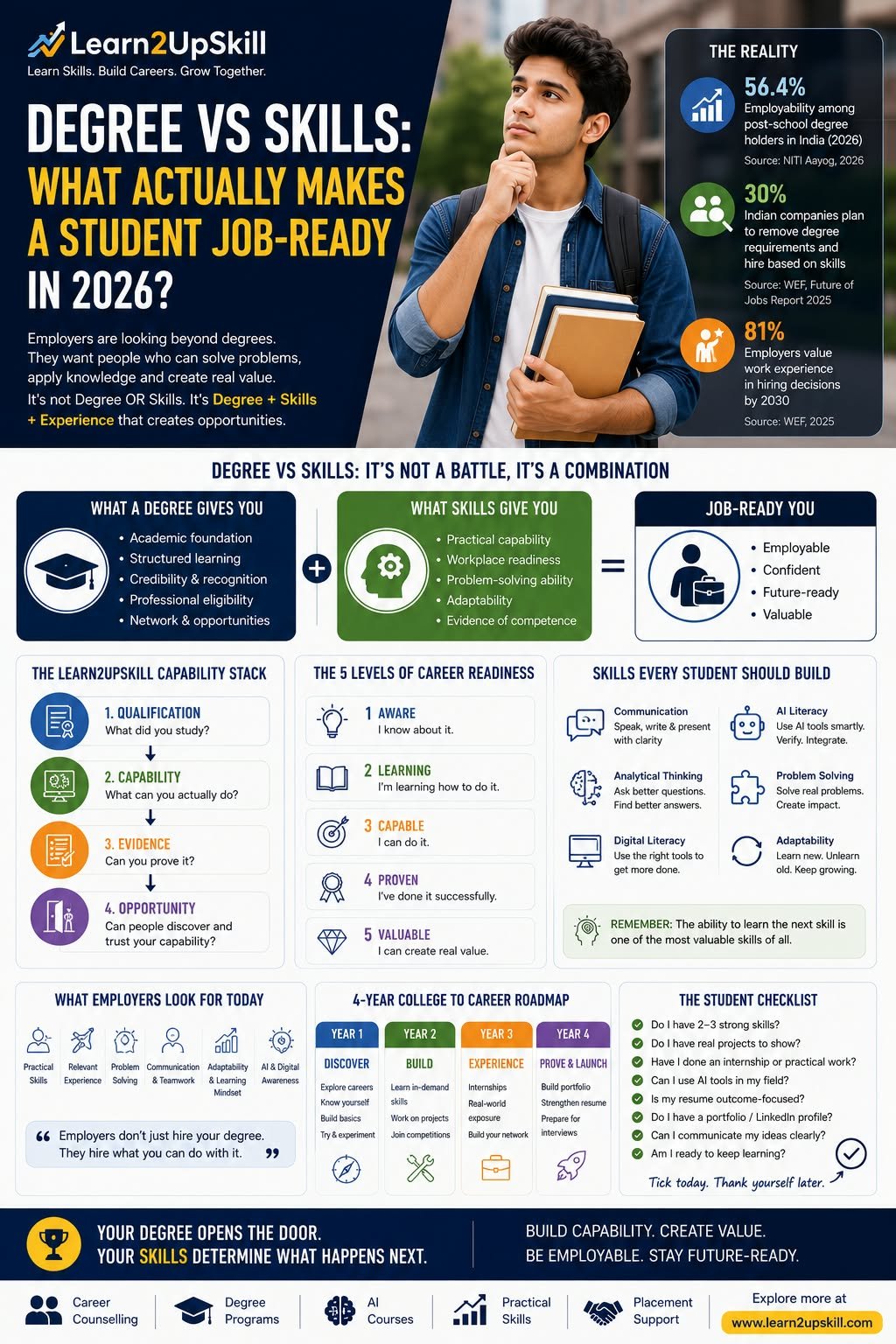
Degree vs Skills: What Actually Makes a Student Job-Ready in 2026?
The answer isn’t “degree or skills.” It’s what you can do with both.
Imagine this.
Two students walk into the same interview.
Both have respectable degrees.
Both have similar marks.
Both have completed their college education.
The interviewer asks:
«“Tell me something you have actually built, solved or improved.”»
Student A starts talking about subjects studied.
Student B opens a laptop.
«“Here is the dashboard I built.”»
«“Here is the marketing campaign I worked on.”»
«“Here is the analysis I completed.”»
«“Here is the project I built during my internship.”»
Suddenly, the conversation changes.
The question is no longer:
“What did you study?”
It becomes:
«“What can you do?”»
And that may be one of the most important questions for students entering the workforce in 2026.
—
The Degree vs Skills Debate Is Asking the Wrong Question
For years, the debate has sounded like this:
Team Degree
«“Without a degree, you won’t get anywhere.”»
Team Skills
«“Degrees don’t matter anymore. Skills are everything.”»
Both statements are incomplete.
A degree can provide:
– academic foundation
– structured learning
– credibility
– professional eligibility
– exposure
– networks
– opportunities for higher education
Skills can provide:
– practical capability
– adaptability
– workplace readiness
– problem-solving ability
– productivity
– evidence of competence
So the real question isn’t:
Degree OR Skills?
It is:
Degree + Skills + Experience = Stronger Employability
And that distinction matters.
—
The Reality Behind the Numbers
India’s employability story is improving, but there is still a gap between education and workplace readiness.
A 2026 NITI Aayog working paper reports that employability among post-school degree holders—including polytechnic graduates—rose from 47.3% in 2019 to 56.4% in 2026. The same analysis notes scope for improving pedagogy, practical learning and industry exposure.
That number tells us something important.
Millions of students are earning qualifications.
But qualification and employability are not the same thing.
And that is precisely where skills become important.
—
The Hiring World Is Changing Too
The shift isn’t happening only inside classrooms.
Employers are changing how they look for talent.
The World Economic Forum’s Future of Jobs Report 2025 says 81% of businesses expect work experience to remain a hiring assessment mechanism through 2030, while 48% expect to use skills assessments. University degrees remain important, but the report also describes growing recognition of skills-first hiring.
For India specifically, the WEF reports that 30% of companies expect removing degree requirements and using skills-based hiring to help address talent needs, compared with 19% globally. It also identifies Big Data Specialists, AI and Machine Learning Specialists, and Security Management Specialists among India’s fastest-growing roles.
LinkedIn’s 2025 skills-based hiring research likewise found that applying skills-first approaches can substantially expand the potential talent pool in India.
So something important is happening.
The hiring conversation is slowly moving from:
«“Where did you study?”»
toward:
«“What can you contribute?”»
Not everywhere.
Not for every profession.
But enough to matter.
—
Here’s the Career Mistake We Need to Stop Making
Students are often told:
«“Get good marks.”»
Then:
«“Get into a good college.”»
Then:
«“Get your degree.”»
Then:
«“You’ll get a good job.”»
But there is a missing middle.
What happens between the degree and the job?
That’s where employability is built.
Think of it as a bridge.
One side:
Education
Other side:
Employment
The bridge:
Skills + Experience + Projects + Communication + Adaptability + Visibility
Without the bridge, students may find themselves standing on one side with a qualification and wondering why the other side feels so far away.
—
The Learn2UpSkill “Capability Stack”
Here’s a framework I want students to remember.
Qualification → Capability → Evidence → Opportunity
- Qualification
What did you study?
Your degree, diploma or formal education.
- Capability
What can you actually do?
Your technical and professional skills.
- Evidence
Can you prove it?
Projects, internships, portfolio, achievements and real-world work.
- Opportunity
Can someone discover and trust your capability?
Resume, LinkedIn, networking, interviews and professional visibility.
This is the journey from:
«“I have a degree.”»
to:
«“I can create value.”»
—
Your Degree Is the Map. Skills Are the Ability to Travel.
Here’s another way to think about it.
A degree is like a map.
It gives you:
– direction
– concepts
– frameworks
– foundational knowledge
But a map doesn’t move you forward.
You still need:
skills
practice
experience
judgement
adaptability
Think of a student studying finance.
The degree may teach:
– accounting
– economics
– financial management
– taxation
– business concepts
Excellent.
Now add:
– Excel
– data analysis
– financial modelling
– AI tools
– presentation
– business communication
Then add:
– internship
– project
– portfolio
Now the student has something much more powerful.
Academic knowledge + practical capability.
—
The “Certificate Collector” Trap
This deserves a warning.
A student completes:
Certificate 1
Then:
Certificate 2
Then:
Certificate 3
Then:
Certificate 7
And proudly says:
«“I have seven certifications.”»
But the interviewer asks:
«“What have you done with those skills?”»
Silence.
Certificates can be useful.
They can demonstrate structured learning.
But a certificate should be the beginning of application, not the end.
Instead of asking:
«“How many certificates do I have?”»
ask:
«“What can I demonstrate because I completed them?”»
One strong project can sometimes tell a better story than several certificates sitting unused on a resume.
—
The 5 Levels of Career Readiness
Let’s make this simple.
LEVEL 1 — AWARE
“I know about it.”
You understand the concept.
—
LEVEL 2 — LEARNING
“I’m learning how to do it.”
You are building the skill.
—
LEVEL 3 — CAPABLE
“I can do it.”
You can complete tasks independently.
—
LEVEL 4 — PROVEN
“I’ve done it successfully.”
You have projects, internships or outcomes demonstrating the skill.
—
LEVEL 5 — VALUABLE
“I can use it to solve a real problem.”
This is where employability becomes powerful.
The journey isn’t:
Degree → Job
It is:
Learn → Practise → Apply → Prove → Create Value
—
So What Skills Should Students Actually Build?
Not every student needs the same skills.
That’s important.
A student shouldn’t blindly collect whatever skill is trending on social media.
Instead:
Start with the career direction.
Then identify the skills that support it.
But several broad capabilities are becoming increasingly useful across professions.
—
- Communication
You can be technically brilliant.
If you cannot explain your thinking, your value may remain invisible.
Students should practise:
– speaking
– writing
– presentations
– professional email
– storytelling
– active listening
– explaining complex ideas simply
Communication isn’t just an HR skill.
It is a career multiplier.
—
- Analytical Thinking
Employers don’t only need people who can follow instructions.
They need people who can ask:
«“What is actually happening here?”»
and:
«“Why?”»
and:
«“What should we do next?”»
Analytical thinking is valuable across:
– finance
– marketing
– technology
– operations
– HR
– consulting
– healthcare
– entrepreneurship
—
- Digital Literacy
Every profession is becoming more digital.
Students should understand the tools relevant to their field.
That might include:
– spreadsheets
– collaboration platforms
– data tools
– presentation tools
– digital marketing platforms
– analytics
– cloud tools
– automation
You don’t need to know everything.
You need to know what matters for your career.
—
- AI Literacy
This is becoming impossible to ignore.
But AI literacy doesn’t mean:
«“I know how to ask ChatGPT questions.”»
It means understanding:
– how AI works at a practical level
– where it can help
– where it can fail
– how to verify outputs
– how to use AI responsibly
– how to integrate AI into workflows
– how to combine AI with professional judgement
The goal isn’t:
AI instead of your profession.
It is:
AI + your profession
—
- Problem-Solving
This may be one of the most valuable skills of all.
Companies don’t hire people simply because they know things.
They hire people who can help solve problems.
A student should practise asking:
«What is the problem?»
«What is causing it?»
«What information do I need?»
«What options exist?»
«What would I recommend?»
«How would I measure the result?»
That is the beginning of professional thinking.
—
- Adaptability
The job you enter in 2030 may not look exactly like the job described today.
Technology changes.
Industries change.
Business models change.
Customer behaviour changes.
The people who remain employable are often those who can keep learning.
The WEF continues to highlight resilience, flexibility, creative thinking and lifelong learning alongside technological capabilities as important workplace skills.
So perhaps one of the most valuable skills is:
«The ability to learn the next skill.»
—
The AI + Human Advantage
There is a dangerous misunderstanding about AI.
Some students think:
«“AI will replace me.”»
Others think:
«“AI is just a tool. I don’t need to worry about it.”»
Both can be problematic.
The stronger mindset is:
«“I will become good at my profession and learn how AI can make me better at it.”»
Imagine:
Accountant + AI
Faster analysis and reporting.
Marketer + AI
Faster research, ideation and experimentation.
HR professional + AI
More efficient information processing and workflow support.
Data analyst + AI
Faster exploration and interpretation.
Designer + AI
Faster ideation and iteration.
Entrepreneur + AI
More leverage with limited resources.
The winning combination may increasingly be:
Domain Expertise + AI Literacy + Human Judgement
—
Don’t Become “AI Guy” Without Becoming Good at Something
This is important.
A student tells an interviewer:
«“I know ChatGPT, Gemini, Copilot and several AI tools.”»
The interviewer asks:
«“Excellent. What can you do with them?”»
That’s the real question.
AI is not a profession by itself for everyone.
It is increasingly becoming a capability layer across professions.
So don’t just learn:
AI tools.
Learn:
AI + Marketing
AI + Finance
AI + HR
AI + Data
AI + Education
AI + Design
AI + Operations
That’s where the opportunity becomes more meaningful.
—
The Project Test
Here’s a simple test for students.
Suppose you say:
«“I know digital marketing.”»
Can you build a campaign?
Suppose you say:
«“I know Excel.”»
Can you analyse a business dataset?
Suppose you say:
«“I know AI.”»
Can you improve a real workflow?
Suppose you say:
«“I know Python.”»
Can you build something useful?
Suppose you say:
«“I know finance.”»
Can you analyse a company’s financial performance?
If the answer is yes:
you are moving from knowledge to capability.
—
Build “Proof of Skill”
This is one of the biggest changes students can make.
For every important skill, ask:
What is my proof?
Excel
Build a dashboard.
Digital Marketing
Run a campaign.
Data Analytics
Analyse data and present insights.
Coding
Build an application.
Design
Create a portfolio.
AI
Automate or improve a workflow.
Communication
Present something publicly.
Business
Build a business case.
Now your resume becomes much stronger.
Because you aren’t merely saying:
«“I know this.”»
You’re saying:
«“Here is what I did.”»
—
What Should a Student Do During College?
Here’s the Learn2UpSkill Capability Calendar.
Year 1 — DISCOVER
Explore careers.
Identify interests.
Learn digital fundamentals.
Improve communication.
Try different areas.
—
Year 2 — BUILD
Choose 2–3 relevant skills.
Complete meaningful projects.
Learn AI relevant to your field.
Participate in competitions.
—
Year 3 — EXPERIENCE
Intern.
Freelance.
Volunteer.
Work on real-world projects.
Build your network.
—
Year 4 — PROVE
Strengthen your resume.
Build your portfolio.
Practise interviews.
Create professional visibility.
Target relevant opportunities.
—
What Should Parents Tell Their Children?
Not:
«“Just get a good degree.”»
Instead:
«“Get a good education—and learn how to use it.”»
Not:
«“Just get good marks.”»
Instead:
«“Get good marks and build useful capabilities.”»
Not:
«“Do what everyone else is doing.”»
Instead:
«“Understand where your strengths and opportunities intersect.”»
And perhaps most importantly:
«“Don’t be afraid to experiment.”»
A student who discovers the wrong career direction during college has gained valuable information.
A professional who discovers it ten years later may face a much harder transition.
—
What Employers Should See
Imagine your future resume.
Instead of:
BBA — XYZ University
Certificate — Digital Marketing
Certificate — AI
Certificate — Excel
Try:
BBA — XYZ University
Digital Marketing: Planned and executed a student-led campaign.
Analytics: Built an Excel dashboard analysing campaign performance.
AI: Designed an AI-assisted content workflow that reduced repetitive research work.
Experience: Marketing internship with XYZ company.
Portfolio: Three projects demonstrating campaign, analytics and AI-assisted workflows.
Same degree.
Completely different story.
—
The New Career Currency
For decades, one of the strongest signals was:
Degree.
Today, degree still matters.
But the career conversation is increasingly adding:
Skills
Experience
Evidence
Adaptability
AI literacy
Problem-solving
Communication
So perhaps the new career currency isn’t one thing.
It’s a combination.
Knowledge + Capability + Evidence + Adaptability
That is what makes someone increasingly valuable.
—
The Most Important Question Students Should Ask
Not:
«“What salary will I get?”»
Not:
«“Which course is trending?”»
Not:
«“Which college is famous?”»
Not even:
«“Which degree has the highest scope?”»
Start with:
“What problems do I want to become good at solving?”
That question changes everything.
Because careers are ultimately built around problems.
Businesses have problems.
Customers have problems.
Society has problems.
Technology creates problems—and opportunities.
The people who can understand problems, learn quickly and create useful solutions will continue to have opportunities.
—
The Learn2UpSkill 4-Part Career Test
Before graduation, every student should be able to answer:
- WHAT DO I KNOW?
My academic foundation.
- WHAT CAN I DO?
My practical skills.
- WHAT HAVE I DONE?
My projects and experience.
- WHAT VALUE CAN I CREATE?
My ability to solve real problems.
If you can answer all four confidently, you are moving toward genuine employability.
—
Degree vs Skills: The Final Answer
So, which is more important?
Degree or skills?
The answer is:
Neither one is enough by itself for most students.
A degree can give you the foundation.
Skills help you apply it.
Experience teaches you how the real world works.
Projects create evidence.
AI literacy gives you another layer of leverage.
Communication helps you make your value visible.
Adaptability helps you stay relevant.
And continuous learning keeps the whole system moving.
So don’t choose between:
Degree OR Skills.
Build:
Degree + Skills + Experience + AI + Evidence
That is a much stronger career equation.
—
Don’t Graduate With a Question Mark
Imagine your final day of college.
You receive your degree.
You take the photographs.
You celebrate with your family.
And then Monday arrives.
The world asks:
«“So, what can you do?”»
Your degree is one answer.
But it shouldn’t be your only answer.
You should be able to say:
«“I can analyse.”»
«“I can communicate.”»
«“I can build.”»
«“I can solve.”»
«“I can use AI responsibly.”»
«“I have experience.”»
«“Here is my work.”»
«“And I’m ready to keep learning.”»
That’s what job readiness looks like.
—
Your Degree Opens the Door. Your Capability Determines What Happens Next.
A degree matters.
Never underestimate it.
But don’t stop there.
Build skills.
Get experience.
Create projects.
Learn AI.
Develop communication.
Build your professional identity.
Stay curious.
Keep upgrading.
Because the goal of education shouldn’t simply be:
«“I have a qualification.”»
The bigger goal is:
«“I am capable.”»
And that’s the difference between graduating and becoming career-ready.
Learn Skills. Build Careers. Grow Together.
At Learn2UpSkill, we believe students should not have to choose between education and employability.
The future belongs to people who can learn, apply, adapt and grow.
Start building that future today.
—
Frequently Asked Questions
Is a degree more important than skills?
A degree and skills serve different purposes. A degree can provide academic foundation and credentials, while skills demonstrate practical capability. For many careers, combining both provides a stronger foundation.
Can skills replace a degree?
In some roles and industries, skills-first hiring is expanding. However, many professions still require formal qualifications, and degrees remain important for numerous career paths. Students should understand the requirements of their target profession rather than assume one approach works everywhere.
What are the most important employability skills for students?
Useful employability skills can include communication, analytical thinking, problem-solving, digital literacy, AI literacy, teamwork, adaptability and profession-specific technical skills.
How can students become job-ready before graduation?
Students can build job readiness by developing relevant skills, completing projects, gaining internships, learning AI tools relevant to their profession, building portfolios, networking and practising interviews.
Are certificates enough to get a job?
Certificates can demonstrate learning, but they are stronger when supported by practical application and evidence. Employers may want to understand what you can actually do with the knowledge.
Should every college student learn AI?
AI literacy is becoming increasingly useful across many professions. Students do not necessarily need to become AI engineers, but understanding how AI can support their chosen field can be valuable.
What is skills-based hiring?
Skills-based hiring is an approach where employers place greater emphasis on candidates’ demonstrated abilities and competencies rather than relying exclusively on formal qualifications or traditional career signals.
—
Suggested URL:
“/degree-vs-skills-job-ready-students/”
Leave a Reply