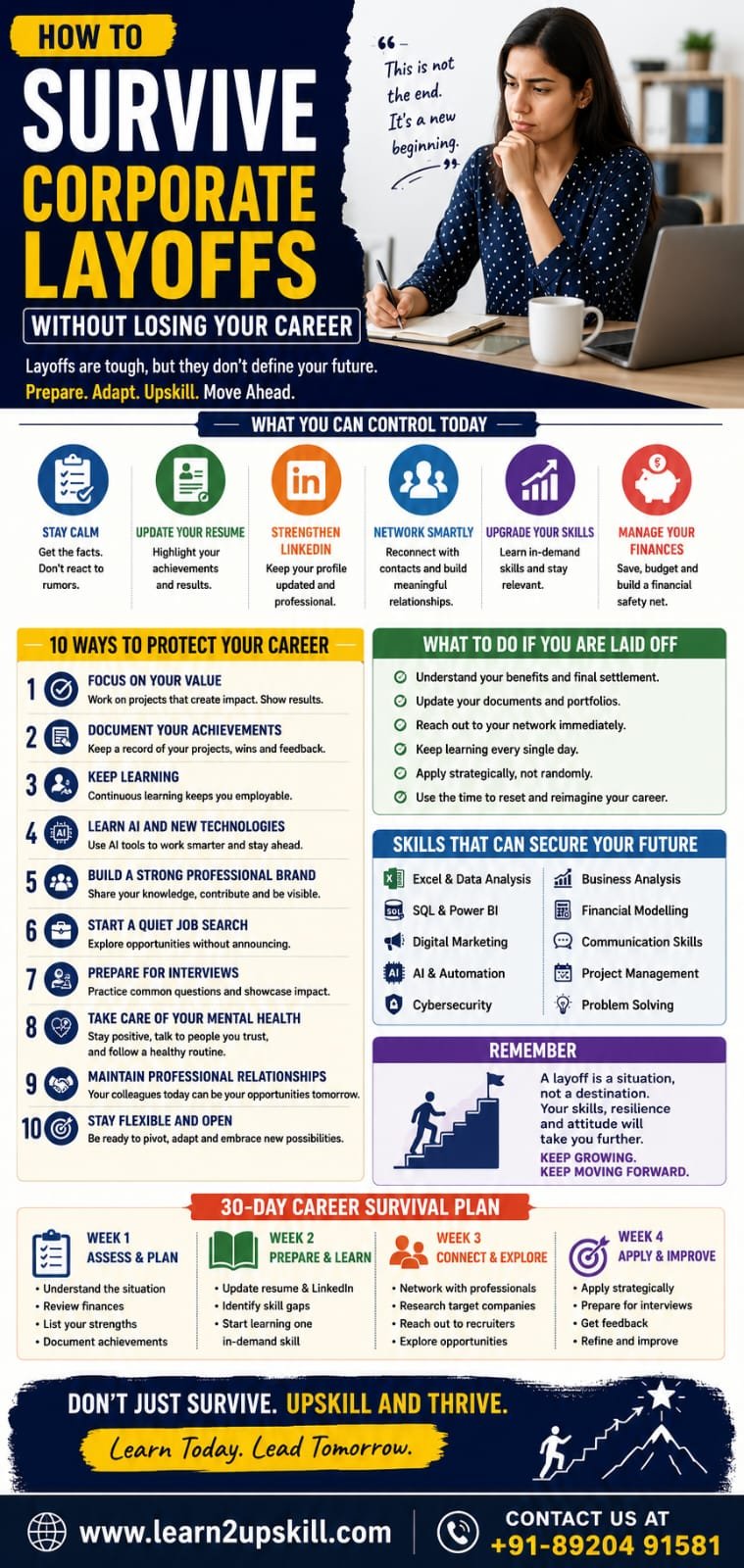
How to Survive Corporate Layoffs Without Losing Your Career
Meta Title: How to Survive Corporate Layoffs Without Losing Your Career
Meta Description: Worried about corporate layoffs? Learn how to protect your career, finances, professional reputation, skills, and future opportunities during layoffs and restructuring.
—
How to Survive Corporate Layoffs Without Losing Your Career
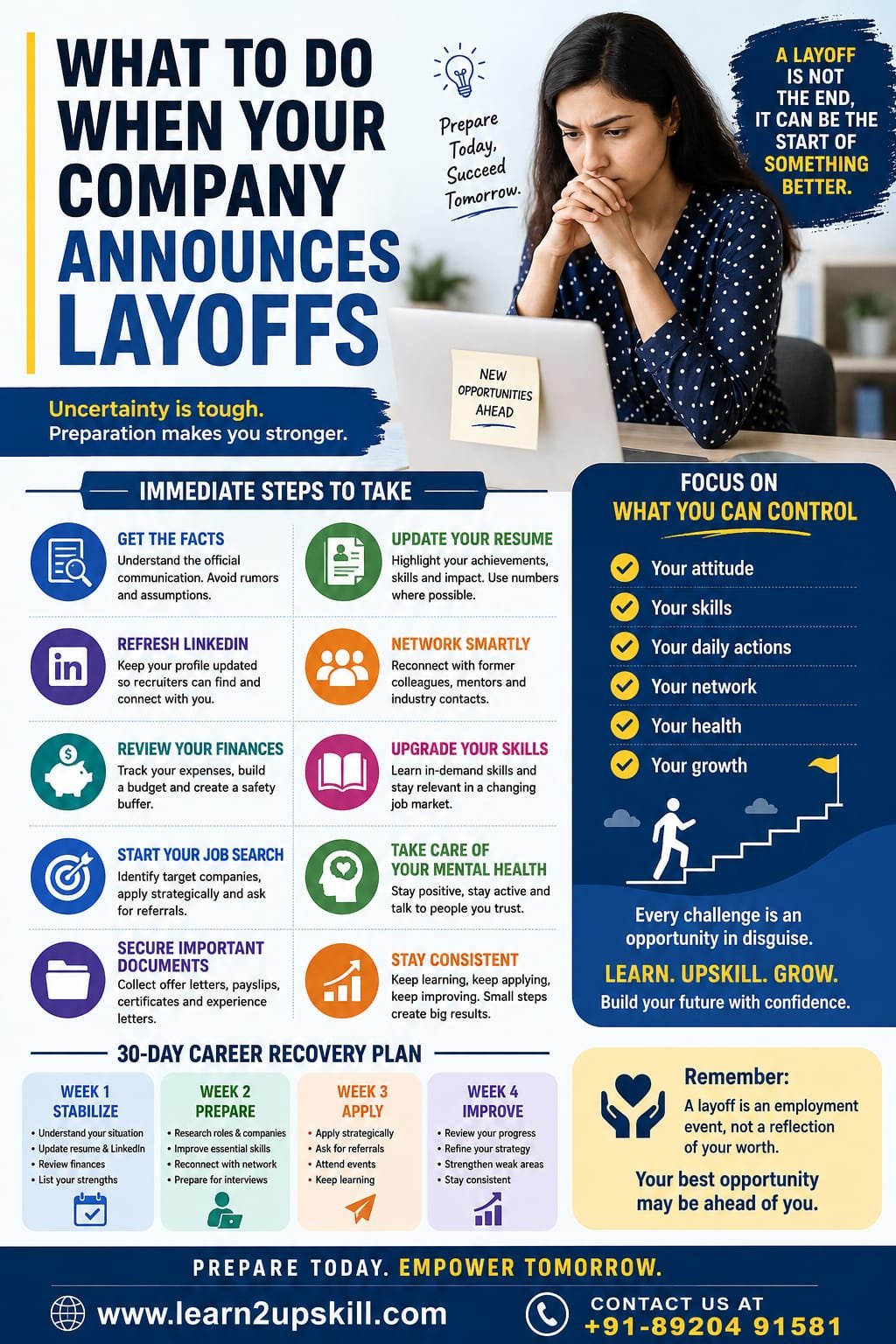
Corporate layoffs can be frightening.
One day, everything seems normal. The next day, your company announces restructuring, cost-cutting, or workforce reductions. Suddenly, employees begin wondering who will stay, who will leave, and what will happen next.
Even if your job is safe today, the uncertainty can affect your confidence and productivity.
You may start asking yourself:
– “Will I be next?”
– “Should I start looking for another job?”
– “Will a layoff damage my career?”
– “What skills should I learn?”
– “How can I stay financially prepared?”
– “What should I tell recruiters if I lose my job?”
The good news is that a corporate layoff does not have to derail your career.
Companies go through restructuring for many reasons, including changing market conditions, declining revenue, mergers, automation, business strategy, or cost reduction. Being affected by a layoff is not necessarily a reflection of your talent or performance.
The key is to prepare early and respond strategically.
This guide explains how to survive corporate layoffs while protecting your career and positioning yourself for your next opportunity.
—
- Understand That a Layoff Is Not the End of Your Career
The first step is psychological.
A job is important, but it is not your entire professional identity.
If your company eliminates your position, it doesn’t erase:
– Your experience
– Your skills
– Your knowledge
– Your achievements
– Your professional relationships
– Your industry experience
– Your ability to learn and adapt
Thousands of professionals experience layoffs during their careers and go on to find new roles, change industries, start businesses, freelance, or move into better positions.
Instead of thinking:
«“My career is over.”»
Try thinking:
«“This is a difficult career transition, and I need a plan.”»
That small change in mindset can help you make better decisions.
—
- Don’t Make Decisions Based on Workplace Rumors
When layoffs are announced, rumors can spread faster than official information.
Someone may say:
«“The entire department is going.”»
Another person may say:
«“Only people with low performance will be removed.”»
Someone else may claim:
«“The company is shutting down.”»
Don’t make important career or financial decisions based on speculation.
Look for official communication from:
– HR
– Senior management
– Your manager
– Company announcements
– Written employment documents
Get the facts before reacting.
At the same time, don’t use uncertainty as an excuse to do nothing.
Stay calm, but start preparing.
—
- Become More Valuable in Your Current Role
If layoffs are being discussed but your position hasn’t been affected, focus on demonstrating your value.
Ask yourself:
“What problems do I solve for my company?”
Employees who can clearly demonstrate business impact are better positioned to communicate their value.
Focus on:
– Important projects
– Revenue-generating activities
– Cost reduction
– Customer satisfaction
– Process improvement
– Productivity
– Technology adoption
– Team leadership
– Business-critical responsibilities
For example, instead of saying:
«“I prepare monthly reports.”»
You could demonstrate:
«“I automated monthly reporting and reduced the reporting process from two days to four hours.”»
The second statement clearly communicates business value.
—
- Document Your Achievements
Don’t wait until your last day to remember what you accomplished.
Create a personal career achievement record.
Include:
– Major projects
– Awards
– Promotions
– Certifications
– Performance achievements
– Problems you solved
– Processes you improved
– Revenue you helped generate
– Costs you helped reduce
– Teams you supported
– Positive feedback
Use numbers whenever possible.
For example:
Weak:
«Managed customer support.»
Stronger:
«Managed customer support operations for 500+ customers while improving response times and maintaining service quality.»
These achievements can later become powerful resume bullet points and interview stories.
—
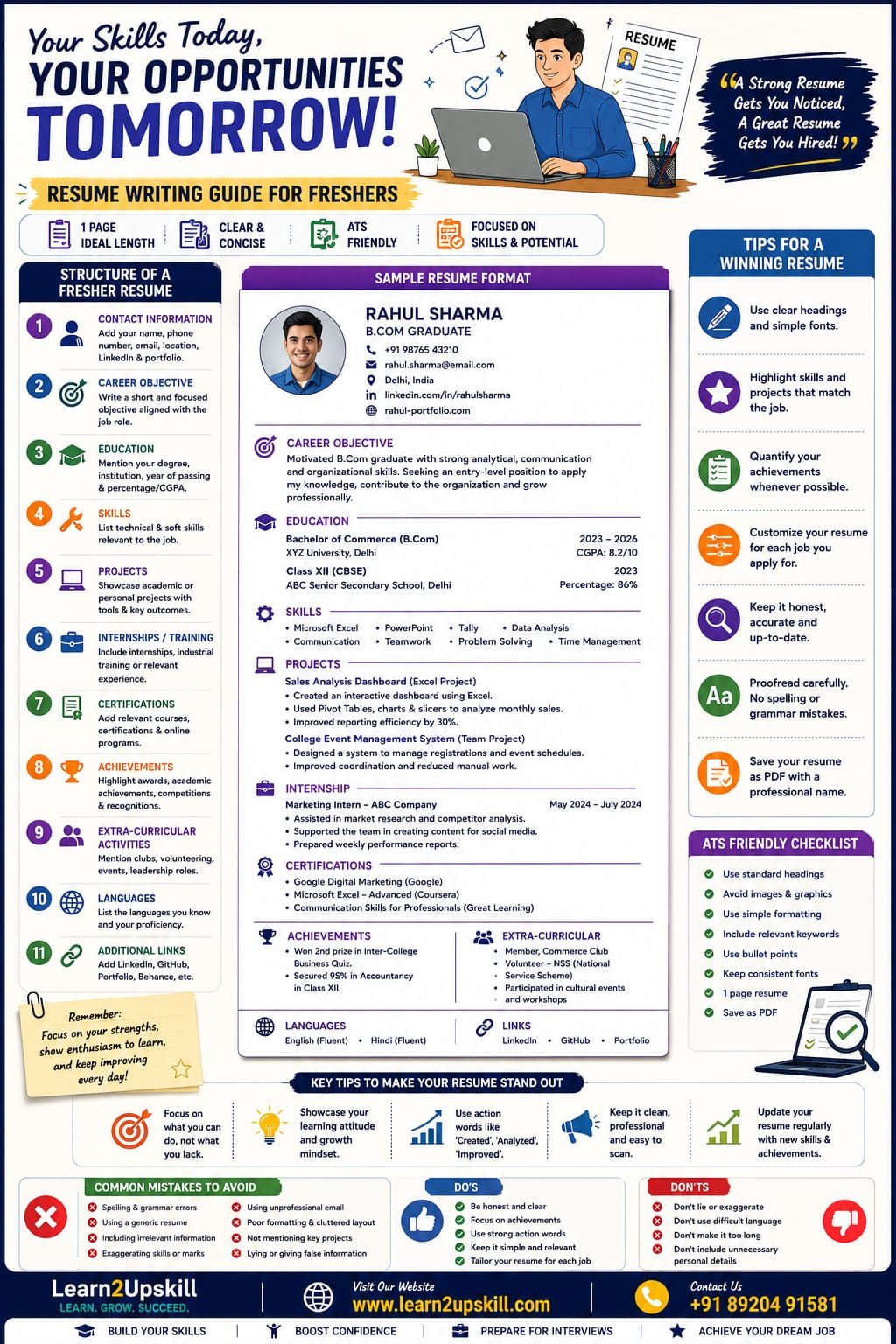
- Update Your Resume Before You Need It
One of the biggest career mistakes is waiting until you lose your job before updating your resume.
If layoffs are happening, update it now.
Your resume should communicate three things quickly:
What do you do?
Your professional role or specialization.
What are you good at?
Your key skills.
What results have you achieved?
Your measurable accomplishments.
Don’t turn your resume into a list of responsibilities.
Recruiters want to understand your contribution.
—
- Strengthen Your LinkedIn Presence
Your LinkedIn profile can become an important career asset during uncertain times.
Make sure it includes:
– A professional photograph
– A clear headline
– Updated work experience
– Relevant skills
– Certifications
– Projects
– Achievements
– A strong About section
Your headline should be specific.
Instead of:
«“Professional | Looking for Opportunities”»
Consider:
«“Business Analyst | Excel, SQL & Power BI | Data-Driven Business Insights”»
This makes it easier for recruiters and professional contacts to understand your expertise.
—
- Build Your Professional Network Before You Need It
Networking is much easier when you are employed than when you urgently need a job.
Don’t wait until you’re laid off to contact everyone you know.
Reconnect gradually with:
– Former colleagues
– College classmates
– Previous managers
– Clients
– Mentors
– Industry professionals
– Recruiters
– Professional communities
You don’t need to ask everyone for a job.
Simply stay connected.
Share useful information, congratulate people on their achievements, participate in professional discussions, and occasionally check in with former colleagues.
A strong network can open doors that job portals cannot.
—
- Build an Emergency Financial Buffer
Career survival and financial survival are closely connected.
If your income suddenly stops, financial pressure can force you to accept an unsuitable job.
That’s why an emergency fund matters.
Review your monthly expenses and determine how much money you need for essential costs.
Prioritize:
– Housing
– Food
– Utilities
– Education
– Insurance
– Transportation
– Loan payments
– Other essential commitments
Temporarily reduce unnecessary expenses if your job situation is uncertain.
The objective isn’t to panic about money.
It’s to create financial breathing room.
If you have savings available, you may have more flexibility to search for a suitable opportunity rather than accepting the first offer you receive.
—
- Understand Your Employment Benefits
If layoffs become a possibility, review your employment documents.
Understand your:
– Notice period
– Salary structure
– Leave balance
– Insurance coverage
– Bonus conditions
– Retirement-related benefits
– Provident fund procedures, where applicable
– Stock or equity arrangements, if applicable
– Experience and relieving letter procedures
– Final settlement process
If the company provides a separation or severance document, read it carefully.
If you don’t understand a clause, ask HR for clarification or seek professional advice where appropriate.
Employment rights and benefits depend on your country, state, employment contract, and circumstances.
Don’t rely on advice from colleagues or social media when dealing with important employment documents.
—
- Upgrade Skills That Increase Your Employability
One of the best ways to protect your career is to remain employable.
Ask:
«“If I had to apply for a new job tomorrow, would my current skills be competitive?”»
Look at current job descriptions in your industry.
Identify skills employers repeatedly request.
Depending on your career, these might include:
Business & Analytics
– Advanced Excel
– SQL
– Power BI
– Data visualization
– Business analysis
– AI productivity tools
Digital Marketing
– SEO
– Google Ads
– Social media marketing
– Analytics
– Content strategy
– AI-assisted marketing
Finance
– Financial modelling
– Advanced Excel
– Power BI
– Data analytics
– Business intelligence
– AI tools for finance
Technology
– Cloud computing
– Cybersecurity
– Data analytics
– AI
– Automation
– Software development
Don’t attempt to learn everything.
Choose one or two skills that are relevant to your target career and build genuine competence.
—
- Learn to Work With AI
AI is changing how many organizations operate.
Instead of viewing AI only as a threat, learn how to use it as a productivity tool.
Depending on your profession, AI can help with:
– Research
– Data analysis
– Writing
– Presentations
– Brainstorming
– Customer service
– Marketing
– Reporting
– Automation
– Administrative tasks
The valuable skill isn’t simply knowing the name of an AI tool.
It’s knowing how to use AI responsibly to produce better business outcomes.
For example, an employee who can use AI to reduce repetitive work, analyze information faster, and improve productivity may become more valuable to an organization.
At the same time, always review AI-generated information and follow your employer’s rules regarding confidential data and approved tools.
—
- Don’t Stop Performing Just Because You’re Worried
This can be difficult.
When employees become anxious about layoffs, their productivity can sometimes decline.
They may think:
«“Why should I work so hard if I might be laid off anyway?”»
But maintaining professionalism is important.
Continue to:
– Meet deadlines
– Communicate clearly
– Support colleagues
– Complete important projects
– Document your work
– Maintain professional relationships
Even if you eventually leave the company, your reputation can follow you.
Your manager may become a future reference.
Your colleague may work at your next company.
Your client may recommend you for an opportunity.
Never underestimate the long-term value of a professional reputation.
—
- Prepare for Multiple Career Scenarios
Don’t create only one plan.
Create three.
Plan A: I stay with the company
Focus on:
– Increasing your value
– Taking on meaningful projects
– Building skills
– Growing your internal network
Plan B: I am laid off
Focus on:
– Financial stability
– Job searching
– Networking
– Skill development
– Interview preparation
Plan C: I decide to change direction
Consider:
– Career change
– Freelancing
– Consulting
– Entrepreneurship
– Further education
– Remote work
– A different industry
Having multiple possibilities can reduce the feeling that everything depends on one outcome.
—
- Start a Quiet Job Search
If your company is going through significant restructuring, you can begin exploring the market without announcing that you’re leaving.
Research:
– Companies hiring in your field
– Salary ranges
– Required skills
– Job titles
– Career progression
– Industry trends
Set up job alerts.
Update your resume.
Connect with recruiters.
Apply selectively to relevant opportunities.
You don’t necessarily need to quit.
Preparation is not betrayal.
It’s responsible career planning.
—
- Prepare Your Layoff Explanation
If you are eventually laid off, don’t feel ashamed.
A simple and professional explanation is usually enough.
For example:
«“My previous company went through a restructuring and my position was impacted as part of the workforce reduction. I’m now looking for an opportunity where I can use my experience in [field] and continue growing professionally.”»
Then move the conversation toward your skills and achievements.
Avoid:
– Blaming your manager
– Criticizing the company
– Sharing confidential information
– Complaining about colleagues
– Giving a long emotional explanation
Recruiters generally want to know what happened and whether you’re ready for the next opportunity.
—
- Protect Your Professional Reputation
During a layoff, emotions can run high.
You may feel angry, disappointed, or betrayed.
That’s understandable.
But think carefully before posting about your employer publicly.
Avoid angry LinkedIn posts, social media arguments, or sharing confidential information.
You never know who may see your post.
Instead, leave professionally whenever possible.
Thank people who supported you.
Stay connected with good colleagues.
Ask for recommendations from people who know your work.
Your final impression matters.
—
- Take Care of Your Mental Health
Career uncertainty can affect your confidence.
You may compare yourself with colleagues who kept their jobs.
You may worry about your future.
You may feel embarrassed about telling friends or relatives.
Remember:
A company decision does not determine your personal worth.
Maintain a healthy routine.
Exercise.
Sleep properly.
Spend time with people you trust.
Limit excessive doom-scrolling and constant checking of workplace rumors.
If stress becomes overwhelming or starts interfering significantly with daily life, consider speaking ith a qualified mental-health professional.
—
- Don’t Let a Layoff Stop Your Learning
One of the biggest risks after a layoff is losing momentum.
A person may spend weeks applying for jobs without improving their skills.
Instead, combine job searching with learning.
For example:
2 hours: Job applications
1 hour: Networking
1–2 hours: Skill development
30 minutes: Interview preparation
This approach keeps you moving forward.
Even if the job search takes longer than expected, you’re becoming more capable during the process.
—
- Consider a Career Pivot
A layoff can sometimes reveal that you were already ready for a change.
Perhaps you’ve wanted to move:
– From administration to business analysis
– From traditional marketing to digital marketing
– From finance operations to financial analytics
– From HR administration to HR analytics
– From manual reporting to data analytics
– From a general role to a specialized role
A career pivot requires planning.
Research the target role.
Identify skill gaps.
Take relevant courses.
Build practical projects.
Update your resume.
Network with professionals in the new field.
Don’t make a sudden career decision based solely on fear.
Make it based on research and preparation.
—
- Build Your Career Around Skills, Not Just Job Titles
Job titles can disappear.
Skills remain transferable.
For example, someone working as an “Operations Executive” may have developed:
– Data analysis
– Customer management
– Process improvement
– Reporting
– Team coordination
– Problem-solving
Those skills can potentially transfer into other roles.
This is why you should regularly ask:
«“What skills am I building through my current job?”»
The stronger your transferable skills, the easier it becomes to adapt when the job market changes.
—
Your 30-Day Corporate Layoff Survival Plan
Here’s a simple action plan you can follow.
Week 1: Assess
– Understand the official situation.
– Review your employment documents.
– Calculate your essential expenses.
– Identify your strongest skills.
– Start documenting achievements.
Week 2: Prepare
– Update your resume.
– Refresh LinkedIn.
– Research target roles.
– Identify skill gaps.
– Begin learning one relevant skill.
Week 3: Connect
– Reconnect with former colleagues.
– Contact professional connections.
– Speak with recruiters.
– Ask for referrals where appropriate.
– Join relevant professional communities.
Week 4: Act
– Apply for suitable positions.
– Practice interviews.
– Continue learning.
– Review your progress.
– Improve your job-search strategy.
Don’t measure success only by the number of job offers.
Measure progress by the actions you control.
—
Common Mistakes to Avoid During Corporate Layoffs
- Panicking
Fear can lead to poor decisions.
- Believing every rumor
Always verify important information.
- Waiting until the last day
Start preparing early.
- Ignoring your finances
Understand your financial runway.
- Stopping skill development
The job market rewards adaptability.
- Burning professional bridges
Your network may help you later.
- Taking rejection personally
Job searches can take time.
- Applying randomly
Focus on relevant opportunities.
- Sharing confidential information
Protect your professional reputation.
- Giving up on yourself
A difficult career transition isn’t the same as career failure.
—
Final Thoughts: Your Career Is Bigger Than One Company
Corporate layoffs can be painful, but they don’t have to define your career.
The professionals who navigate uncertainty successfully aren’t necessarily the ones who never face setbacks.
They are often the ones who learn how to adapt, prepare, communicate, and keep developing their skills.
Your company may change.
Your role may change.
The economy may change.
Technology may change.
But your ability to learn and adapt can continue to grow.
So if your company has announced layoffs, don’t wait for the worst-case scenario.
Start preparing today.
Update your resume.
Strengthen your network.
Protect your finances.
Upgrade your skills.
Learn AI.
Build your professional reputation.
Prepare for your next opportunity.
Because your career is not defined by one employer.
Your career is defined by the skills, experience, resilience, and choices you carry with you.
—
Quick Corporate Layoff Survival Checklist
– [ ] Get the facts from official sources.
– [ ] Assess your role and department.
– [ ] Document your achievements.
– [ ] Update your resume.
– [ ] Refresh your LinkedIn profile.
– [ ] Review your finances.
– [ ] Understand your employment benefits.
– [ ] Strengthen your professional network.
– [ ] Research target companies.
– [ ] Identify in-demand skills.
– [ ] Learn one valuable new skill.
– [ ] Learn how AI can improve your work.
– [ ] Prepare interview answers.
– [ ] Start a targeted job search.
– [ ] Maintain your professional reputation.
– [ ] Take care of your mental well-being.
– [ ] Keep learning even during a job transition.
—
Ready to Future-Proof Your Career?
The workplace is changing rapidly. Technology, AI, automation, and evolving business requirements are creating new opportunities—but they are also changing the skills employers expect.
At Learn2upskill, our goal is to help students, professionals, job seekers, and career changers develop practical skills for the modern workplace.
Explore learning opportunities in areas such as:
AI • Digital Marketing • Excel • Business Analysis • Cybersecurity • Data Skills • Professional Development
Don’t wait for a career crisis to start learning.
Learn. Upskill. Grow.
🌐 www.coral-kudu-326218.hostingersite.com
Contact Us: +91-89204 91581
—