Category: Carrer Growth and Counseling

  • Interview & Placement Preparation

    Interview & Placement Preparation

    Interview & Placement Preparation

    Introduction

    Getting placed in a good company is one of the biggest milestones in a student’s career. Whether you are preparing for campus placements, internships, or your first job interview, success depends on much more than academic performance. Companies today look for candidates who possess technical knowledge, communication skills, confidence, problem-solving ability, and a positive attitude.

    Interview and placement preparation is a continuous process that begins well before the interview date. With proper planning, consistent practice, and the right guidance, every student can improve their chances of securing a rewarding career.

    At Learn2Upskill, we help students become industry-ready through career counselling, personality development, communication skills, resume building, interview preparation, and professional grooming.

    —

    What Is Placement Preparation?

    Placement preparation is the process of developing the knowledge, skills, and confidence needed to successfully clear recruitment rounds and secure a job.

    It includes:

    – Resume building

    – Aptitude preparation

    – Technical knowledge

    – Communication skills

    – Group discussion practice

    – HR interview preparation

    – Mock interviews

    – Personality development

    – Professional etiquette

    – Time management

    A balanced preparation strategy ensures you are ready for every stage of the hiring process.

    —

    Why Is Placement Preparation Important?

    Proper preparation helps you:

    – Increase confidence.

    – Perform better in interviews.

    – Improve communication skills.

    – Build a professional resume.

    – Stand out among other candidates.

    – Reduce interview anxiety.

    – Increase your chances of getting selected.

    – Build a successful career.

    Preparation turns opportunities into success.

    —

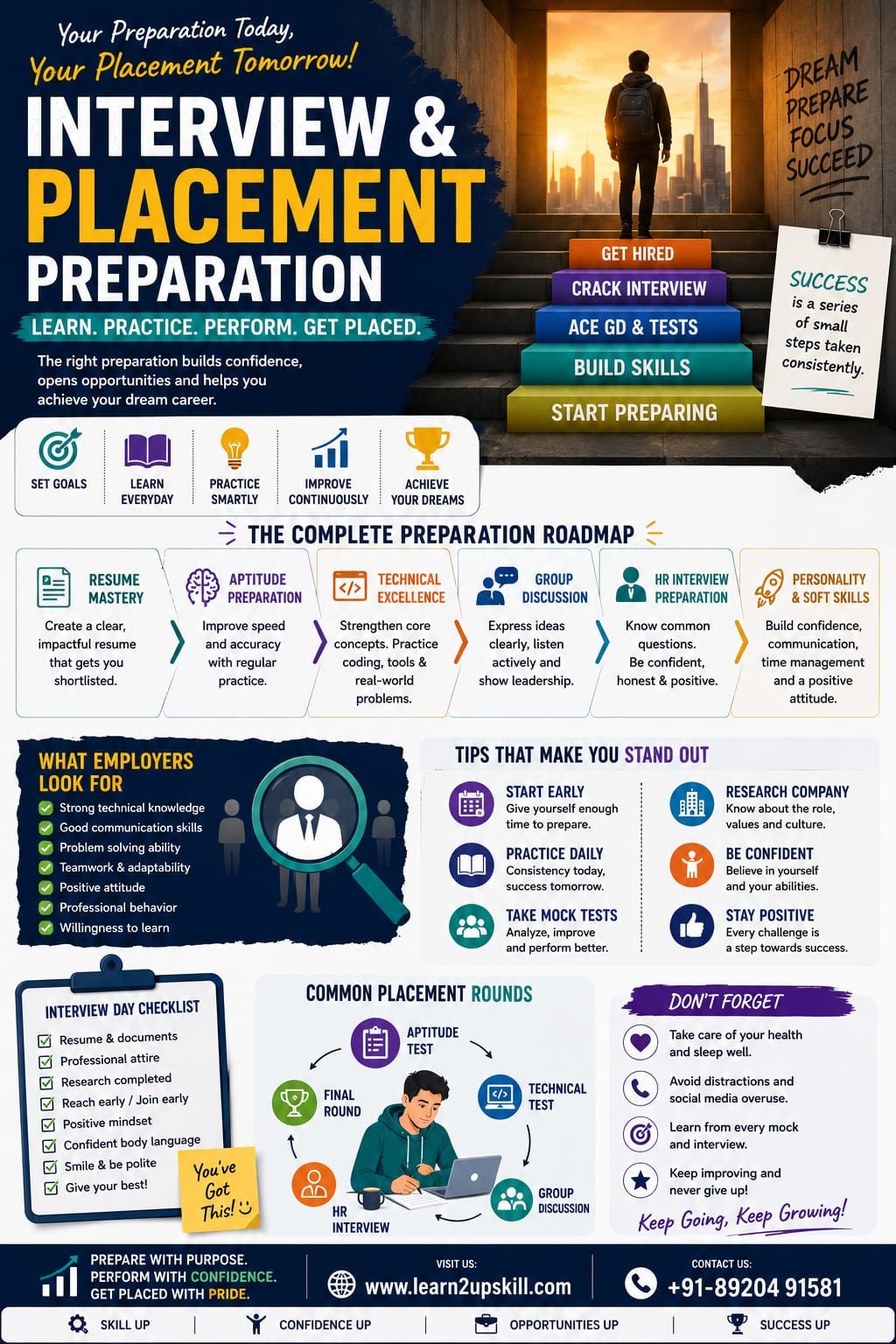
    Stages of the Recruitment Process

    Most companies follow these recruitment stages:

    1. Resume Screening

    Recruiters review your resume to shortlist candidates.

    1. Aptitude Test

    Tests may include:

    – Quantitative aptitude

    – Logical reasoning

    – Verbal ability

    – Data interpretation

    1. Technical Assessment

    Depending on the role, candidates may face coding tests, technical questions, or practical assignments.

    1. Group Discussion

    Companies assess:

    – Communication

    – Leadership

    – Teamwork

    – Listening skills

    – Confidence

    1. HR Interview

    The final stage focuses on personality, attitude, career goals, and cultural fit.

    Understanding the process helps you prepare effectively.

    —

    Step 1: Build a Professional Resume

    Your resume creates the first impression.

    Include:

    – Contact information

    – Career objective

    – Educational qualifications

    – Technical skills

    – Soft skills

    – Projects

    – Internships

    – Certifications

    – Achievements

    – Languages known

    Keep your resume clear, concise, and error-free.

    —

    Step 2: Improve Communication Skills

    Strong communication helps throughout the recruitment process.

    Practice:

    – Speaking confidently.

    – Active listening.

    – Professional vocabulary.

    – Public speaking.

    – Group discussions.

    – Presentation skills.

    Good communication builds confidence and trust.

    —

    Step 3: Develop Technical Skills

    Technical knowledge depends on your career field.

    Examples include:

    – Programming

    – Microsoft Excel

    – Data Analytics

    – Artificial Intelligence (AI)

    – Digital Marketing

    – Cybersecurity

    – Cloud Computing

    – Graphic Design

    – Financial Analysis

    Keep learning through online courses, projects, and certifications.

    —

    Step 4: Prepare for Aptitude Tests

    Practice regularly:

    – Percentage

    – Profit and Loss

    – Time and Work

    – Probability

    – Number Series

    – Logical Reasoning

    – Coding-Decoding

    – Reading Comprehension

    Daily practice improves speed and accuracy.

    —

    Step 5: Master Group Discussions

    During group discussions:

    – Speak confidently.

    – Respect others’ opinions.

    – Support your ideas with examples.

    – Avoid interrupting.

    – Listen actively.

    – Maintain positive body language.

    Leadership is demonstrated through collaboration, not domination.

    —

    Step 6: Prepare for HR Interviews

    Common HR questions include:

    – Tell me about yourself.

    – Why should we hire you?

    – What are your strengths?

    – What is one area you are working to improve?

    – Where do you see yourself in five years?

    – Why do you want to join our company?

    Practice your answers aloud to improve confidence.

    —

    Step 7: Work on Personality Development

    Employers value candidates who are:

    – Confident

    – Positive

    – Responsible

    – Adaptable

    – Honest

    – Professional

    – Team-oriented

    Personality development plays a major role in placement success.

    —

    Step 8: Build Professional Etiquette

    Professional behavior includes:

    – Dressing appropriately.

    – Arriving on time.

    – Being respectful.

    – Maintaining eye contact.

    – Using polite language.

    – Sending thank-you emails after interviews (where appropriate).

    Good etiquette leaves a lasting impression.

    —

    Step 9: Practice Mock Interviews

    Mock interviews help you:

    – Improve confidence.

    – Identify weak areas.

    – Reduce nervousness.

    – Improve body language.

    – Receive constructive feedback.

    Practice with mentors, teachers, or friends.

    —

    Step 10: Stay Updated

    Recruiters appreciate candidates who are aware of:

    – Industry trends

    – Emerging technologies

    – Company updates

    – Current affairs

    – Market developments

    Reading news and industry blogs daily helps you stay informed.

    —

    Common Placement Mistakes

    Avoid these common errors:

    – Poor resume formatting

    – Lack of preparation

    – Weak communication skills

    – Negative attitude

    – Arriving late

    – Inappropriate dressing

    – Lack of company research

    – Overconfidence

    – Poor body language

    – Giving up after one rejection

    Every interview is an opportunity to learn and improve.

    —

    Interview Day Checklist

    Before your interview:

    – ✔ Review your resume.

    – ✔ Research the company.

    – ✔ Carry all necessary documents.

    – ✔ Dress professionally.

    – ✔ Reach the venue early or join online on time.

    – ✔ Keep your phone on silent.

    – ✔ Maintain a positive attitude.

    – ✔ Stay calm and confident.

    Preparation reduces stress and boosts confidence.

    —

    Skills Employers Look For

    Recruiters value candidates who demonstrate:

    – Communication skills

    – Problem-solving ability

    – Teamwork

    – Leadership

    – Adaptability

    – Time management

    – Critical thinking

    – Emotional intelligence

    – Technical expertise

    – Willingness to learn

    Developing these skills gives you a competitive advantage.

    —

    Tips for Successful Placements

    – Start preparing early.

    – Build a strong LinkedIn profile.

    – Complete internships.

    – Earn industry-recognized certifications.

    – Participate in workshops and competitions.

    – Practice interviews regularly.

    – Stay consistent and disciplined.

    – Learn from every experience.

    Success is the result of preparation and perseverance.

    —

    Conclusion

    Interview and placement preparation is not just about clearing one interview—it is about building the skills and confidence needed for a successful career. By focusing on communication, technical knowledge, personality development, resume building, and interview practice, students can greatly improve their chances of getting hired.

    Stay committed to continuous learning, believe in yourself, and keep improving every day. Your dream job is within reach when preparation meets opportunity.

    At Learn2Upskill, we are committed to helping students become career-ready through expert guidance in career counselling, interview preparation, personality development, communication skills, resume writing, and placement training.

    —

    Contact Learn2Upskill

    Website: www.coral-kudu-326218.hostingersite.com

    Contact Us: +91-89204 91581

    Learn2Upskill – Learn. Grow. Succeed.
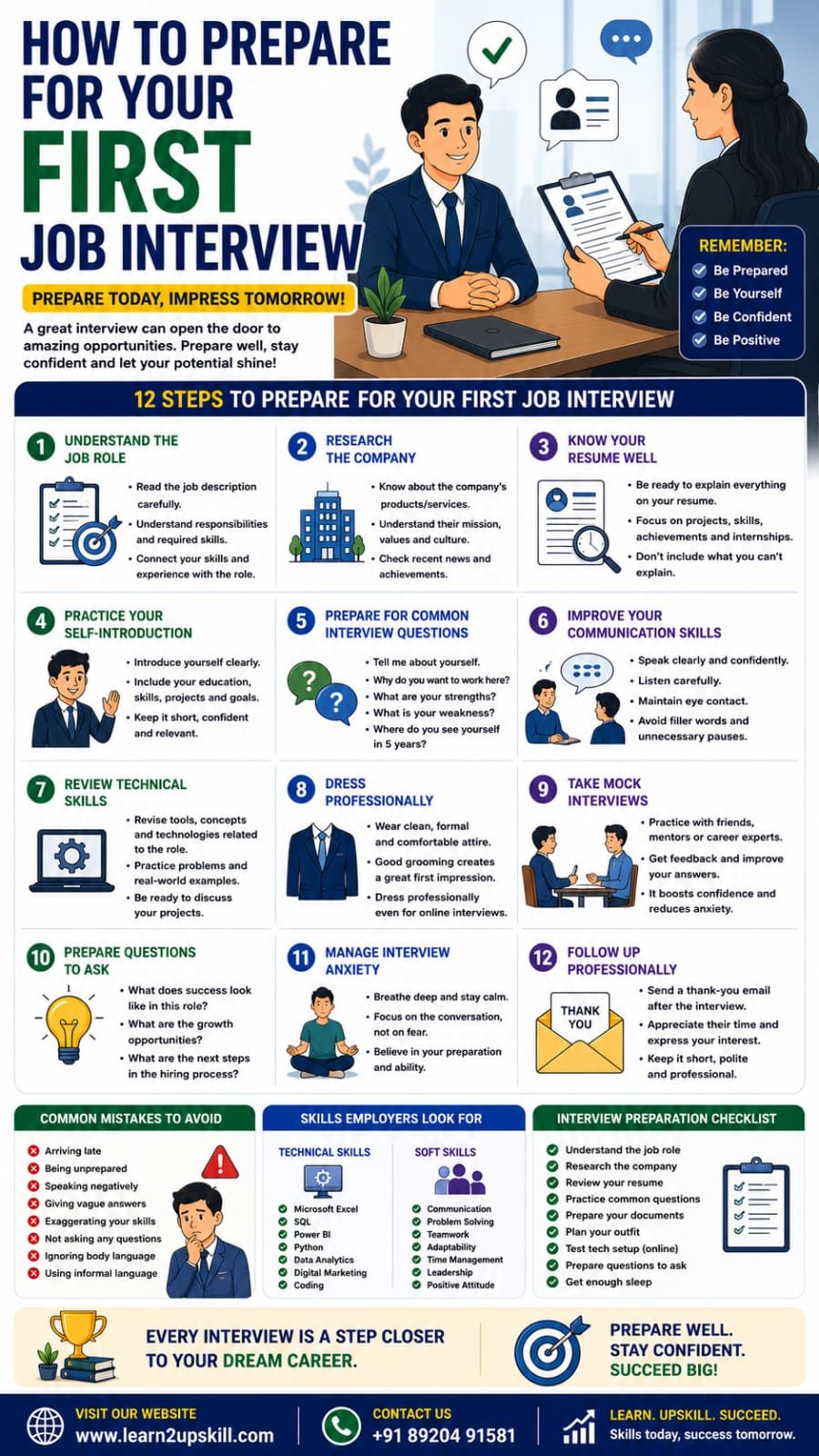
  • How to Prepare for Your First Job Interview

    How to Prepare for Your First Job Interview

    How to Prepare for Your First Job Interview

    Learn how to prepare for your first job interview with practical tips, common interview questions, resume advice, interview etiquette, and confidence-building strategies for students and freshers.

    Focus Keyword: How to Prepare for Your First Job Interview

    —

    How to Prepare for Your First Job Interview

    Your first job interview is an exciting milestone. It marks the beginning of your professional journey and gives you an opportunity to showcase your skills, personality, and potential.

    It’s completely normal to feel nervous before an interview. Most freshers worry about questions like:

    – What should I wear?

    – What questions will be asked?

    – How do I answer confidently?

    – What if I don’t know an answer?

    – How can I impress the interviewer?

    The good news is that interview success isn’t just about having the perfect answers—it’s about preparation, confidence, communication, and a positive attitude.

    This guide will help students and freshers prepare effectively for their first job interview.

    —

    Why Interview Preparation Matters

    A job interview allows employers to evaluate more than your qualifications.

    They want to understand:

    – Your communication skills

    – Problem-solving ability

    – Confidence

    – Attitude

    – Professionalism

    – Willingness to learn

    – Cultural fit

    Good preparation helps you present yourself clearly and confidently.

    —

    Step 1: Understand the Job Role

    Before attending any interview:

    – Read the job description carefully.

    – Understand the required skills.

    – Research the responsibilities.

    – Identify how your education and projects relate to the role.

    Tailoring your preparation to the specific position makes a strong impression.

    —

    Step 2: Research the Company

    Employers appreciate candidates who understand their organization.

    Learn about:

    – Company products or services

    – Mission and values

    – Industry

    – Recent achievements

    – Company culture

    Review the company’s website and professional social media profiles to gain a better understanding of its work.

    —

    Step 3: Know Your Resume Thoroughly

    Everything listed on your resume is fair game for discussion.

    Be ready to explain:

    – Education

    – Certifications

    – Projects

    – Internships

    – Technical skills

    – Achievements

    – Extracurricular activities

    Never include skills or experiences you cannot confidently discuss.

    —

    Step 4: Practice Your Self-Introduction

    One of the first questions is often:

    “Tell me about yourself.”

    A good introduction should include:

    – Your name

    – Educational background

    – Relevant skills

    – Academic or personal projects

    – Career interests

    – Why you’re excited about the opportunity

    Keep your introduction clear, concise, and focused on the role.

    —

    Step 5: Prepare for Common Interview Questions

    Some frequently asked questions include:

    Tell me about yourself.

    Why do you want to work here?

    What are your strengths?

    What is one area you are working to improve?

    Why should we hire you?

    Describe a challenge you overcame.

    Where do you see yourself in five years?

    Tell us about a project you worked on.

    Practice your responses, but avoid memorizing them word for word.

    —

    Step 6: Improve Communication Skills

    Interviewers value candidates who communicate clearly.

    Practice:

    – Speaking confidently

    – Maintaining eye contact (for in-person interviews)

    – Listening carefully

    – Answering concisely

    – Asking thoughtful questions

    Strong communication leaves a lasting impression.

    —

    Step 7: Review Technical Skills

    Depending on the role, refresh your knowledge of relevant tools and concepts.

    Examples include:

    Data Analytics

    Digital Marketing

    Review projects where you’ve applied these skills.

    —

    Step 8: Dress Professionally

    Your appearance contributes to the first impression.

    Choose:

    – Clean, professional clothing

    – Comfortable footwear

    – Minimal accessories

    – Neat grooming

    Even for virtual interviews, dress professionally from head to toe—it can help you feel more confident.

    —

    Step 9: Practice Mock Interviews

    Conduct practice interviews with:

    – Friends

    – Family members

    – Mentors

    – Career counselors

    Mock interviews help you:

    – Improve confidence

    – Identify weak areas

    – Refine answers

    – Receive constructive feedback

    —

    Step 10: Prepare Questions for the Interviewer

    At the end of many interviews, you’ll be asked:

    “Do you have any questions for us?”

    Consider asking:

    – What does success look like in this role?

    – What learning opportunities are available?

    – What does the onboarding process involve?

    – How does the team collaborate?

    Thoughtful questions demonstrate genuine interest.

    —

    Step 11: Manage Interview Anxiety

    Feeling nervous is normal.

    Try these strategies:

    – Prepare thoroughly.

    – Practice deep breathing before the interview.

    – Arrive early or log in ahead of time.

    – Focus on sharing your knowledge rather than being perfect.

    – Remember that the interview is also your chance to evaluate the company.

    Confidence grows with preparation.

    —

    Step 12: Follow Up Professionally

    After the interview, send a polite thank-you email if appropriate.

    Express appreciation for the interviewer’s time and reaffirm your interest in the role.

    A professional follow-up can leave a positive impression.

    —

    Common Interview Mistakes to Avoid

    Avoid these common mistakes:

    – Arriving late

    – Speaking negatively about previous employers or teachers

    – Interrupting the interviewer

    – Giving vague answers

    – Exaggerating your skills

    – Forgetting to research the company

    – Ignoring body language

    – Not asking any questions

    – Using informal language in a professional setting

    —

    Skills Employers Look For

    Employers value candidates who demonstrate:

    Technical Skills

    Soft Skills

    These qualities often make a strong impression, even for entry-level roles.

    —

    Virtual Interview Tips

    Many first interviews now take place online.

    Before the interview:

    – Test your internet connection.

    – Check your camera and microphone.

    – Choose a quiet, well-lit location.

    – Close unnecessary applications.

    – Keep your resume and notes nearby.

    – Maintain eye contact by looking at the camera when speaking.

    —

    Interview Preparation Checklist

    Before your interview, make sure you have:

    – Reviewed the job description

    – Researched the company

    – Practiced common questions

    – Updated your resume

    – Prepared your documents

    – Planned your outfit

    – Tested your technology (for online interviews)

    – Prepared thoughtful questions

    – Gotten enough sleep the night before

    —

    Frequently Asked Questions (FAQs)

    How long should I prepare for my first interview?

    Ideally, begin preparing several days in advance. Focus on understanding the role, researching the company, reviewing your resume, and practicing interview questions.

    What if I don’t know the answer to a question?

    Stay calm and honest. Explain your thought process or related knowledge instead of guessing or pretending to know something you don’t.

    Is confidence more important than technical knowledge?

    Both matter. Employers often look for candidates who combine relevant skills with a positive attitude, communication abilities, and a willingness to learn.

    Should freshers ask questions during the interview?

    Yes. Asking thoughtful questions about the role, team, or learning opportunities shows genuine interest and engagement.

    —

    Final Thoughts

    Your first interview is not about being perfect—it’s about showing your potential. Employers understand that freshers are still learning. They value candidates who are prepared, curious, professional, and eager to grow.

    With consistent preparation, practice, and confidence, you can make a strong impression and increase your chances of landing your first job.

    Remember, every interview is also a learning experience. Even if one opportunity doesn’t work out, the experience will help you perform better in the next one.

    At Learn2Upskill, we help students and freshers become job-ready through practical training, career guidance, interview preparation, and industry-focused courses in Microsoft Excel, Power BI, Python, Data Analytics, Artificial Intelligence, Digital Marketing, and more.

    Visit: www.coral-kudu-326218.hostingersite.com

    Contact Us: +91 89204 91581

    Prepare with Confidence. Interview with Impact. Start Your Career with Learn2Upskill.

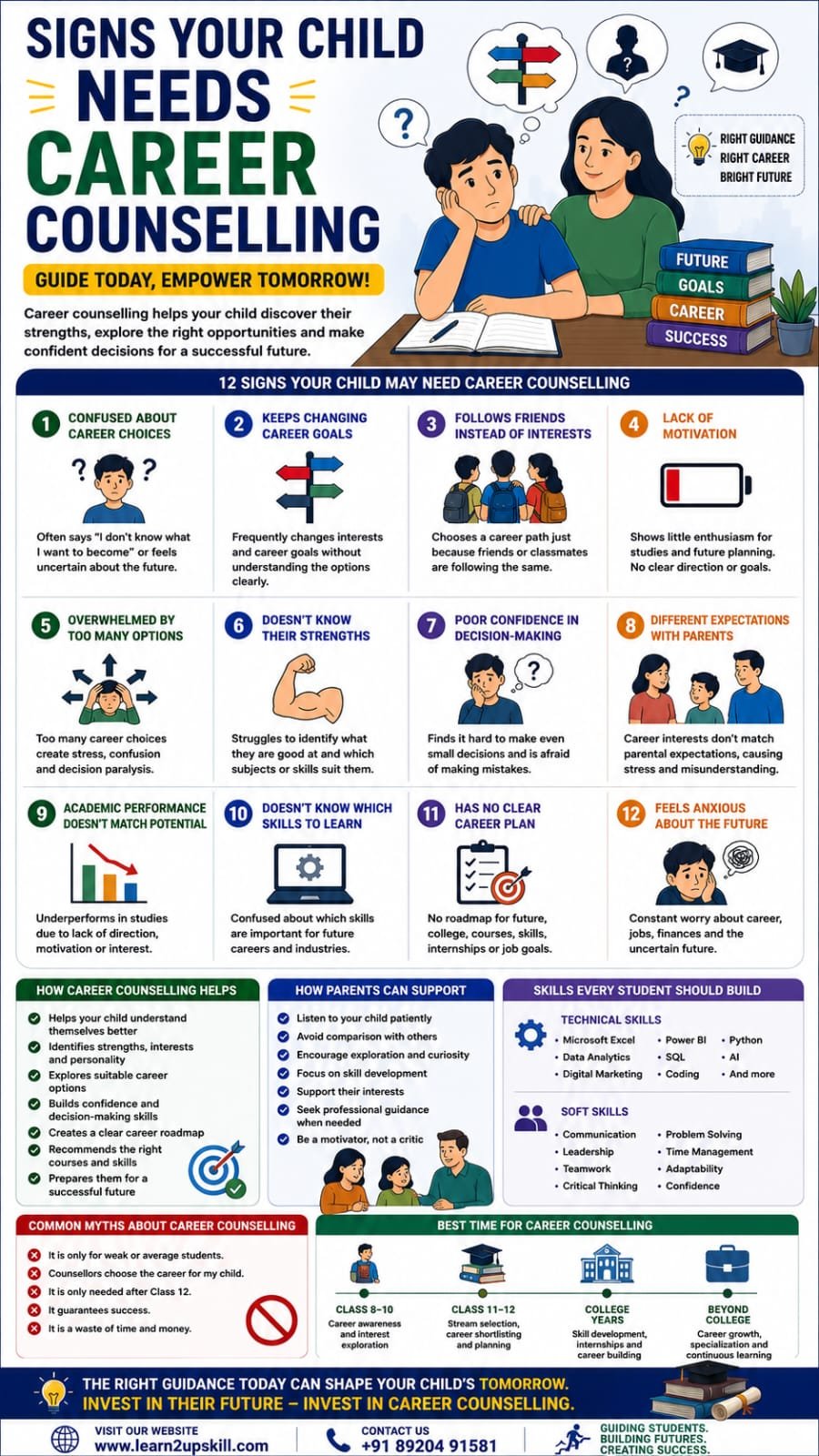
  • Signs Your Child Needs Career Counselling

    Signs Your Child Needs Career Counselling

    Signs Your Child Needs Career Counselling

    Learn the common signs that your child may need career counselling. Discover how career guidance helps students choose the right career path, reduce confusion, and build a successful future.

    Focus Keyword: Signs Your Child Needs Career Counselling

    —

    Signs Your Child Needs Career Counselling

    Every parent wants their child to have a successful and fulfilling career. However, with thousands of career options, changing industry demands, and increasing competition, many students feel overwhelmed when deciding what to do after school or college.

    Career counselling provides structured guidance that helps students understand themselves, explore career options, and make informed decisions based on their interests, abilities, and goals.

    But how do you know when your child actually needs career counselling?

    In this guide, we’ll discuss the most common signs, the benefits of career counselling, and how parents can support their children through this important stage of life.

    —

    What Is Career Counselling?

    Career counselling is a professional process that helps students:

    – Discover their interests

    – Identify strengths and abilities

    – Understand personality traits

    – Explore suitable career options

    – Choose the right courses

    – Set career goals

    – Build confidence in decision-making

    It is not about choosing a career for the student—it is about helping them make informed and confident choices.

    —

    Why Career Counselling Is Important Today

    The career landscape has changed dramatically in recent years. In addition to traditional careers, students now have opportunities in:

    – Artificial Intelligence

    – Data Analytics

    – Cybersecurity

    – Digital Marketing

    – UI/UX Design

    – Cloud Computing

    – Content Creation

    – Entrepreneurship

    – Healthcare

    – Finance

    – Environmental Sciences

    With so many choices, students often need guidance to identify the options that best match their interests and strengths.

    —

    Sign 1: Your Child Is Confused About Career Choices

    One of the biggest indicators is uncertainty.

    Your child may frequently say:

    – “I don’t know what I want to become.”

    – “Every career sounds interesting.”

    – “I’m scared of choosing the wrong field.”

    – “I keep changing my mind.”

    Career counselling can help bring clarity through structured exploration and planning.

    —

    Sign 2: They Keep Changing Career Goals

    One week they want to become an engineer.

    Next month they want to become a designer.

    Later they want to start a business.

    Changing interests is natural, especially during adolescence. However, if your child frequently switches career goals without understanding what each path involves, counselling can help them make more informed decisions.

    —

    Sign 3: They Follow Friends Instead of Their Interests

    Many students choose careers simply because:

    – Their friends selected them.

    – Their classmates are preparing for the same entrance exams.

    – They fear missing out.

    Career decisions should be based on individual strengths, interests, and long-term aspirations—not peer pressure.

    —

    Sign 4: Lack of Motivation

    If your child:

    – Shows little enthusiasm for studies.

    – Doesn’t seem interested in future planning.

    – Avoids discussing career topics.

    It may be because they don’t yet see a meaningful connection between their education and future opportunities.

    Career counselling can help students discover goals that motivate them.

    —

    Sign 5: They Feel Overwhelmed by Career Options

    Today’s students can choose from hundreds of career paths.

    Too many choices can lead to:

    – Stress

    – Decision paralysis

    – Anxiety

    – Self-doubt

    A counsellor helps narrow down options based on the student’s profile and aspirations.

    —

    Sign 6: They Don’t Know Their Strengths

    Many students struggle to answer questions such as:

    – What am I good at?

    – What are my natural talents?

    – Which subjects suit me best?

    Career counselling often includes self-assessment activities that help students better understand their strengths and areas for growth.

    —

    Sign 7: Poor Confidence in Decision-Making

    Students may hesitate to make decisions because they fear making mistakes.

    You might notice:

    – Constantly asking others what they should do.

    – Difficulty making even small academic choices.

    – Worrying excessively about the future.

    Counselling can help build confidence and decision-making skills.

    —

    Sign 8: Parents and Child Have Different Career Expectations

    Sometimes parents prefer one career path while the child prefers another.

    Examples:

    – Engineering vs. Design

    – Medicine vs. Business

    – Government Job vs. Entrepreneurship

    Career counselling provides an objective space to discuss options and align expectations based on the student’s interests and abilities.

    —

    Sign 9: Academic Performance Doesn’t Match Potential

    A bright student may underperform if they lack direction or motivation.

    Career counselling can help students:

    – Set meaningful goals.

    – Improve focus.

    – Understand how their current studies relate to future opportunities.

    —

    Sign 10: They Don’t Know Which Skills to Learn

    Students often ask:

    – Should I learn coding?

    – Is Excel important?

    – Should I study AI?

    – Is Digital Marketing a good career?

    – Do I need communication skills?

    Career counselling helps prioritize skills based on the student’s chosen career path.

    —

    Sign 11: They Have No Career Plan

    If your child has never thought about:

    – Career goals

    – College choices

    – Skill development

    – Internships

    – Certifications

    It may be time to create a structured career roadmap.

    —

    Sign 12: They Feel Anxious About the Future

    Some level of concern is normal.

    However, if your child is constantly worried about:

    – Finding a job

    – Choosing the wrong career

    – Financial stability

    – Future success

    Professional guidance can help reduce uncertainty by providing practical next steps.

    —

    How Career Counselling Helps Students

    Career counselling can help students:

    – Understand themselves better.

    – Explore career opportunities.

    – Set realistic goals.

    – Build confidence.

    – Develop job-ready skills.

    – Make informed decisions.

    – Create a long-term career plan.

    —

    How Parents Can Support Their Child

    Parents play an important role in career planning.

    Listen Without Judgment

    Encourage open conversations about interests and aspirations.

    Avoid Comparison

    Every child has unique strengths and learns at their own pace.

    Encourage Exploration

    Allow your child to explore different fields through courses, workshops, reading, and projects.

    Focus on Skills

    Support the development of practical skills alongside academics.

    Seek Professional Guidance

    If confusion persists, career counselling can provide structured support.

    —

    Skills Students Should Develop

    Regardless of the career they choose, students benefit from building:

    Technical Skills

    Soft Skills

    These skills improve employability across many industries.

    —

    Common Myths About Career Counselling

    Myth 1

    Career counselling is only for weak students.

    Reality: Students of all academic levels can benefit from guidance.

    —

    Myth 2

    A counsellor chooses your child’s career.

    Reality: Counsellors help students make informed decisions—they don’t decide for them.

    —

    Myth 3

    Career counselling is only needed after Class 12.

    Reality: Career awareness can begin much earlier and evolve as students grow.

    —

    Frequently Asked Questions (FAQs)


    At what age should career counselling begin?

    Students can begin exploring careers during middle or high school, with more focused planning during Classes 9–12 and college.

    Does career counselling guarantee career success?

    No. Success depends on continuous learning, effort, and adaptability. Counselling provides direction and informed guidance.

    Is career counselling useful for college students?

    Yes. It can help with specialization choices, internships, higher education planning, and career transitions.

    Can parents attend career counselling sessions?

    In many cases, involving parents can improve communication and help everyone understand the student’s goals and options.

    —

    Final Thoughts

    Every child has unique talents, interests, and aspirations. The role of career counselling is not to decide their future but to help them discover it with confidence.

    If your child feels confused, overwhelmed, or uncertain about career decisions, seeking guidance early can make the journey smoother and more informed. Combined with practical skill development, self-awareness, and family support, career counselling can help students prepare for meaningful and rewarding careers.

    At Learn2Upskill, we guide students and parents through career planning while offering practical, industry-focused training in Microsoft Excel, Data Analytics, Power BI, Python, Artificial Intelligence, Digital Marketing, and other high-demand skills.

    Why Choose Learn2Upskill?

    – Personalized career guidance

    – Industry-oriented training

    – Practical learning with real-world projects

    – Expert mentors

    – Job-ready skill development

    – Support for students and working professionals

    Visit: www.coral-kudu-326218.hostingersite.com

    Contact Us: +91 89204 91581

    Guide Your Child Today. Build a Brighter Tomorrow.

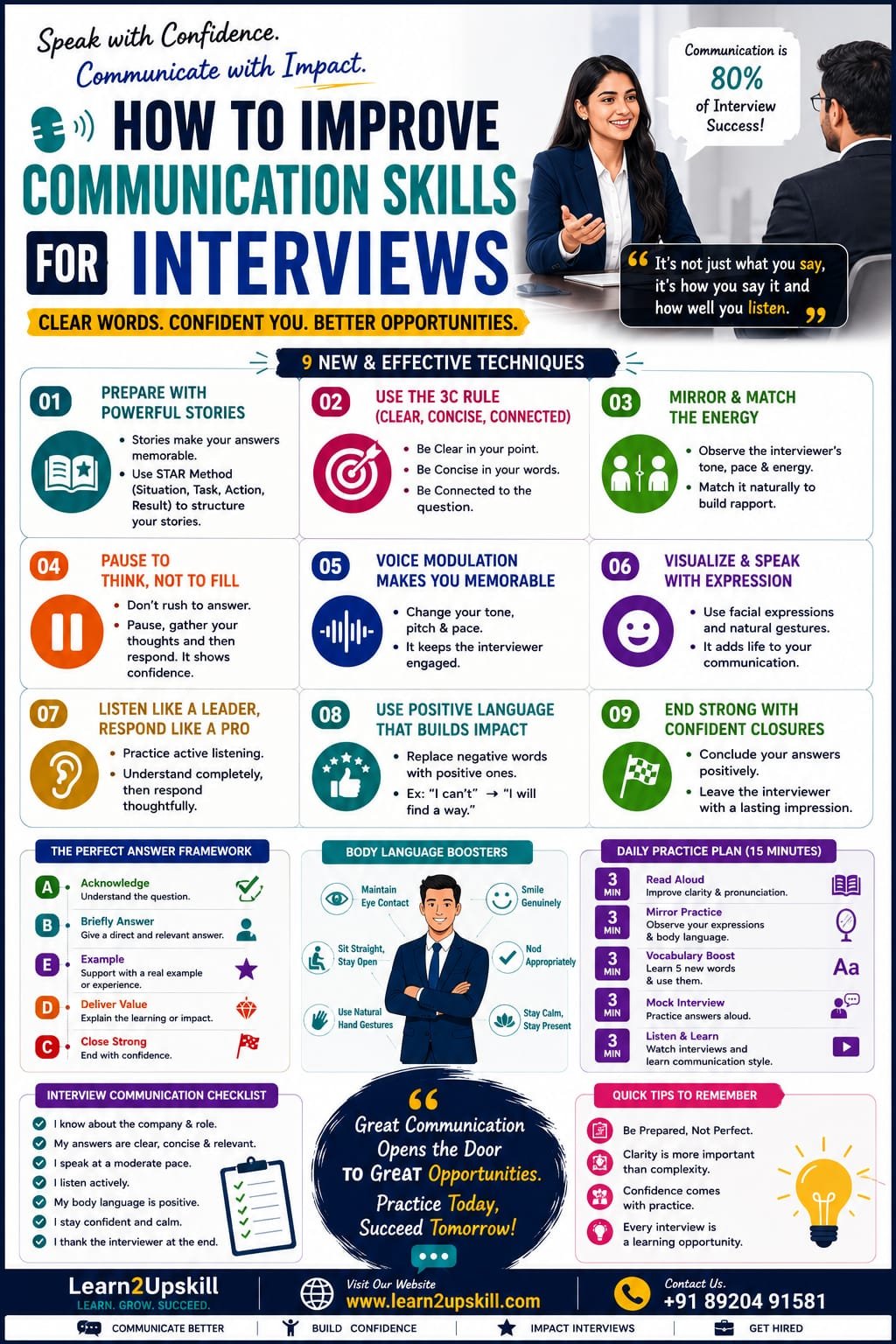
  • How to Improve Communication Skills for Interviews

    How to Improve Communication Skills for Interviews

    How to Improve Communication Skills for Interviews
    Introduction
    Communication skills are one of the most important qualities employers look for during interviews. Even if you have excellent academic qualifications and technical knowledge, poor communication can reduce your chances of getting selected. On the other hand, candidates who communicate clearly, confidently, and professionally often leave a strong and lasting impression.
    Communication in an interview is not just about speaking—it also includes listening, body language, confidence, tone of voice, and the ability to express your thoughts effectively. The good news is that communication is a skill that can be learned and improved with regular practice.
    At Learn2Upskill, we help students, fresh graduates, and job seekers build strong communication skills, confidence, and interview readiness to achieve their career goals.
    —
    Why Are Communication Skills Important in Interviews?
    Recruiters evaluate your communication to understand:
    – Your confidence
    – Clarity of thought
    – Professionalism
    – Listening ability
    – Problem-solving approach
    – Teamwork skills
    – Leadership potential
    – Customer interaction skills
    – Overall personality
    Strong communication helps employers trust that you can represent the organization effectively.
    —
    Common Communication Mistakes During Interviews
    Many candidates lose opportunities because they:
    – Speak too fast.
    – Speak too softly.
    – Give very long answers.
    – Use filler words like “um” or “you know” repeatedly.
    – Interrupt the interviewer.
    – Avoid eye contact.
    – Fail to listen carefully.
    – Give unclear or confusing answers.
    – Show nervous body language.
    – Use informal language.
    Identifying these mistakes is the first step toward improvement.
    —
    1. Prepare Before the Interview
    Good communication begins with preparation.
    Research:
    – The company
    – The job role
    – The industry
    – Common interview questions
    Preparation helps you answer confidently and reduces nervousness.
    —
    2. Practice Speaking Clearly
    Speak at a moderate pace.
    Remember to:
    – Pronounce words clearly.
    – Pause briefly between ideas.
    – Avoid rushing your answers.
    – Keep your tone calm and confident.
    Clear speech makes your message easier to understand.
    —
    3. Improve Your Vocabulary
    You don’t need complicated words, but using professional language improves your communication.
    Read:
    – Newspapers
    – Business magazines
    – Career blogs
    – Books
    Learning new words regularly helps you express ideas more effectively.
    —
    4. Listen Actively
    Communication is a two-way process.
    Before answering:
    – Listen carefully.
    – Allow the interviewer to finish speaking.
    – Think for a moment.
    – Answer only what was asked.
    Good listening demonstrates respect and professionalism.
    —
    5. Maintain Positive Body Language
    Your body language speaks before your words.
    Maintain:
    – Eye contact
    – Good posture
    – Natural smile
    – Relaxed shoulders
    – Gentle hand gestures
    Avoid:
    – Crossing your arms
    – Looking at the floor
    – Fidgeting
    – Checking your phone
    – Slouching
    Positive body language reinforces your spoken message.
    —
    6. Practice Common Interview Questions
    Prepare answers for questions such as:
    – Tell me about yourself.
    – Why should we hire you?
    – What are your strengths?
    – What is one area you are working to improve?
    – Why do you want to join our company?
    – Where do you see yourself in five years?
    Practice aloud until your answers sound natural.
    —
    7. Think Before You Speak
    Take a brief pause before answering difficult questions.
    This helps you:
    – Organize your thoughts.
    – Avoid unnecessary words.
    – Give structured answers.
    – Reduce nervousness.
    A thoughtful pause is perfectly acceptable.
    —
    8. Keep Your Answers Structured
    A simple structure works well:
    – Introduce your main point.
    – Explain briefly.
    – Give an example if appropriate.
    – Conclude clearly.
    Well-organized answers are easier to follow and remember.
    —
    9. Build Confidence Through Practice
    Confidence improves with repetition.
    Practice by:
    – Speaking in front of a mirror.
    – Recording yourself.
    – Participating in group discussions.
    – Giving presentations.
    – Taking mock interviews.
    Every practice session strengthens your communication.
    —
    10. Improve Your English Communication (If Needed)
    If interviews are conducted in English:
    – Read English articles daily.
    – Watch English news.
    – Speak English with friends.
    – Learn five new words each day.
    – Practice answering interview questions in English.
    Consistency leads to improvement.
    —
    Communication Tips for Online Interviews
    Virtual interviews require extra attention.
    Before joining:
    – Test your microphone and camera.
    – Ensure good internet connectivity.
    – Sit in a quiet, well-lit place.
    – Look into the camera while speaking.
    – Avoid distractions.
    Professional online communication is equally important.
    —
    Daily Habits to Improve Communication
    Develop these habits:
    – Read for 20 minutes every day.
    – Practice speaking aloud.
    – Learn one new word daily.
    – Listen to quality podcasts or speeches.
    – Participate in discussions.
    – Maintain good posture.
    – Observe confident speakers.
    – Ask for constructive feedback.
    Small daily improvements create long-term confidence.
    —
    Communication Skills Employers Value
    Recruiters appreciate candidates who can:
    – Speak clearly
    – Listen actively
    – Explain ideas logically
    – Remain calm under pressure
    – Communicate respectfully
    – Work well in teams
    – Resolve conflicts professionally
    – Build positive relationships
    These skills are valuable in every profession.
    —
    Interview Day Communication Checklist
    Before and during the interview:
    – ✔ Greet the interviewer politely.
    – ✔ Smile naturally.
    – ✔ Maintain eye contact.
    – ✔ Listen carefully.
    – ✔ Speak clearly and confidently.
    – ✔ Keep answers concise.
    – ✔ Avoid interrupting.
    – ✔ Thank the interviewer before leaving.

    These small habits create a positive impression.
    —
    Benefits of Strong Communication Skills
    Good communication helps you:
    – Perform better in interviews.
    – Build confidence.
    – Create a strong first impression.
    – Improve leadership skills.
    – Strengthen teamwork.
    – Build professional relationships.
    – Increase career opportunities.
    – Achieve long-term success.
    Communication is one of the most valuable career skills.
    —
    Conclusion
    Improving communication skills is one of the best investments you can make in your future. It not only helps you perform well in interviews but also supports academic success, professional growth, leadership, and personal development.
    Remember, effective communication is not about speaking perfectly—it is about expressing your ideas clearly, listening actively, and interacting with confidence and respect. Practice consistently, stay positive, and keep learning.
    At Learn2Upskill, we are committed to helping students and job seekers develop communication skills, interview confidence, personality development, career counselling, and professional grooming so they can achieve their academic and career goals.
    —
    Contact Learn2Upskill
    Website: www.coral-kudu-326218.hostingersite.com
    Contact Us: +91-89204 91581
    Learn2Upskill – Learn. Grow. Succeed.
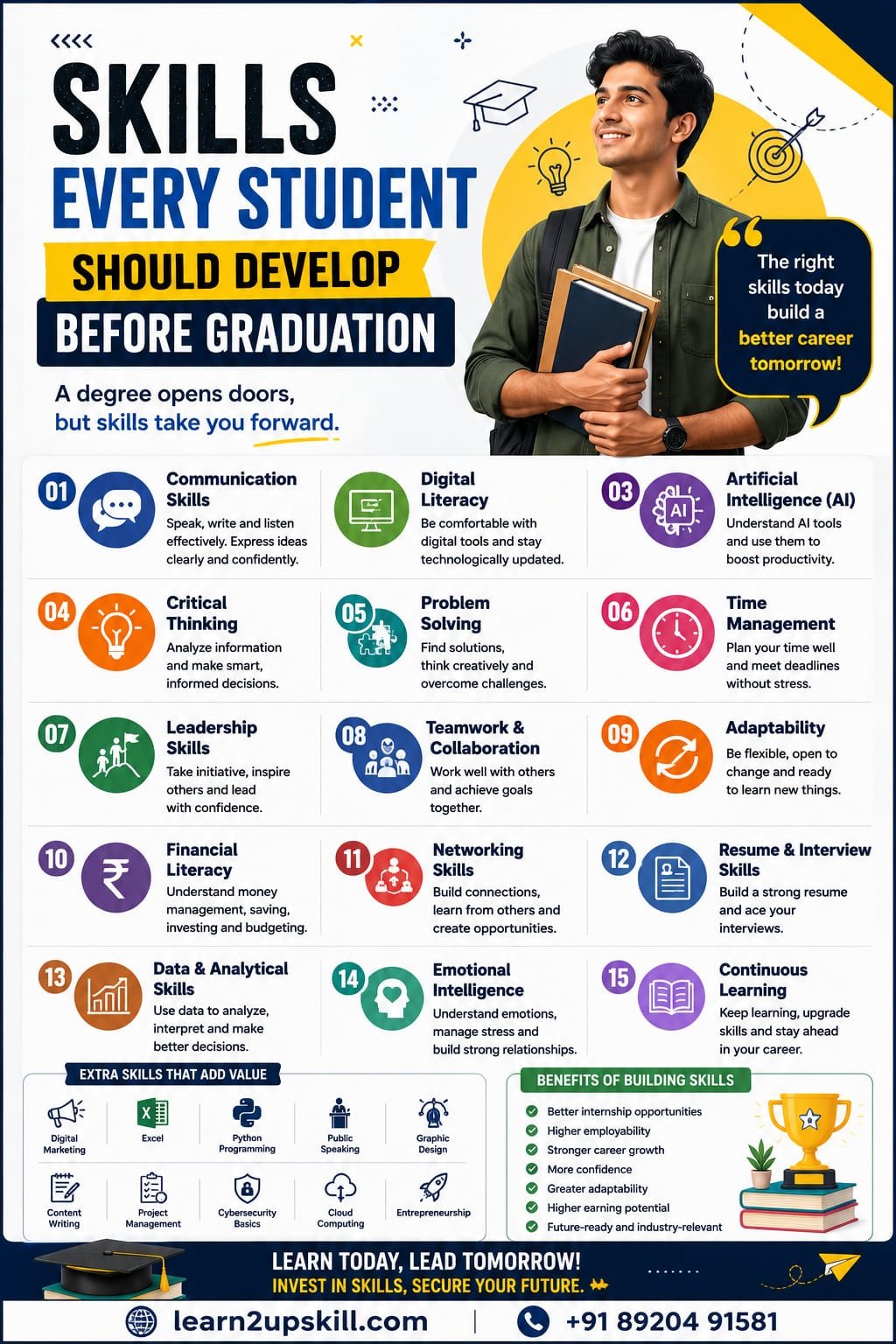
  • Skills Every Student Should Develop Before Graduation

    Skills Every Student Should Develop Before Graduation

    Skills Every Student Should Develop Before Graduation

    Published by: Learn2Upskill

    Website: www.coral-kudu-326218.hostingersite.com

    Contact: +91 89204 91581

    Introduction

    Graduating from college is an exciting milestone, but today’s employers expect more than just a degree. They look for graduates who can communicate effectively, solve problems, adapt to change, and use modern technology with confidence.

    Developing the right skills before graduation can make the transition from classroom to workplace much smoother. Whether you plan to pursue a job, higher education, or entrepreneurship, building these skills early will give you a competitive advantage.

    In this blog, we’ll explore the essential skills every student should develop before graduation to improve employability and prepare for long-term career success.

    —

    Why Skills Matter More Than Ever

    The job market is evolving rapidly due to technology, automation, and Artificial Intelligence (AI). While academic knowledge remains important, employers increasingly value practical skills that help employees contribute from day one.

    Students who combine a strong educational foundation with practical, professional, and digital skills are better positioned to secure internships, job offers, and career growth opportunities.

    —

    1. Communication Skills

    Strong communication is essential in every profession.

    Develop the ability to:

    – Speak confidently

    – Write professional emails

    – Deliver presentations

    – Listen actively

    – Communicate with diverse teams

    Good communication builds confidence and improves workplace relationships.

    —

    1. Digital Literacy

    Every graduate should be comfortable using modern digital tools.

    Learn:

    – Microsoft Word

    – Microsoft Excel

    – Microsoft PowerPoint

    – Google Workspace

    – Online collaboration tools

    – Cloud storage platforms

    Digital literacy is now a basic requirement across industries.

    —

    1. Artificial Intelligence (AI) Skills

    AI is changing the way businesses operate.

    Students should understand:

    – Generative AI tools

    – Prompt writing

    – AI-assisted research

    – AI for productivity

    – Responsible use of AI

    Learning AI can improve efficiency and open doors to future-ready careers.

    —

    1. Critical Thinking

    Employers value people who can analyze situations and make informed decisions.

    Practice:

    – Evaluating information

    – Asking thoughtful questions

    – Comparing solutions

    – Identifying risks

    – Making logical decisions

    Critical thinking helps solve real-world challenges.

    —

    1. Problem-Solving Skills

    Every organization faces challenges.

    Develop the ability to:

    – Identify problems

    – Analyze causes

    – Generate solutions

    – Test ideas

    – Learn from outcomes

    Strong problem-solvers are valuable in every industry.

    —

    1. Time Management

    Managing time effectively helps students balance academics, internships, projects, and personal life.

    Useful habits include:

    – Creating daily schedules

    – Setting priorities

    – Avoiding procrastination

    – Meeting deadlines

    – Reviewing progress regularly

    Time management increases productivity and reduces stress.

    —

    1. Leadership Skills

    Leadership is not limited to managers.

    Students can build leadership by:

    – Leading group projects

    – Organizing events

    – Volunteering

    – Taking initiative

    – Mentoring peers

    Leadership demonstrates responsibility and confidence.

    —

    1. Teamwork and Collaboration

    Most workplaces rely on teamwork.

    Develop skills such as:

    – Respecting different opinions

    – Sharing responsibilities

    – Resolving conflicts

    – Supporting teammates

    – Achieving common goals

    Employers highly value professionals who work well with others.

    —

    1. Adaptability

    Technology and industries continue to change rapidly.

    Adaptable students are willing to:

    – Learn new tools

    – Accept feedback

    – Adjust to change

    – Develop new skills

    – Embrace innovation

    Adaptability is essential for long-term career growth.

    —

    1. Financial Literacy

    Understanding money management is an important life skill.

    Learn:

    – Budgeting

    – Saving

    – Investing basics

    – Taxes

    – Managing expenses

    – Emergency planning

    Financial literacy supports personal and professional stability.

    —

    1. Networking Skills

    Professional networking creates opportunities.

    Students should:

    – Build a professional LinkedIn profile

    – Attend seminars and workshops

    – Connect with mentors

    – Participate in career fairs

    – Join professional communities

    Strong networks often lead to internships and job opportunities.

    —

    1. Resume and Interview Skills

    Before graduation, every student should know how to:

    – Create a professional resume

    – Write an effective cover letter

    – Prepare for interviews

    – Answer common HR questions

    – Showcase projects and achievements

    Preparation increases confidence during recruitment.

    —

    1. Data and Analytical Skills

    Many careers require data-driven decision-making.

    Useful skills include:

    – Microsoft Excel

    – SQL basics

    – Power BI

    – Data visualization

    – Basic statistics

    Analytical skills are valuable in business, finance, marketing, healthcare, and technology.

    —

    1. Emotional Intelligence

    Emotional intelligence helps students succeed both personally and professionally.

    Develop the ability to:

    – Understand emotions

    – Manage stress

    – Show empathy

    – Build positive relationships

    – Handle workplace challenges calmly

    Strong emotional intelligence improves teamwork and leadership.

    —

    1. Continuous Learning Mindset

    Learning shouldn’t stop after graduation.

    Successful professionals:

    – Read books and industry blogs

    – Take online courses

    – Earn certifications

    – Attend webinars

    – Stay updated with industry trends

    Continuous learning keeps your skills relevant.

    —

    Additional Skills That Add Value

    Students can further strengthen their profiles by learning:

    – Digital Marketing

    – Python Programming

    – Public Speaking

    – Graphic Design

    – Video Editing

    – Content Writing

    – Cybersecurity Basics

    – Cloud Computing Fundamentals

    – Project Management

    – Entrepreneurship

    These skills increase career flexibility and job opportunities.

    —

    How to Start Developing These Skills

    – Enroll in online courses.

    – Participate in internships.

    – Join student clubs and organizations.

    – Volunteer for community projects.

    – Build personal projects and portfolios.

    – Practice communication every day.

    – Seek feedback from mentors.

    – Set monthly learning goals.

    Small, consistent efforts create long-term success.

    —

    Benefits of Building Skills Before Graduation

    Students who develop these skills often enjoy:

    – Better internship opportunities

    – Stronger resumes

    – Improved interview performance

    – Higher employability

    – Greater confidence

    – Faster career growth

    – Increased earning potential

    – Better adaptability to workplace changes

    —

    Final Tips for Students

    – Don’t wait until your final semester to prepare.

    – Learn one new skill every few months.

    – Balance academics with practical experience.

    – Stay curious and open to learning.

    – Build a portfolio that showcases your achievements.

    – Invest in your personal and professional development.

    —

    Conclusion

    A degree is an important achievement, but it is your skills that help you stand out in today’s competitive job market. Employers seek graduates who can communicate effectively, solve problems, adapt to change, and use modern technology confidently.


    By developing these essential skills before graduation, you’ll be better prepared to seize opportunities, overcome challenges, and build a successful career.

    Start today, stay consistent, and invest in lifelong learning—your future self will thank you.

    —

    Learn with Learn2Upskill

    At Learn2Upskill, we help students become career-ready through practical, industry-focused training and expert guidance.

    Our programs cover in-demand skills such as Artificial Intelligence (AI), Microsoft Excel, Data Analytics, Digital Marketing, Programming, Communication Skills, Career Development, and much more.

    Whether you’re preparing for your first job or planning your future career, we’re here to help you succeed.

    Website: www.coral-kudu-326218.hostingersite.com

    Contact: +91 89204 91581

    Build the skills employers want. Graduate with confidence. Grow your career with Learn2Upskill.

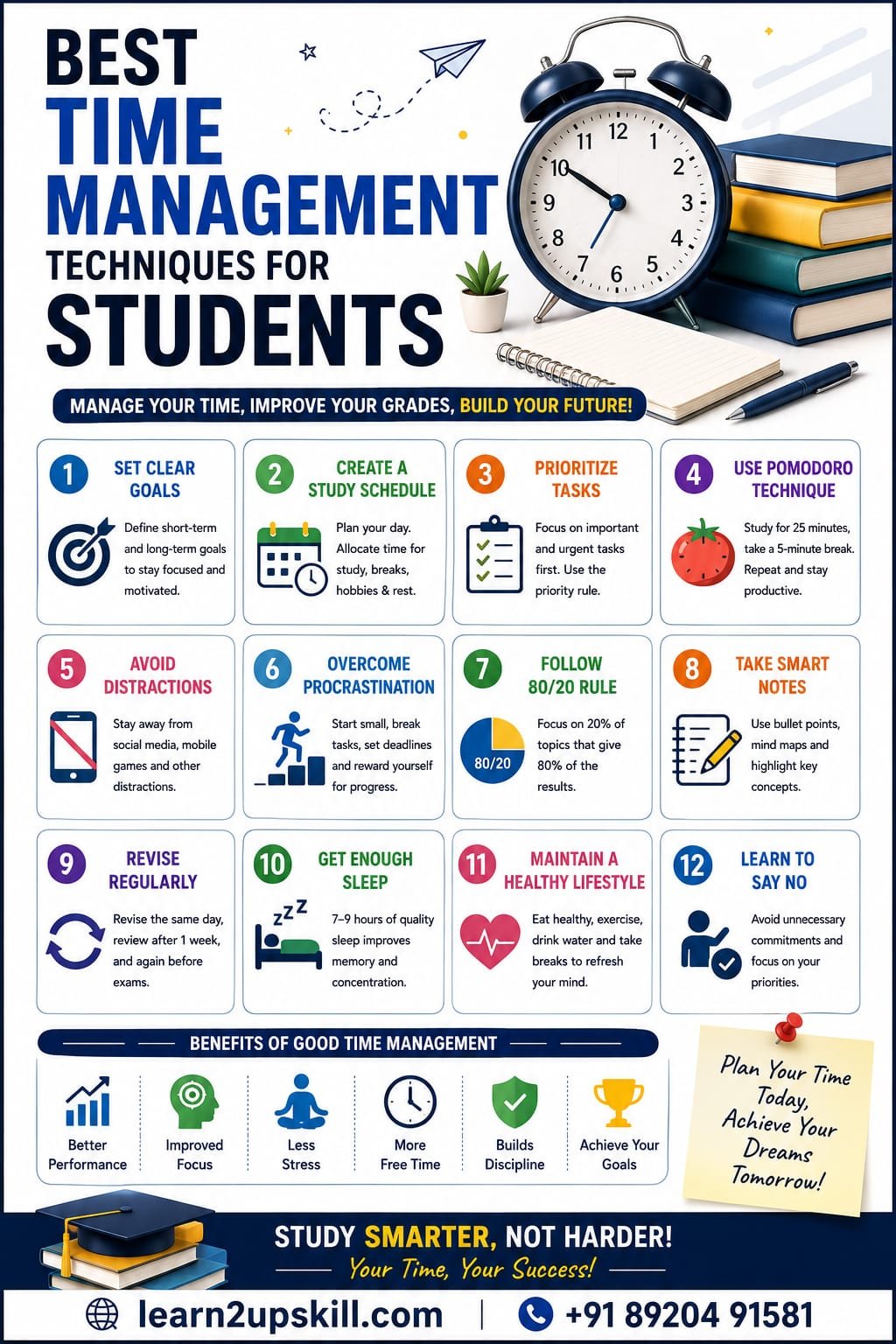
  • Best Time Management Techniques for Students: Study Smarter, Stress Less

    Best Time Management Techniques for Students: Study Smarter, Stress Less

    Best Time Management Techniques for Students: Study Smarter, Stress Less

    Published by: Learn2Upskill

    Website: www.coral-kudu-326218.hostingersite.com

    Contact: +91 89204 91581

    Introduction

    Time is one of the most valuable resources for every student. Whether you’re preparing for board exams, college entrance tests, competitive exams, or balancing academics with extracurricular activities, managing your time effectively can make a huge difference.

    Many students struggle not because they lack intelligence, but because they don’t have a proper plan for using their time. By developing good time management habits, you can improve your grades, reduce stress, and still have time for hobbies, family, and relaxation.

    In this blog, we’ll explore the best time management techniques every student should use to become more productive and successful.

    Why Time Management Is Important

    Effective time management helps students:

    – Complete assignments on time

    – Reduce exam stress

    – Improve concentration

    – Increase productivity

    – Maintain a healthy study-life balance

    – Build self-discipline and confidence

    Students who manage their time well are more likely to achieve their academic and career goals.

    —

    1. Set Clear Goals

    Start by defining what you want to achieve.

    Short-Term Goals

    – Finish today’s homework

    – Revise one chapter

    – Practice 20 math questions

    Long-Term Goals

    – Score above 90%

    – Crack competitive exams

    – Improve English communication

    – Learn a new skill

    Clear goals give your studies direction and purpose.

    —

    1. Create a Daily Study Schedule

    A timetable helps you organize your day effectively.

    Remember to keep your schedule realistic and flexible.

    —

    1. Prioritize Important Tasks

    Not every task has the same importance.

    Focus first on:

    – Upcoming exams

    – Assignments with deadlines

    – Difficult subjects

    – Project work

    Complete high-priority tasks before spending time on less important activities.

    —

    1. Use the Pomodoro Technique

    The Pomodoro Technique is a simple and effective study method.

    – Study for 25 minutes

    – Take a 5-minute break

    – Repeat four times

    – Take a longer 20–30 minute break

    This technique helps maintain focus and prevents mental fatigue.

    —

    1. Avoid Procrastination

    Procrastination is one of the biggest obstacles to success.

    Common reasons include:

    – Fear of failure

    – Lack of motivation

    – Mobile phone distractions

    – Poor planning

    How to overcome it:

    – Start with small tasks.

    – Break large projects into smaller steps.

    – Set deadlines for yourself.

    – Reward yourself after completing tasks.

    —

    1. Eliminate Distractions

    Distractions reduce productivity and waste valuable study time.

    Common distractions:

    – Social media

    – Mobile games

    – TV

    – Notifications

    – Unnecessary internet browsing

    1. Follow the 80/20 Rule

    The Pareto Principle suggests that 20% of your efforts often produce 80% of your results.

    Identify the topics that carry the most marks or require the most attention, and focus on mastering them first.

    —

    1. Take Smart Notes

    Well-organized notes make revision easier.

    Use:

    – Bullet points

    – Mind maps

    – Flowcharts

    – Highlight key formulas and definitions

    – Color coding for important concepts

    Good notes save time during exam preparation.

    —

    1. Revise Regularly

    Revision helps move information into long-term memory.

    A simple revision plan:

    – Revise the same day.

    – Review after one week.

    – Revise again before exams.

    Frequent revision improves retention and confidence.

    —

    1. Get Enough Sleep

    Sleeping less does not mean studying more effectively.

    Aim for 7–9 hours of quality sleep each night. Adequate rest improves memory, concentration, and learning ability.

    —

    1. Maintain a Healthy Lifestyle

    Your brain performs better when your body is healthy.

    – Eat nutritious meals.

    – Drink plenty of water.

    – Exercise regularly.

    – Take short breaks while studying.

    A healthy routine supports better academic performance.

    —

    1. Learn to Say No

    Avoid unnecessary commitments that take time away from your priorities.

    Politely decline activities that interfere with your study schedule and focus on what matters most.

    —

    Useful Time Management Apps

    Students can use these apps to stay organized:

    – Google Calendar

    – Microsoft To Do

    – Notion

    – Todoist

    – Forest

    – Trello

    These tools help you manage tasks, deadlines, and study plans effectively.

    —

    Common Time Management Mistakes

    Avoid these habits:

    – Studying without a plan

    – Multitasking

    – Leaving work until the last minute

    – Ignoring breaks

    – Spending excessive time on social media

    – Not reviewing completed work

    Recognizing these mistakes is the first step toward improving your productivity.

    —

    Benefits of Good Time Management

    Students who manage their time effectively often experience:

    – Better academic performance

    – Reduced stress

    – Improved focus

    – Increased confidence

    – More free time

    – Stronger discipline

    – Better career preparation

    —

    Final Tips for Success

    – Plan your day the night before.

    – Start with the hardest subject.

    – Review your progress weekly.

    – Keep learning consistently.

    – Stay positive and motivated.

    – Celebrate small achievements.

    —

    Conclusion


    Time management is a skill that every student can develop. By planning your day, setting clear goals, avoiding distractions, and staying consistent, you can improve your academic performance while maintaining a healthy balance in life.

    Remember, success isn’t about studying for the longest hours—it’s about making the best use of the time you have. Start applying these techniques today, and you’ll be one step closer to achieving your educational and career goals.

    Learn with Learn2Upskill

    At Learn2Upskill, we help students build practical, career-ready skills through expert guidance, online courses, and professional development resources.

    Website: www.coral-kudu-326218.hostingersite.com

    Contact: +91 89204 91581

    Learn smarter. Manage your time better. Build a brighter future with Learn2Upskill!

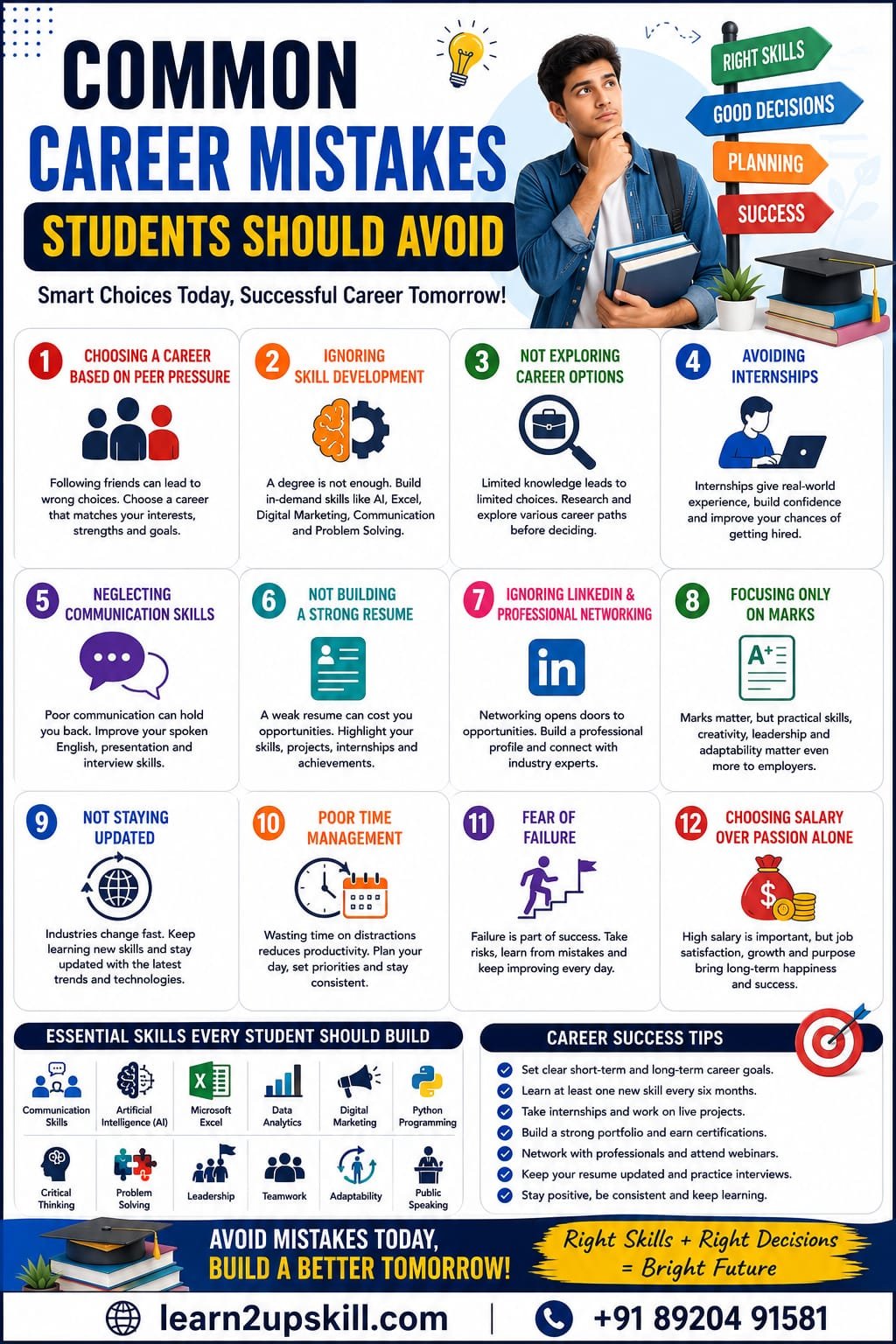
  • Common Career Mistakes Students Should Avoid: A Complete Guide to Building a Successful Future

    Common Career Mistakes Students Should Avoid: A Complete Guide to Building a Successful Future

    Common Career Mistakes Students Should Avoid: A Complete Guide to Building a Successful Future

    Published by: Learn2Upskill

    Website: www.coral-kudu-326218.hostingersite.com

    Contact: +91 89204 91581

    Introduction

    Choosing a career is one of the most important decisions in a student’s life. However, many students make avoidable mistakes that can delay their success, limit opportunities, or lead to dissatisfaction in the future.

    The good news is that these mistakes can be avoided with the right guidance, planning, and continuous learning. Whether you’re in school, college, or preparing for your first job, understanding these common career mistakes can help you make smarter decisions and build a rewarding career.

    In this guide, we’ll discuss the most common career mistakes students make and practical ways to avoid them.

    —

    Why Career Planning Matters

    A well-planned career helps you:

    – Choose the right education path

    – Build relevant skills

    – Increase employability

    – Save time and money

    – Achieve long-term career goals

    – Stay competitive in a changing job market

    Career planning isn’t about predicting the future—it’s about preparing for it.

    —

    1. Choosing a Career Based on Peer Pressure

    Many students choose a course or career simply because their friends are doing it.

    Why It’s a Mistake

    – Your interests may be different.

    – You may lose motivation over time.

    – It can lead to poor job satisfaction.

    What You Should Do

    – Identify your strengths and interests.

    – Research different career options.

    – Seek guidance from teachers, mentors, or career counselors.

    —

    1. Ignoring Skill Development

    A degree alone is often not enough to secure a good job.

    Employers increasingly look for practical skills such as:

    – Communication

    – Digital Marketing

    – Artificial Intelligence (AI)

    – Data Analytics

    – Microsoft Excel

    – Programming

    – Problem Solving

    – Teamwork

    Investing in skill development alongside your studies gives you a competitive edge.

    —

    1. Not Exploring Career Options

    Many students only know about a few traditional professions.

    Today’s career landscape includes opportunities in:

    – Artificial Intelligence

    – Cybersecurity

    – Cloud Computing

    – Data Science

    – UI/UX Design

    – Digital Marketing

    – Content Creation

    – Business Analytics

    – Product Management

    – Entrepreneurship

    Explore a wide range of industries before making a decision.

    —

    1. Avoiding Internships

    Internships provide valuable real-world experience.

    Benefits

    – Learn workplace skills

    – Build confidence

    – Improve your resume

    – Network with professionals

    – Increase your chances of getting hired

    Even short internships can make a big difference.

    —

    1. Neglecting Communication Skills

    Strong communication is essential in almost every profession.

    Improve your:

    – Spoken English

    – Presentation skills

    – Email writing

    – Interview communication

    – Listening skills

    Clear communication can set you apart from equally qualified candidates.

    —

    1. Not Building a Strong Resume

    Your resume is often your first impression.

    A good resume should include:

    – Education

    – Skills

    – Certifications

    – Projects

    – Internships

    – Achievements

    Keep it concise, accurate, and tailored to each job application.

    —

    1. Ignoring LinkedIn and Professional Networking

    Networking can open doors to internships, jobs, and mentorship opportunities.

    Create a professional LinkedIn profile and:

    – Share your achievements

    – Connect with industry professionals

    – Follow companies

    – Engage with relevant content

    Building your professional presence early can benefit your career.

    —

    1. Focusing Only on Marks

    Good grades are important, but employers also value:

    – Practical skills

    – Creativity

    – Leadership

    – Adaptability

    – Critical thinking

    – Teamwork

    Balance academic performance with skill development and real-world experience.

    —

    1. Not Staying Updated

    Industries evolve rapidly, especially with advances in technology.

    Stay informed by:

    – Reading industry blogs

    – Following reputable news sources

    – Taking online courses

    – Attending webinars

    – Learning new tools and technologies

    Continuous learning keeps you relevant.

    —

    1. Poor Time Management

    Many students waste valuable time on distractions.

    Improve productivity by:

    – Creating a daily schedule

    – Setting priorities

    – Avoiding procrastination

    – Limiting unnecessary screen time

    Effective time management helps you balance studies, learning, and personal life.

    —

    1. Fear of Failure

    Many students avoid applying for internships, competitions, or jobs because they fear rejection.

    Remember:

    – Every successful professional has faced setbacks.

    – Failure is an opportunity to learn and improve.

    – Confidence grows through experience.

    Take calculated risks and keep moving forward.

    —

    1. Choosing Salary Over Passion Alone

    While salary is important, don’t choose a career based only on immediate earnings.

    Consider:

    – Long-term growth

    – Job satisfaction

    – Learning opportunities

    – Work-life balance

    – Career stability

    The best careers often combine passion, skills, and market demand.

    —

    Essential Skills Every Student Should Build

    – Communication Skills

    – Artificial Intelligence (AI)

    – Microsoft Excel

    – Data Analytics

    – Digital Marketing

    – Python Programming

    – Critical Thinking

    – Problem Solving

    – Leadership

    – Teamwork

    – Adaptability

    – Public Speaking

    These skills can improve your employability across industries.

    —

    Career Success Tips

    – Set clear career goals.

    – Learn at least one new skill every six months.

    – Complete internships or live projects.

    – Build a professional portfolio.

    – Earn relevant certifications.

    – Keep your resume updated.

    – Network with professionals.

    – Practice interview skills regularly.

    – Stay curious and keep learning.

    —

    Conclusion

    Avoiding common career mistakes can save you years of frustration and help you achieve your goals more quickly. Focus on building practical skills, gaining real-world experience, and making informed career decisions based on your interests and strengths.

    Success doesn’t happen overnight—it comes from consistent learning, smart choices, and a willingness to grow. Start preparing today, and you’ll be ready for the opportunities of tomorrow.

    —

    Learn with Learn2Upskill

    At Learn2Upskill, we are committed to helping students become career-ready through practical courses, industry-relevant training, and expert guidance.

    Whether you want to learn AI, Digital Marketing, Excel, Data Analytics, Programming, or other job-ready skills, we’re here to support your journey.

    Website: www.coral-kudu-326218.hostingersite.com

    Contact: +91 89204 91581


    Start learning today. Build the skills employers want. Shape a successful future with Learn2Upskill!

  • Will AI Replace Jobs?

    Will AI Replace Jobs?

    Will AI Replace Jobs?

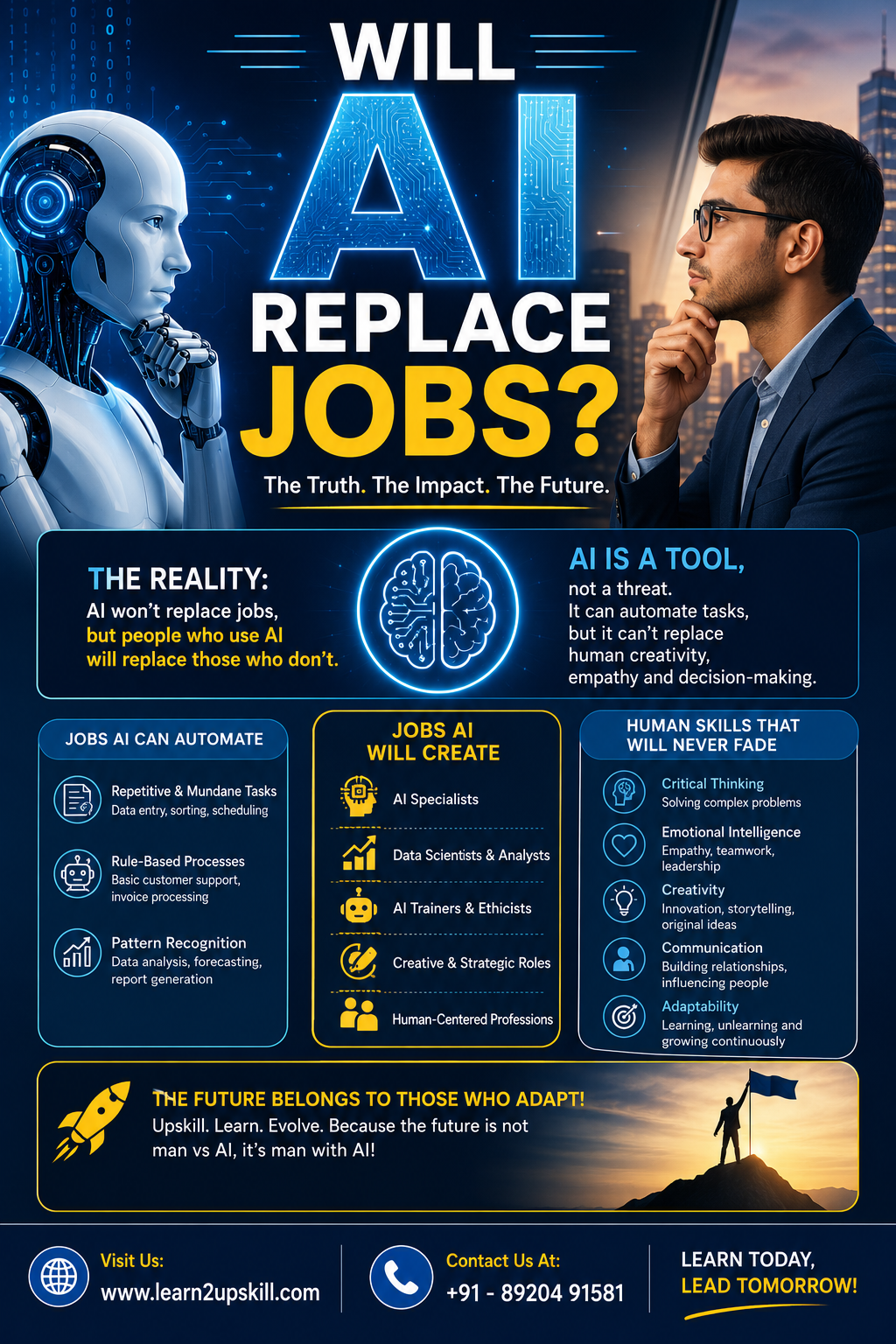
    AI is unlikely to replace every job completely. Instead, it is changing how work gets done.

    Tasks that are repetitive, rule-based, and predictable are more likely to be automated. Jobs that require creativity, emotional intelligence, strategic thinking, leadership, and complex decision-making are much harder to replace.

    Think of AI as a powerful assistant rather than a complete replacement. Professionals who learn to use AI effectively can often become more productive and valuable.

    Jobs Most Likely to Be Affected by AI

    Some roles involve repetitive work that AI can perform quickly and efficiently.

    These include:

    Data Entry Operators

    Basic Customer Support Executives

    Transcriptionists

    Routine Administrative Assistants

    Simple Content Writers

    Basic Bookkeeping Roles

    Basic Graphic Editing Tasks

    Telemarketing Jobs

    This doesn’t mean these jobs will disappear overnight. Instead, many of them are evolving, with employees expected to use AI tools as part of their daily work.

    Jobs That Are Growing Because of AI

    As AI adoption increases, demand is rising for professionals who can build, manage, and use AI effectively.

    Some of the fastest-growing roles include:

    AI Engineer

    Machine Learning Engineer

    Data Analyst

    Data Scientist

    AI Product Manager

    Prompt Engineer

    Digital Marketing Specialist

    Cybersecurity Analyst

    Cloud Computing Engineer

    AI Trainer

    Automation Specialist

    Business Intelligence Analyst

    AI Content Strategist

    These careers combine technical knowledge with problem-solving and often offer excellent long-term growth opportunities.

    Skills You Should Learn Instead

    Instead of worrying about job loss, focus on building skills that complement AI.

    1. Artificial Intelligence Literacy

    Understand how AI works and how to use popular AI tools responsibly.

    Learn:

    ChatGPT

    AI-powered search

    AI image generation

    AI productivity tools

    AI ethics and responsible use

    1. Digital Marketing

    Digital marketing remains one of the fastest-growing fields.

    Key skills include:

    Search Engine Optimization (SEO)

    Social Media Marketing

    Google Ads

    Meta Ads

    Email Marketing

    Content Marketing

    Marketing Analytics

    Professionals who can combine AI with digital marketing are becoming increasingly valuable.

    1. Data Analytics

    Businesses rely on data to make better decisions.

    Learn:

    Microsoft Excel

    SQL

    Power BI

    Tableau

    Data Visualization

    Google Analytics

    Being able to interpret data is a skill AI supports—but doesn’t replace.

    1. Cybersecurity

    As organizations use more technology and AI, protecting digital systems becomes even more important.

    Important skills include:

    Network Security

    Ethical Hacking

    Security Monitoring

    Risk Assessment

    Incident Response

    Cybersecurity professionals remain in high demand.

    1. Programming

    Coding continues to be a valuable skill.

    Popular languages include:

    Python

    JavaScript

    Java

    C#

  • Top 10 High-Paying Skills to Learn in 2026

    Top 10 High-Paying Skills to Learn in 2026

    Top 10 High-Paying Skills to Learn in 2026

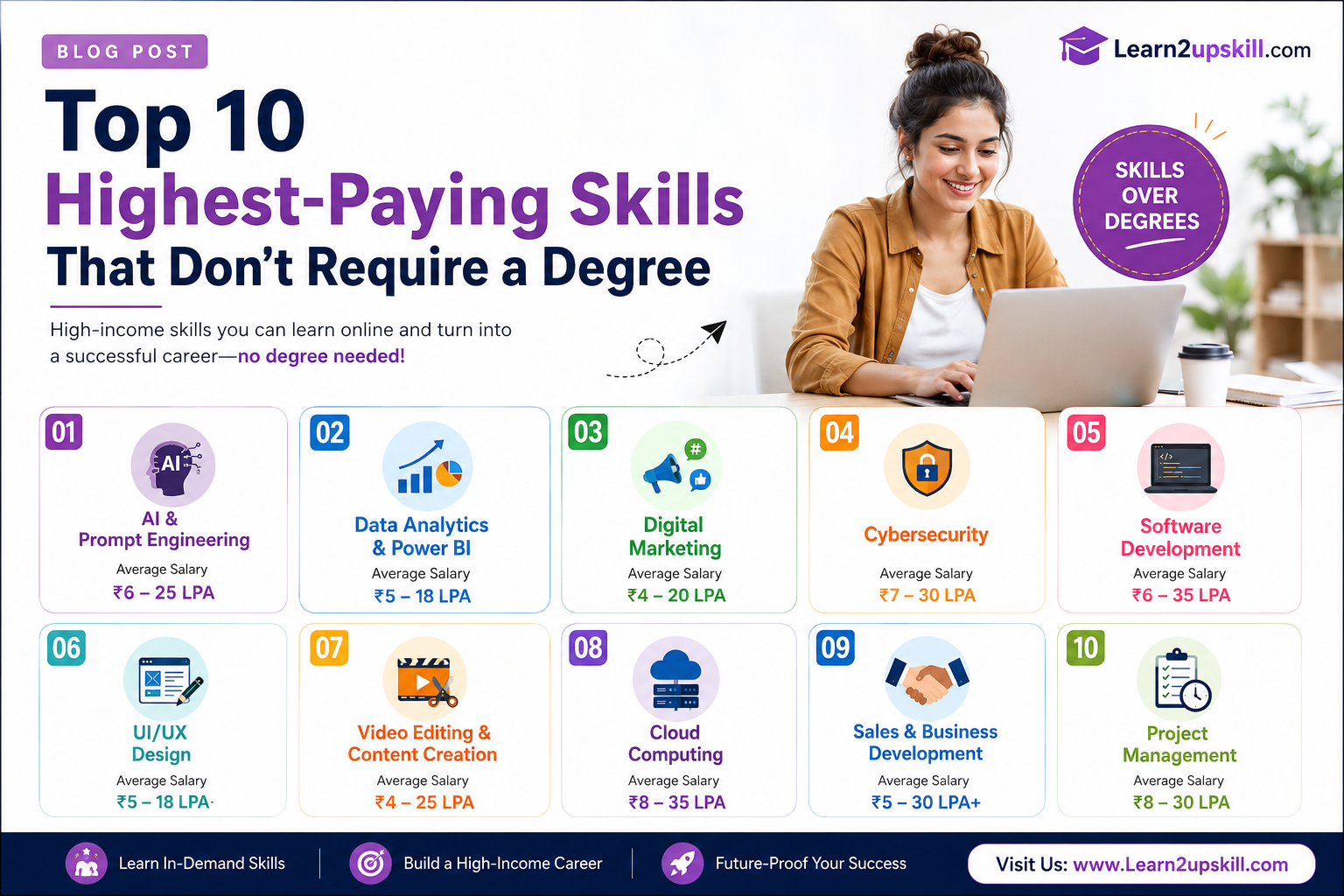
    Introduction

    The job market is evolving faster than ever. With Artificial Intelligence, automation, and digital transformation reshaping industries, employers are looking for professionals with practical, future-ready skills—not just degrees.

    Whether you’re a student, a recent graduate, or a working professional planning a career switch, learning the right skills in 2026 can significantly boost your salary, job security, and career growth.

    In this blog, we’ll explore the Top 10 High-Paying Skills to Learn in 2026 and explain why they’re in demand.

    1. Artificial Intelligence (AI)

    Artificial Intelligence is no longer limited to tech companies. Businesses across healthcare, finance, education, retail, manufacturing, and marketing are adopting AI to improve productivity and decision-making.

    Why Learn AI?

    • High demand across industries
    • Excellent salary packages
    • Future-proof career opportunities
    • Ability to automate repetitive tasks

    Career Opportunities

    • AI Engineer
    • AI Consultant
    • Prompt Engineer
    • AI Product Manager
    • AI Business Analyst
    1. Data Analytics & Power BI

    Companies generate enormous amounts of data every day. Professionals who can analyze this data and create insightful dashboards are highly valued.

    Key Skills

    • Power BI
    • Microsoft Excel
    • SQL
    • Data Visualization
    • Dashboard Design

    Career Opportunities

    • Data Analyst
    • Business Intelligence Analyst
    • Reporting Analyst
    • MIS Executive
    1. Digital Marketing

    As businesses move online, digital marketing has become one of the fastest-growing career fields.

    Important Skills

    • SEO
    • Social Media Marketing
    • Google Ads
    • Content Marketing
    • Email Marketing

    Career Opportunities

    • Digital Marketing Specialist
    • SEO Expert
    • Performance Marketer
    • Content Strategist
    1. Cybersecurity

    Cyber threats continue to increase every year, making cybersecurity one of the highest-paying and most stable career options.

    Skills to Learn

    • Network Security
    • Ethical Hacking
    • Risk Assessment
    • Cloud Security
    • Security Auditing

    Career Opportunities

    • Cybersecurity Analyst
    • Ethical Hacker
    • Security Consultant
    • SOC Analyst
    1. Cloud Computing

    Businesses rely heavily on cloud platforms to store data, host applications, and scale operations efficiently.

    Popular Platforms

    • AWS
    • Microsoft Azure
    • Google Cloud Platform

    Career Opportunities

    • Cloud Engineer
    • Cloud Architect
    • DevOps Engineer
    • Infrastructure Consultant

    Average Salary: ₹8–35 LPA

    1. Microsoft Excel (Advanced)

    Excel remains one of the most requested skills across finance, HR, operations, and business management.

    Learn Topics Like

    • Pivot Tables
    • VLOOKUP & XLOOKUP
    • Power Query
    • Dashboards
    • Advanced Formulas

    Career Opportunities

    • MIS Executive
    • Financial Analyst
    • Business Analyst
    • Operations Executive
    1. Project Management

    Organizations seek professionals who can lead projects, manage teams, and deliver results on time.

    Valuable Certifications

    • PMP
    • Scrum Master
    • Agile
    • PRINCE2

    Career Opportunities

    • Project Manager
    • Scrum Master
    • Program Manager
    • Delivery Manager
    1. UI/UX Design

    Businesses need attractive, user-friendly websites and mobile apps to stand out in a competitive market.

    Skills Required

    • Figma
    • Adobe XD
    • Wireframing
    • Prototyping
    • User Research

    Career Opportunities

    • UI Designer
    • UX Designer
    • Product Designer
    1. Financial Analysis

    Financial professionals help organizations make informed business decisions through budgeting, forecasting, and investment analysis.

    Learn

    • Financial Modeling
    • Excel
    • Business Valuation
    • Budget Planning
    • Corporate Finance

    Career Opportunities

    • Financial Analyst
    • Investment Analyst
    • Corporate Finance Executive
    1. Communication & Leadership

    Technical expertise alone isn’t enough. Employers increasingly value professionals who can communicate effectively, solve problems, collaborate, and lead teams.

    Essential Soft Skills

    • Public Speaking
    • Business Communication
    • Leadership
    • Critical Thinking
    • Negotiation
    • Team Management

    Career Opportunities

    These skills are valuable across every profession and often lead to faster promotions and leadership roles.

    How to Choose the Right Skill?

    Before investing your time and money, ask yourself:

    • What are my interests?
    • Which industries are growing?
    • What skills complement my current education?
    • Which skill offers long-term career opportunities?
    • Can I build practical projects while learning?

    The best skill is one that aligns with both your interests and market demand.

    Why Upskilling Matters in 2026

    Technology is changing the way we work. Employers are hiring candidates who can adapt, learn continuously, and solve real-world problems.

    By investing in future-ready skills today, you can:

    • Increase your earning potential
    • Improve your employability
    • Access better job opportunities
    • Stay competitive in a changing job market
    • Build a long-term, rewarding career

    Learn Future-Ready Skills with Learn2upskill

    At Learn2upskill, we help students and professionals become job-ready through industry-focused training.

    Our popular programs include:

    • Artificial Intelligence
    • Microsoft Excel
    • Power BI
    • Digital Marketing
    • Resume Building
    • Placement Assistance
    • Soft Skills & Interview Preparation

    Our courses combine practical learning, real-world projects, expert guidance, and career support to help you succeed.

    Conclusion

    The demand for skilled professionals continues to rise, and 2026 offers exciting opportunities for those willing to learn. Whether you’re aiming for your first job, a promotion, or a complete career change, developing the right skills can open doors to higher salaries and better career prospects.

    Start your learning journey today, stay consistent, and invest in skills that will remain valuable for years to come.

    Ready to future-proof your career? Visit Learn2upskill and take the first step toward building the skills employers are looking for in 2026.


  • Top 25 AI Tools Every Student and Professional Should Use in 2026

    Top 25 AI Tools Every Student and Professional Should Use in 2026

    Top 25 AI Tools Every Student and Professional Should Use in 2026

    Meta Title: Top 25 AI Tools Every Student and Professional Should Use in 2026

    Meta Description: Discover the 25 best AI tools for students and professionals in 2026. Boost productivity, improve learning, create content, and save time with these powerful AI tools.

    URL Slug: top-25-ai-tools-for-students-and-professionals-2026

    Top 25 AI Tools Every Student and Professional Should Use in 2026

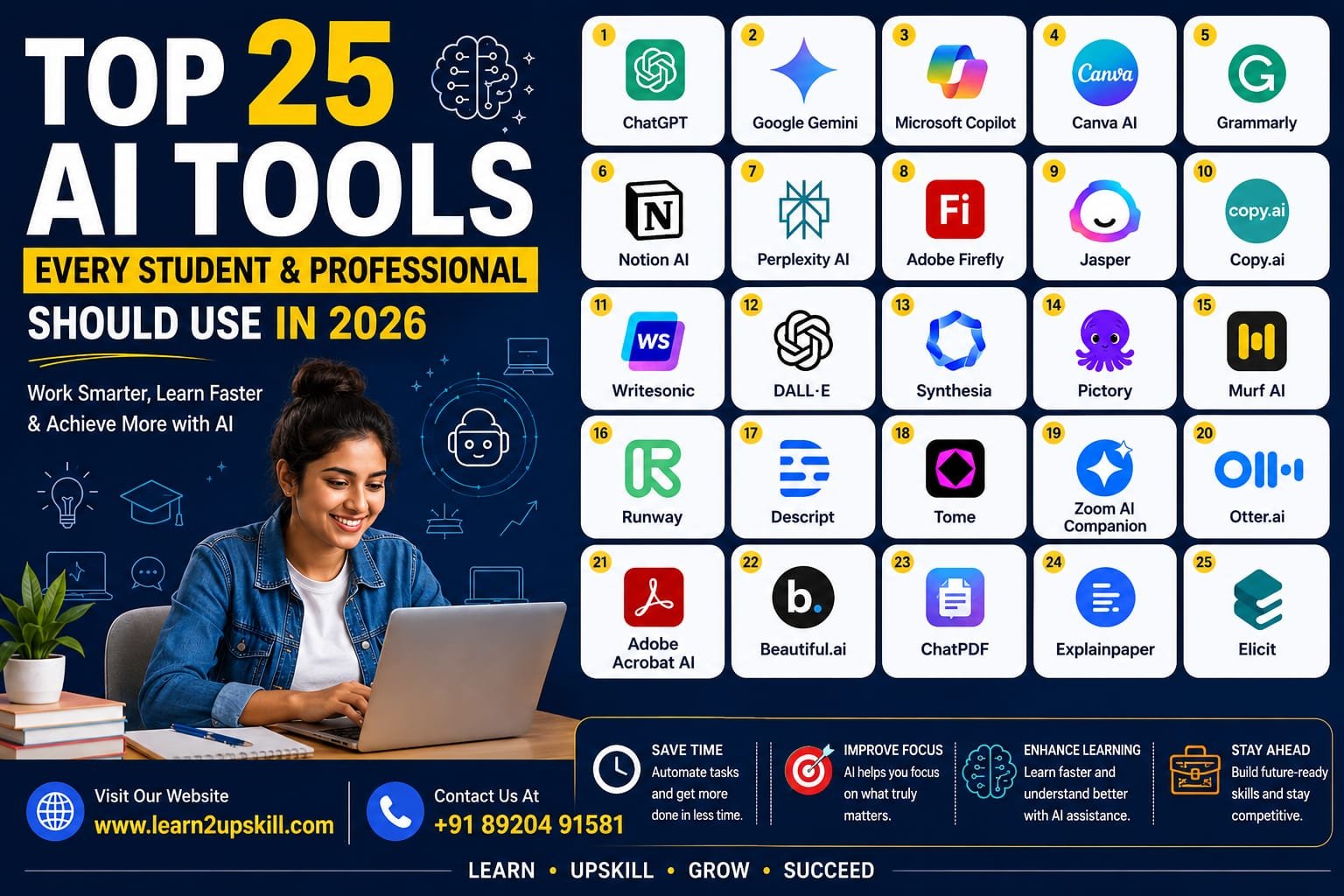
    Artificial Intelligence (AI) has become an essential part of education and the workplace. From writing assignments and creating presentations to designing graphics and analyzing data, AI tools can help students and professionals work faster and more efficiently.

    The key is not to replace your skills with AI, but to use AI to improve your productivity, creativity, and decision-making.

    In this guide, we’ll explore 25 of the best AI tools you should know in 2026.

    —

    1. ChatGPT

    Best For: Writing, brainstorming, coding, learning, and research

    ChatGPT is one of the most versatile AI assistants available today. Students can use it to understand complex concepts, summarize notes, prepare for exams, and practice interviews. Professionals can use it to draft emails, create reports, generate ideas, write code, and solve business problems.

    Key Features

    – Content writing
    – Coding assistance
    – Research support
    – Resume writing
    – Language translation

    —

    2. Google Gemini

    Best For: Research, document creation, and productivity

    Google Gemini integrates with Google Workspace, making it useful for users who rely on Docs, Gmail, Sheets, and Drive. It can help draft documents, summarize emails, and assist with research.

    Key Features

    – Google Workspace integration
    – AI-powered writing
    – Smart research
    – Image understanding

    —

    3. Microsoft Copilot

    Best For: Office productivity

    Microsoft Copilot works inside Word, Excel, PowerPoint, Outlook, and Teams. It helps create presentations, analyze spreadsheets, summarize meetings, and draft professional documents.

    Key Features

    – Excel analysis
    – PowerPoint generation
    – Meeting summaries
    – Email drafting

    —

    4. Canva AI

    Best For: Graphic design and presentations

    Canva AI allows anyone to create professional designs without advanced design skills. It can generate presentations, social media posts, logos, posters, and marketing materials in minutes.

    Key Features

    – AI image generation
    – Magic Design
    – Presentation creator
    – Background remover

    —

    5. Grammarly

    Best For: Writing improvement

    Grammarly checks grammar, spelling, punctuation, tone, and clarity. It is especially useful for students writing assignments and professionals preparing business emails and reports.

    Key Features

    – Grammar checking
    – Tone suggestions
    – AI writing assistance
    – Plagiarism detection (Premium)

    —

    6. Notion AI

    Best For: Notes and project management

    Notion AI helps users summarize notes, organize projects, create task lists, and generate content within the Notion workspace.

    Key Features

    – AI note summaries
    – Task management
    – Meeting notes
    – Content generation

    —

    7. Perplexity AI

    Best For: Research with sources

    Perplexity AI provides direct answers with references, making it valuable for students, researchers, and professionals who need reliable information quickly.

    Key Features

    – Source-backed answers
    – Research assistant
    – Web search
    – AI summaries

    —

    8. Adobe Firefly

    Best For: AI-powered image creation

    Adobe Firefly helps create images, text effects, and design assets from simple prompts. It is widely used by designers and marketers.

    Key Features

    – AI image generation
    – Text effects
    – Commercial-friendly content
    – Easy integration with Adobe Creative Cloud

    Contact us for more details

    Why Should You Learn AI Tools?

    Learning AI tools can help you:

    – Save time on repetitive tasks.
    – Improve productivity.
    – Create professional documents and presentations.
    – Learn new concepts faster.
    – Build valuable workplace skills.
    – Stay competitive in a rapidly changing job market.

    Employers increasingly expect candidates to understand how to use AI responsibly and effectively. Combining AI with strong communication, analytical thinking, and technical skills can make you more valuable in almost any industry.

    Conclusion

    AI is transforming the way we study and work. Whether you’re a student preparing for exams or a professional looking to improve productivity, these tools can help you achieve more in less time. The most successful users won’t be those who rely entirely on AI—they’ll be the ones who combine AI with critical thinking, creativity, and continuous learning.

    Start by exploring a few tools that match your goals, practice using them regularly, and keep learning as AI continues to evolve.

    Ready to build future-ready skills? Explore more career guides, digital skills, and AI learning resources on Learn2UpSkill to stay ahead in 2026 and beyond.