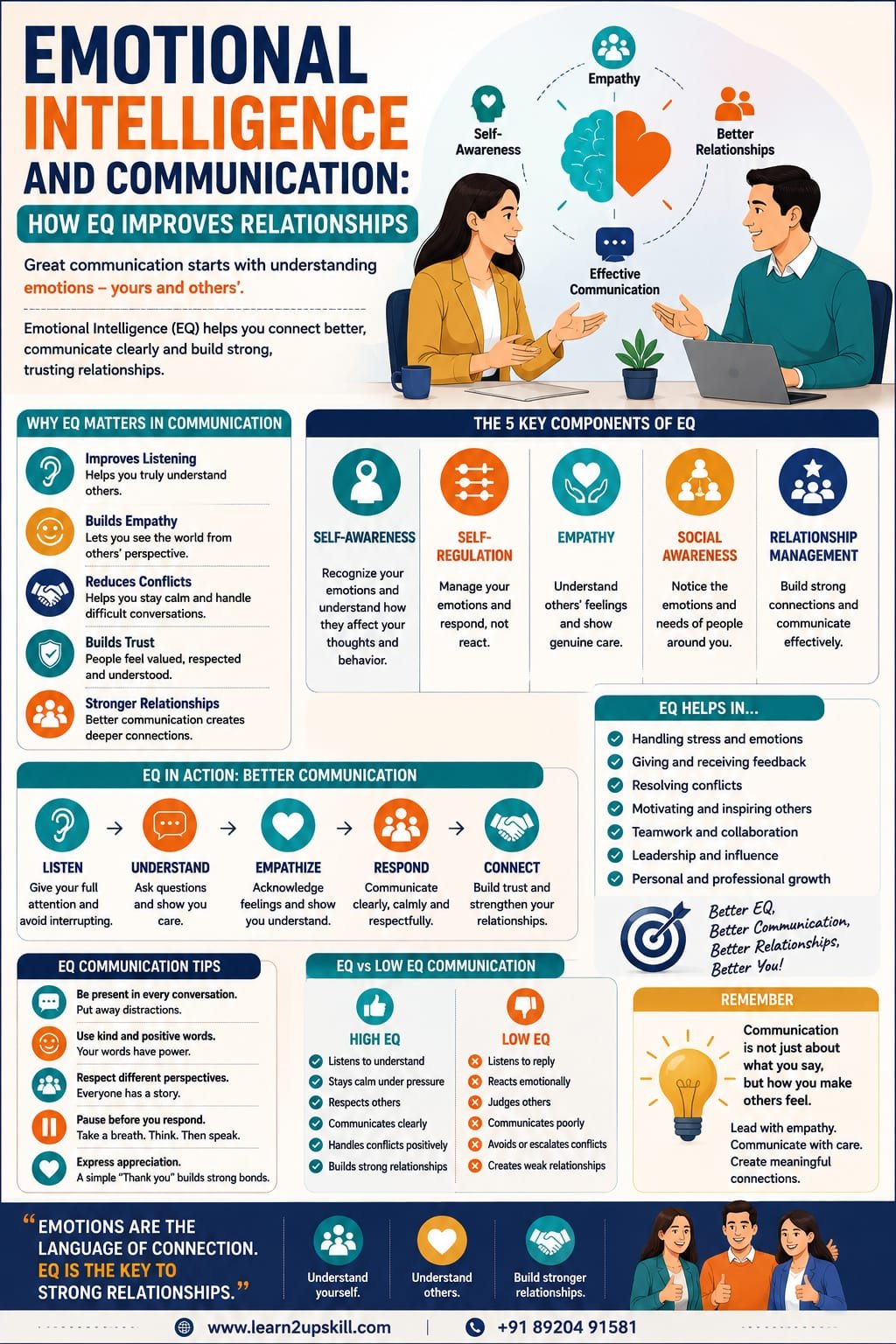
Emotional Intelligence and Communication: How EQ Improves Relationships
Description: Discover how emotional intelligence improves communication and relationships. Learn the key components of EQ, practical communication skills and ways to build stronger personal and professional relationships.
Suggested URL Slug:
“/emotional-intelligence-and-communication/”
—
Emotional Intelligence and Communication: How EQ Improves Relationships
Have you ever had a conversation where the words seemed perfectly normal, but something still went wrong?
Perhaps someone misunderstood your tone.
Maybe you reacted emotionally and later wished you had responded differently.
Or perhaps the other person wasn’t really listening to what you were trying to say.
This is where emotional intelligence, often called EQ, plays an important role.
Communication is not only about choosing the right words.
It is also about understanding emotions—your own emotions and the emotions of the people around you.
A person may have excellent technical knowledge and strong professional qualifications, but if they cannot manage emotions, listen to others or communicate with empathy, building strong relationships can become difficult.
In today’s workplace, where teams collaborate across departments, cultures and digital platforms, emotional intelligence has become an essential skill.
The good news?
Emotional intelligence can be developed and improved with practice.
In this guide, we’ll explore the connection between emotional intelligence and communication, understand how EQ improves relationships and learn practical ways to become a more emotionally intelligent communicator.
—
What Is Emotional Intelligence?
Emotional intelligence is the ability to recognize, understand and manage emotions effectively.
It also involves understanding the emotions of other people and responding appropriately.
In simple words:
«EQ is the ability to be aware of emotions and use that awareness to communicate and interact more effectively.»
Emotional intelligence can help you:
– Understand your reactions
– Manage stress
– Communicate calmly
– Listen with empathy
– Handle disagreements
– Build trust
– Give and receive feedback
– Develop stronger relationships
EQ does not mean hiding your emotions.
It means understanding them and responding thoughtfully.
For example, feeling angry is a normal human emotion.
But sending an angry email immediately may not be the best response.
An emotionally intelligent person may:
- Recognize their anger.
- Pause before reacting.
- Understand why they are upset.
- Choose a constructive response.
That is emotional intelligence in action.
—
Why Emotional Intelligence Matters in Communication
Every conversation has two levels.
The Information Level
What is being said?
The Emotional Level
How is it being said, and how is the other person feeling?
Consider this simple sentence:
«”That’s fine.”»
Depending on the situation, tone and facial expression, it could mean:
– Genuine agreement
– Disappointment
– Frustration
– Anger
– Indifference
Words alone do not always communicate the complete message.
Emotionally intelligent communicators pay attention to both the words and the emotional context.
They ask themselves:
– What am I feeling?
– Why am I reacting this way?
– How might the other person feel?
– What is the best way to respond?
This awareness can significantly improve communication.
—
The Key Components of Emotional Intelligence
A useful way to understand EQ is through several important skills.
- Self-Awareness
Self-awareness means understanding your own emotions.
Ask yourself:
– What am I feeling right now?
– Why am I feeling this way?
– How is my mood affecting my communication?
For example, imagine you had a stressful morning.
A colleague asks you a simple question.
You respond sharply.
The colleague may not know anything about your stressful morning.
Self-awareness helps you recognize:
«”I’m stressed, and my stress is affecting how I’m speaking.”»
Once you recognize this, you can manage your response better.
—
- Self-Regulation
Self-regulation means managing your emotional reactions.
This doesn’t mean pretending that you don’t have emotions.
It means avoiding impulsive reactions.
Example:
You receive an email that frustrates you.
Your first instinct may be to write an angry reply.
Instead:
– Pause.
– Read the email again.
– Take a few minutes.
– Focus on the facts.
– Write a professional response.
That pause can prevent unnecessary conflict.
—
- Empathy
Empathy is the ability to understand another person’s perspective or feelings.
Empathy does not necessarily mean agreeing with someone.
You can understand someone’s feelings without agreeing with their decision.
For example:
«”I understand why this situation has been frustrating for you.”»
This statement does not mean:
«”You are completely right.”»
It simply shows that you are willing to understand the other person’s experience.
Empathy can make communication feel more respectful and human.
—
- Social Awareness
Social awareness involves understanding the people and environment around you.
This can include noticing:
– Group dynamics
– Emotional atmosphere
– Communication styles
– Reactions from others
For example, during a meeting, an emotionally aware professional may notice that a team member has been trying to speak but has repeatedly been interrupted.
They might say:
«”I’d also like to hear what Priya thinks about this.”»
This helps create a more inclusive conversation.
—
- Relationship Management
Relationship management involves using emotional intelligence to build and maintain positive relationships.
It includes:
– Communication
– Trust
– Collaboration
– Conflict management
– Feedback
– Respect
Strong relationships do not mean avoiding every disagreement.
They mean handling disagreements constructively.
—
How Emotional Intelligence Improves Communication
- EQ Helps You Listen Better
Emotionally intelligent people understand that communication is not just about speaking.
It is also about listening.
Active listening involves:
– Paying attention
– Avoiding unnecessary interruptions
– Asking questions
– Clarifying information
– Responding thoughtfully
Instead of immediately thinking about what you want to say next, focus on understanding the other person.
Try asking:
«”Can you explain that a little more?”»
or:
«”So, if I understand correctly, you’re saying that…”»
These simple phrases can improve understanding.
—
- EQ Helps You Control Emotional Reactions
We all experience frustration.
We all feel stressed sometimes.
The difference is how we respond.
Imagine a colleague criticizes your work.
An emotional reaction might be:
«”You don’t understand how difficult this project was!”»
An emotionally intelligent response might be:
«”I appreciate the feedback. Can you help me understand which areas you think need improvement?”»
The second response creates an opportunity for learning.
—
- EQ Helps You Communicate With Empathy
Empathy can transform conversations.
Imagine an employee is struggling to meet a deadline.
A manager could say:
«”You missed the deadline again.”»
Or:
«”I noticed the deadline was missed. Is there something affecting your ability to complete the work?”»
The second question encourages discussion.
This does not mean ignoring performance problems.
It means addressing them while treating people with respect.
—
- EQ Helps Reduce Misunderstandings
Many communication problems happen because people make assumptions.
Someone sends a short message:
«”Call me.”»
You immediately assume:
«”Something is wrong.”»
But perhaps they simply want to discuss a routine matter.
Emotionally intelligent communicators avoid jumping to conclusions.
They ask for clarification.
—
- EQ Helps You Give Better Feedback
Feedback can be difficult.
Poor feedback attacks the person.
Helpful feedback focuses on the work or behavior.
Instead of:
«”You’re terrible at presentations.”»
Try:
«”Your main points were strong, but slowing down during the financial section could make the presentation easier for the audience to follow.”»
The second example is:
– Specific
– Respectful
– Actionable
That’s more likely to lead to improvement.
—
Emotional Intelligence and Relationships
Relationships are built through repeated interactions.
Every conversation can either strengthen or weaken trust.
EQ helps improve relationships by encouraging:
Trust
People are more likely to trust communicators who are consistent and respectful.
Understanding
Listening and empathy help people feel understood.
Respect
Emotional intelligence encourages thoughtful communication.
Better Conflict Management
EQ helps people focus on solutions instead of personal attacks.
Stronger Collaboration
Teams work better when people communicate openly and respectfully.
—
Emotional Intelligence in the Workplace
EQ is especially important in professional environments.
Employees work with people who may have:
– Different personalities
– Different communication styles
– Different experiences
– Different cultural backgrounds
– Different opinions
A workplace cannot function effectively if everyone expects others to think and communicate in exactly the same way.
Emotional intelligence helps professionals adapt.
For example, one colleague may prefer direct communication.
Another may prefer more detailed explanations.
A good communicator learns to understand different styles.
—
How EQ Helps Leaders Communicate Better
Leadership is closely connected to communication.
A leader needs to:
– Explain goals
– Give feedback
– Handle conflict
– Make decisions
– Motivate teams
– Build trust
A leader with high emotional intelligence can better understand how their communication affects others.
For example, during a difficult period, employees may feel uncertain.
A leader who ignores those emotions may create additional anxiety.
An emotionally intelligent leader communicates clearly while acknowledging concerns.
For example:
«”I understand that there are questions about the changes happening in the organization. I will share the information available to me and keep the team updated as we learn more.”»
This type of communication is honest and respectful.
—
Emotional Intelligence and Difficult Conversations
Difficult conversations are part of life and work.
You may need to discuss:
– Poor performance
– Missed deadlines
– Disagreements
– Customer complaints
– Salary expectations
– Personal boundaries
EQ can help you approach these conversations more effectively.
A Simple Formula:
Pause → Listen → Understand → Respond
Pause
Don’t react immediately.
Listen
Allow the other person to explain.
Understand
Try to understand the facts and emotions.
Respond
Choose your words carefully.
This approach can prevent many unnecessary arguments.
—
Emotional Intelligence in Digital Communication
EQ is not only important during face-to-face conversations.
It matters in:
– Emails
– Workplace chats
– Video meetings
– Social media
– Online collaboration
Written communication can easily be misunderstood because people cannot always see facial expressions or hear tone.
Before sending an important message, ask:
– Could this sound rude?
– Is my tone clear?
– Am I reacting emotionally?
– Should I wait before replying?
A five-minute pause can sometimes save hours of unnecessary conflict.
—
How to Improve Your Emotional Intelligence
The good news is that EQ can be developed.
Here are some practical strategies.
- Practice Self-Reflection
At the end of the day, ask:
– What situations affected my emotions?
– How did I respond?
– Could I have responded differently?
You don’t need to judge yourself.
The goal is awareness.
—
- Learn to Pause
When emotions are strong, don’t rush to respond.
Take a breath.
Think.
Then respond.
—
- Listen More Carefully
Focus on understanding instead of preparing your next answer.
—
- Ask Questions
Don’t assume you know what another person is thinking.
Ask:
«”Can you help me understand your perspective?”»
—
- Practice Empathy
Try to see situations from another person’s point of view.
Ask:
«”What might this situation feel like for them?”»
—
- Ask for Feedback
Ask trusted colleagues or friends:
«”How do I communicate when I’m stressed?”»
Their answer may help you discover blind spots.
—
Common Emotional Intelligence Mistakes
❌ Reacting Immediately
Strong emotions can lead to poor decisions.
Pause first.
—
❌ Assuming You Know What Others Feel
You cannot always know.
Ask questions instead.
—
❌ Avoiding Every Difficult Conversation
Avoiding problems doesn’t usually solve them.
Learn to communicate respectfully.
—
❌ Taking Everything Personally
Not every disagreement is a personal attack.
Focus on the facts.
—
❌ Ignoring Your Own Emotions
Understanding emotions is the first step toward managing them.
—
A Simple EQ Communication Framework
Before responding to an emotional situation, remember:
STOP
S — Stop
Don’t react immediately.
T — Think
What is happening?
O — Observe
What am I feeling? What might the other person be feeling?
P — Proceed
Choose a thoughtful response.
This simple technique can be useful at work and in personal relationships.
—
Emotional Intelligence for Students and Freshers
EQ is also important before entering the workplace.
Students and freshers can develop emotional intelligence through:
– Group projects
– Presentations
– Team activities
– Debates
– Internships
– Volunteer work
– Feedback sessions
Learning to work with different people is an important professional skill.
Technical knowledge may help you perform tasks.
Emotional intelligence can help you work effectively with people.
—
Emotional Intelligence in the AI Era
Artificial intelligence is becoming increasingly common in the workplace.
AI can:
– Analyze information
– Generate content
– Automate tasks
– Process data
But human relationships still require:
– Empathy
– Trust
– Judgment
– Emotional awareness
– Understanding
AI can help write a message.
But humans must decide:
Should this message be sent?
Is the tone appropriate?
How will the recipient feel?
Is this the right time for this conversation?
This is why emotional intelligence remains a valuable human skill.
The future workplace will increasingly need professionals who combine:
«Technology Skills + Communication Skills + Emotional Intelligence»
—
Frequently Asked Questions
What is emotional intelligence in communication?
Emotional intelligence in communication means understanding and managing your own emotions while recognizing and responding appropriately to the emotions of others.
How does emotional intelligence improve relationships?
EQ can improve relationships by encouraging empathy, active listening, respectful communication, trust and better conflict management.
Can emotional intelligence be improved?
Yes. Emotional intelligence can be developed through self-awareness, reflection, active listening, empathy and feedback.
Why is EQ important in the workplace?
EQ helps professionals communicate effectively, collaborate with others, handle disagreements, give feedback and build stronger working relationships.
What is the difference between IQ and EQ?
IQ generally relates to cognitive abilities and problem-solving, while EQ focuses on understanding and managing emotions and interpersonal relationships. Both can be valuable in different situations.
How does emotional intelligence help with conflict?
EQ helps people pause before reacting, understand different perspectives, manage emotions and focus on solutions.
—
Conclusion
Effective communication is about much more than speaking clearly.
It requires emotional awareness.
It requires listening.
It requires empathy.
And it requires the ability to manage your reactions.
Emotional intelligence helps us understand an important truth:
«People may forget the exact words you used, but the way your communication made them feel can influence the relationship that follows.»
By developing your EQ, you can become a better:
– Communicator
– Team member
– Leader
– Listener
– Problem-solver
Start with one simple habit today.
Before reacting emotionally:
Pause. Think. Listen. Respond.
Small changes in emotional awareness can lead to stronger communication—and stronger relationships.
—
🌟 Build Stronger Professional Skills With Learn2Upskill
The future workplace needs professionals with both technical skills and human skills.
Develop your communication, emotional intelligence, leadership and career-ready skills with Learn2Upskill.
🌐 www.coral-kudu-326218.hostingersite.com
📞 Contact Us: +91 89204 91581
Learn. Upskill. Grow. Succeed.
Leave a Reply