10 Effective Communication Skills Every Professional Needs in 2026
Discover the 10 most important communication skills professionals need in 2026, including active listening, AI-era communication, presentation, empathy, writing and leadership.
Suggested URL Slug:
/10-effective-communication-skills-professionals-2026/
What Are Professional Communication Skills?
Professional communication skills are the abilities that help you exchange information, ideas, instructions and feedback effectively in a workplace.
They include:
Speaking
Listening
Writing
Presentation
Body language
Emotional intelligence
Digital communication
Collaboration
Feedback
Conflict management
Good professional communication is not about using complicated words or sounding overly formal.
It’s about being:
Clear + Concise + Confident + Respectful + Audience-focused
And in 2026, there is another important element:
Knowing when and how to use AI without losing your human voice.
Why Are Communication Skills So Important in 2026?
The modern workplace increasingly combines human capabilities with technology.
The World Economic Forum’s Future of Jobs Report 2025 identifies skills such as leadership and social influence, empathy and active listening, resilience, flexibility and agility, and technological literacy among important workforce capabilities. �
World Economic Forum +1
LinkedIn’s 2026 skills research similarly shows that employers are increasingly focusing on what professionals can actually do rather than relying only on degrees or traditional career paths. �
LinkedIn Pressroom
And in India, communication has particular importance. ETS reported in 2026 that 91% of Indian employers surveyed said a more competitive job market increases the need for English proficiency, while 94% said global collaboration drives this need. �
ETS
The message is clear:
Technical skills can help you get noticed. Communication skills can help you make an impact.
- Clear and Concise Communication
One of the most valuable professional communication skills is the ability to explain something clearly without unnecessary complexity.
Think about the number of messages professionals receive every day:
Emails
Slack or Teams messages
Reports
Presentations
Meetings
Customer requests
Project updates
Nobody wants to spend ten minutes figuring out what a two-line message means.
Poor communication:
“Regarding the issue that we discussed previously, I wanted to provide an update concerning the current situation and some possible things that we may potentially consider.”
Better communication:
“Here’s the latest update: the issue has been identified, and the team expects to resolve it by Friday.”
Same basic message.
Much better communication.
How to improve:
Start with your main point.
Use short sentences.
Remove unnecessary words.
Use simple language.
Organize information logically.
Tell people what action is required.
Professional rule:
Don’t make people work hard to understand you.
- Active Listening
Many people think communication is primarily about speaking.
It’s not.
Great communicators are great listeners.
Active listening means paying attention to what someone is saying, understanding the meaning behind their words and responding appropriately.
It involves:
Paying attention
Avoiding unnecessary interruptions
Asking questions
Clarifying information
Summarizing key points
Noticing tone and body language
The World Economic Forum identifies empathy and active listening among important core skills for today’s workforce. �
World Economic Forum
Example
A manager says:
“The client isn’t happy with the latest version.”
Instead of immediately saying:
“But we delivered everything they asked for.”
A better response would be:
“What specific parts of the latest version did the client want changed?”
Now you’re solving the problem instead of defending yourself.
Practice active listening by:
Listen → Understand → Clarify → Respond
Not:
Listen → Interrupt → Defend → Argue
- Confident Verbal Communication
Professional confidence doesn’t mean speaking loudly or dominating conversations.
It means communicating your ideas with clarity, composure and purpose.
You should be able to:
Explain an idea
Answer questions
Give an opinion
Participate in meetings
Speak with clients
Talk to senior leaders
Handle unexpected questions
Try this technique
Before speaking, quickly organize your answer:
Point → Reason → Example → Conclusion
For example:
Point: “I recommend launching the campaign next month.”
Reason: “We need more time to test the landing page.”
Example: “Our previous campaign had conversion issues because testing was rushed.”
Conclusion: “A one-month delay should give us enough time to improve performance.”
This structure makes your communication easier to follow.
- Professional Writing and Email Communication
Written communication is everywhere in modern workplaces.
A professional may write:
Emails
Reports
Proposals
Project updates
Messages
Documentation
Presentations
Customer responses
Your writing creates an impression of your professionalism.
A strong professional email should usually have:
- Clear subject line
Example:
Project Update – Website Launch – August 30
- Purpose
Explain why you’re writing.
- Key information
Keep the details organized.
- Action
Clearly state what you need from the recipient.
- Professional closing
Keep it appropriate and courteous.
2026 tip: Don’t outsource your personality to AI
AI can help you draft and edit workplace communication, but you should still review the message.
Ask:
Does it sound like me?
Is the tone appropriate?
Are the facts correct?
Is the message too generic?
Did AI accidentally change the meaning?
AI should make communication better, not make everyone sound like the same corporate robot.
- Presentation and Storytelling Skills
Professionals often need to communicate ideas through presentations.
You might present:
Sales results
Financial information
Project updates
Business proposals
Marketing strategies
Research
Performance reports
But simply putting information onto slides isn’t enough.
You need a story.
A simple presentation structure:
Problem → Insight → Solution → Action
For example:
Problem: Customer retention has declined.
Insight: Most customers leave after their first purchase.
Solution: Introduce a personalized follow-up campaign.
Action: Launch a pilot program next month.
This structure helps your audience understand not only what is happening but why it matters.
- Emotional Intelligence and Empathy
Imagine two managers giving the same feedback.
Manager A:
“This work isn’t good enough. Fix it.”
Manager B:
“There are a few areas we can improve. Let’s look at them together and see how we can strengthen the final version.”
Both communicate dissatisfaction.
But the second approach is more likely to encourage collaboration.
Emotional intelligence helps professionals:
Understand emotions
Control reactions
Show empathy
Handle difficult conversations
Build relationships
Respond thoughtfully
In an AI-driven workplace, these human capabilities can become especially valuable because technology can generate information, but people still need to interpret situations and manage relationships.
GMAC’s 2026 recruiter research similarly emphasizes communication, adaptability and human capabilities alongside rising demand for AI and technology skills. �
GMAC +1
- Digital Communication Skills
Communication is no longer limited to face-to-face conversations.
Professionals communicate through:
Microsoft Teams
Slack
Video meetings
Workplace messaging
Project management platforms
Collaborative documents
Digital communication requires additional awareness.
For example:
Not every message needs to be a meeting.
Not every issue should be handled through a private DM.
And not every message should simply say:
“Hi”
…and then wait for the other person to respond.
Give context.
Instead:
“Hi Rahul, I need your approval on the campaign budget before 4 PM today. I’ve attached the revised proposal. Could you please review it?”
Much easier.
Interestingly, workplace leaders are increasingly emphasizing accessible documentation of important decisions and information so that both people and AI systems can find and use organizational knowledge effectively. �
The Wall Street Journal
Digital communication rule:
Context saves time.
- Giving and Receiving Feedback
Feedback is essential for professional growth.
But giving feedback badly can create conflict.
Instead of:
“Your presentation was confusing.”
Try:
“The main idea was strong, but the presentation would be easier to follow if we reduced the amount of information on slides 3 and 4.”
This is more specific and actionable.
A useful feedback formula:
Situation → Observation → Impact → Improvement
Example:
“During today’s client presentation, the pricing explanation moved very quickly. Some clients appeared unsure about the different plans. Next time, we could slow down and include a simple comparison.”
Receiving feedback
Don’t automatically become defensive.
Try:
“Thank you. Can you give me an example so I can understand what I should improve?”
That’s professional maturity.
- Conflict Resolution and Difficult Conversations
Disagreements are normal in professional environments.
The goal isn’t to eliminate every disagreement.
The goal is to handle disagreement constructively.
Strong conflict communication involves:
Staying calm
Listening to the other person
Separating facts from assumptions
Avoiding personal attacks
Focusing on the issue
Looking for common ground
Agreeing on next steps
Instead of:
“You’re always changing the requirements.”
Try:
“We’ve had several requirement changes this week. Can we confirm the final scope before development continues?”
Notice the difference?
The second statement focuses on the problem, not the person.
- Cross-Cultural and Adaptable Communication
Modern workplaces often involve people from different:
Countries
Cultures
Age groups
Professional backgrounds
Communication styles
A message that seems perfectly normal to one person may sound rude or confusing to another.
That’s why adaptability matters.
Good cross-cultural communication includes:
Avoiding assumptions
Respecting differences
Using clear language
Being aware of cultural expectations
Asking questions when unsure
Avoiding unnecessary slang or idioms
Adjusting communication style when appropriate
This becomes especially important for Indian professionals working with international clients and global teams.
Bonus Skill: AI-Assisted Communication
There is one communication skill that deserves special attention in 2026:
Knowing how to communicate effectively with and through AI.
AI can help professionals:
Draft emails
Summarize documents
Improve grammar
Create presentations
Brainstorm ideas
Translate content
Prepare meeting summaries
But professionals still need human judgment.
For example, AI can write an email.
You decide:
Whether the email should be sent
Whether the information is accurate
Whether the tone is appropriate
Whether sensitive information should be included
Whether the message represents your organization correctly
LinkedIn reported in 2026 that AI proficiency is increasingly important to professionals, while other research shows employers continue to value human skills such as communication and adaptability. �
LinkedIn Pressroom +1
The winning combination isn’t:
AI OR communication
It’s:
AI + communication + judgment
Communication Skills Professionals Should Practice Every Day
You don’t need a six-month communication boot camp to start improving.
Try these small habits.
Every morning
Write down your three most important priorities.
This improves clarity.
During meetings
Ask at least one meaningful question.
During conversations
Practice active listening.
Before sending an email
Read it once from the recipient’s perspective.
Before a presentation
Practice explaining your main idea in 30 seconds.
After receiving feedback
Write down one improvement you can make.
At the end of the day
Ask yourself:
“Did I communicate clearly today?”
Simple habits compound.
30-Day Communication Skills Challenge
Want to improve your professional communication?
Try this:
Week 1 – Speak Clearly
Practice speaking for five minutes every day.
Record yourself twice during the week.
Week 2 – Listen Better
Practice active listening in meetings and conversations.
Don’t interrupt.
Ask follow-up questions.
Week 3 – Write Better
Review your emails before sending them.
Remove unnecessary words.
Use clear subject lines.
Week 4 – Communicate With Confidence
Practice:
One presentation
Three interview questions
One difficult conversation
One professional feedback conversation
At the end of 30 days, review your progress.
10 Communication Skills at a Glance
Skill
Why It Matters
Clear communication
Reduces confusion
Active listening
Improves understanding
Verbal communication
Helps express ideas confidently
Professional writing
Creates credibility
Presentation skills
Helps influence and inform
Emotional intelligence
Improves relationships
Digital communication
Supports modern teamwork
Feedback
Enables continuous improvement
Conflict resolution
Prevents unnecessary escalation
Adaptability
Helps communicate across people and cultures
Common Communication Mistakes Professionals Should Avoid
Even experienced professionals can fall into communication traps.
❌ Talking more than listening
Good communication is a two-way process.
❌ Using complicated language
Simple doesn’t mean unprofessional.
❌ Sending vague messages
Always provide enough context.
❌ Ignoring tone
Written words can easily be misunderstood.
❌ Avoiding difficult conversations
Problems rarely disappear because we don’t discuss them.
❌ Reacting emotionally
Pause before responding when a conversation becomes difficult.
❌ Depending completely on AI
AI can assist communication, but human judgment remains essential.
❌ Forgetting the audience
Your communication should be designed for the person receiving it.
How Communication Skills Can Boost Your Career
Strong communication can support your career in several ways.
Better Interviews
You can explain your skills and experience more effectively.
Better Teamwork
You can collaborate with colleagues more smoothly.
Better Leadership
You can communicate expectations and motivate teams.
Better Client Relationships
You can understand needs and explain solutions.
Better Presentations
You can communicate ideas with greater impact.
Better Career Visibility
Professionals who communicate their contributions clearly are often better positioned to demonstrate their value.
The goal isn’t to become the loudest person in the room.
It’s to become someone whose ideas are understood, trusted and remembered.
Conclusion
The workplace of 2026 isn’t simply about having the right technical skills.
It’s about combining technical capability with human capability.
Professionals who can analyze information, use AI tools and communicate their ideas clearly will be better prepared to collaborate, lead and adapt.
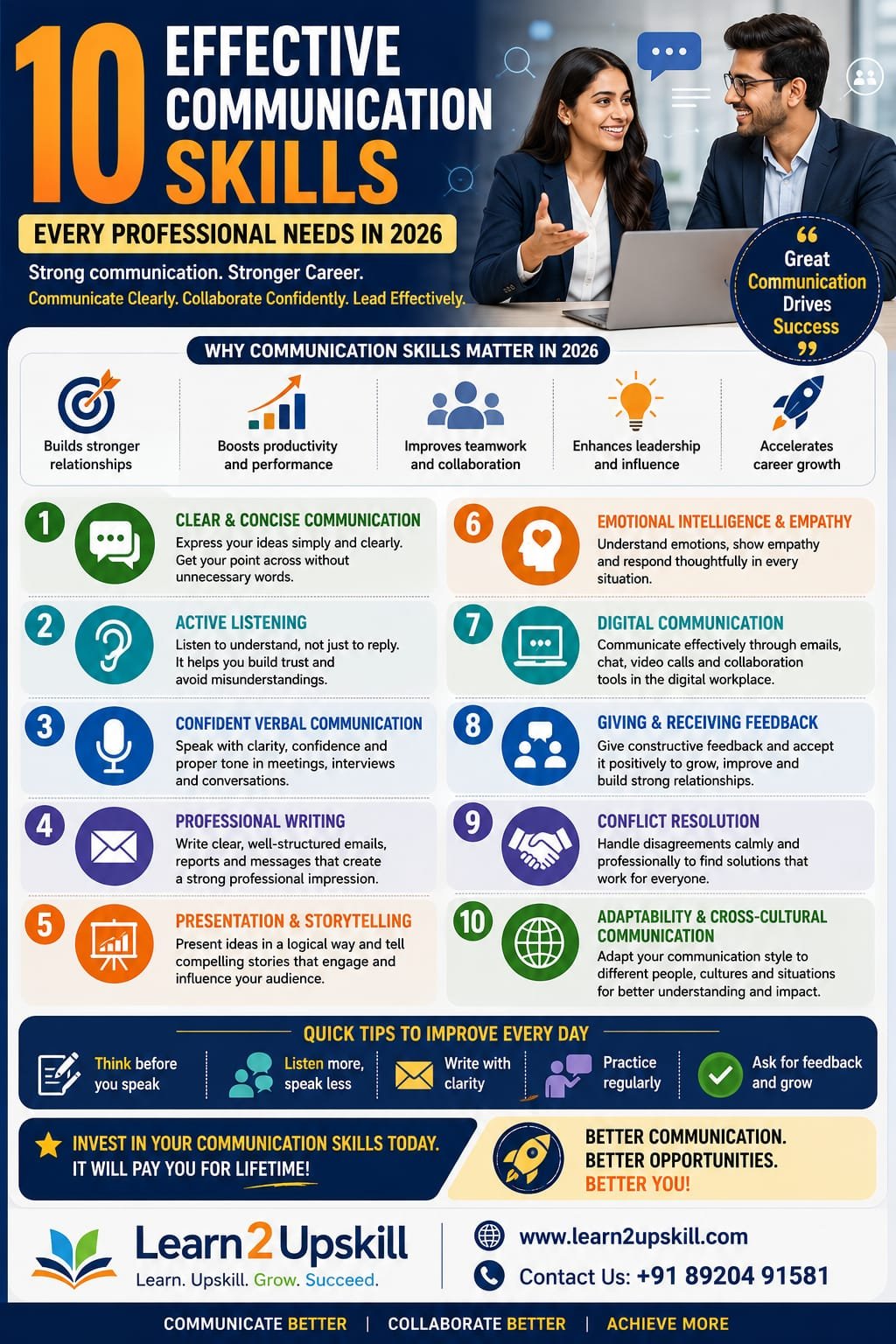
The 10 communication skills to focus on are:
Clear and concise communication
Active listening
Confident verbal communication
Professional writing
Presentation and storytelling
Emotional intelligence
Digital communication
Giving and receiving feedback
Conflict resolution
Cross-cultural adaptability
And remember:
Communication isn’t just about speaking well. It’s about making your message understood and making other people feel heard.
Start practicing one skill today.
Then build from there.
🚀 Develop Your Professional Skills With Learn2Upskill
Want to become more confident, professional and career-ready?
Explore career-focused learning resources and practical courses at Learn2Upskill.
🌐 www.coral-kudu-326218.hostingersite.com�
📞 Contact Us: +91 89204 91581
Learn. Upskill. Grow. Succeed.