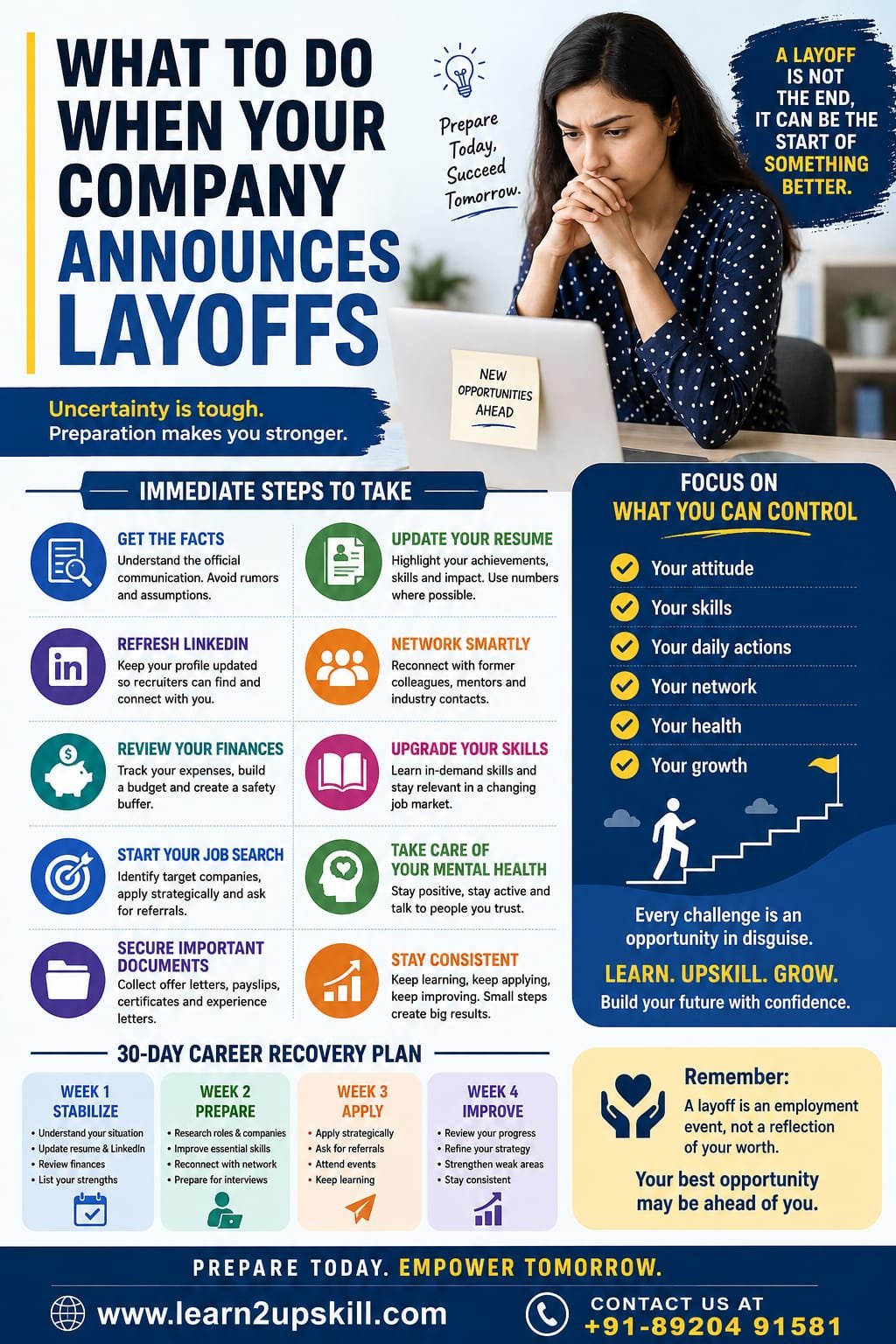
What to Do When Your Company Announces Layoffs: A Practical Guide for Employees
Meta Title: What to Do When Your Company Announces Layoffs: Complete Guide
Meta Description: Company announced layoffs? Learn what to do next, how to protect your finances, update your resume, build your network, find a new job, and turn a difficult situation into a career opportunity.
—
What to Do When Your Company Announces Layoffs
Hearing that your company is planning layoffs can be one of the most stressful experiences in your professional life.
Even if your job is not immediately affected, uncertainty can create anxiety:
* “Will I be next?”
* “Should I start looking for another job?”
* “What happens to my salary and benefits?”
* “Should I update my resume?”
* “What if I cannot find another job quickly?”
* “Will a layoff hurt my career?”
These are completely understandable concerns.
However, a company announcing layoffs does not automatically mean that your career is over. In many cases, the best thing you can do is replace panic with preparation.
A layoff can be difficult, but it can also become an opportunity to reassess your career, improve your skills, strengthen your professional network, and move toward a better role.
This guide explains exactly what you should do when your company announces layoffs—whether your position is directly affected or you simply want to prepare for the possibility.
—
- Don’t Panic—Get the Facts First
Your first reaction may be emotional, and that’s normal.
But avoid making major decisions based only on rumors.
When layoffs are announced, employees often hear different versions of the story through colleagues, WhatsApp groups, social media, or informal conversations.
Instead, find out what is officially known.
Ask:
– How many employees are affected?
– Which departments are affected?
– When will decisions be communicated?
– Is the company offering voluntary separation?
– Are certain locations or teams being reorganized?
– What happens to employees whose roles are eliminated?
– Is there a notice period?
– Will severance or other benefits be provided?
– What happens to unused leave and other employment benefits?
– Who should employees contact for official information?
Don’t assume that you will be laid off simply because your company has announced layoffs.
Wait for official communication before drawing conclusions.
At the same time, don’t ignore the warning sign. A layoff announcement is a good reason to start preparing.
—
- Find Out Whether Your Job Is Actually at Risk
Once layoffs are announced, assess your situation objectively.
Look at your department, role, responsibilities, and recent business changes.
Consider:
Is your department growing or shrinking?
If your team has recently lost projects, clients, or budgets, there may be a higher level of uncertainty.
Is your role critical to business operations?
Roles directly connected to revenue, customers, technology, compliance, or essential operations may sometimes have different risk levels than non-core functions.
Has your company been restructuring?
Mergers, acquisitions, automation, outsourcing, and business reorganizations can change which roles are needed.
Are there signs of reduced workload?
A sudden reduction in projects or responsibilities can be worth paying attention to.
However, don’t try to predict everything.
Your goal isn’t to become a workplace detective. Your goal is to become prepared.
—
- Start Preparing Before You Need a Job
One of the biggest mistakes employees make is waiting until their last working day to begin their job search.
If layoffs have been announced, start preparing immediately.
You don’t necessarily have to announce that you’re looking for a job.
Begin quietly:
– Update your resume.
– Refresh your LinkedIn profile.
– Reconnect with professional contacts.
– Research companies hiring in your field.
– Identify skills employers are currently seeking.
– Start applying selectively.
– Prepare for interviews.
– Build a list of target companies.
This gives you a significant advantage.
If your position is eventually affected, you won’t be starting from zero.
—
- Update Your Resume
Your resume should reflect what you achieved, not simply what your job description said.
Instead of writing:
«Responsible for managing digital marketing campaigns.»
Write something like:
«Managed digital marketing campaigns across multiple channels and improved lead generation through data-driven campaign optimization.»
Whenever possible, include measurable outcomes:
– Increased sales by 20%
– Reduced processing time by 30%
– Managed a team of 10
– Generated 500+ leads
– Reduced operational costs by ₹5 lakh
– Improved customer satisfaction
– Delivered projects before deadlines
Think about the value you created.
Create different versions of your resume
You don’t need to send exactly the same resume for every job.
Create versions tailored to your target roles.
For example:
Resume 1: Business Analyst
Resume 2: Data Analyst
Resume 3: Project Coordinator
The more closely your resume matches the role, the easier it becomes for recruiters to understand your suitability.
—
- Refresh Your LinkedIn Profile
Your LinkedIn profile is often one of the first places recruiters check.
Make sure your profile contains:
– A professional photograph
– A clear headline
– Updated experience
– Relevant skills
– Key achievements
– Certifications
– Projects
– Education
– A strong About section
Don’t simply write:
«Looking for new opportunities.»
Instead, clearly communicate what you do and what problems you can solve.
For example:
«Business Analyst with experience in Excel, SQL, data visualization, reporting, and business process improvement.»
This immediately tells recruiters what you bring to the table.
—
- Start Networking Before You Need Help
Networking becomes extremely important during uncertain employment periods.
But networking doesn’t mean sending messages to hundreds of strangers asking:
«“Do you have a job for me?”»
Instead, reconnect naturally with:
– Former colleagues
– Former managers
– College classmates
– Clients
– Industry professionals
– Trainers
– Recruiters
– Professional communities
A simple message can reopen a relationship.
For example:
«Hi, hope you’re doing well. It’s been a while since we connected. I’m currently exploring opportunities in business analysis and would love to stay connected and hear about any relevant opportunities you come across.»
Networking works best when it is based on relationships rather than desperation.
—
- Review Your Financial Situation
If your job may be at risk, your financial plan becomes just as important as your career plan.
Start by calculating your essential monthly expenses.
Separate them into:
Essential expenses
– Rent or home loan
– Food
– Utilities
– Education
– Insurance
– Transportation
– Loan payments
– Essential medical expenses
Non-essential expenses
– Dining out
– Shopping
– Entertainment
– Subscriptions
– Luxury purchases
– Unplanned spending
If uncertainty is increasing, temporarily reduce unnecessary expenses.
The goal isn’t to stop living your life.
The goal is to create financial breathing room.
If a layoff happens, having savings can give you time to search for the right job instead of accepting the first opportunity out of desperation.
—
- Understand Your Salary, Notice Period and Benefits
If your position is affected, carefully review the documents provided by your employer.
Understand:
– Final salary
– Notice period
– Severance, if applicable
– Unused leave
– Bonuses or incentives
– Insurance coverage
– Retirement-related benefits
– Provident fund-related procedures
– Stock or equity, if applicable
– Company equipment return requirements
– Relieving and experience letters
– Tax-related documents
Don’t sign documents you don’t understand simply because you’re under pressure.
If something is unclear, ask HR for an explanation and, where necessary, seek qualified legal or financial advice.
Employment rights and benefits vary by country, state, employment contract, and circumstances.
For example, in the United States, the federal WARN Act can require certain covered employers to provide advance notice for qualifying mass layoffs and plant closures, generally 60 days. State laws may provide additional protections.
Important: This example applies to U.S. law. Employees in India should check their employment contract and applicable Indian employment laws rather than assuming U.S. rules apply.
—
- Secure Your Professional Records—But Respect Company Confidentiality
Before leaving a company, make sure you have copies of legitimate personal and employment records you may need later.
These may include:
– Offer letter
– Promotion letters
– Salary documents
– Performance reviews
– Experience letters
– Training certificates
– Personal payslips
– Tax documents
– Benefits information
However, do not copy confidential company information.
Do not take:
– Customer databases
– Proprietary files
– Internal financial information
– Passwords
– Source code
– Confidential presentations
– Trade secrets
– Company intellectual property
Your career reputation matters more than one document.
—
- Collect Your Achievements Before You Leave
This is one of the most useful things you can do.
Make a private career achievement document containing information you are allowed to retain.
Write down:
– Projects you completed
– Problems you solved
– Awards you received
– Skills you developed
– Processes you improved
– Revenue or cost impact
– Leadership responsibilities
– Team achievements
– Positive feedback
– Major clients or industries you worked with
This information will become extremely useful when preparing your resume and answering interview questions.
Remember:
You may lose a job. You don’t lose the experience you gained from doing it.
—
- Upgrade Your Skills
A layoff—or the possibility of one—is a good time to ask:
«“What skills will make me more employable?”»
Look at job descriptions for the positions you want.
Identify the skills appearing repeatedly.
For example:
Business professionals
Consider:
– Excel
– Power BI
– SQL
– Data analysis
– Business communication
– AI productivity tools
Digital marketing professionals
Consider:
– SEO
– Google Ads
– Meta Ads
– Analytics
– Content marketing
– AI tools
Finance professionals
Consider:
– Advanced Excel
– Financial modelling
– Power BI
– Data analysis
– AI tools for finance
HR professionals
Consider:
– HR analytics
– Recruitment technology
– Excel
– People analytics
– AI tools
Don’t try to learn 20 skills simultaneously.
Choose one or two high-value skills and become genuinely competent.
Training and retraining can be part of the support available to displaced workers in some jurisdictions. For example, U.S. Department of Labor Rapid Response services can include career counseling, resume assistance, job-search support, and training opportunities.
—
- Learn How to Use AI as a Career Advantage
AI is changing the workplace rapidly.
If you are already worried about job security, learning how to work effectively with AI can make you more competitive.
Depending on your profession, learn how AI can help you with:
– Research
– Data analysis
– Writing
– Presentations
– Customer service
– Marketing
– Reporting
– Productivity
– Automation
– Content creation
But don’t simply collect AI tool names.
Learn how to use AI to solve real workplace problems.
For example:
Instead of saying:
«“I know ChatGPT.”»
Say:
«“I use AI tools to accelerate research, generate first drafts, analyze information, and automate repetitive tasks while reviewing outputs for accuracy.”»
That’s a much stronger professional skill.
—
- Begin a Focused Job Search
Don’t apply randomly to 50 jobs every day.
Instead, create a targeted strategy.
Identify:
5–10 target companies
and
2–3 job roles
that match your skills.
Then customize your applications.
Use multiple channels:
– Company career pages
– Recruitment agencies
– Professional networks
– Alumni networks
– Industry communities
– Employee referrals
Job searching is often a numbers game—but quality still matters.
Ten highly relevant applications can be more useful than 100 generic applications.
—
- Prepare Your Interview Stories
After a layoff, some candidates worry:
«“What will I say when the interviewer asks why I left my previous company?”»
The answer doesn’t need to be complicated.
If you were laid off because of restructuring, you can state the situation professionally:
«“My previous company underwent a restructuring that resulted in workforce reductions, and my position was affected. I’m now looking for an opportunity where I can apply my experience in ___ and continue developing in ___.”»
Don’t blame your previous employer.
Don’t complain about management.
Don’t turn the interview into a detailed explanation of everything that went wrong.
Keep the focus on what you learned and what you can contribute next.
—
- Don’t Hide a Layoff as a Personal Failure
A layoff can feel embarrassing.
It shouldn’t.
Companies eliminate roles for many reasons:
– Cost reduction
– Restructuring
– Mergers
– Automation
– Business downturns
– Project cancellations
– Market changes
– Strategic shifts
A layoff doesn’t automatically mean poor performance.
Your job title is one part of your professional identity—not your entire identity.
Instead of thinking:
«“I lost my job.”»
Try asking:
«“What can I build from this point?”»
That shift in thinking can make a huge difference.
—
- Take Care of Your Mental Well-Being
Career uncertainty can affect sleep, confidence, relationships, and motivation.
Don’t spend every waking hour checking job portals.
Create a daily routine.
For example:
Morning: Exercise and job applications
Afternoon: Skill development
Evening: Networking and interview preparation
Night: Disconnect from job searching
Stay connected with family and friends.
Talk to people you trust.
If anxiety or emotional distress becomes overwhelming, consider speaking with a qualified mental-health professional.
Taking care of yourself isn’t wasting time.
It helps you perform better when opportunities appear.
—
- Don’t Accept the First Job Out of Fear
If you are laid off, financial pressure can make you want to accept the first offer available.
Sometimes that’s necessary.
But if you have financial breathing room, evaluate the opportunity carefully.
Consider:
– Salary
– Job stability
– Growth opportunities
– Work culture
– Role responsibilities
– Learning opportunities
– Location
– Work-from-home or hybrid options
– Management
– Career progression
A new job should ideally move your career forward rather than simply replace your previous salary.
—
- Create a 30-Day Career Recovery Plan
If you are affected by layoffs, don’t try to solve your entire career in one day.
Break it into manageable steps.
Week 1: Stabilize
– Understand your financial situation.
– Review your employment documents.
– Update your resume.
– Update LinkedIn.
– Identify your strongest skills.
Week 2: Prepare
– Identify target companies.
– Research job descriptions.
– Start improving one high-value skill.
– Contact former colleagues.
– Prepare interview answers.
Week 3: Apply
– Start targeted applications.
– Ask for referrals.
– Contact recruiters.
– Attend professional events.
– Continue skill development.
Week 4: Improve
Review your results.
Ask:
– How many applications did I send?
– How many interviews did I receive?
– Which roles responded?
– Which skills are missing?
– Is my resume working?
– Do I need to improve my interview skills?
Then adjust your strategy.
—
- Turn a Layoff Into a Career Reset
Sometimes a layoff forces you to make a decision you’ve been postponing.
Maybe you have wanted to:
– Change careers
– Start freelancing
– Learn technology
– Move into management
– Start a business
– Work remotely
– Become a consultant
– Pursue a certification
– Return to education
You don’t have to make a dramatic change immediately.
But this can be a good moment to ask:
«“If I could redesign my career today, what would I want it to look like?”»
Your next chapter doesn’t have to be a copy of your previous one.
—
Final Thoughts
When your company announces layoffs, uncertainty is unavoidable—but helplessness isn’t.
The best response is preparation.
Get the facts.
Protect your finances.
Update your resume.
Strengthen your LinkedIn profile.
Reconnect with your network.
Upgrade your skills.
Learn how to use AI effectively.
Prepare for interviews.
Start your job search early.
Most importantly, remember that a layoff is an employment event—not a definition of your worth or potential.
The skills, experience, relationships, and knowledge you’ve built throughout your career stay with you.
And sometimes, the career opportunity you find after a difficult transition turns out to be better than the job you lost.
Don’t wait until your job disappears to prepare for your next opportunity. Start preparing today.
—
Quick Layoff Preparation Checklist
– [ ] Understand the company’s official layoff announcement.
– [ ] Determine whether your role or department may be affected.
– [ ] Review your employment contract.
– [ ] Understand your notice period and benefits.
– [ ] Calculate your essential monthly expenses.
– [ ] Update your resume.
– [ ] Refresh your LinkedIn profile.
– [ ] Document your professional achievements.
– [ ] Reconnect with your professional network.
– [ ] Research target companies.
– [ ] Identify in-demand skills in your industry.
– [ ] Learn at least one valuable new skill.
– [ ] Improve your interview skills.
– [ ] Begin a targeted job search.
– [ ] Maintain a healthy daily routine.
—
Looking to Upskill for Your Next Career Opportunity?
The job market keeps changing, and staying employable requires continuous learning.
At Learn2upskill, you can explore practical learning resources and courses designed to help students, professionals, job seekers, and career changers build relevant skills for today’s workplace.
From AI and digital skills to Excel, business analysis, digital marketing, cybersecurity, and professional development, learning the right skills can help you approach career transitions with greater confidence.
Learn. Upskill. Grow.
🌐 www.coral-kudu-326218.hostingersite.com
Contact Us: +91-89204 91581
—
Leave a Reply