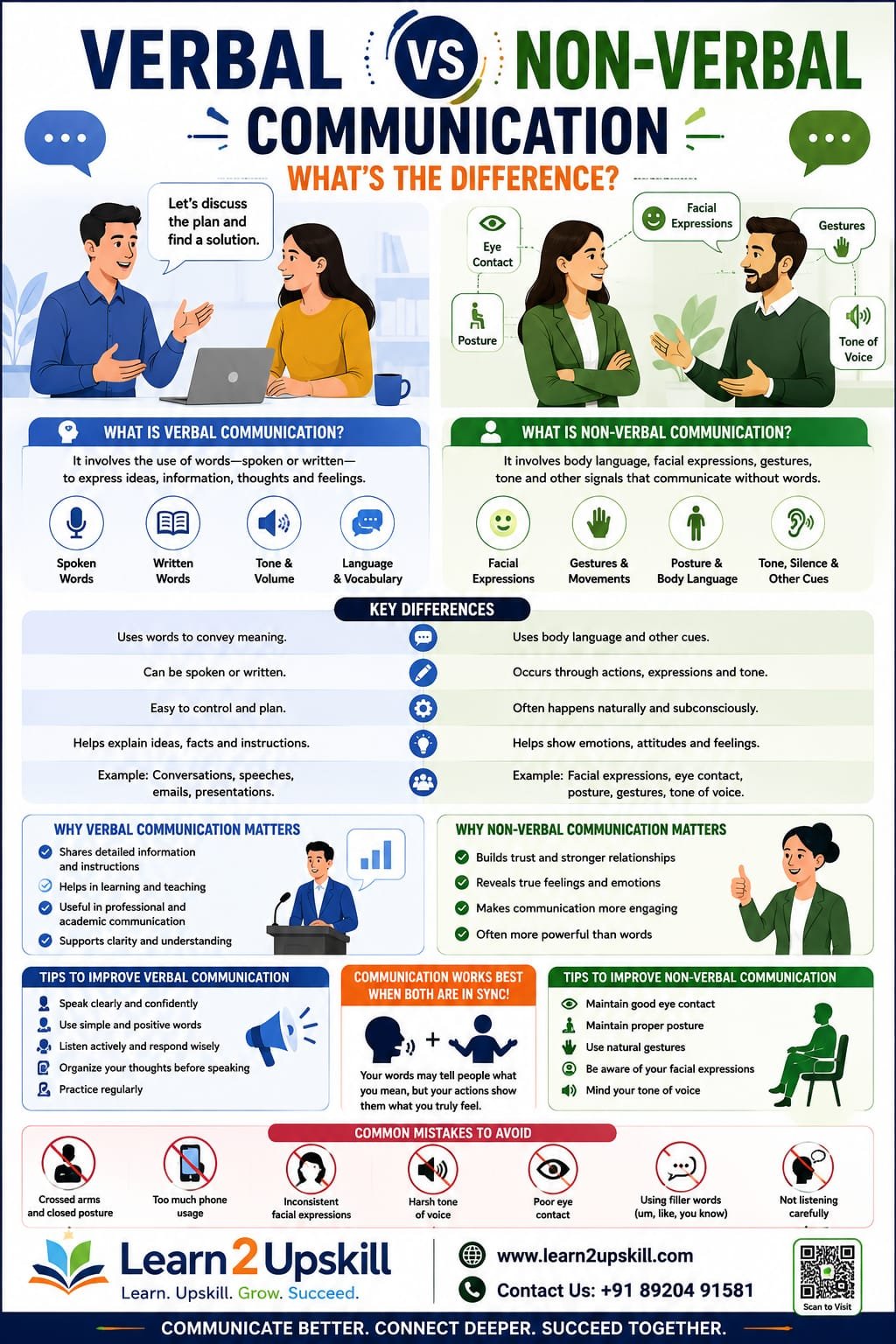
Verbal vs Non-Verbal Communication: What’s the Difference?
Learn the difference between verbal and non-verbal communication, with examples, benefits, common mistakes and practical tips for students and professionals.
Suggested URL Slug: /verbal-vs-non-verbal-communication/
Every day, we communicate through words, tone of voice, facial expressions, gestures, posture, eye contact and even silence. In professional and academic environments, understanding both verbal and non-verbal communication can help you express ideas more clearly, build stronger relationships and avoid misunderstandings.
Imagine a professional saying:
“I’m happy with the results.”
But they say it with a flat voice, avoid eye contact and look visibly frustrated.
The words say one thing.
The non-verbal signals may suggest something completely different.
This is why understanding verbal vs non-verbal communication is an essential part of developing effective communication skills.
What Is Verbal Communication?
Verbal communication is communication that uses words to share information, ideas, opinions, instructions or feelings.
It can happen through:
Face-to-face conversations
Phone calls
Meetings
Interviews
Presentations
Classroom discussions
Group discussions
Video conferences
Speeches
Verbal communication can be formal or informal depending on the situation.
Example
A manager says:
“Please submit the report by Friday afternoon.”
This is verbal communication because the message is delivered through spoken words.
What Is Non-Verbal Communication?
Non-verbal communication is the communication of meaning without relying primarily on spoken words.
It includes:
Facial expressions
Eye contact
Gestures
Posture
Body movements
Tone and vocal cues
Personal space
Appearance
Physical presence
Silence
For example, someone may say:
“Yes, I understand.”
But if they are looking away, constantly checking their phone and showing confusion on their face, their non-verbal behavior may suggest that they don’t fully understand.
Verbal vs Non-Verbal Communication: The Key Difference
The simplest distinction is:
Verbal communication = the words you use.
Non-verbal communication = the signals you send through your behavior and physical cues.
However, there is an important nuance: tone of voice and vocal qualities are often classified as non-verbal or paraverbal communication, depending on the communication framework being used.
For practical workplace communication, it’s useful to think about three layers:
Words → Voice → Body Language
For example:
“That’s a great idea.”
Words: Positive
Tone: Enthusiastic or sarcastic
Body language: Open and engaged or closed and dismissive
The complete message comes from all three.
Verbal vs Non-Verbal Communication: Comparison
Verbal Communication
Non-Verbal Communication
Uses words
Uses physical and behavioral signals
Can be spoken or language-based
Often communicates without words
Includes conversations and presentations
Includes gestures and facial expressions
Useful for explaining detailed information
Useful for expressing emotions and attitudes
Can be planned carefully
Can sometimes happen unconsciously
Includes vocabulary and sentence structure
Includes posture, eye contact and gestures
Can be formal or informal
Can reinforce or contradict spoken words
Important for instructions and explanations
Important for relationships and emotional communication
Examples of Verbal Communication
Let’s look at some everyday examples.
- Job Interview
A candidate says:
“I enjoy working as part of a team.”
That’s verbal communication.
But the interviewer also notices how confidently the candidate explains the answer.
- Workplace Meeting
A team leader says:
“We need to complete this project by the end of the month.”
The spoken statement communicates the deadline.
- Presentation
A professional explains quarterly business results to senior management.
The information delivered through spoken language is verbal communication.
- Classroom Discussion
A student answers a teacher’s question and explains their reasoning.
Again, this is verbal communication.
Examples of Non-Verbal Communication
- Eye Contact
Appropriate eye contact can demonstrate attention and engagement.
However, cultural expectations around eye contact can vary, so it is important not to treat one level of eye contact as universally “correct.”
- Facial Expressions
A smile can communicate friendliness.
A frown may communicate concern or disagreement.
Raised eyebrows can suggest surprise.
Facial expressions can provide additional information alongside spoken words.
- Posture
Your posture can influence how others perceive your confidence and engagement.
For example:
Open posture: May appear approachable and engaged.
Closed posture: May sometimes appear defensive, uncomfortable or disengaged.
Remember that body language should always be interpreted in context.
- Gestures
Hand movements can help emphasize an idea.
For example, a presenter may use their hands to show:
Size
Direction
Sequence
Comparison
Too many gestures, however, can become distracting.
- Personal Space
The physical distance people prefer during conversations can communicate comfort, formality or familiarity.
Personal-space expectations vary significantly across cultures and situations.
Why Is Non-Verbal Communication Important?
Non-verbal communication can influence how people interpret your message.
Imagine two employees saying:
“I understand.”
Employee A maintains appropriate attention, nods naturally and appears engaged.
Employee B looks at their phone and repeatedly looks away.
Although the words are identical, the overall impression can be very different.
Non-verbal communication can help:
Build trust
Consistent verbal and non-verbal signals can make communication feel more genuine.
Show attention
Appropriate eye contact, posture and listening behavior can demonstrate engagement.
Express emotions
Facial expressions and vocal cues can communicate emotions that words don’t fully capture.
Support presentations
Gestures, posture and facial expressions can make presentations more engaging.
Strengthen relationships
Positive non-verbal behavior can help create a comfortable communication environment.
Can Non-Verbal Communication Contradict Verbal Communication?
Yes.
This is one of the most important concepts to understand.
Suppose someone says:
“I’m not angry.”
But they are:
Speaking loudly
Frowning
Clenching their fists
Avoiding a calm conversation
The non-verbal signals may suggest emotional tension.
However, you shouldn’t automatically assume the person is lying or angry.
Context matters.
Body language is not a perfect lie detector.
Someone may avoid eye contact because they are:
Nervous
Thinking
Uncomfortable
Distracted
From a culture with different eye-contact norms
So instead of immediately interpreting one gesture, look at the overall pattern and situation.
The Role of Tone of Voice
Tone is extremely important in communication.
Consider the sentence:
“That’s interesting.”
Depending on how it is said, it could communicate:
Genuine interest
Surprise
Doubt
Sarcasm
Disagreement
The words haven’t changed.
The tone has.
That’s why professional communication requires attention not only to what you say, but also to how you say it.
Verbal and Non-Verbal Communication Work Together
The most effective communication usually combines both.
For example, imagine a manager telling an employee:
“You’ve done a great job on this project.”
If the manager:
Uses a warm tone
Makes appropriate eye contact
Smiles naturally
Gives specific praise
the message may feel more sincere.
The words and non-verbal signals support each other.
How to Improve Your Verbal Communication Skills
- Think Before You Speak
Take a moment to organize your thoughts.
Ask:
What is my main message?
- Use Simple Language
Don’t use complicated words just to sound professional.
Clear communication is usually more effective than unnecessarily complex communication.
- Speak at a Comfortable Pace
Speaking too quickly can make your message difficult to understand.
Pause between important points.
- Improve Your Vocabulary
Reading regularly can help you develop vocabulary and become more comfortable expressing ideas.
- Practice Explaining Ideas
Choose a topic and explain it aloud for two or three minutes.
Record yourself and listen back.
- Ask Questions
Good communication isn’t just about answering questions.
Asking thoughtful questions demonstrates attention and curiosity.
How to Improve Your Non-Verbal Communication
- Maintain Appropriate Eye Contact
Look at the person you’re communicating with without staring continuously.
In group settings, naturally distribute your attention across the group.
- Improve Your Posture
Sit or stand comfortably upright.
Avoid constantly slouching or appearing disengaged.
- Use Natural Facial Expressions
Let your expressions match the conversation.
Don’t force a smile or exaggerated reaction.
- Control Distracting Gestures
Gestures can be helpful, but repetitive movements may distract your audience.
- Pay Attention to Your Tone
Before an important conversation, think about whether your tone matches your intended message.
- Observe Others
Watch how effective speakers communicate.
Pay attention to:
Their pace
Pauses
Facial expressions
Gestures
Posture
Audience engagement
Then practice what works for you.
Verbal and Non-Verbal Communication in the Workplace
Communication skills are especially important in professional environments.
Consider a team meeting.
A professional needs to:
Verbally:
Explain ideas
Ask questions
Give updates
Share opinions
Provide feedback
Non-verbally:
Listen attentively
Use appropriate eye contact
Demonstrate engagement
Respond naturally
Maintain professional body language
Both work together.
Communication During Job Interviews
Job interviews are a perfect example of verbal and non-verbal communication working together.
Verbal communication includes:
How you answer questions
How clearly you explain your experience
Your vocabulary
Your examples
Your ability to structure answers
Non-verbal communication includes:
Posture
Facial expressions
Eye contact
Hand gestures
Listening behavior
Tone
Interview tip
Don’t try to “perform” perfect body language.
Instead, focus on:
Listening → Understanding → Answering clearly → Staying natural
Authenticity generally works better than trying to memorize a list of body-language tricks.
Communication in Online Meetings
Non-verbal communication becomes slightly different when working remotely.
In video meetings, people may rely heavily on:
Facial expressions
Voice
Camera positioning
Eye gaze
Head movements
Digital reactions
Screen-sharing behavior
Tips for online meetings
Check your camera position.
Use appropriate lighting.
Avoid constantly looking at your phone.
Listen actively.
Don’t interrupt unnecessarily.
Use clear verbal responses.
Keep your background and appearance professional where appropriate.
Remember that online communication also includes written channels such as email, chat and collaboration tools.
Common Verbal Communication Mistakes
Avoid these habits:
❌ Speaking without organizing your thoughts
Your audience may struggle to follow you.
❌ Using too many filler words
Words like “um,” “actually,” “basically” and “like” can become distracting when overused.
❌ Speaking too quickly
Slow down and allow people to process your message.
❌ Using unnecessary jargon
Technical terms are useful when your audience understands them, but not when they create confusion.
❌ Interrupting
Let people finish their thoughts.
Common Non-Verbal Communication Mistakes
❌ Looking constantly at your phone
This can signal disengagement.
❌ Closed or distracted posture
Your physical behavior can affect how approachable you appear.
❌ Excessive gestures
Too much movement can distract from your message.
❌ Ignoring facial expressions
Your expression can communicate emotions you may not intend to show.
❌ Misinterpreting individual gestures
Never assume one gesture has one universal meaning.
Context is king.
How Students Can Improve Both Skills
Students can practice verbal and non-verbal communication through everyday activities.
Try:
Classroom presentations
Debates
Group discussions
Public speaking
Storytelling
Mock interviews
Reading aloud
Recording presentations
Participating in student activities
After every presentation, ask:
Was my message clear?
Did I speak confidently?
Did my body language support my message?
Did I listen to questions carefully?
How Professionals Can Improve Both Skills
Professionals can practice communication during regular workplace activities.
Before a meeting:
Prepare your key points.
During the meeting:
Listen actively and contribute clearly.
During presentations:
Use structured explanations and natural gestures.
During difficult conversations:
Stay calm and pay attention to tone.
After meetings:
Confirm important decisions in writing when appropriate.
This last step is particularly useful in modern workplaces because clear written records can reduce confusion.
Verbal vs Non-Verbal Communication: Quick Example
Imagine a manager says:
“I’m confident we’ll complete this project successfully.”
Verbal message:
The manager communicates confidence.
Tone:
An enthusiastic and steady tone can reinforce that confidence.
Body language:
An open posture and attentive facial expression can further support the message.
Overall communication:
The words, voice and body language work together to create a stronger message.
The 3C Formula for Better Communication
A simple way to improve your communication is to remember the 3Cs:
- Clear
Make your message easy to understand.
- Concise
Avoid unnecessary information.
- Consistent
Make sure your words, tone and behavior support the same message.
When these three work together, communication becomes more effective.
Frequently Asked Questions
What is the difference between verbal and non-verbal communication?
Verbal communication primarily uses words to communicate information, while non-verbal communication uses signals such as facial expressions, gestures, posture, eye behavior and other physical or behavioral cues.
Is body language verbal or non-verbal communication?
Body language is a form of non-verbal communication. It includes posture, gestures, facial expressions and body movements.
Why is non-verbal communication important?
Non-verbal communication can reinforce spoken messages, express emotions, demonstrate attention and influence how a message is interpreted.
Which is more important: verbal or non-verbal communication?
Neither should be considered universally more important. Effective communication depends on how words, voice, behavior and context work together.
Can body language be misunderstood?
Yes. Body language is highly dependent on context, culture and individual differences. One gesture should not automatically be interpreted as having a specific meaning.
How can I improve my communication skills?
Practice speaking clearly, listen actively, improve your writing, observe your body language, participate in presentations and discussions, and ask others for constructive feedback.
Are verbal and non-verbal communication important for job interviews?
Yes. Interviews involve both. Your answers communicate your knowledge and experience, while your tone, facial expressions, posture and listening behavior contribute to the overall interaction.
Conclusion
Verbal and non-verbal communication are two essential parts of effective communication.
Verbal communication tells people what you want to say.
Non-verbal communication can influence how your message is received.
The strongest communicators understand that both matter.
Whether you’re a student preparing for a presentation, a fresher attending a job interview or an experienced professional leading a team, developing both skills can help you communicate with greater clarity and confidence.
Remember:
Don’t just focus on what you say. Pay attention to how you say it, how you listen and what your behavior communicates.
Start with small improvements.
Speak clearly.
Listen carefully.
Use natural body language.
Pay attention to tone.
And always consider your audience.
Better communication can lead to better understanding, stronger relationships and greater professional opportunities.
🚀 Improve Your Communication Skills With Learn2Upskill
Ready to become a more confident communicator?
Develop practical communication, professional and career-ready skills with Learn2Upskill.
🌐 www.coral-kudu-326218.hostingersite.com�
📞 Contact Us: +91 89204 91581
Learn. Upskill. Grow. Succeed.
Leave a Reply