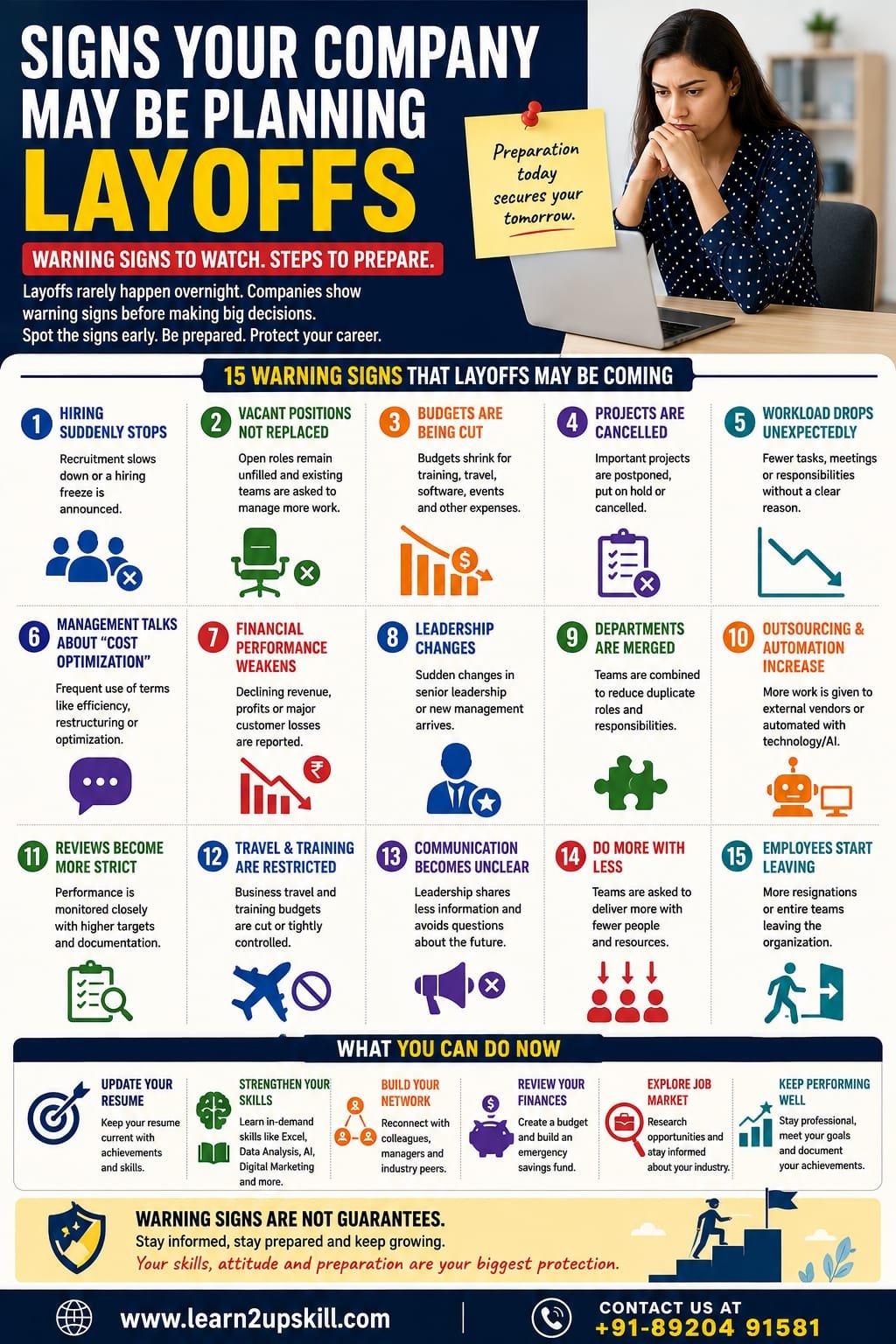
Signs Your Company May Be Planning Layoffs: 15 Warning Signs to Watch
Learn the common signs your company may be planning layoffs, from hiring freezes and budget cuts to restructuring and reduced workloads—and what you can do to prepare.
—
Signs Your Company May Be Planning Layoffs
Nobody wants to hear the words “workforce reduction” or “organizational restructuring.”
But when a company starts experiencing financial pressure or changing its business strategy, there may be warning signs before layoffs are officially announced.
The important thing to remember is that one warning sign does not automatically mean layoffs are coming. Companies make changes for many reasons, and some restructuring decisions have nothing to do with job cuts.
However, if several signs appear at the same time, it may be sensible to start preparing for different career scenarios.
The goal isn’t to panic or spread workplace rumors.
The goal is simple:
«Stay informed, stay professional, and make sure you are prepared.»
Here are 15 signs that may indicate your company is considering layoffs—and what you can do about them.
—
- Hiring Suddenly Stops
A company that was previously hiring aggressively may suddenly announce a hiring freeze.
Open positions may disappear from the careers page, recruitment may slow down, or managers may be told not to replace employees who leave.
A hiring freeze doesn’t necessarily mean layoffs are coming. It can simply mean the company wants to control costs.
However, if a hiring freeze appears alongside other cost-cutting measures, it is worth paying attention.
What you can do:
– Keep your resume updated.
– Monitor your industry’s job market.
– Strengthen your professional network.
– Continue developing relevant skills.
—
- Vacant Positions Are Not Being Replaced
Imagine someone leaves your department and management decides not to hire a replacement.
Instead, their responsibilities are distributed among existing employees.
If this happens repeatedly, it may indicate that management is trying to reduce staffing costs.
You may notice phrases such as:
– “We’ll manage with the current team.”
– “Let’s see if we can absorb the workload.”
– “This position is on hold.”
Pay attention to patterns rather than one isolated vacancy.
—
- Budgets Are Being Cut
Budget reductions can be an early warning sign of financial pressure.
You may notice:
– Training budgets being reduced
– Business travel restricted
– Office events cancelled
– Software subscriptions being reviewed
– Team-building activities reduced
– Equipment purchases delayed
– Department budgets frozen
Some cost-cutting is completely normal.
But when multiple departments are being asked to reduce expenses at the same time, employees should take notice.
—
- Projects Are Suddenly Cancelled
If important projects are repeatedly postponed, cancelled, or put “on hold,” it may indicate changing business priorities.
This can happen because of:
– Lower revenue
– Loss of customers
– Changing market conditions
– New leadership
– Budget restrictions
– Strategic restructuring
If your role depends heavily on a project that has been cancelled, think about how your skills can transfer to other areas.
—
- Your Workload Drops Unexpectedly
A sudden and unexplained reduction in workload can sometimes be concerning.
For example, you may notice:
– Fewer projects
– Fewer meetings
– Reduced responsibilities
– Important tasks being reassigned
– Long-term projects disappearing
However, don’t immediately assume you’re being targeted.
Workloads naturally change.
The important question is whether the reduction is part of a broader organizational pattern.
—
- Senior Management Starts Talking About “Cost Optimization”
Pay attention to the language used by leadership.
Terms such as:
– Cost optimization
– Efficiency
– Restructuring
– Operational efficiency
– Organizational redesign
– Business transformation
– Workforce optimization
– Strategic realignment
can sometimes indicate that management is reviewing staffing and operating costs.
These phrases do not automatically mean layoffs.
But if they’re repeatedly mentioned alongside declining business performance or budget cuts, employees should prepare themselves.
—
- Your Company Reports Financial Problems
Financial difficulties can increase the possibility of workforce reductions.
Watch for official announcements about:
– Declining revenue
– Losses
– Falling profits
– Major customer losses
– Debt problems
– Reduced forecasts
– Store or office closures
– Business-unit restructuring
Public companies usually provide financial information through official disclosures and investor communications.
Don’t rely solely on workplace gossip.
—
- Leadership Changes Suddenly Increase
A sudden change in senior leadership can sometimes lead to restructuring.
A new CEO, CFO, business head, or department leader may review:
– Teams
– Budgets
– Projects
– Processes
– Organizational structures
– Performance
This doesn’t mean layoffs will definitely happen.
But leadership transitions can create changes in priorities, and some roles may be affected.
If your company has recently undergone major leadership changes, stay informed about its strategic direction.
—
- Departments Start Getting Merged
If two departments are suddenly combined, management may be looking for ways to eliminate duplicated responsibilities.
For example:
Marketing + Communications
or
Customer Support + Operations
When two teams perform overlapping functions, some roles may be redesigned or eliminated.
If your department is being merged with another, focus on demonstrating the skills that make you valuable to the combined team.
—
- Outsourcing and Automation Increase
Companies often adopt technology, automation, or outsourcing to reduce costs or improve efficiency.
You may notice:
– Repetitive work being automated
– External vendors taking over certain tasks
– AI tools replacing manual processes
– Customer service moving to external providers
– Finance or HR processes being outsourced
– New software reducing manual work
This doesn’t necessarily mean everyone performing those tasks will lose their jobs.
It does mean your skills may need to evolve.
The smart response:
Don’t compete with technology by refusing to use it.
Learn how to work with technology.
For example, an employee who understands both business processes and AI automation may become more valuable than someone who only performs manual tasks.
—
- Performance Reviews Become More Frequent or Strict
Changes in performance management can sometimes accompany restructuring.
You may notice:
– More frequent performance reviews
– New performance targets
– Increased documentation
– Tighter deadlines
– New productivity measurements
– More formal performance improvement processes
This doesn’t automatically indicate layoffs.
Companies may simply be improving performance management.
However, if these changes happen at the same time as cost reductions and restructuring, employees should take them seriously.
—
- Travel and Training Are Suddenly Restricted
Training and business travel are often among the first discretionary expenses companies reduce when budgets become tighter.
You might hear:
«“Only essential travel is approved.”»
or:
«“Training budgets are temporarily frozen.”»
Again, this isn’t proof that layoffs are coming.
But if travel restrictions appear together with hiring freezes, project cancellations, and other cost-cutting measures, the overall picture becomes more important.
—
- Communication From Leadership Becomes Less Clear
Employees sometimes notice a change in communication before major organizational decisions are announced.
For example:
– Town halls become less frequent.
– Questions about future plans receive vague answers.
– Meetings are cancelled.
– Leadership avoids discussing budgets.
– Managers appear unable to provide clear information.
This can happen for innocent reasons too.
Management may simply be waiting for decisions to be finalized.
Avoid filling information gaps with rumors.
Instead, rely on official communication.
—
- Employees Are Being Asked to Do More With Less
If teams are repeatedly told to:
«“Do more with fewer resources.”»
it may indicate that management is trying to improve productivity without increasing headcount.
This can lead to:
– Increased workloads
– Hiring restrictions
– Role consolidation
– Process automation
– Reduced team sizes
If you find yourself taking on additional responsibilities, document what you’re doing.
Those responsibilities can strengthen your resume and demonstrate your adaptability.
—
- Former Colleagues or Entire Teams Start Leaving
If experienced employees begin leaving unexpectedly—or entire teams are being reorganized—pay attention.
Sometimes employees leave because they see changes coming.
But don’t assume that every resignation is connected to layoffs.
Instead, look for the broader pattern:
Are people leaving? Are vacancies being replaced? Are budgets shrinking? Are projects disappearing? Is management restructuring teams?
The combination matters more than any single event.
—
What Should You Do If You Notice Several Warning Signs?
Seeing multiple warning signs can be stressful.
But panic isn’t productive.
Instead, take practical steps.
- Update Your Resume
Don’t wait until you’re unemployed.
Add:
– Recent achievements
– New skills
– Projects
– Certifications
– Measurable results
—
- Update LinkedIn
Make sure recruiters can understand your professional background quickly.
Highlight your strongest skills and achievements.
—
- Build Your Professional Network
Reconnect with:
– Former colleagues
– Managers
– College friends
– Recruiters
– Industry professionals
– Mentors
Networking is much easier when you’re still employed.
—
- Strengthen Your Skills
Look at current job descriptions and identify the skills employers want.
Consider learning:
– AI tools
– Advanced Excel
– Data analysis
– Power BI
– SQL
– Digital marketing
– Cybersecurity
– Financial modelling
– Business communication
– Project management
Choose skills that match your career goals rather than trying to learn everything.
—
- Review Your Finances
Calculate your essential monthly expenses.
If your job security is uncertain, temporarily reduce unnecessary spending and work toward building an emergency financial buffer.
—
- Start Exploring the Job Market
You don’t necessarily need to resign.
You can quietly research:
– Available jobs
– Companies hiring
– Salary expectations
– Required skills
– Career opportunities
This helps you understand your options.
—
- Keep Doing Your Job Well
This is extremely important.
Don’t become disengaged simply because you are worried.
Continue to:
– Meet deadlines
– Communicate professionally
– Support your team
– Deliver quality work
– Document your achievements
Your professional reputation can help you long after you leave your current employer.
—
What NOT to Do When You Suspect Layoffs
Don’t spread rumors
You may accidentally create unnecessary panic.
Don’t confront management aggressively
Ask professional questions through appropriate channels.
Don’t stop working
Keep maintaining your performance.
Don’t post angry messages about your company online
Social media posts can affect your future opportunities.
Don’t share confidential information
Protect your employer’s information and your own professional reputation.
Don’t wait until the last minute
Preparation is most powerful when you start early.
—
Remember: Warning Signs Are Not Guarantees
It’s important to maintain perspective.
A hiring freeze doesn’t automatically mean layoffs.
A cancelled project doesn’t automatically mean layoffs.
A new CEO doesn’t automatically mean layoffs.
Budget cuts don’t automatically mean layoffs.
Companies change their strategies all the time.
The purpose of watching for warning signs isn’t to predict the future with certainty.
It’s to make sure you aren’t caught completely unprepared if your situation changes.
Think of it as career insurance.
—
Build a Career That Can Adapt
The safest career isn’t necessarily the one with the most impressive job title.
It’s the career built around valuable, transferable, and continuously updated skills.
Ask yourself regularly:
«“If my current job disappeared tomorrow, what could I offer another employer?”»
If the answer is clear, you’re already in a stronger position.
Keep learning.
Keep networking.
Keep documenting your achievements.
Keep your resume updated.
And learn how technology—including AI—is changing your industry.
—
Final Thoughts
Corporate layoffs are difficult, but uncertainty doesn’t have to leave you powerless.
If you notice several warning signs—such as hiring freezes, budget cuts, project cancellations, restructuring, outsourcing, or declining business performance—don’t panic.
Instead, prepare quietly and professionally.
Update your resume.
Strengthen your network.
Build in-demand skills.
Review your finances.
Explore the job market.
And most importantly, continue doing good work.
Your company may change its strategy.
Your department may change.
Your job title may change.
But the skills and experience you build throughout your career belong to you.
Don’t wait for a layoff announcement to start thinking about your next opportunity.
Prepare today. Upskill today. Stay ready for tomorrow.
—
Quick Layoff Warning Signs Checklist
– [ ] Hiring freeze
– [ ] Vacant positions aren’t being replaced
– [ ] Department budgets are being reduced
– [ ] Projects are being cancelled
– [ ] Workloads are declining
– [ ] Management discusses cost optimization
– [ ] Company financial performance is weakening
– [ ] Senior leadership changes
– [ ] Departments are being merged
– [ ] Outsourcing or automation is increasing
– [ ] Performance monitoring becomes stricter
– [ ] Travel and training budgets are reduced
– [ ] Leadership communication becomes unclear
– [ ] Employees are asked to do more with fewer resources
– [ ] Teams are being reorganized
—
Future-Proof Your Career With Learn2upskill
The workplace is changing quickly. AI, automation, new technologies, and evolving business requirements are changing the skills employers need.
At Learn2upskill, we help students and professionals develop practical skills for today’s changing workplace.
Explore learning opportunities in areas such as:
AI • Excel • Business Analysis • Digital Marketing • Cybersecurity • Data Skills • Professional Development
Don’t wait for a career crisis to start learning.
Learn. Upskill. Grow.
🌐 www.coral-kudu-326218.hostingersite.com
Contact Us: +91-89204 91581
—
Leave a Reply