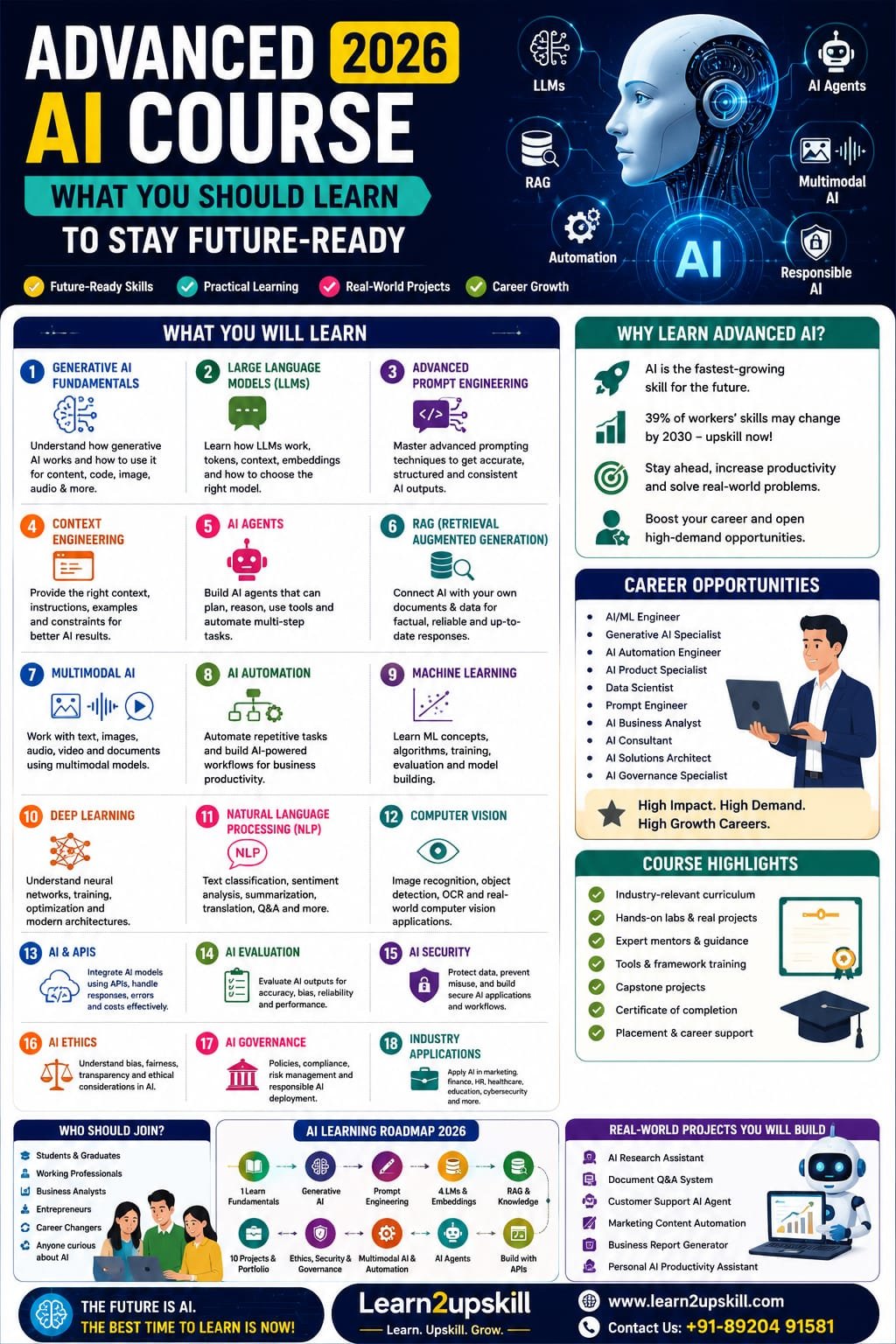
Advanced AI Course 2026: Skills, Syllabus & Career Guide
Suggested URL Slug: /advanced-ai-course-2026/
Advanced AI Course: What You Should Learn in 2026
Artificial intelligence has moved far beyond simple chatbots and basic AI tools.
A few years ago, learning AI might have meant understanding machine learning fundamentals or experimenting with a chatbot.
Today, the AI landscape includes Generative AI, large language models, AI agents, multimodal AI, retrieval-augmented generation, AI automation, computer vision, AI security and responsible AI.
For students and professionals, this creates an important question:
What should you actually learn if you want to build advanced AI skills in 2026?
The answer isn’t simply “learn ChatGPT.”
An advanced AI learner should understand how AI works, how to use AI effectively, how to build AI-powered workflows, how AI systems interact with data, and how to apply AI responsibly in real-world situations.
The World Economic Forum’s Future of Jobs Report 2025 identifies AI and big data as the fastest-growing skill area, followed by networks and cybersecurity and technological literacy. It also emphasizes that human capabilities such as analytical thinking, creative thinking, resilience and leadership remain important. �
World Economic Forum +1
India’s current national AI-skilling initiatives reflect a similar direction, covering areas from foundational AI through advanced topics such as Agentic AI, LLMs, Deep Learning, Computer Vision, AI Security and AI Governance. �
Press Information Bureau +1
So, what should an Advanced AI Course in 2026 actually include?
Let’s break it down.
What Is an Advanced AI Course?
An advanced AI course goes beyond learning how to use individual AI tools.
It should teach you how to understand, evaluate, build and apply AI systems.
A good advanced AI course can include:
Generative AI
Large Language Models
Advanced Prompt Engineering
Context Engineering
AI Agents
Retrieval-Augmented Generation
AI Automation
Multimodal AI
Machine Learning
Deep Learning
Natural Language Processing
Computer Vision
AI APIs
AI-powered applications
AI Security
AI Ethics
AI Governance
Real-world AI projects
You don’t necessarily need to become a machine-learning researcher.
The right depth depends on your career goal.
Why Learn Advanced AI in 2026?
AI is rapidly changing how organizations work.
The World Economic Forum reports that AI and information-processing technologies are among the technologies employers expect to have a major transformative impact through 2030. AI and big data also rank at the top of its fastest-growing skills list. �
World Economic Forum
The report also estimates that around 39% of workers’ existing skill sets could be transformed or become outdated between 2025 and 2030. �
World Economic Forum
That doesn’t mean everyone needs to become an AI engineer.
It does mean that understanding AI is becoming increasingly useful across many professions.
For example:
Marketing + AI
Finance + AI
HR + AI
Business Analysis + AI
Cybersecurity + AI
Education + AI
Healthcare + AI
Operations + AI
The future isn’t necessarily about becoming an AI specialist.
For many people, it’s about becoming a professional who knows how to work effectively with AI.
1. Start With Advanced Generative AI
Generative AI is one of the most important areas to understand.
You should learn how AI systems can generate:
Text
Images
Audio
Video
Code
Summaries
Reports
Structured information
But don’t stop at simply generating content.
Learn how to:
Give effective instructions
Provide context
Control outputs
Evaluate results
Refine responses
Build repeatable workflows
Use AI responsibly
The goal is to move from:
“I know how to use an AI chatbot.”
to:
“I know how to integrate generative AI into my work.”
2. Learn Large Language Models (LLMs)
Large Language Models, or LLMs, power many modern generative-AI applications.
You don’t necessarily need to train a giant model from scratch.
But you should understand concepts such as:
What an LLM is
How language models process information
Tokens
Context windows
Model limitations
Hallucinations
Model evaluation
Fine-tuning concepts
Embeddings
APIs
Model selection
Understanding these concepts helps you make better decisions when using AI tools.
3. Master Advanced Prompt Engineering
Basic prompting is only the beginning.
Advanced AI learners should understand how to design prompts systematically.
Topics can include:
Role prompting
Few-shot prompting
Structured prompting
Output constraints
Context management
Prompt templates
Multi-step prompting
Evaluation prompts
Prompt refinement
Task decomposition
For example, instead of:
“Analyze this data.”
an advanced workflow might specify:
The role of the AI
The business objective
The available data
The analysis criteria
The expected output format
Limitations
Validation requirements
The result is usually much more useful.
4. Learn Context Engineering
As AI systems become more capable, simply writing a clever prompt isn’t always enough.
You need to understand what information the AI should receive and how that information should be structured.
This includes:
Relevant context
User instructions
Reference documents
Examples
Data sources
Constraints
Conversation history
Output requirements
Think of it as giving AI the right information at the right time.
This becomes especially important when building AI applications and agents.
5. Understand AI Agents
This is one of the most important advanced AI topics to learn in 2026.
A traditional chatbot generally responds to your request.
An AI agent can be designed to perform multiple steps toward a goal, potentially using tools, retrieving information and taking actions according to defined rules and permissions.
For example:
Traditional chatbot
User asks:
“What are the latest sales numbers?”
AI provides an answer.
AI-powered agent
A business agent could potentially:
Retrieve sales data.
Analyze performance.
Identify unusual changes.
Create a summary.
Prepare a report.
Route the report to the appropriate person.
The exact capabilities depend on the system, tools, permissions and implementation.
AI agents are increasingly becoming part of workplace AI discussions, and the World Economic Forum’s 2026 outlook specifically highlights AI agents entering the workplace and the need for understandable, reliable and accountable systems. �
World Economic Forum
6. Learn Retrieval-Augmented Generation (RAG)
RAG stands for:
Retrieval-Augmented Generation.
It is an important concept for building AI applications that need to work with specific information sources.
For example, imagine a company has:
HR policies
Product manuals
Training documents
Customer FAQs
Internal knowledge bases
A RAG-based application can retrieve relevant information from an approved knowledge source and use it to help generate a response.
Potential applications include:
Internal knowledge assistants
Customer-support systems
Research tools
Document assistants
HR information systems
Educational assistants
Understanding RAG is valuable for anyone moving from AI tool usage toward AI application development.
7. Understand Multimodal AI
AI is no longer limited to text.
Modern AI systems can work across multiple types of information, including:
Text
Images
Audio
Video
Documents
Structured data
This is known as multimodal AI.
For example, an AI application might:
Read a document → Analyze an image → Listen to audio → Generate a written report.
This opens opportunities across:
Education
Healthcare
Marketing
Manufacturing
Customer service
Research
Finance
An advanced AI course should introduce learners to these possibilities.
8. Learn AI Automation
AI becomes particularly valuable when connected to workflows.
Instead of using AI only for individual tasks, learn how it can support repeatable processes.
For example:
Marketing workflow
Customer data → AI analysis → Content recommendation → Draft → Human review
HR workflow
Job description → Candidate information → AI-assisted screening → Summary → Human decision
Customer service
Customer request → Classification → Knowledge retrieval → Draft response → Human approval
Business reporting
Data → Analysis → AI-generated summary → Dashboard → Management report
The goal is not to automate everything.
The goal is to identify where AI can reduce repetitive work while keeping appropriate human oversight.
9. Learn Machine Learning Fundamentals
Even if your primary goal is Generative AI, understanding machine learning provides valuable context.
An advanced AI curriculum can introduce:
Supervised learning
Unsupervised learning
Classification
Regression
Clustering
Training data
Validation
Model evaluation
Overfitting
Feature engineering
You don’t necessarily need advanced mathematics unless you’re pursuing a technical AI/ML career.
But you should understand the basic concepts behind machine learning.
10. Explore Deep Learning
Deep learning is an important part of modern AI.
At an introductory advanced level, learn about:
Neural networks
Training
Layers
Weights
Optimization
Deep neural networks
Transformers
Transformers are particularly important for understanding modern language and multimodal AI systems.
The objective isn’t to memorize complicated equations.
It’s to understand why these architectures matter.
11. Understand Natural Language Processing
Natural Language Processing, or NLP, focuses on how computers work with human language.
Applications include:
Text classification
Sentiment analysis
Translation
Summarization
Information extraction
Question answering
Search
Chatbots
NLP is particularly relevant for anyone interested in:
Customer service
Marketing
Research
Document analysis
AI assistants
12. Learn Computer Vision Basics
Computer Vision allows AI systems to work with images and visual information.
You can explore:
Image classification
Object detection
Image recognition
Document processing
Optical character recognition
Visual inspection
Business applications can include:
Manufacturing quality control
Document processing
Retail analytics
Security systems
Healthcare imaging
Product recognition
You don’t need to become a computer-vision engineer to understand the possibilities.
13. Learn How AI APIs Work
An important step toward advanced AI development is learning how applications communicate with AI models.
You should understand basic concepts such as:
APIs
Authentication
Requests and responses
Structured outputs
Model parameters
Rate limits
Error handling
Cost considerations
Even professionals who aren’t full-time developers can benefit from understanding how AI applications are connected.
14. Learn AI Evaluation
One of the biggest mistakes beginners make is assuming:
“The AI gave me an answer, so it must be correct.”
Advanced AI learning should include evaluation.
Learn how to ask:
Is the output accurate?
Is the source reliable?
Is the response consistent?
Is there bias?
Did the AI follow instructions?
Are important details missing?
Can the result be reproduced?
Does it meet the business requirement?
AI evaluation becomes especially important when AI is used in professional or high-impact environments.
15. Understand AI Hallucinations
AI systems can sometimes produce information that sounds convincing but is incorrect or unsupported.
These outputs are commonly described as hallucinations.
You should learn:
Why hallucinations occur
How to detect them
How to verify information
How retrieval can help
Why human review matters
When AI should not be trusted without verification
This is an essential professional AI skill.
16. Learn Responsible AI, Ethics and Governance
Advanced AI isn’t just about what technology can do.
It’s also about what it should do.
Important topics include:
Bias
Fairness
Privacy
Transparency
Accountability
Human oversight
Data protection
AI safety
Responsible deployment
AI governance is becoming an increasingly relevant professional skill.
India’s current AI-skilling ecosystem explicitly includes AI Ethics and AI Governance, alongside AI Security and advanced technical domains. �
Press Information Bureau
17. Learn AI Security
As AI becomes integrated into business systems, security becomes increasingly important.
An advanced course can introduce:
Data privacy
Prompt injection
Sensitive information exposure
Model misuse
Access controls
AI application security
Secure AI workflows
Human approval mechanisms
This creates an important connection between:
AI + Cybersecurity
which is particularly valuable for business professionals and security teams.
18. Develop Human Skills Alongside AI
Don’t make the mistake of learning only technology.
The World Economic Forum identifies human capabilities such as analytical thinking, creative thinking, resilience, flexibility, agility and leadership/social influence as important alongside rapidly growing technology skills. �
World Economic Forum +1
Develop:
Communication
Critical thinking
Problem-solving
Creativity
Leadership
Public speaking
Collaboration
Adaptability
AI can generate an answer.
You still need to decide what to do with it.
19. Build Practical AI Projects
This is one of the most important parts of an advanced AI course.
Don’t finish the course with only notes and certificates.
Build projects.
Project 1: AI Research Assistant
Create a workflow that summarizes information and produces structured research notes.
Project 2: Document Q&A Assistant
Create a basic system that answers questions from a selected document collection.
Project 3: AI Customer Support Assistant
Design an AI workflow that classifies questions and drafts responses.
Project 4: AI Marketing Assistant
Create a workflow for content ideas, audience analysis and campaign planning.
Project 5: AI Business Reporting Assistant
Combine business data with AI-generated summaries and insights.
Project 6: AI Career Assistant
Create a system that helps analyze job descriptions and identify relevant skill gaps.
Projects give learners something much more valuable than theoretical knowledge:
evidence of practical ability.
20. Learn AI for Your Specific Industry
You don’t have to learn every AI technology.
Choose applications relevant to your career.
AI for Finance
Financial analysis
Document processing
Reporting
Forecasting support
Risk analysis
AI for Marketing
Content
Customer insights
Campaign analysis
Personalization
SEO workflows
AI for HR
Job descriptions
Candidate communication
Learning and development
Workforce analytics
AI for Business Analysts
Requirements analysis
Data interpretation
Reporting
Process automation
AI-assisted documentation
AI for Cybersecurity
Threat analysis
Security operations
Detection support
Security awareness
AI security
AI for Education
Personalized learning
Content generation
Assessment support
Research assistance
Learning analytics
This industry-specific approach can make your AI skills much more useful.
Advanced AI Course: Suggested 2026 Syllabus
If you’re designing an Advanced AI Course for Learn2upskill, I recommend a compact, practical structure like this:
Module 1: Advanced AI Foundations
AI landscape
Machine learning overview
Generative AI
AI capabilities and limitations
Module 2: Large Language Models
LLM fundamentals
Tokens
Context
Embeddings
Model selection
Module 3: Advanced Prompt Engineering
Structured prompting
Few-shot prompting
Prompt templates
Task decomposition
Output control
Module 4: Context Engineering
Context design
Knowledge sources
Instructions
Examples
Constraints
Module 5: AI Agents
What are AI agents?
Agent architecture
Tools
Planning
Memory
Multi-step workflows
Module 6: RAG
RAG concepts
Retrieval
Embeddings
Vector databases
Knowledge assistants
Module 7: Multimodal AI
Text
Images
Audio
Video
Document intelligence
Module 8: AI Automation
Workflow design
AI-powered automation
Business processes
Human-in-the-loop systems
Module 9: AI Development Basics
APIs
AI applications
Structured outputs
Testing
Evaluation
Module 10: Responsible AI
Ethics
Privacy
Security
Governance
Bias
Human oversight
Module 11: Industry Applications
Finance
Marketing
HR
Education
Business analysis
Cybersecurity
Module 12: Capstone Project
Build a practical AI-powered solution.
Who Should Take an Advanced AI Course?
An advanced AI course can be suitable for:
Students
Graduates
Working professionals
Business analysts
Digital marketers
Finance professionals
HR professionals
Entrepreneurs
Managers
Trainers
Technology professionals
Career changers
Freelancers
However, the right course depends on your starting point.
Do You Need Programming Experience?
Not necessarily.
There are different paths.
Non-technical professionals
Focus on:
Generative AI
Prompt engineering
AI productivity
AI automation
AI agents
Responsible AI
Industry applications
Technical learners
Go deeper into:
Python
Machine learning
Deep learning
APIs
RAG
Vector databases
Model evaluation
AI application development
A good advanced AI course should clearly explain which parts are no-code, low-code and technical.
Advanced AI vs Basic AI Course
Basic AI Course
Advanced AI Course
AI fundamentals
Advanced AI concepts
Basic ChatGPT use
Advanced AI workflows
Simple prompts
Prompt engineering
AI productivity
AI automation
Basic AI tools
AI agents
General applications
Industry-specific applications
AI awareness
AI implementation
Basic ethics
AI governance and security
Simple exercises
Real-world projects
The goal isn’t to make the advanced course unnecessarily complicated.
The goal is to move learners from using AI toward understanding and applying AI strategically.
What Jobs Can Advanced AI Skills Support?
Advanced AI skills can complement many career paths.
Potential roles include:
AI Specialist
Generative AI Specialist
AI Automation Specialist
AI/ML Engineer
Machine Learning Engineer
Data Scientist
AI Product Specialist
AI Business Analyst
AI Consultant
Prompt Engineer
AI Solutions Specialist
AI Governance Specialist
AI Security Specialist
Job titles vary by company, and many AI skills are increasingly being incorporated into existing roles rather than creating entirely new titles.
The broader trend is clear: AI, big data and technological literacy are among the fastest-growing skill areas, while AI and machine-learning-related roles are among the fastest-growing occupations identified by the World Economic Forum. �
World Economic Forum +1
How to Choose the Right Advanced AI Course
Before enrolling in a course, check whether it includes:
✔ Practical projects
Not just theory.
✔ Current AI topics
Look for GenAI, LLMs, agents, RAG and automation.
✔ Industry applications
Learn how AI is used beyond technology companies.
✔ Responsible AI
Ethics, privacy and governance matter.
✔ Hands-on practice
You should actually build and test things.
✔ Portfolio work
Ideally, finish with projects you can demonstrate.
✔ Appropriate difficulty
The course should match your background.
✔ Updated content
AI changes quickly, so outdated material can lose value.
2026 AI Learning Roadmap
If you’re starting today, here’s a practical sequence:
Step 1
Learn AI fundamentals.
↓
Step 2
Learn Generative AI.
↓
Step 3
Master Prompt Engineering.
↓
Step 4
Learn LLMs and embeddings.
↓
Step 5
Understand RAG.
↓
Step 6
Learn AI Agents.
↓
Step 7
Build AI automation workflows.
↓
Step 8
Explore multimodal AI.
↓
Step 9
Learn AI security, ethics and governance.
↓
Step 10
Build real-world AI projects.
This approach gives you a progression from AI user → AI practitioner → AI problem-solver.
The Biggest Mistake to Avoid
Don’t try to learn every AI tool available.
There are new AI products appearing constantly.
If you chase every new tool, you’ll spend more time switching tools than developing useful skills.
Instead, focus on concepts.
Learn:
How AI works.
How to evaluate AI.
How to design AI workflows.
How to connect AI with data.
How to automate tasks.
How to use AI responsibly.
Tools will change.
The underlying skills will remain useful.
Final Thoughts
Advanced AI in 2026 is much bigger than knowing how to write good prompts.
The next stage of AI learning is about understanding how different technologies fit together:
Generative AI + LLMs + Prompt Engineering + Context + RAG + AI Agents + Automation + Multimodal AI + Security + Governance
But technical knowledge alone isn’t enough.
The most valuable AI professionals will also understand their industry, business problems, communication and human needs.
The World Economic Forum’s research points to exactly this combination: rapidly growing AI and big-data skills alongside analytical thinking, creativity, adaptability and leadership. �
World Economic Forum +1
So don’t ask:
“What AI tool should I learn next?”
Ask:
“What problem can I solve better because I understand AI?”
That’s the mindset that turns AI learning into career value.
Learn AI. Build practical skills. Solve real problems. Future-proof your career.
Advanced AI Skills Checklist
[ ] AI fundamentals
[ ] Generative AI
[ ] Large Language Models
[ ] Advanced Prompt Engineering
[ ] Context Engineering
[ ] AI Agents
[ ] Retrieval-Augmented Generation
[ ] Embeddings
[ ] Multimodal AI
[ ] AI Automation
[ ] Machine Learning fundamentals
[ ] Deep Learning basics
[ ] NLP
[ ] Computer Vision
[ ] AI APIs
[ ] AI Evaluation
[ ] AI Security
[ ] AI Ethics
[ ] AI Governance
[ ] Industry-specific AI
[ ] Real-world AI projects
[ ] Human and communication skills
Build Advanced AI Skills With Learn2upskill
The AI landscape is changing quickly.
At Learn2upskill, our goal is to help students, professionals, job seekers and career changers develop practical, future-ready skills.
Explore learning opportunities in:
Advanced AI • Generative AI • ChatGPT • Prompt Engineering • AI Automation • Business Analysis • Excel • Digital Marketing • Cybersecurity • Professional Development
Don’t just learn how to use AI.
Learn how to apply AI.
Learn. Upskill. Grow.
🌐 www.coral-kudu-326218.hostingersite.com�
Leave a Reply