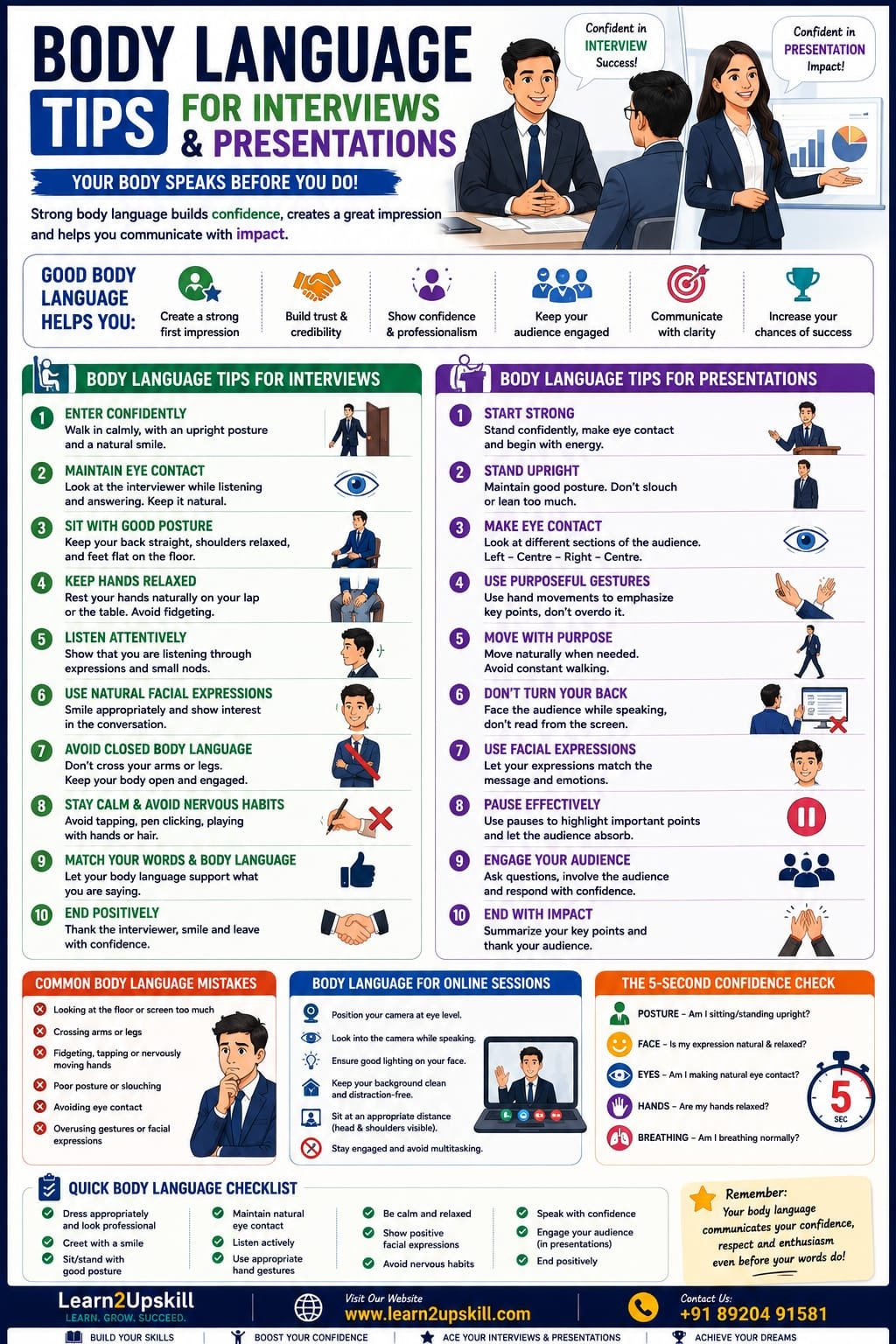
Body Language Tips for Interviews and Presentations
Introduction
When you attend an interview or give a presentation, your words are only part of the message you communicate. Your posture, facial expressions, eye contact, hand gestures, movement, and overall presence can strongly influence how others perceive your confidence and professionalism.
Body language is especially important for students and freshers because it can help communicate confidence even when you are nervous. You don’t need to use dramatic gestures or try to appear overly confident. The goal is to look comfortable, attentive, professional, and genuine.
Whether you are preparing for a job interview, campus placement, college presentation, Group Discussion, seminar, or public speaking activity, improving your body language can make a significant difference.
At Learn2Upskill, we help students develop communication skills, confidence, personality, interview readiness, and professional presentation skills for academic and career success.
What Is Body Language?
Body language is the way we communicate through physical behavior rather than words.
It includes:
Facial expressions
Eye contact
Posture
Hand gestures
Head movements
Sitting and standing style
Walking
Personal space
Voice-related physical cues
Overall appearance and presence
Body language can support your spoken communication and help your audience understand your attitude and confidence.
Why Is Body Language Important?
Positive body language can help you:
Create a strong first impression.
Appear confident and prepared.
Build trust with interviewers.
Keep your audience engaged.
Communicate enthusiasm.
Demonstrate professionalism.
Reduce the appearance of nervousness.
Make presentations more effective.
However, body language should complement your words rather than replace them.
Body Language Tips for Interviews
- Enter the Room Confidently
Your interview can begin before you answer your first question.
When entering:
Walk at a natural pace.
Keep your shoulders relaxed.
Maintain an upright posture.
Greet the interviewer politely.
Use a natural smile.
Avoid looking at the floor or rushing into the room.
A calm entrance creates a positive first impression.
- Master Your Handshake
If a handshake is culturally and contextually appropriate, keep it professional.
A good handshake should be:
Brief
Comfortable
Confident
Accompanied by eye contact
Avoid an excessively strong or extremely weak handshake.
For situations where a handshake isn’t appropriate, a polite verbal greeting is perfectly professional.
- Maintain Natural Eye Contact
Eye contact communicates confidence and attentiveness.
During an interview:
Look at the interviewer while listening.
Maintain eye contact while answering.
Look away naturally from time to time.
If multiple interviewers are present, include each person appropriately.
Avoid staring continuously, as this can feel uncomfortable.
The goal is natural eye contact, not constant eye contact.
- Sit With Good Posture
Once you sit down:
Keep your back reasonably straight.
Keep your shoulders relaxed.
Place your feet comfortably on the floor.
Keep your hands relaxed.
Avoid:
Slouching
Constantly changing positions
Leaning too far back
Resting your head on your hand
Good posture communicates alertness and professionalism.
- Keep Your Hands Relaxed
Nervous candidates often don’t know what to do with their hands.
You can:
Keep them comfortably on your lap.
Rest them naturally on the table when appropriate.
Use small gestures while explaining something.
Avoid constantly:
Tapping your fingers
Playing with a pen
Touching your hair
Adjusting your clothes
Checking your phone
Relaxed hands make you appear more comfortable.
- Use Natural Facial Expressions
Your face should reflect the conversation.
For example:
Smile when appropriate.
Show interest while listening.
Maintain a calm expression during serious questions.
Avoid looking constantly worried.
You don’t need to force a smile throughout the interview.
Authentic expressions are more effective than exaggerated ones.
- Show That You Are Listening
Listening is an important part of communication.
Show attentiveness through:
Eye contact
Small natural nods
Appropriate facial expressions
Facing the interviewer
Waiting until they finish speaking
Avoid looking distracted or impatient.
- Avoid Closed Body Language
Closed body language can sometimes make you appear uncomfortable or defensive.
Avoid:
Crossing your arms tightly.
Turning your body away.
Looking down constantly.
Hiding your hands.
Sitting with your shoulders closed.
Instead, maintain an open and relaxed posture.
- Control Nervous Movements
Interview nervousness is completely normal.
However, try to avoid repetitive movements such as:
Shaking your leg
Tapping your foot
Clicking a pen
Playing with your fingers
Repeatedly adjusting your hair or clothing
Before the interview, take a few slow breaths and consciously relax your shoulders.
- Match Your Body Language With Your Words
Your verbal and non-verbal communication should support each other.
For example, if you say:
“I’m very excited about this opportunity.”
but appear uninterested, avoid eye contact, and speak without energy, your body language may contradict your words.
Try to communicate enthusiasm through both your voice and your expressions.
Body Language Tips for Presentations
Interviews are usually one-to-one or small-group conversations. Presentations are different because you need to connect with an entire audience.
Your body language therefore becomes even more visible.
- Start With a Strong Opening
Walk to the front confidently.
Stand comfortably, take a breath, look at your audience, and begin.
Avoid immediately looking at your slides or reading from your notes.
Your audience should feel that you are speaking to them, not simply reading information.
- Stand Upright
Good presentation posture includes:
Standing tall.
Keeping shoulders relaxed.
Keeping your head naturally raised.
Distributing your weight comfortably.
Avoid leaning against a desk or wall unless the presentation style specifically calls for it.
- Make Eye Contact With the Audience
Instead of looking at only one person, gradually make eye contact across different sections of the room.
Try this simple approach:
Left → Centre → Right → Centre
This makes the entire audience feel included.
For larger audiences, look at different sections rather than trying to focus on individual faces.
- Use Purposeful Hand Gestures
Hand gestures can make presentations more engaging.
Use gestures when:
Highlighting an important point.
Comparing two ideas.
Explaining a process.
Showing size or direction.
Emphasizing a key message.
Avoid excessive movement.
Your hands should support your message—not become the main attraction.
- Move With a Purpose
Movement can add energy to a presentation, but constant walking can become distracting.
Move when:
Changing sections.
Approaching a different part of the audience.
Emphasizing a transition.
Engaging with a visual or demonstration.
Then stop and speak.
Purposeful movement looks more confident than continuous pacing.
- Don’t Turn Your Back to the Audience
When using a presentation screen, avoid speaking toward the screen for long periods.
Instead:
Look at the slide.
Understand the information.
Turn back toward the audience.
Explain the point.
The audience came to hear you, not the screen.
- Avoid Reading Every Word From Slides
Reading every line from a presentation can make your body language appear less confident.
Use slides as visual support.
Your presentation should add explanation, examples, stories, or insights rather than simply repeating the text on the screen.
- Use Facial Expressions
Your facial expressions can help communicate enthusiasm and emotion.
For example:
Show curiosity when asking a question.
Smile when sharing something positive.
Use appropriate seriousness when discussing an important issue.
A presentation becomes more engaging when your expressions match your message.
- Use Pauses
A pause can be a powerful communication tool.
After an important statement, pause briefly.
This gives the audience time to:
Understand your point.
Think about the information.
Focus their attention.
You don’t have to fill every second with words.
Silence can sometimes communicate confidence.
- Avoid Hiding Behind a Podium or Desk
If the setting allows, maintain an open connection with your audience.
Standing naturally where people can see you helps your facial expressions and gestures become more visible.
If you are using a podium, avoid gripping it tightly throughout the presentation.
Common Body Language Mistakes
Students often make these mistakes without realizing it.
Looking at the Floor
This can make you appear nervous or disengaged.
Crossing Arms
It may create a closed impression.
Excessive Gestures
Too much movement can distract your audience.
Pacing Continuously
Constant movement can make you appear nervous.
Looking at Your Phone
This is particularly distracting during interviews and presentations.
Fidgeting
Repeated small movements can attract unnecessary attention.
Reading Slides
It reduces interaction with your audience.
Slouching
Poor posture can affect your professional presence.
Body Language for Online Interviews and Presentations
Virtual communication has its own challenges.
Position Your Camera Correctly
Ideally, keep your camera around eye level.
Avoid placing the camera too low, as it can create an awkward angle.
Look Into the Camera
When speaking, occasionally look toward the camera to create a sense of eye contact.
When listening, looking at the screen is natural.
Maintain Good Lighting
Your face should be clearly visible.
Avoid sitting with a bright window directly behind you.
Keep Your Background Professional
Choose a clean and distraction-free background.
Sit at an Appropriate Distance
Your face and upper body should be comfortably visible.
This allows your expressions and some gestures to be seen.
How to Practice Your Body Language
Improving body language requires practice.
Try these exercises.
Mirror Practice
Stand in front of a mirror and practice answering interview questions.
Observe:
Your posture
Facial expressions
Hand movements
Eye contact
Record Yourself
Record a short presentation using your phone.
Watch it afterward and ask:
Am I speaking too quickly?
Am I making enough eye contact?
Are my gestures natural?
Do I look confident?
Am I moving unnecessarily?
Recording yourself can reveal habits you may not notice otherwise.
Practice With Friends
Ask friends or classmates to conduct a mock interview or watch your presentation.
Ask them for honest feedback.
Practice One Change at a Time
Don’t try to fix everything immediately.
For example:
Week 1: Focus on posture.
Week 2: Work on eye contact.
Week 3: Improve hand gestures.
Week 4: Work on facial expressions and movement.
Small improvements become easier to maintain.
The 5-Second Confidence Check
Before an interview or presentation begins, quickly check:
Posture: Am I standing or sitting upright?
Face: Is my expression relaxed?
Eyes: Am I looking at the audience/interviewer?
Hands: Are they relaxed?
Breathing: Am I breathing normally?
This simple check can help you reset before you begin.
Body Language Checklist
Before an Interview
✔ Dress professionally.
✔ Practice your posture.
✔ Relax your shoulders.
✔ Take a few slow breaths.
✔ Prepare your documents.
✔ Practice eye contact.
During an Interview
✔ Sit upright.
✔ Maintain natural eye contact.
✔ Listen carefully.
✔ Smile appropriately.
✔ Keep your hands relaxed.
✔ Avoid fidgeting.
Before a Presentation
✔ Check your posture.
✔ Take a breath.
✔ Know your opening.
✔ Keep your hands relaxed.
✔ Look at the audience.
During a Presentation
✔ Make eye contact.
✔ Use purposeful gestures.
✔ Move naturally.
✔ Use facial expressions.
✔ Pause after important points.
✔ Avoid reading every word from the slides.
The Most Important Rule: Be Natural
The purpose of improving body language is not to turn yourself into someone else.
You don’t need to copy a celebrity, speaker, teacher, or influencer.
Your goal is to become a more confident version of yourself.
Natural, relaxed body language is usually more effective than exaggerated movements.
Conclusion
Body language can significantly influence how you communicate during interviews and presentations. A confident posture, natural eye contact, appropriate gestures, attentive listening, and calm facial expressions can help you create a professional and positive impression.
The best body language is not about perfection. It is about being comfortable, attentive, confident, and authentic.
Start practicing one small change at a time. Record yourself, ask for feedback, and keep improving. With regular practice, confident body language can become a natural part of your communication style.
At Learn2Upskill, we help students and job seekers develop communication skills, personality, professional grooming, interview preparation, presentation skills, and career readiness.
Contact Learn2Upskill
Website: www.coral-kudu-326218.hostingersite.com
Contact Us: +91-89204 91581
Learn2Upskill – Learn. Grow. Succeed.
Leave a Reply