Category: Carrer Growth and Counseling

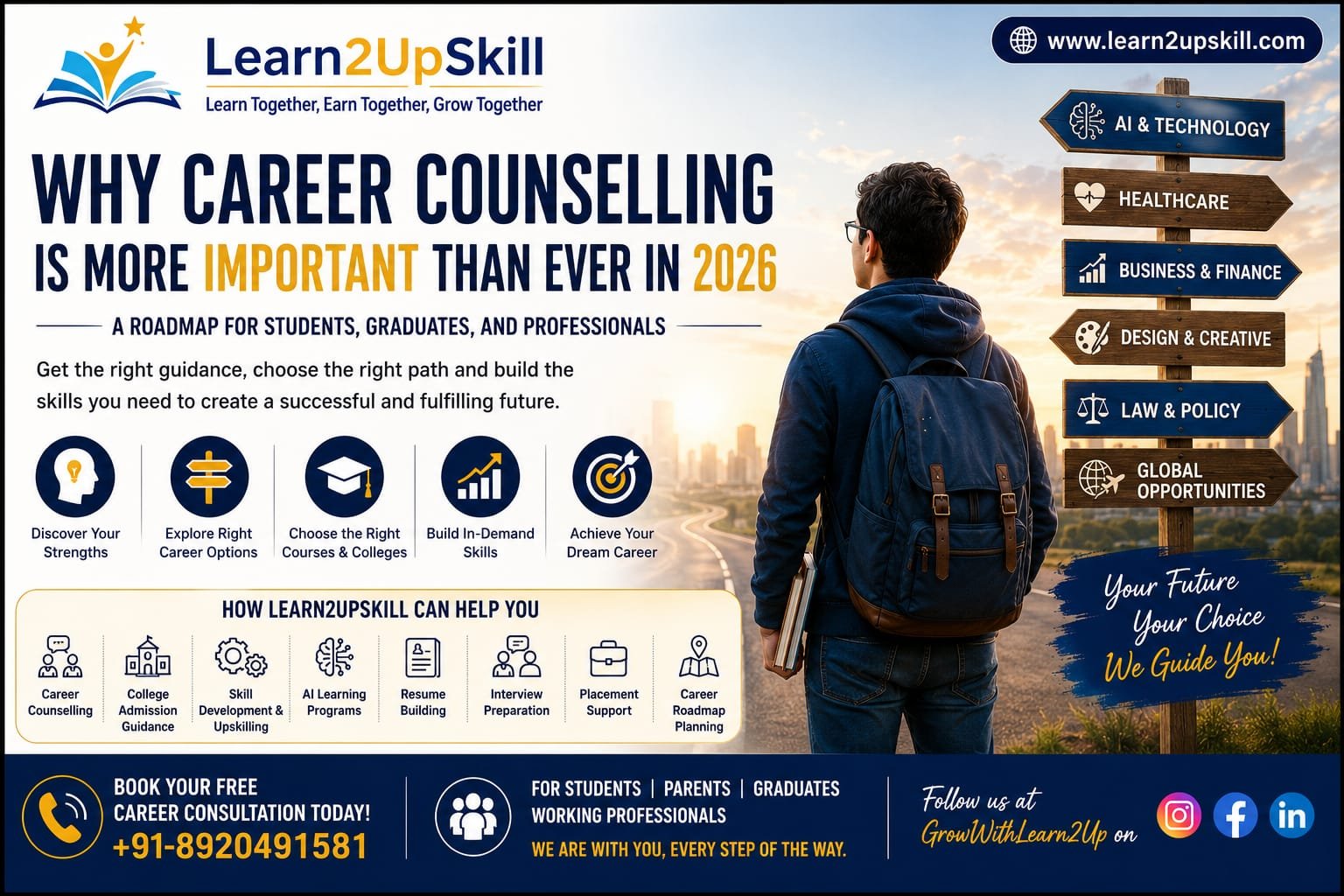
  • Why Career Counselling Is More Important Than Ever in 2026: A Roadmap for Students, Graduates, and Professionals

    Why Career Counselling Is More Important Than Ever in 2026: A Roadmap for Students, Graduates, and Professionals

    Why Career Counselling Is More Important Than Ever in 2026: A Roadmap for Students, Graduates, and Professionals

    In today’s fast-changing world, choosing the right career has become more challenging than ever before. Artificial Intelligence, automation, new industries, and evolving job roles are transforming the employment landscape at an unprecedented pace. A degree alone is no longer enough. Success now depends on choosing the right career path, continuously upgrading your skills, and making informed decisions at every stage of your journey.

    This is where professional career counselling plays a vital role.

    Why Career Counselling Matters

    Many students and professionals make career decisions based on trends, peer pressure, or limited information. Unfortunately, these choices can lead to frustration, wasted time, and missed opportunities.

    Professional career counselling helps you:

    – Identify your strengths, interests, and personality.
    – Explore career options that match your abilities.
    – Select the right course, college, or certification.
    – Understand future industry trends.
    – Build a clear roadmap towards your career goals.

    The right guidance today can save years of uncertainty tomorrow.

    The Career Landscape Is Changing

    Employers are increasingly looking for practical skills rather than qualifications alone. Fields such as Artificial Intelligence, Cybersecurity, Data Analytics, Digital Marketing, Healthcare, Finance, and Sustainable Technologies are creating exciting opportunities for learners who are prepared.

    To stay competitive, students and professionals must embrace lifelong learning and regularly update their skills.

    Common Mistakes to Avoid

    Many people unknowingly make career decisions that limit their future growth. Some of the most common mistakes include:

    – Following friends instead of personal interests.
    – Choosing courses without understanding career opportunities.
    – Ignoring emerging technologies like Artificial Intelligence.
    – Waiting until graduation to think about employment.
    – Avoiding career counselling because of overconfidence or confusion.

    Awareness is the first step towards making better decisions.

    How Learn2UpSkill Can Help

    At Learn2UpSkill, we believe every individual deserves access to expert guidance and practical learning opportunities.

    Our services include:

    – Career Counselling
    – College Admission Guidance
    – Skill Development & Upskilling
    – AI Learning Programs
    – Resume Building
    – Interview Preparation
    – Placement Support
    – Career Roadmap Planning

    Whether you are a school student, college student, graduate, working professional, or parent, our experienced team helps you make informed career decisions with confidence.

    Your Five-Step Career Roadmap

    1. Discover your strengths and interests.
    2. Explore career opportunities that match your goals.
    3. Build the right skills for your chosen field.
    4. Gain practical experience through projects and internships.
    5. Continue learning and adapting throughout your career.

    Remember, successful careers are built through continuous improvement—not one-time decisions.

    Final Thoughts

    Your future is shaped by the choices you make today. Investing time in career planning is one of the smartest decisions you can make for yourself or your child.

    Instead of leaving your future to chance, build it with clarity, confidence, and expert guidance.

    Visit www.coral-kudu-326218.hostingersite.com to explore our career counselling and upskilling services.

    Book your FREE career consultation today.

    📞 Contact us: +91-8920491581

    Learn Together. Earn Together. Grow Together.

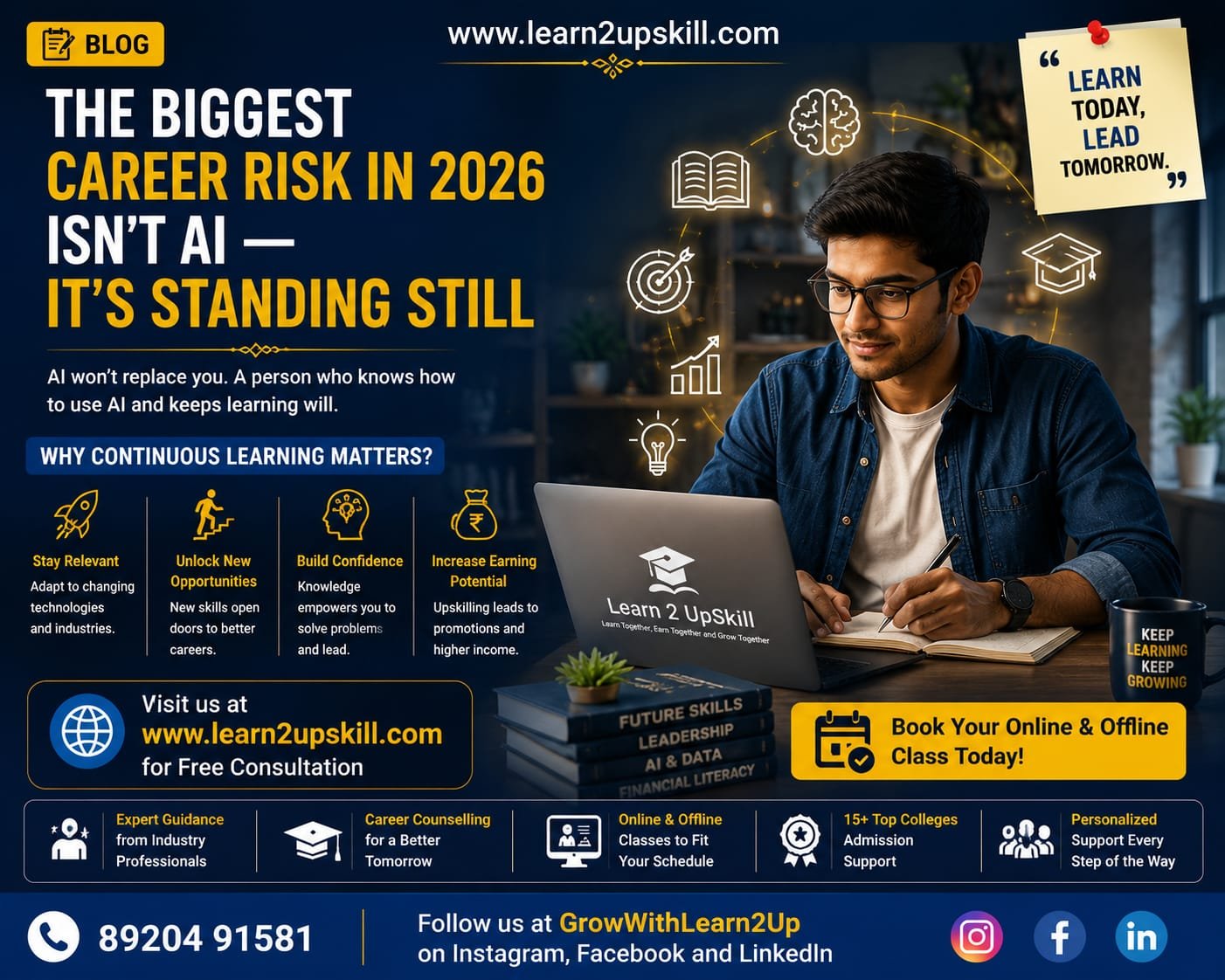
  • The Biggest Career Risk in 2026 Isn’t AI — It’s Standing Still

    The Biggest Career Risk in 2026 Isn’t AI — It’s Standing Still

    The Biggest Career Risk in 2026 Isn’t AI — It’s Standing Still

    “AI won’t replace you. A person who knows how to use AI and keeps learning will.”

    This statement is becoming more relevant every day.

    Across industries, companies are adopting Artificial Intelligence, automation, and digital technologies at an incredible pace. Jobs are changing faster than ever before. But here’s the good news—this isn’t the end of opportunities. It’s the beginning of a new era for people who are willing to learn.

    The World Rewards Learners

    The most successful professionals are no longer the ones with the highest degrees alone. They are the ones who continuously upgrade their knowledge.

    Whether you are:

    – A college student
    – A working professional
    – Someone returning to work
    – An entrepreneur
    – A freelancer

    Your greatest investment today is your ability to learn new skills.

    Skills That Will Matter in the Coming Years

    Instead of worrying about what AI will replace, focus on what it cannot easily replace.

    Build skills like:

    – AI & Prompt Engineering
    – Communication & Leadership
    – Data Analysis
    – Digital Marketing
    – Financial Literacy
    – Problem Solving
    – Critical Thinking
    – Emotional Intelligence

    These skills will create opportunities regardless of how technology evolves.

    Don’t Wait for a Crisis

    Many people decide to learn only after losing a job or missing a promotion.

    The smartest professionals prepare before they need to.

    Imagine where you could be one year from now if you dedicated just 30 minutes every day to learning something new.

    That’s over 180 hours of self-investment in a year.

    Small daily improvements create extraordinary long-term results.

    Your Career Is Your Responsibility

    No company can guarantee lifetime employment.

    But you can guarantee your own growth by continuously improving yourself.

    Learning is no longer optional—it is your career insurance.

    How Learn2UpSkill Can Help

    At Learn2UpSkill, we believe everyone deserves access to quality learning, career guidance, and opportunities to grow.

    Whether you’re preparing for college admissions, looking to upgrade your skills, or planning your next career move, our experts are here to support you.

    🌐 Visit: www.coral-kudu-326218.hostingersite.com

    Because the future belongs to those who never stop learning.

    Learn Together. Earn Together. Grow Together.

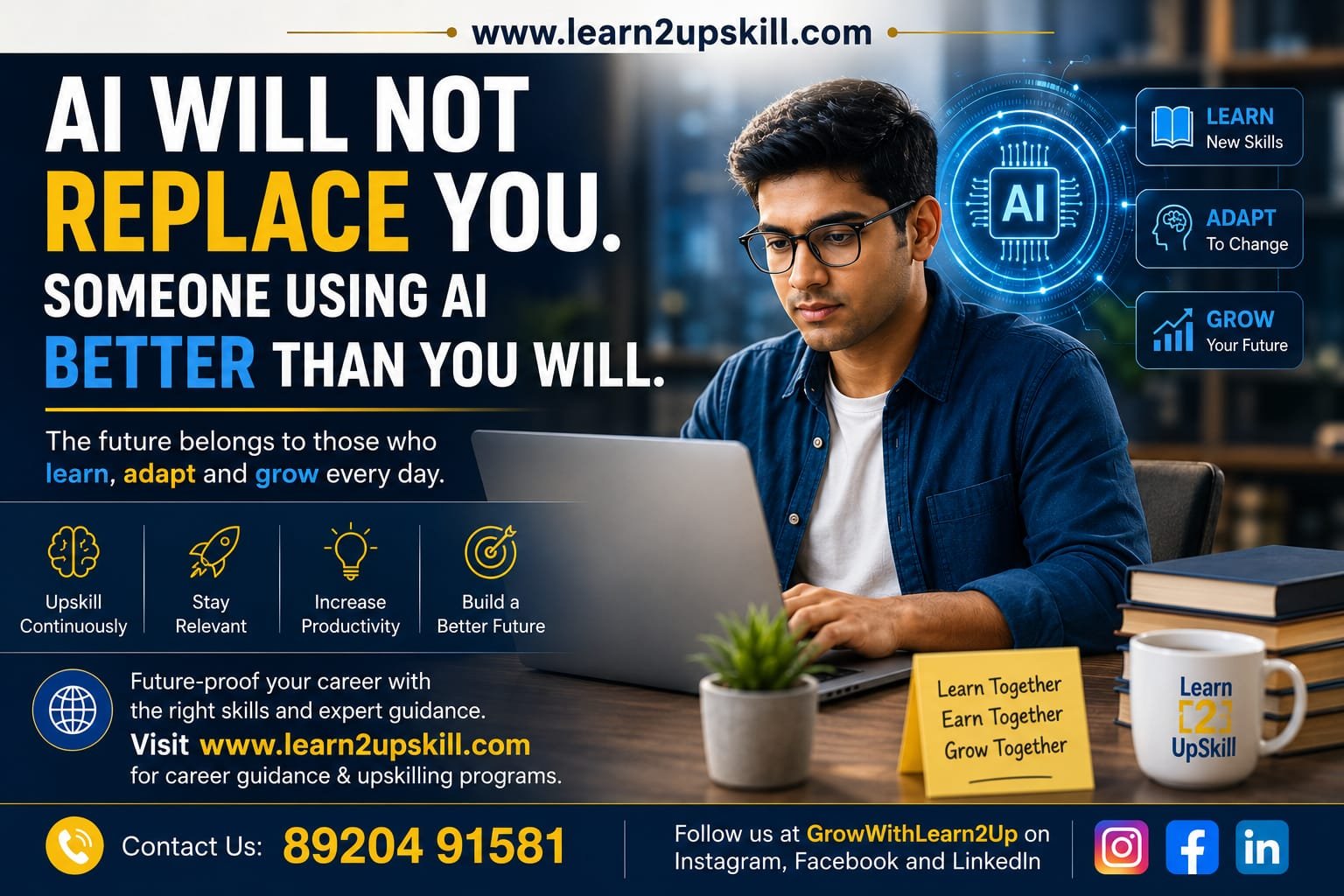
  • AI Will Not Replace You. Someone Using AI Better Than You Will.

    AI Will Not Replace You. Someone Using AI Better Than You Will.

    AI Will Not Replace You. Someone Using AI Better Than You Will.

    Artificial Intelligence is no longer a technology of the future—it is already changing the way we work, learn, communicate, and build careers. Every day, professionals across industries are discovering new ways to complete tasks faster, make better decisions, and create higher-quality work using AI.

    The real question is no longer whether AI will impact your career.

    The question is whether you are prepared to work alongside it.

    AI Is a Tool, Not a Replacement

    Many people fear that AI will replace jobs. While automation is changing certain roles, history has shown that technology creates new opportunities for those willing to learn.

    Think about calculators, computers, and the internet. None of these eliminated the need for skilled professionals. Instead, they rewarded those who adapted early.

    AI is following the same path.

    Professionals who understand how to use AI effectively are becoming more productive, more valuable, and better positioned for future opportunities.

    The Skills That Will Matter Most

    Technical knowledge remains important, but employers are increasingly looking for people who can combine human intelligence with AI capabilities.

    Some of the most valuable skills include:

    – Critical thinking and problem-solving
    – Effective communication
    – AI prompting and productivity
    – Data interpretation
    – Creativity and innovation
    – Leadership and collaboration
    – Continuous learning

    These are skills that AI supports—but cannot replace.

    Why Continuous Learning Is Your Greatest Investment

    The workplace is evolving faster than ever.

    Employees who dedicate even 30–60 minutes each day to learning new tools, improving communication, or understanding AI trends will have a significant advantage over those who rely only on existing knowledge.

    Learning is no longer optional—it is becoming a career necessity.

    How Students Can Prepare Today

    Students entering college or planning their careers should begin building future-ready skills alongside their academic education.

    Start by:

    – Learning AI tools for productivity.
    – Building digital communication skills.
    – Developing strong presentation abilities.
    – Exploring freelancing and side-income opportunities.
    – Creating a portfolio of projects instead of relying only on grades.

    Employers increasingly value practical skills and demonstrated abilities.

    The Learn2UpSkill Mission

    At Learn2UpSkill, we believe education should prepare learners for the future—not just for examinations.

    Our mission is to help students, graduates, and working professionals develop practical skills through expert guidance, career counseling, upskilling programs, and industry-focused learning.

    Whether you are preparing for college admissions, looking to advance your career, or planning to stay relevant in the AI era, continuous learning is your greatest competitive advantage.

    Final Thoughts

    The future belongs to people who are willing to adapt.

    AI is not your competition.

    Your real competition is someone who is continuously learning, improving, and using AI to become more productive every single day.

    Start investing in your skills today because your future career depends on what you learn now—not what you learned yesterday.

    Ready to future-proof your career?

    Visit www.coral-kudu-326218.hostingersite.com to explore career guidance, upskilling opportunities, and expert support that helps you stay ahead in an AI-driven world.

    Learn Together. Earn Together. Grow Together.

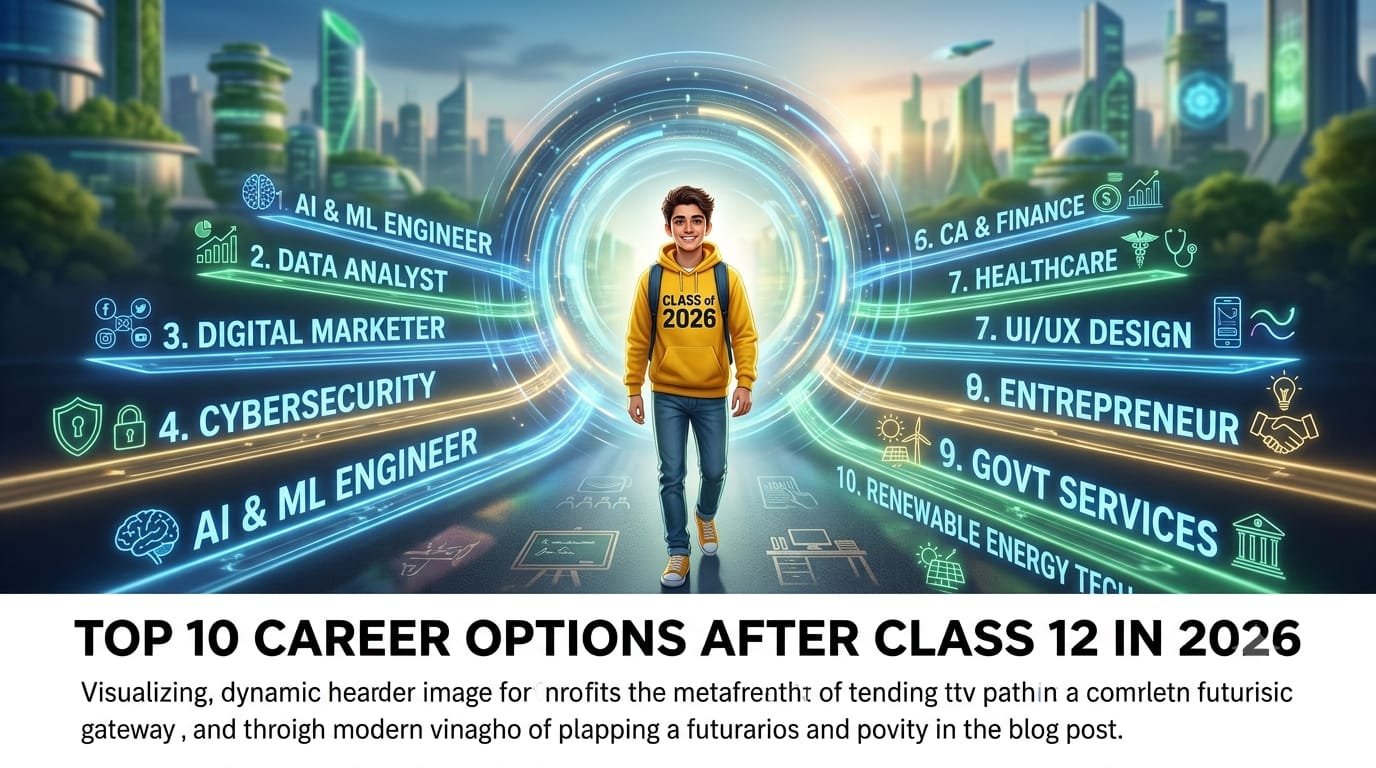
  • Top 10 Career Options After Class 12 in 2026: Salary, Skills & Future Scope

    Top 10 Career Options After Class 12 in 2026: Salary, Skills & Future Scope

    Choosing a career after Class 12 is one of the most important decisions in a student’s life. With rapid advances in artificial intelligence, automation, and digital transformation, many traditional careers are evolving while new opportunities are emerging every year.

    If you’re confused about which career path to choose after Class 12, this guide will help you understand the most promising options in 2026, the skills required, expected salary ranges, and long-term growth potential.

    Why Choosing the Right Career Matters

    A career should not be selected only because friends are choosing it or because it is popular. The best career combines your interests, abilities, and future job opportunities.

    Before making a decision, ask yourself:

    – What subjects do I enjoy?
    – What are my strengths?
    – What kind of work environment do I prefer?
    – Which industries are expected to grow over the next 10 years?

    1. Artificial Intelligence & Machine Learning

    AI is transforming healthcare, finance, education, retail, manufacturing, and almost every other industry.

    Skills Required

    – Python
    – Prompt Engineering
    – Machine Learning Basics
    – Data Analysis
    – Problem Solving

    Career Roles

    – AI Engineer
    – Machine Learning Engineer
    – AI Consultant
    – Data Scientist

    Growth Potential

    Very High

    2. Data Analytics

    Every business relies on data to make decisions, creating strong demand for data professionals.

    Skills Required

    – Excel
    – SQL
    – Power BI
    – Tableau
    – Statistics

    Career Roles

    – Data Analyst
    – Business Analyst
    – Reporting Specialist

    Growth Potential

    Excellent

    3. Digital Marketing

    As businesses move online, digital marketing continues to create opportunities for creative professionals.

    Skills Required

    – SEO
    – Social Media Marketing
    – Google Ads
    – Content Marketing
    – Email Marketing

    Career Roles

    – Digital Marketing Executive
    – SEO Specialist
    – Content Strategist
    – Performance Marketer

    4. Cybersecurity

    Protecting digital systems and customer information has become a top priority for organizations worldwide.

    Skills Required

    – Network Security
    – Ethical Hacking
    – Security Tools
    – Risk Assessment

    Career Roles

    – Cybersecurity Analyst
    – Security Consultant
    – Ethical Hacker

    5. Software Development

    Software developers continue to be among the most sought-after professionals across industries.

    Skills Required

    – Java
    – Python
    – JavaScript
    – Cloud Technologies

    Career Roles

    – Software Developer
    – Full Stack Developer
    – Mobile App Developer

    6. Chartered Accountancy & Finance

    Students interested in commerce can build rewarding careers in finance, taxation, auditing, and consulting.

    Career Opportunities

    – Chartered Accountant
    – Financial Analyst
    – Tax Consultant
    – Investment Analyst

    7. Healthcare & Allied Sciences

    Healthcare remains one of the fastest-growing sectors globally.

    Career options include:

    – MBBS
    – BDS
    – Nursing
    – Physiotherapy
    – Pharmacy
    – Medical Laboratory Sciences

    8. UI/UX Design

    Companies increasingly value professionals who can create intuitive and engaging digital experiences.

    Career opportunities include:

    – UI Designer
    – UX Designer
    – Product Designer

    9. Entrepreneurship

    Starting a business has become more accessible than ever through digital platforms.

    Essential skills include:

    – Communication
    – Marketing
    – Financial Planning
    – Leadership
    – Problem Solving

    10. Government Services

    Government careers continue to attract students seeking stability and long-term growth.

    Popular options include:

    – UPSC
    – SSC
    – Banking
    – Railways
    – State Public Service Commissions

    Skills Every Student Should Develop

    Regardless of the career you choose, these skills will increase your employability:

    – Communication
    – Critical Thinking
    – Artificial Intelligence Basics
    – Microsoft Excel
    – Problem Solving
    – Time Management
    – Leadership
    – Teamwork
    – Digital Literacy

    Common Mistakes Students Make

    – Choosing a course because friends are joining it.
    – Ignoring future industry trends.
    – Selecting a college without researching placements and acc

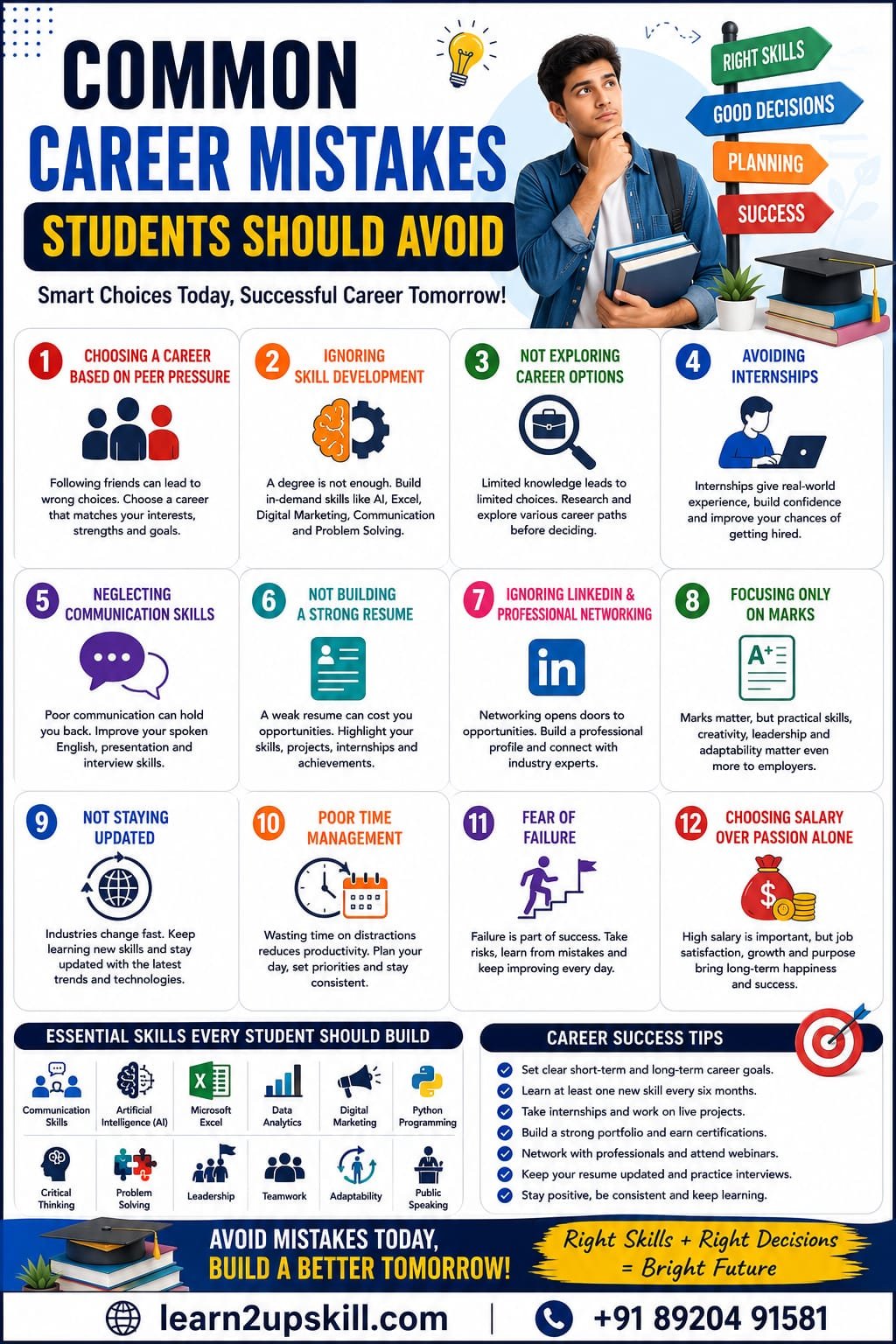
  • Common Career Mistakes Students Should Avoid: A Complete Guide to Building a Successful Future

    Common Career Mistakes Students Should Avoid: A Complete Guide to Building a Successful Future

    Common Career Mistakes Students Should Avoid: A Complete Guide to Building a Successful Future

    Published by: Learn2Upskill

    Website: www.coral-kudu-326218.hostingersite.com

    Contact: +91 89204 91581

    Introduction

    Choosing a career is one of the most important decisions in a student’s life. However, many students make avoidable mistakes that can delay their success, limit opportunities, or lead to dissatisfaction in the future.

    The good news is that these mistakes can be avoided with the right guidance, planning, and continuous learning. Whether you’re in school, college, or preparing for your first job, understanding these common career mistakes can help you make smarter decisions and build a rewarding career.

    In this guide, we’ll discuss the most common career mistakes students make and practical ways to avoid them.

    —

    Why Career Planning Matters

    A well-planned career helps you:

    – Choose the right education path

    – Build relevant skills

    – Increase employability

    – Save time and money

    – Achieve long-term career goals

    – Stay competitive in a changing job market

    Career planning isn’t about predicting the future—it’s about preparing for it.

    —

    1. Choosing a Career Based on Peer Pressure

    Many students choose a course or career simply because their friends are doing it.

    Why It’s a Mistake

    – Your interests may be different.

    – You may lose motivation over time.

    – It can lead to poor job satisfaction.

    What You Should Do

    – Identify your strengths and interests.

    – Research different career options.

    – Seek guidance from teachers, mentors, or career counselors.

    —

    1. Ignoring Skill Development

    A degree alone is often not enough to secure a good job.

    Employers increasingly look for practical skills such as:

    – Communication

    – Digital Marketing

    – Artificial Intelligence (AI)

    – Data Analytics

    – Microsoft Excel

    – Programming

    – Problem Solving

    – Teamwork

    Investing in skill development alongside your studies gives you a competitive edge.

    —

    1. Not Exploring Career Options

    Many students only know about a few traditional professions.

    Today’s career landscape includes opportunities in:

    – Artificial Intelligence

    – Cybersecurity

    – Cloud Computing

    – Data Science

    – UI/UX Design

    – Digital Marketing

    – Content Creation

    – Business Analytics

    – Product Management

    – Entrepreneurship

    Explore a wide range of industries before making a decision.

    —

    1. Avoiding Internships

    Internships provide valuable real-world experience.

    Benefits

    – Learn workplace skills

    – Build confidence

    – Improve your resume

    – Network with professionals

    – Increase your chances of getting hired

    Even short internships can make a big difference.

    —

    1. Neglecting Communication Skills

    Strong communication is essential in almost every profession.

    Improve your:

    – Spoken English

    – Presentation skills

    – Email writing

    – Interview communication

    – Listening skills

    Clear communication can set you apart from equally qualified candidates.

    —

    1. Not Building a Strong Resume

    Your resume is often your first impression.

    A good resume should include:

    – Education

    – Skills

    – Certifications

    – Projects

    – Internships

    – Achievements

    Keep it concise, accurate, and tailored to each job application.

    —

    1. Ignoring LinkedIn and Professional Networking

    Networking can open doors to internships, jobs, and mentorship opportunities.

    Create a professional LinkedIn profile and:

    – Share your achievements

    – Connect with industry professionals

    – Follow companies

    – Engage with relevant content

    Building your professional presence early can benefit your career.

    —

    1. Focusing Only on Marks

    Good grades are important, but employers also value:

    – Practical skills

    – Creativity

    – Leadership

    – Adaptability

    – Critical thinking

    – Teamwork

    Balance academic performance with skill development and real-world experience.

    —

    1. Not Staying Updated

    Industries evolve rapidly, especially with advances in technology.

    Stay informed by:

    – Reading industry blogs

    – Following reputable news sources

    – Taking online courses

    – Attending webinars

    – Learning new tools and technologies

    Continuous learning keeps you relevant.

    —

    1. Poor Time Management

    Many students waste valuable time on distractions.

    Improve productivity by:

    – Creating a daily schedule

    – Setting priorities

    – Avoiding procrastination

    – Limiting unnecessary screen time

    Effective time management helps you balance studies, learning, and personal life.

    —

    1. Fear of Failure

    Many students avoid applying for internships, competitions, or jobs because they fear rejection.

    Remember:

    – Every successful professional has faced setbacks.

    – Failure is an opportunity to learn and improve.

    – Confidence grows through experience.

    Take calculated risks and keep moving forward.

    —

    1. Choosing Salary Over Passion Alone

    While salary is important, don’t choose a career based only on immediate earnings.

    Consider:

    – Long-term growth

    – Job satisfaction

    – Learning opportunities

    – Work-life balance

    – Career stability

    The best careers often combine passion, skills, and market demand.

    —

    Essential Skills Every Student Should Build

    – Communication Skills

    – Artificial Intelligence (AI)

    – Microsoft Excel

    – Data Analytics

    – Digital Marketing

    – Python Programming

    – Critical Thinking

    – Problem Solving

    – Leadership

    – Teamwork

    – Adaptability

    – Public Speaking

    These skills can improve your employability across industries.

    —

    Career Success Tips

    – Set clear career goals.

    – Learn at least one new skill every six months.

    – Complete internships or live projects.

    – Build a professional portfolio.

    – Earn relevant certifications.

    – Keep your resume updated.

    – Network with professionals.

    – Practice interview skills regularly.

    – Stay curious and keep learning.

    —

    Conclusion

    Avoiding common career mistakes can save you years of frustration and help you achieve your goals more quickly. Focus on building practical skills, gaining real-world experience, and making informed career decisions based on your interests and strengths.

    Success doesn’t happen overnight—it comes from consistent learning, smart choices, and a willingness to grow. Start preparing today, and you’ll be ready for the opportunities of tomorrow.

    —

    Learn with Learn2Upskill

    At Learn2Upskill, we are committed to helping students become career-ready through practical courses, industry-relevant training, and expert guidance.

    Whether you want to learn AI, Digital Marketing, Excel, Data Analytics, Programming, or other job-ready skills, we’re here to support your journey.

    Website: www.coral-kudu-326218.hostingersite.com

    Contact: +91 89204 91581


    Start learning today. Build the skills employers want. Shape a successful future with Learn2Upskill!

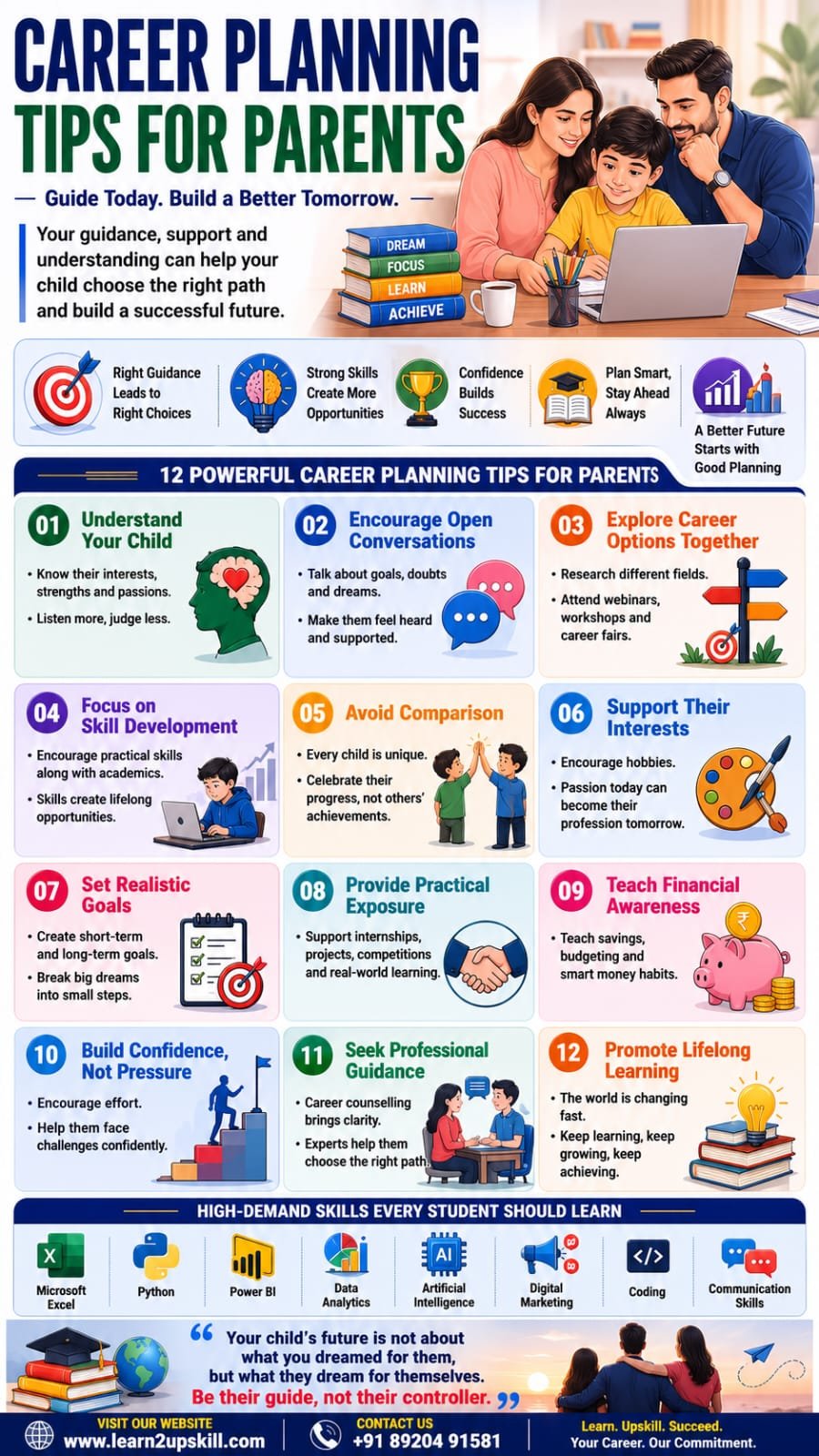
  • Career Planning Tips for Parents: A Complete Guide to Helping Your Child Build a Successful Future

    Career Planning Tips for Parents: A Complete Guide to Helping Your Child Build a Successful Future

    Career Planning Tips for Parents: A Complete Guide to Helping Your Child Build a Successful Future

    Discover practical career planning tips for parents. Learn how to guide your child, support career decisions, develop future-ready skills, and prepare them for a successful career.

    Focus Keyword: Career Planning Tips for Parents

    —

    Career Planning Tips for Parents

    Every parent dreams of seeing their child happy, confident, and successful. One of the greatest gifts parents can give is the right guidance during their child’s career journey. However, today’s career world is very different from what it was a decade ago.

    New industries such as Artificial Intelligence (AI), Data Analytics, Cybersecurity, Cloud Computing, Digital Marketing, and Content Creation have created exciting opportunities beyond traditional professions like engineering, medicine, and government jobs.

    With so many career options available, students often need guidance—not pressure. Parents play a vital role in helping children discover their strengths, build confidence, and make informed career decisions.

    This guide provides practical career planning tips that every parent can use to support their child’s future.

    —

    Why Career Planning Matters

    Career planning helps students:

    – Understand their strengths

    – Explore suitable career options

    – Build job-ready skills

    – Set achievable goals

    – Make informed decisions

    – Reduce career confusion

    – Prepare for future opportunities

    Parents who actively support career planning help children develop confidence and direction.

    —

    Tip 1: Start Career Conversations Early

    Career planning should not begin only after Class 12.

    Introduce career awareness during school years by discussing:

    – Different professions

    – Everyday job roles

    – Emerging industries

    – Skills required for success

    Simple conversations can spark curiosity and help children discover their interests over time.

    —

    Tip 2: Understand Your Child’s Interests

    Every child has unique talents and passions.

    Observe what your child naturally enjoys.

    Ask questions such as:

    – Which subjects do you like most?

    – What activities make you excited?

    – What kind of work would you enjoy doing every day?

    – What problems do you enjoy solving?

    Listening without judgment helps children express themselves openly.

    —

    Tip 3: Identify Strengths and Areas for Improvement

    Encourage your child to recognize both strengths and growth opportunities.

    Strengths

    – Communication

    – Creativity

    – Mathematics

    – Leadership

    – Problem Solving

    – Technology

    – Writing

    Areas to Improve

    – Public Speaking

    – Time Management

    – Confidence

    – Organization

    – Technical Skills

    Self-awareness is the foundation of effective career planning.

    —

    Tip 4: Encourage Exploration

    Instead of limiting your child to a few traditional professions, encourage them to explore different industries.

    Technology

    Business

    Creative Careers

    Healthcare

    Researching different careers helps students make informed choices.

    —

    Tip 5: Focus on Skills, Not Just Marks

    Academic performance is important, but employers also value practical skills.

    Encourage learning in areas such as:

    Technical Skills

    Soft Skills

    Balanced skill development prepares students for future workplaces.

    —

    Tip 6: Avoid Comparing Your Child

    Every student has different strengths, interests, and learning styles.

    Avoid statements like:

    – “Your cousin scored higher.”

    – “Your friend already knows what career to choose.”

    Instead, appreciate your child’s individual progress and encourage continuous improvement.

    —

    Tip 7: Encourage Practical Learning

    Learning through experience helps students discover what they enjoy.

    Support opportunities such as:

    – Internships

    – Volunteer work

    – Personal projects

    – Competitions

    – Online courses

    – Workshops

    – Summer training

    Practical experience builds confidence and employability.

    —

    Tip 8: Help Set Realistic Career Goals

    Guide your child in creating achievable goals.

    Short-Term Goals

    – Learn Microsoft Excel

    – Improve communication skills

    – Complete an online course

    Medium-Term Goals

    – Build projects

    – Earn certifications

    – Complete internships

    Long-Term Goals

    – Secure a job

    – Pursue higher education

    – Start a business

    – Become a specialist in a chosen field

    Breaking goals into smaller steps makes progress easier.

    —

    Tip 9: Teach the Importance of Lifelong Learning

    Technology and industries evolve rapidly.

    Encourage habits such as:

    – Reading books

    – Taking online courses

    – Learning new software

    – Following industry trends

    – Practicing new skills


    Continuous learning helps students stay competitive throughout their careers.

    —

    Tip 10: Build Confidence Through Encouragement

    Children perform better when they feel supported.

    Celebrate:

    – Effort

    – Improvement

    – Curiosity

    – Creativity

    – Persistence

    Constructive encouragement helps children develop resilience and confidence.

    —

    Tip 11: Introduce Financial Awareness

    Career planning also includes understanding finances.

    Teach basic concepts such as:

    – Budgeting

    – Saving

    – Scholarships

    – Education costs

    – Career investments

    Financial literacy supports better educational and career decisions.

    —

    Tip 12: Seek Professional Career Guidance

    Career counsellors can help students:

    – Understand their strengths

    – Explore career paths

    – Identify suitable courses

    – Build career roadmaps

    – Develop decision-making confidence

    Professional guidance complements parental support.

    —

    Common Mistakes Parents Should Avoid

    Avoid:

    – Choosing a career on behalf of your child.

    – Comparing them with others.

    – Focusing only on marks.

    – Ignoring emerging careers.

    – Discouraging creative interests.

    – Expecting immediate clarity.

    – Putting excessive pressure on performance.

    Supportive guidance is more effective than control.

    —

    Final Thoughts

    Parents play an essential role in shaping their child’s career journey—not by deciding the destination, but by helping them build the confidence and skills to choose their own path.

    By encouraging curiosity, supporting practical learning, promoting continuous skill development, and maintaining open communication, parents can help children prepare for rewarding and future-ready careers.

    The world of work is changing rapidly. The greatest advantage parents can offer is not just advice, but the opportunity to learn, explore, and grow.

    At Learn2Upskill, we partner with students and parents to build career-ready skills through expert guidance and practical training in Microsoft Excel, Data Analytics, Power BI, Python, Artificial Intelligence, Digital Marketing, and other high-demand technologies.

    Why Choose Learn2Upskill?

    – Career guidance for students and parents

    – Industry-relevant skill development

    – Practical, hands-on learning

    – Experienced mentors

    – Real-world projects

    – Job-oriented training programs

    Visit: www.coral-kudu-326218.hostingersite.com

    Contact Us: +91 89204 91581

    Guide with Confidence. Support with Purpose. Build a Brighter Future Together.

  • How Career Counselling Helps Students Make Better Decisions: A Complete Guide

    How Career Counselling Helps Students Make Better Decisions: A Complete Guide

    How Career Counselling Helps Students Make Better Decisions: A Complete Guide

    Published by: Learn2Upskill

    Website: www.coral-kudu-326218.hostingersite.com

    Contact: +91 89204 91581

    Introduction

    Choosing the right career is one of the biggest decisions a student will ever make. With thousands of courses, careers, certifications, and job opportunities available today, it’s easy to feel confused or overwhelmed.

    Many students choose careers based on family expectations, peer pressure, or limited information. Unfortunately, these decisions can lead to dissatisfaction, wasted time, and missed opportunities.

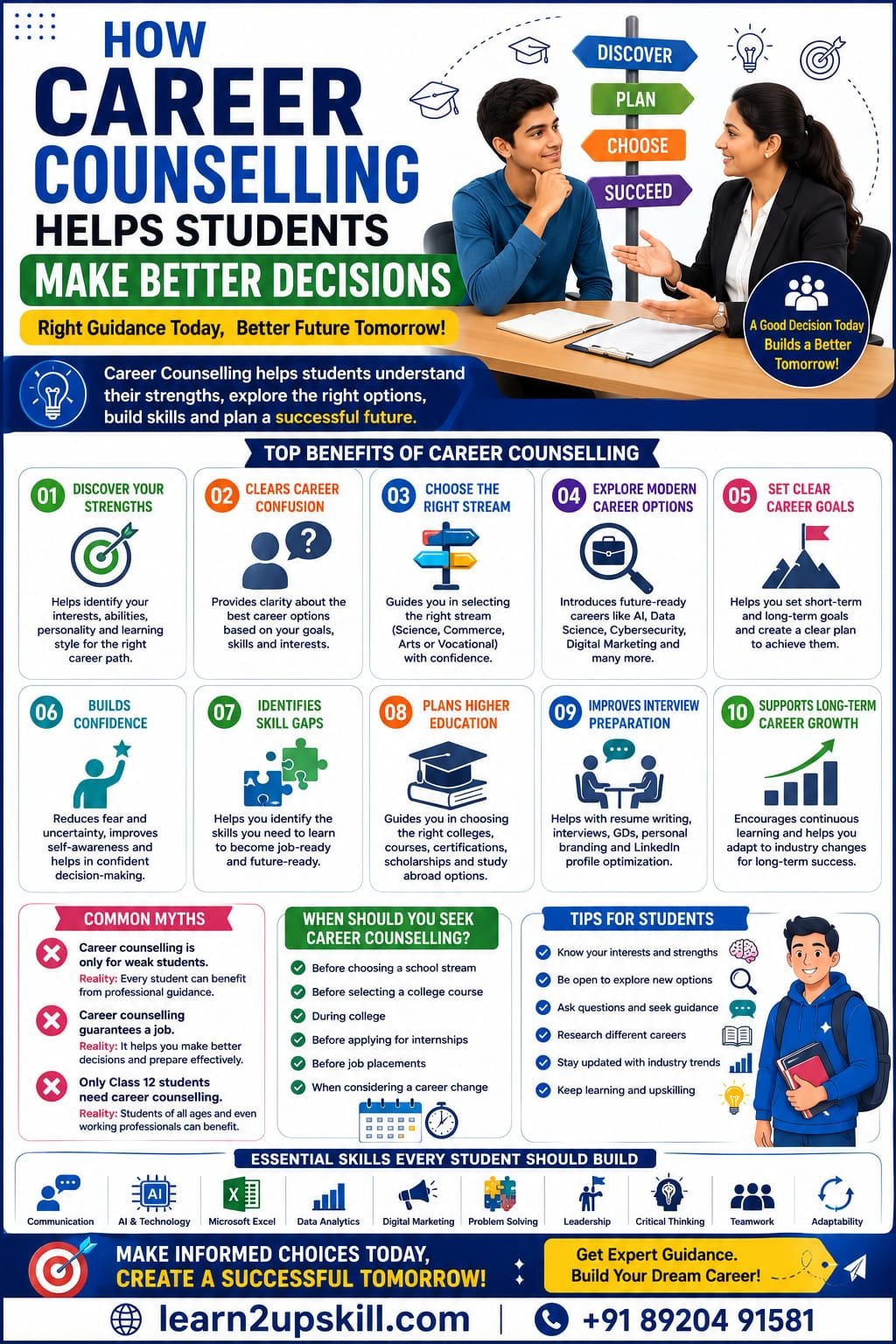
    This is where career counselling plays a vital role. A professional career counsellor helps students understand their strengths, interests, personality, and career options, enabling them to make informed decisions that align with their goals.

    In this blog, we’ll explore how career counselling benefits students and why it has become more important than ever in today’s fast-changing world.

    —

    What Is Career Counselling?

    Career counselling is a structured process that helps students:

    – Understand their interests and abilities

    – Identify suitable career options

    – Select the right course or stream

    – Set career goals

    – Develop job-ready skills

    – Plan for long-term success

    Career counselling is not about telling students what to do—it’s about helping them make confident, well-informed choices.

    —

    Why Career Counselling Is Important

    Today’s job market is changing rapidly due to technology, automation, and Artificial Intelligence (AI). New careers are emerging while others are evolving.

    Career counselling helps students:

    – Make informed decisions

    – Avoid choosing the wrong career path

    – Save time and money

    – Build confidence

    – Stay prepared for future job opportunities

    —

    Benefits of Career Counselling

    1. Helps Students Discover Their Strengths

    Every student has unique talents.

    Career counselling helps identify:

    – Academic strengths

    – Natural abilities

    – Interests

    – Personality traits

    – Learning style

    Understanding yourself is the first step toward choosing the right career.

    —

    1. Clears Career Confusion

    Many students ask questions like:

    – Which course should I choose?

    – Which career has the best future?

    – What skills should I learn?

    – Which industry pays well?

    – Should I study abroad?

    Career counselling provides personalized answers based on your goals and interests.

    —

    1. Helps Choose the Right Stream

    Students often struggle to choose between:

    – Science

    – Commerce

    – Arts/Humanities

    – Vocational Courses

    A counsellor can explain the opportunities available in each stream and help students choose wisely.


    —

    1. Introduces Modern Career Options

    Many students know only about traditional professions such as engineering, medicine, or government jobs.

    Career counselling also introduces exciting careers in:

    – Artificial Intelligence (AI)

    – Data Analytics

    – Cybersecurity

    – Cloud Computing

    – Digital Marketing

    – UI/UX Design

    – Content Creation

    – Business Analytics

    – Animation

    – Entrepreneurship

    This broadens students’ career horizons.

    —

    1. Helps Set Career Goals

    Students learn to create:

    Short-Term Goals

    – Improve communication skills

    – Complete certifications

    – Build a portfolio

    Long-Term Goals

    – Secure a dream job

    – Start a business

    – Become an industry expert

    Goal-setting provides clarity and motivation.

    —

    1. Builds Confidence

    Many students lack confidence when making career decisions.

    Career counselling helps by:

    – Reducing fear and uncertainty

    – Improving self-awareness

    – Encouraging informed decision-making

    – Providing a clear action plan

    Confident students are better prepared for academic and professional success.

    —

    1. Identifies Skill Gaps

    Employers today look beyond degrees.

    Career counselling helps students identify important skills such as:

    – Communication

    – Artificial Intelligence (AI)

    – Microsoft Excel

    – Digital Marketing

    – Data Analytics

    – Coding

    – Leadership

    – Critical Thinking

    – Problem Solving

    – Teamwork

    Students can then focus on learning the skills employers value most.

    —

    1. Helps Plan Higher Education

    Career counsellors guide students on:

    – College selection

    – Degree programs

    – Professional certifications

    – Online learning opportunities

    – Scholarships

    – Study-abroad options

    This ensures students make informed educational choices.

    —

    1. Improves Interview Preparation

    Career counselling often includes guidance on:

    – Resume writing

    – Interview skills

    – Group discussions

    – Personal branding

    – LinkedIn profile optimization

    These skills improve employability.

    —

    1. Supports Long-Term Career Growth

    Career planning doesn’t stop after choosing a course.

    Career counselling encourages lifelong learning, helping students:

    – Adapt to industry changes

    – Learn new technologies

    – Upgrade skills

    – Stay competitive throughout their careers

    —

    Common Career Counselling Myths

    Myth 1: Career counselling is only for weak students.

    Reality: Every student can benefit from professional career guidance.

    Myth 2: Career counselling guarantees a job.

    Reality: It helps students make better decisions and prepare effectively, but success still depends on effort and continuous learning.

    Myth 3: Only Class 12 students need career counselling.

    Reality: Students from middle school, high school, college, and even working professionals can benefit.

    —

    When Should Students Seek Career Counselling?

    The ideal time is:

    – Before choosing a school stream

    – Before selecting a college course

    – During college

    – Before applying for internships

    – Before job placements

    – When considering a career change

    Early guidance can prevent costly mistakes later.

    —

    Tips for Students Before Career Counselling

    – Think about your interests and hobbies.

    – List your strengths and weaknesses.

    – Be open to exploring new career paths.

    – Ask questions without hesitation.

    – Research different industries.

    – Keep an open mind about future opportunities.

    —

    The Future of Career Counselling

    Technology is changing career guidance.

    Modern career counselling may include:

    – AI-powered career assessments

    – Virtual counselling sessions

    – Online aptitude tests

    – Personalized learning plans

    – Industry trend analysis

    – Digital career portfolios

    These tools make career planning more accessible and effective.

    —

    Conclusion

    Career counselling empowers students to make informed, confident decisions about their future. Instead of following the crowd or making choices based on assumptions, students gain clarity about their interests, strengths, and career opportunities.


    Combined with continuous learning and practical skill development, career counselling can lay the foundation for a successful and fulfilling career.


    Remember, the best career decisions are made with knowledge, self-awareness, and proper guidance.

    —

    Learn with Learn2Upskill

    At Learn2Upskill, we believe every student deserves the right guidance to build a successful future.

    We offer career guidance, skill development programs, and industry-focused training in areas such as Artificial Intelligence (AI), Digital Marketing, Microsoft Excel, Data Analytics, Programming, and other in-demand skills.

    Whether you’re choosing your first career path or upgrading your professional skills, we’re here to support your journey.

    Website: www.coral-kudu-326218.hostingersite.com

    Contact: +91 89204 91581

    Choose your career with confidence. Learn the skills that matter. Build your future with Learn2Upskill.
  • Personality Development Tips for College Students: Build Confidence, Leadership, and Career Success

    Personality Development Tips for College Students: Build Confidence, Leadership, and Career Success

    Personality Development Tips for College Students: Build Confidence, Leadership, and Career Success

    Introduction

    College is one of the most important phases of a student’s life. It is not only a place to gain academic knowledge but also an opportunity to develop the personality, communication skills, confidence, and professional attitude needed for a successful career. Employers today look beyond grades—they value students who can communicate effectively, work in teams, solve problems, and adapt to new challenges.

    Personality development is a continuous journey of improving your thoughts, behavior, appearance, communication, and interpersonal skills. It helps students become confident individuals who are ready to face interviews, internships, higher education, and the workplace.

    At Learn2Upskill, we believe that personality development is the key to personal growth and long-term career success. With the right habits and mindset, every college student can build a strong personality and stand out from the crowd.

    —

    What Is Personality Development?

    Personality development is the process of enhancing your overall personality by improving your attitude, confidence, communication, behavior, emotional intelligence, and professional skills.

    It is not about changing who you are. Instead, it is about discovering your strengths, overcoming weaknesses, and becoming the best version of yourself.

    —

    Why Is Personality Development Important for College Students?

    A strong personality helps students:

    – Build self-confidence.

    – Improve communication skills.

    – Develop leadership qualities.

    – Perform better in interviews and group discussions.

    – Create positive first impressions.

    – Handle stress and challenges effectively.

    – Build professional relationships.

    – Increase employability.

    – Adapt to changing work environments.

    – Achieve long-term career success.

    —

    Essential Personality Development Tips

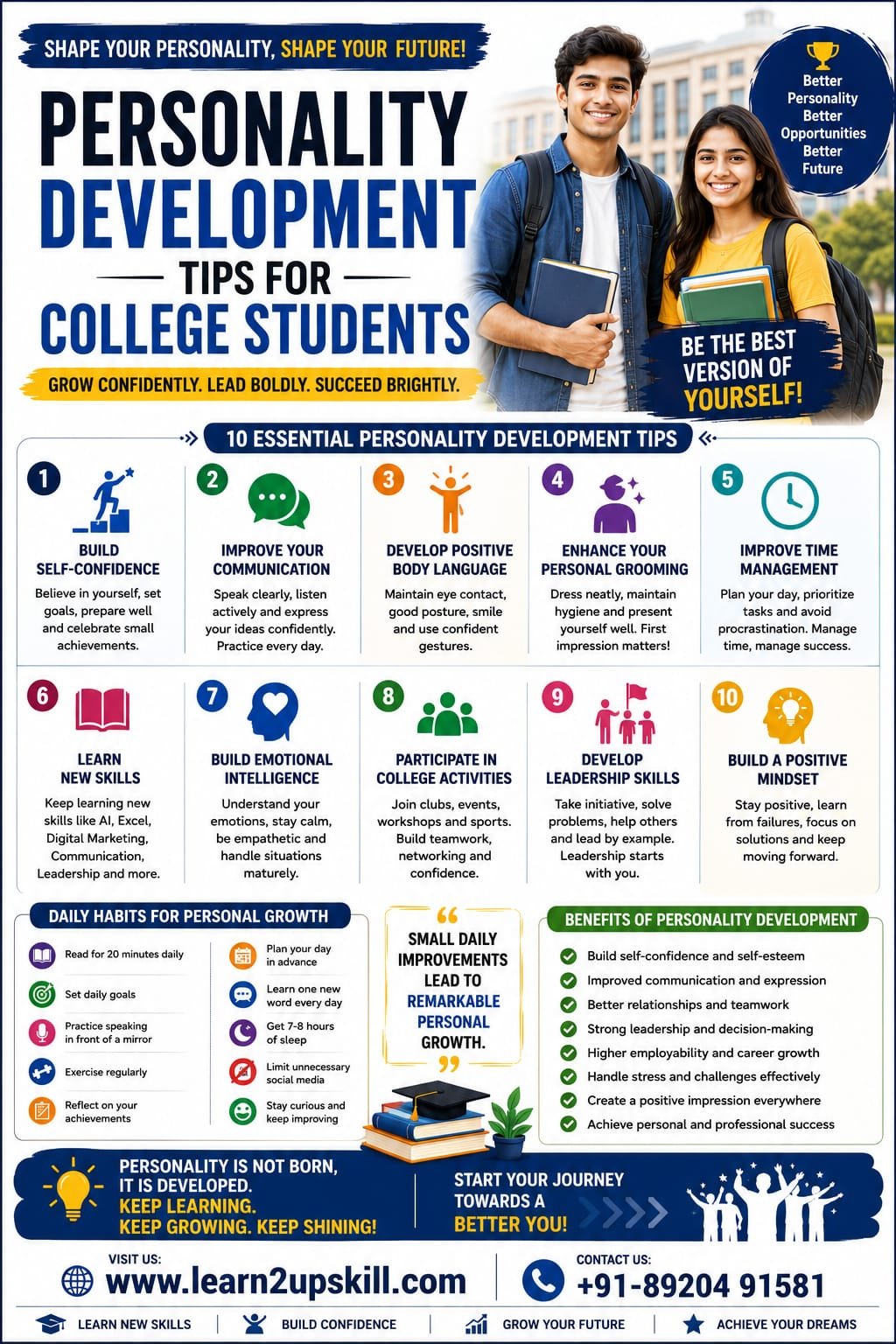
    1. Build Self-Confidence

    Confidence is the foundation of a successful personality.

    You can improve your confidence by:

    – Setting realistic goals.

    – Preparing well before exams and presentations.

    – Learning from mistakes.

    – Celebrating small achievements.

    – Practicing positive self-talk.

    Confidence grows with consistent effort and experience.

    —

    1. Improve Your Communication Skills

    Good communication is one of the most important professional skills.

    Practice by:

    – Speaking clearly and confidently.

    – Listening carefully.

    – Reading newspapers and books.

    – Expanding your vocabulary.

    – Participating in debates and presentations.

    Strong communication skills improve both academic and professional success.

    —

    1. Develop Positive Body Language

    Your body language often speaks before you do.

    Maintain:

    – Eye contact.

    – Good posture.

    – A pleasant smile.

    – Confident hand gestures.

    – Calm and relaxed movements.

    Positive body language creates a strong first impression.

    —

    1. Enhance Your Personal Grooming

    Professional appearance reflects discipline and confidence.

    Maintain:

    – Good personal hygiene.

    – Clean and well-fitted clothes.

    – Neat hairstyle.

    – Appropriate footwear.

    – A well-organized appearance.

    Looking presentable increases self-confidence and professionalism.

    —

    1. Improve Time Management

    Successful students manage their time wisely.

    Useful habits include:

    – Creating daily schedules.

    – Prioritizing important tasks.

    – Avoiding procrastination.

    – Using planners or digital calendars.

    – Balancing studies and personal life.

    Time management reduces stress and improves productivity.

    —

    1. Learn New Skills

    College is the perfect time to develop skills that employers value.

    Consider learning:

    – Artificial Intelligence (AI)

    – Digital Marketing

    – Microsoft Excel

    – Data Analytics

    – Public Speaking

    – Coding

    – Graphic Design

    – Content Writing

    – Leadership

    – Financial Literacy

    Continuous learning keeps you competitive in today’s job market.

    —

    1. Build Emotional Intelligence

    Emotional intelligence helps you understand and manage emotions effectively.

    Develop it by:

    – Practicing empathy.

    – Staying calm under pressure.

    – Respecting different opinions.

    – Managing conflicts professionally.

    – Accepting constructive feedback.

    This skill is highly valued in every profession.

    —

    1. Participate in College Activities

    Join:

    – Student clubs

    – Cultural events

    – Sports

    – Technical societies

    – Volunteer programs

    – Workshops

    – Competitions

    These activities improve leadership, teamwork, networking, and confidence.

    —

    1. Develop Leadership Skills

    Leadership is about inspiring and guiding others.

    Become a leader by:

    – Taking initiative.

    – Helping classmates.

    – Organizing events.

    – Solving problems.

    – Making responsible decisions.

    – Leading by example.

    Leadership skills make your resume stand out.

    —

    1. Build a Positive Mindset

    A positive attitude helps you overcome challenges and stay motivated.

    Practice:

    – Gratitude

    – Positive thinking

    – Learning from failures

    – Staying optimistic

    – Focusing on solutions instead of problems

    A positive mindset improves resilience and emotional well-being.

    —

    Daily Habits for Personality Development

    Spend 20–30 minutes every day on self-improvement:

    – Read for at least 20 minutes.

    – Learn one new word daily.

    – Exercise regularly.

    – Practice speaking in front of a mirror.

    – Maintain good posture.

    – Set daily goals.

    – Reflect on your achievements.

    – Limit unnecessary social media usage.

    – Sleep 7–8 hours.

    – Stay curious and keep learning.

    Small daily habits lead to remarkable personal growth.

    —

    Common Personality Development Mistakes

    Avoid these habits:

    – Lack of confidence

    – Poor communication

    – Negative attitude

    – Poor grooming

    – Procrastination

    – Fear of public speaking

    – Comparing yourself with others

    – Ignoring feedback

    – Lack of discipline

    – Giving up too easily

    Recognizing these habits helps you improve faster.

    —

    Personality Development During College Placements

    Placement season is the ideal time to showcase your personality.

    Focus on:

    – Resume building

    – Interview preparation

    – Group discussion practice

    – Professional etiquette

    – Business communication

    – Leadership examples

    – Problem-solving skills

    – Positive attitude

    Recruiters often remember confident and well-prepared candidates.

    —

    Benefits of Personality Development

    A well-developed personality helps students:

    – Build confidence

    – Improve communication

    – Become better leaders

    – Perform well in interviews

    – Build strong relationships

    – Handle pressure effectively

    – Increase career opportunities

    – Develop professional behavior

    – Improve decision-making

    – Achieve long-term success

    —

    Final Thoughts

    Personality development is not about becoming someone else—it is about becoming the best version of yourself. College provides countless opportunities to grow, learn, and prepare for the future. By developing confidence, communication skills, leadership, emotional intelligence, and a positive attitude, students can build a strong foundation for lifelong success.

    Start with small daily improvements, remain consistent, and never stop learning. Every step you take today will shape the successful professional you become tomorrow.

    At Learn2Upskill, we are committed to empowering students with industry-relevant skills, personality development training, career counselling, interview preparation, communication skills, and professional grooming programs. Our mission is to help students become confident, capable, and career-ready.

    —

    Contact Learn2Upskill

    Website: www.coral-kudu-326218.hostingersite.com

    Contact Us: +91-89204 91581

    Learn2Upskill – Learn. Grow. Succeed.

  • What to Do If You’re Confused About Your Career

    What to Do If You’re Confused About Your Career

    What to Do If You’re Confused About Your Career

    Published by: Learn2Upskill

    Website: www.coral-kudu-326218.hostingersite.com⁠�

    Contact: +91 89204 91581

    Introduction

    Feeling confused about your career is completely normal. Every year, millions of students struggle to decide which course to choose, which career path to follow, or what skills they should develop for the future.

    With hundreds of career options, rapid technological advancements, Artificial Intelligence (AI), and changing industry demands, making the right decision can seem overwhelming.

    The good news is that career confusion doesn’t mean you’re failing—it simply means you’re at the beginning of an important journey. With the right guidance, self-awareness, and planning, you can confidently choose a career that matches your interests, strengths, and future goals.

    This guide will help you overcome career confusion and take the right steps toward a successful future.

    Why Students Feel Confused About Their Career

    There are many reasons students struggle with career decisions.

    Common reasons include:

    Too many career options

    Lack of career guidance

    Family pressure

    Peer influence

    Fear of making the wrong decision

    Uncertainty about future job opportunities

    Lack of confidence

    Limited knowledge about industries

    Understanding the reason behind your confusion is the first step toward finding clarity.

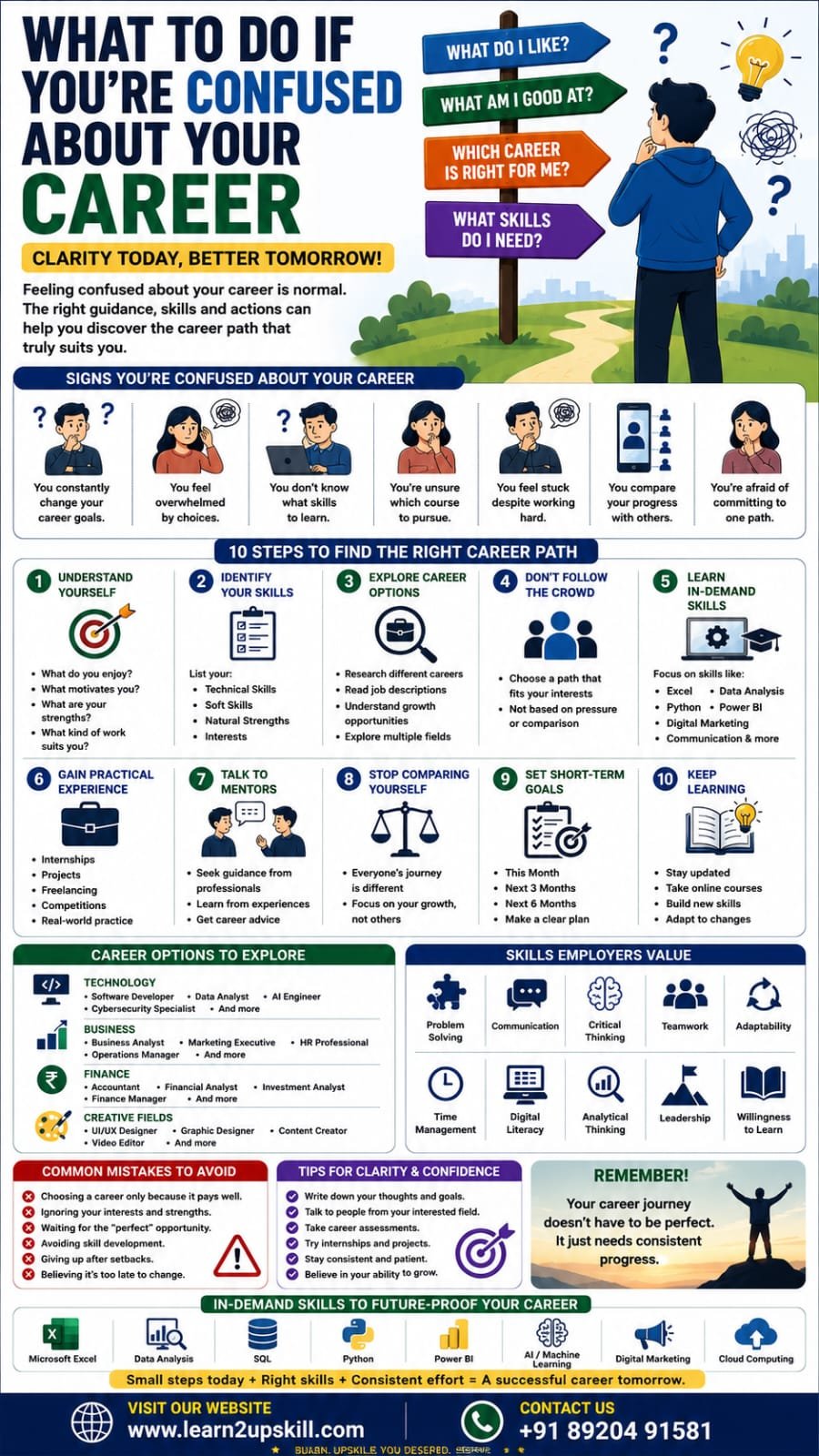
    1. Know Yourself First

    Before choosing a career, understand yourself.

    Ask yourself:

    What subjects do I enjoy?

    What are my strengths?

    What activities make me happy?

    What type of work excites me?

    What problems do I enjoy solving?

    The better you know yourself, the easier it becomes to choose the right career.

    1. Identify Your Skills

    Everyone has different abilities.

    Think about your skills:

    Technical Skills

    Computer knowledge

    Coding

    Excel

    Digital Marketing

    Graphic Design

    Soft Skills

    Communication

    Leadership

    Creativity

    Problem-solving

    Teamwork

    Time management

    Knowing your strengths helps you focus on careers where you can excel.

    1. Explore Different Career Options

    Don’t limit yourself to only traditional careers.

    Explore opportunities in:

    Artificial Intelligence (AI)

    Data Science

    Cybersecurity

    Digital Marketing

    Business Analytics

    UI/UX Design

    Cloud Computing

    Software Development

    Healthcare

    Finance

    Content Creation

    Entrepreneurship

    Research what each career involves, required qualifications, growth potential, and future demand.

    1. Talk to Career Experts

    Career counsellors can help you:

    Understand your strengths

    Explore career options

    Select the right course

    Build a career roadmap

    Avoid common career mistakes

    Professional guidance can save years of confusion.

    1. Don’t Follow the Crowd

    Many students choose careers simply because:

    Friends chose them

    Parents suggested them

    They seem popular

    They offer high salaries

    Remember:

    A career that is perfect for someone else may not be right for you.

    Choose a career based on your interests, abilities, and long-term goals.

    1. Gain Real-World Experience

    Practical experience gives you valuable insights.

    Try:

    Internships

    Volunteering

    Freelancing

    Online projects

    Workshops

    Job shadowing

    These experiences help you discover what kind of work you truly enjoy.

    1. Learn Future-Ready Skills

    Employers today value practical skills alongside academic qualifications.

    Focus on learning:

    Artificial Intelligence (AI)

    Microsoft Excel

    Data Analytics

    Digital Marketing

    Python

    SQL

    Communication Skills

    Public Speaking

    Leadership

    Critical Thinking

    These skills improve employability across many industries.

    1. Take Career Assessment Tests

    Career assessment tools evaluate:

    Personality

    Interests

    Aptitude

    Work preferences

    Strengths

    These assessments can suggest career paths that match your profile.

    Use them as guidance—not as the only basis for your decision.

    1. Set Small Career Goals

    You don’t need to figure out your entire future today.

    Start with manageable goals:

    This Month

    Research three career options.

    Complete one online course.

    Improve your LinkedIn profile.

    Next Six Months

    Build a portfolio.

    Learn a new technical skill.

    Apply for internships.

    Small steps lead to big achievements.

    1. Don’t Fear Making the Wrong Choice

    Many successful professionals changed careers before finding the right fit.

    Your first decision doesn’t have to define your entire future.

    Stay open to learning, adapting, and growing.

    1. Stay Updated with Industry Trends

    The job market changes quickly.

    Follow:

    Industry blogs

    Career websites

    LinkedIn

    Webinars

    Professional communities

    Staying informed helps you make better career decisions.

    1. Build a Strong Professional Profile

    Even before graduation, you can prepare for success.

    Create:

    A professional resume

    A LinkedIn profile

    A portfolio of projects

    Certificates from online courses

    Internship experience

    A strong profile increases your confidence and employability.

    Signs You’re Moving in the Right Direction

    You are likely on the right path if you:

    Enjoy learning about your chosen field.

    Feel motivated to improve your skills.

    Look forward to new challenges.

    Continue learning consistently.

    See opportunities for personal and professional growth.

    Common Career Mistakes to Avoid

    Avoid these common mistakes:

    Choosing a career based only on salary

    Ignoring your interests

    Following peer pressure

    Avoiding internships

    Not learning practical skills

    Waiting until graduation to prepare

    Ignoring career counselling

    Fearing failure

    Learning from these mistakes can save time and effort.

    Practical Career Action Plan

    Week 1

    List your strengths, interests, and career goals.

    Week 2

    Research five careers that interest you.

    Week 3

    Speak with a mentor or career counsellor.

    Week 4

    Enroll in a job-ready online course.

    Month 2

    Complete a project or internship.

    Month 3

    Update your resume and LinkedIn profile.

    Consistency matters more than speed.

    How Learn2Upskill Can Help

    At Learn2Upskill, we guide students toward confident career decisions by offering:

    Career Counselling

    Artificial Intelligence (AI) Courses

    Digital Marketing Training

    Microsoft Excel Programs

    Data Analytics Courses

    Soft Skills Development

    Interview Preparation

    Resume Building Support

    Industry-Focused Skill Development

    Our goal is to help students become job-ready and future-ready.

    Final Thoughts

    Career confusion is a temporary phase—not a permanent problem. Every successful professional started with questions, uncertainty, and the need for guidance.

    Take time to understand yourself, explore career options, develop valuable skills, and seek advice from experienced mentors. Don’t rush your decision, but don’t delay taking action either.

    Remember, your career is a journey, not a single choice. Every skill you learn, every experience you gain, and every informed decision you make brings you one step closer to a successful future.

    Learn with Learn2Upskill

    Whether you’re choosing your first career, preparing for college, or planning your next professional step, Learn2Upskill is here to support your journey.

    We offer practical training, career counselling, and industry-relevant courses to help students and professionals succeed in today’s competitive world.

    🌐 Website: www.coral-kudu-326218.hostingersite.com⁠�

    📞 Contact: +91 89204 91581

    Take the first step toward your dream career with Learn2Upskill—because the right guidance today creates a brighter tomorrow.

  • Career Planning Guide for Students

    Career Planning Guide for Students

    Career Planning Guide for Students

    Learn how to plan your career with this complete guide for students. Discover how to identify your interests, choose the right career, build in-demand skills, and prepare for future job opportunities.

    Focus Keyword: Career Planning Guide for Students

    —

    Career Planning Guide for Students

    Choosing the right career is one of the most important decisions a student will make. With thousands of career options available today and rapid changes in technology, many students feel confused about where to begin.

    The good news is that career planning doesn’t require you to have all the answers immediately. Instead, it’s about understanding yourself, exploring opportunities, developing the right skills, and making informed decisions over time.

    This comprehensive guide will help students create a clear career roadmap and prepare for a successful future.

    —

    What Is Career Planning?

    Career planning is the process of identifying your interests, strengths, values, and goals, then selecting a career path that aligns with them.

    It involves:

    – Self-assessment

    – Career exploration

    – Skill development

    – Goal setting

    – Continuous learning

    – Practical experience

    Good career planning helps you make confident decisions instead of choosing a career based only on trends or pressure.

    —

    Why Is Career Planning Important?

    Proper career planning helps students:

    – Understand their strengths

    – Make informed career choices

    – Reduce confusion and stress

    – Develop job-ready skills

    – Improve employability

    – Build confidence

    – Achieve long-term career goals

    —

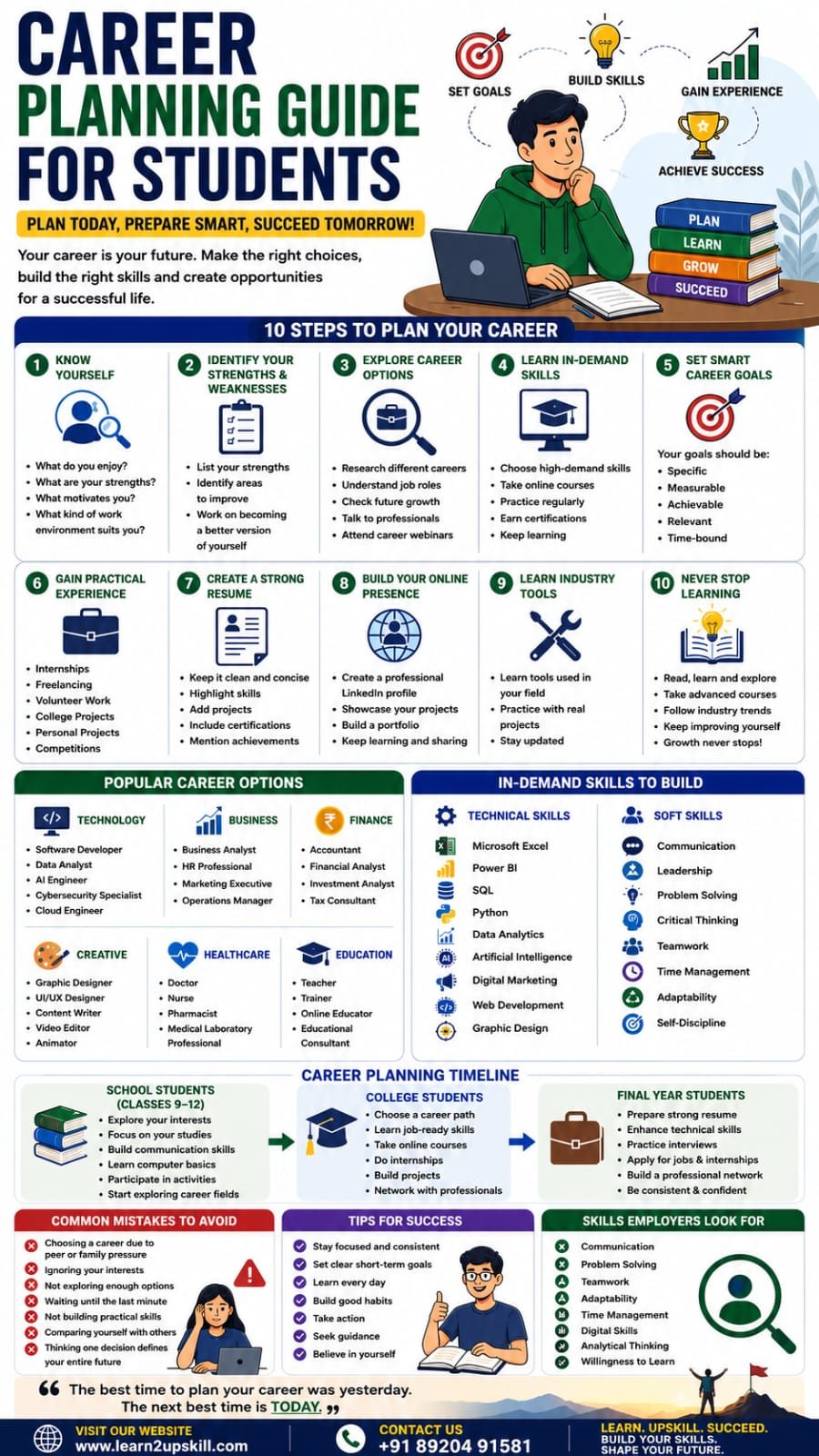
    Step 1: Know Yourself

    Before choosing any profession, understand who you are.


    Ask yourself:


    – What subjects do I enjoy?

    – What activities excite me?

    – What are my strengths?

    – What kind of work environment suits me?

    – What values matter most to me?

    Knowing yourself makes career decisions easier.

    —

    Step 2: Identify Your Strengths and Weaknesses

    Create a simple list.

    Strengths

    Examples:

    – Communication

    – Problem Solving

    – Leadership

    – Creativity

    – Mathematics

    – Analytical Thinking

    – Teamwork

    Areas to Improve

    Examples:

    – Public Speaking

    – Time Management

    – Technical Skills

    – Confidence

    – Organization

    Improving your weaker areas can significantly increase your career opportunities.

    —

    Step 3: Explore Career Options

    Don’t limit yourself to careers you hear about most often.

    Research different industries.

    Technology

    Business

    Finance

    Creative Careers

    Healthcare

    Education

    —

    Step 4: Learn In-Demand Skills

    Today’s employers value practical skills in addition to academic qualifications.

    Some of the most sought-after skills include:

    Technical Skills

    Soft Skills

    These skills are valuable across many industries.

    —

    Step 5: Set SMART Career Goals

    A good goal is:

    – Specific

    – Measurable

    – Achievable

    – Relevant

    – Time-bound

    —

    Step 6: Build Practical Experience

    Experience helps turn knowledge into skills.

    Ways to gain experience:

    – Internships

    – Freelancing

    – Volunteer work

    – College projects

    – Online competitions

    – Personal projects

    – Hackathons

    Employers appreciate candidates who can demonstrate practical work.

    —

    Step 7: Create a Strong Resume

    A student resume should include:

    – Education

    – Skills

    – Certifications

    – Projects

    – Internships

    – Achievements

    – Volunteer Experience

    Keep it concise, accurate, and tailored to the role you’re applying for.

    —

    Step 8: Build Your Online Presence

    Recruiters often review candidates online.

    —

    Step 9: Learn Industry Tools

    Different careers require different tools.

    Examples:

    Data Analytics

    Marketing

    Design

    Project Management

    Learning industry-standard tools gives you a competitive advantage.

    —

    Step 10: Never Stop Learning

    Technology evolves rapidly.

    Stay updated by:

    – Taking online courses

    – Reading industry blogs

    – Watching educational videos

    – Practicing regularly

    – Attending webinars

    – Networking with professionals

    Continuous learning is essential for long-term career growth.

    —

    Common Career Planning Mistakes

    Avoid these common mistakes:

    – Choosing a career because of peer pressure.

    – Ignoring your interests and strengths.

    – Waiting until graduation to build skills.

    – Not gaining practical experience.

    – Comparing yourself with others.

    – Believing one decision determines your entire future.

    —

    Skills Employers Look For

    Across industries, employers consistently value:

    – Communication

    – Problem Solving

    – Teamwork

    – Adaptability

    – Critical Thinking

    – Time Management

    – Digital Skills

    – Microsoft Excel

    – Analytical Thinking

    – Willingness to Learn

    Developing these skills can significantly improve your employability.

    —

    Final Thoughts

    Career planning is not about having your entire future figured out today—it’s about taking consistent steps toward a meaningful and successful career. By understanding yourself, exploring opportunities, building practical skills, and gaining real-world experience, you can create a strong foundation for long-term success.

    Start early, stay curious, and continue learning. Every course you complete, every project you build, and every new skill you develop brings you closer to your career goals.

    At Learn2Upskill, we help students become job-ready with practical training in Microsoft Excel, Data Analytics, Power BI, Python, AI, Digital Marketing, and other high-demand professional skills.

    Why Learn with Learn2Upskill?

    – Industry-focused training

    – Hands-on projects

    – Practical learning approach

    – Career-oriented curriculum

    – Expert guidance

    – Skills aligned with today’s job market

    Visit: www.coral-kudu-326218.hostingersite.com

    Contact Us: +91 89204 91581

    Learn Today. Build Skills. Shape Your Future.