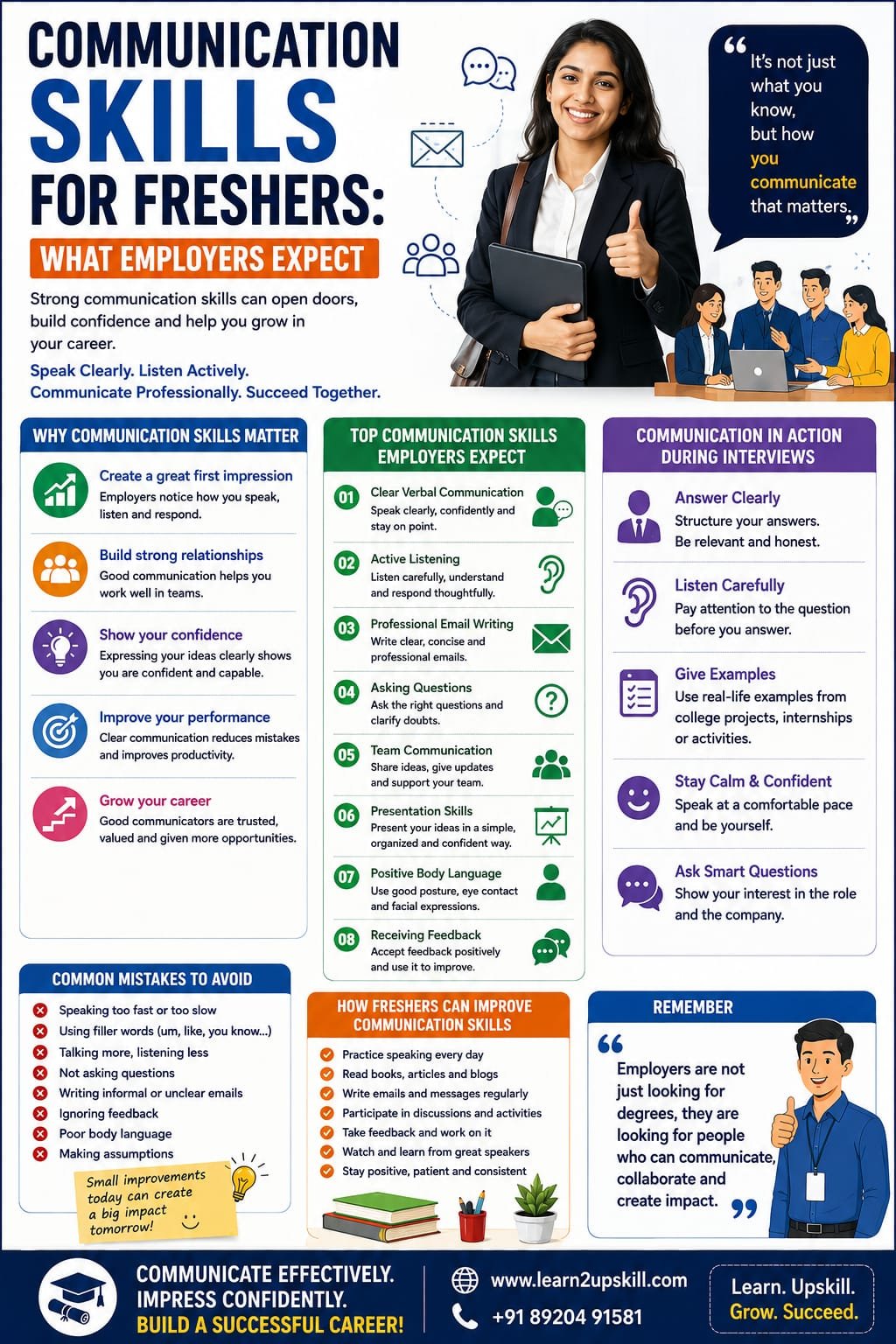
Communication Skills for Freshers: What Employers Expect
Description: Discover the communication skills employers expect from freshers. Learn how verbal communication, email writing, listening, teamwork and presentation skills can improve your job opportunities and career growth.
Suggested URL Slug:
“/communication-skills-for-freshers-what-employers-expect/”
—
Communication Skills for Freshers: What Employers Expect
Starting your first job can be exciting.
It can also be challenging.
As a fresher, you may spend a lot of time preparing your resume, improving your technical knowledge and searching for job opportunities.
But there is another skill that employers often notice from your very first interaction:
«Your communication skills.»
Communication begins even before you get the job.
It can be seen in:
– Your resume
– Your job application
– Your emails
– Your interview answers
– The questions you ask
– The way you interact with recruiters
Once you join an organization, communication becomes even more important.
You may need to:
– Understand instructions
– Ask questions
– Participate in meetings
– Write professional emails
– Work with colleagues
– Present your ideas
– Communicate with managers or clients
This is why strong communication skills can give freshers a significant advantage.
The good news?
You don’t need to be an extrovert or a perfect public speaker to become a good communicator.
Effective communication is a skill that can be learned and improved.
In this guide, we will explore what employers expect from freshers and how you can build strong communication skills for career success.
—
Why Communication Skills Matter for Freshers
Employers understand that freshers may not have years of professional experience.
They may not expect you to know everything.
But they often expect you to show that you can:
– Learn
– Listen
– Communicate
– Collaborate
– Adapt
Imagine a manager giving instructions to two new employees.
Employee A
Doesn’t listen carefully.
Doesn’t ask questions.
Makes assumptions.
Later, completes the wrong task.
Employee B
Listens carefully.
Takes notes.
Asks relevant questions.
Confirms their understanding.
Employee B is more likely to avoid misunderstandings.
That is the practical value of communication.
—
What Do Employers Expect From Freshers?
Employers generally look for more than academic qualifications.
They want employees who can work effectively in a professional environment.
Some of the most important communication-related expectations include:
✅ Clear Speaking
✅ Active Listening
✅ Professional Email Writing
✅ Confidence
✅ Team Communication
✅ Asking Questions
✅ Presentation Skills
✅ Positive Body Language
Let’s explore each of these skills.
—
- Clear and Confident Verbal Communication
Freshers should be able to explain their thoughts clearly.
This does not mean using difficult English or speaking continuously.
Good verbal communication means:
– Speaking clearly
– Organizing your thoughts
– Using appropriate language
– Staying focused on the topic
For example, during an interview, a recruiter may ask:
«Tell me about yourself.»
A weak response may be unstructured and confusing.
A stronger response follows a simple flow:
«Who you are → Your education or background → Your skills → Your career goal»
Clear structure makes communication easier to understand.
—
- Active Listening
Communication is not only about speaking.
Listening is equally important.
Freshers often focus heavily on preparing answers.
But successful workplace communication also requires understanding what others are saying.
Active listening includes:
– Paying attention
– Avoiding unnecessary interruptions
– Asking questions when needed
– Confirming important information
For example:
«Just to confirm, would you like me to complete the report by Friday?»
This simple question can prevent misunderstandings.
—
- Professional Email Communication
Email is an important workplace skill.
Freshers should understand how to write emails that are:
– Clear
– Polite
– Professional
– Concise
A professional email should generally include:
A clear subject line
A professional greeting
The purpose of the email
Important details
A clear next step
A professional closing
For example:
Subject: Request for Clarification Regarding Project Task
Hello [Name],
I would like to clarify one point regarding the project task assigned during today’s meeting.
Could you please confirm the expected submission date?
Thank you.
Kind regards,
[Your Name]
Simple.
Clear.
Professional.
—
- The Confidence to Ask Questions
Many freshers are afraid to ask questions because they don’t want to appear inexperienced.
But asking thoughtful questions is often better than making incorrect assumptions.
For example:
«Could you please explain this process once more? I want to make sure I understand it correctly.»
This demonstrates responsibility.
The key is to ask questions professionally and thoughtfully.
Before asking, first try to understand the available information.
Then ask specific questions.
—
- Team Communication Skills
Most jobs involve teamwork.
Freshers may need to work with:
– Colleagues
– Managers
– Different departments
– Clients
Good team communication involves:
– Sharing information
– Listening to others
– Respecting different opinions
– Giving updates
– Asking for support when necessary
Remember:
«Good teamwork depends on good communication.»
A highly skilled employee who cannot communicate with the team may struggle to create the same impact as someone who combines skills with collaboration.
—
- Presentation Skills
Freshers may be asked to:
– Present a project
– Explain an idea
– Share an update
– Participate in meetings
You don’t need to be a professional public speaker.
Start by developing basic skills:
– Organize your ideas
– Speak slowly and clearly
– Maintain appropriate eye contact
– Avoid reading directly from slides
– Practice before presenting
Confidence improves through experience.
The more you practice, the more comfortable you can become.
—
- Positive Body Language
Communication is also non-verbal.
Employers may notice:
– Eye contact
– Posture
– Facial expressions
– Attention
– Confidence
During an interview, for example, constantly looking at the floor may make you appear nervous or disengaged.
Try to maintain:
– Comfortable posture
– Natural eye contact
– Calm movements
– An attentive expression
You don’t need to act artificially.
The goal is simply to appear engaged and professional.
—
- The Ability to Receive Feedback
Freshers have a lot to learn.
Feedback is part of professional growth.
Employers value employees who can listen to feedback without becoming defensive.
Instead of thinking:
«I made a mistake. I’m not good enough.»
Try thinking:
«What can I learn from this feedback?»
Good communication includes the ability to:
– Listen
– Understand
– Respond professionally
– Improve
Feedback can become one of your most valuable learning tools.
—
Communication Skills During Job Interviews
Your communication skills are being evaluated throughout an interview.
Recruiters may notice:
– How clearly you answer
– Whether you listen carefully
– How confidently you speak
– How you respond to questions
– Your professionalism
You don’t need perfect answers.
But you should try to be:
Clear
Honest
Relevant
Professional
—
How to Answer Interview Questions More Effectively
Use a simple structure.
For example:
Situation
Explain the context.
Action
Explain what you did.
Result
Explain what happened.
This structure can help you give organized answers.
For freshers, examples can come from:
– College projects
– Internships
– Volunteer work
– Group assignments
– Competitions
You don’t always need full-time work experience to demonstrate communication skills.
—
Common Communication Mistakes Freshers Should Avoid
❌ Trying to Sound Too Complicated
Simple and clear communication is better than difficult language.
—
❌ Pretending to Understand Everything
If you don’t understand something important, ask.
—
❌ Interrupting Others
Listen before responding.
—
❌ Writing Informal Workplace Emails
Professional communication requires an appropriate tone.
—
❌ Giving Very Long Answers
Stay focused on the question.
—
❌ Being Afraid to Speak
Your ideas cannot contribute if you never communicate them.
—
❌ Ignoring Feedback
Feedback can help you improve faster.
—
How Freshers Can Improve Communication Skills
The best way to improve is through regular practice.
- Read and Learn
Read professional articles, emails and business communication examples.
Notice how information is structured.
—
- Practice Speaking
Talk about a topic for two or three minutes.
Record yourself if helpful.
Listen for:
– Clarity
– Speed
– Repeated words
– Confidence
—
- Improve Your Writing
Practice writing:
– Emails
– Short reports
– Professional messages
—
- Participate in Group Activities
Join:
– Discussions
– Presentations
– Workshops
– Debates
Practice builds confidence.
—
- Ask for Feedback
Ask a teacher, mentor or trusted professional:
«What can I improve about my communication?»
Specific feedback can help you identify areas for improvement.
—
Communication Skills and Technical Skills: Freshers Need Both
One of the biggest mistakes job seekers make is focusing only on technical skills.
Technical knowledge is important.
But employers also need people who can:
– Explain their work
– Work in teams
– Understand instructions
– Ask questions
– Communicate with others
For example, imagine two candidates applying for the same role.
Candidate A
Has strong technical knowledge but struggles to explain their work.
Candidate B
Has good technical knowledge and can clearly explain their projects and ideas.
Candidate B may have an advantage because they can demonstrate both technical and communication abilities.
The strongest strategy is:
«Build technical skills + communication skills together.»
—
Communication Skills in the AI Era
Artificial Intelligence is changing workplace communication.
AI tools can help professionals:
– Draft emails
– Improve grammar
– Summarize information
– Prepare presentations
These tools can be useful.
However, freshers should not become completely dependent on AI.
You still need to develop your own ability to:
– Think critically
– Communicate clearly
– Understand people
– Make decisions
AI can help you improve productivity.
But human communication remains important.
The future professional needs:
«Digital Skills + AI Skills + Communication Skills + Critical Thinking»
—
A 30-Day Communication Improvement Plan for Freshers
Here is a simple plan.
Week 1: Improve Listening
Focus on listening carefully.
Practice summarizing what others say.
—
Week 2: Improve Speaking
Practice explaining one topic every day.
Focus on clarity rather than complicated vocabulary.
—
Week 3: Improve Writing
Practice writing professional emails and short messages.
—
Week 4: Practice Professional Communication
Participate in a presentation, discussion or mock interview.
At the end of 30 days, ask yourself:
– Am I more confident?
– Can I explain ideas more clearly?
– Do I listen better?
– Has my professional writing improved?
Small daily improvements can create significant progress.
—
The Top 10 Communication Skills Employers Expect From Freshers
Here is a quick summary:
1️⃣ Verbal Communication
2️⃣ Active Listening
3️⃣ Professional Email Writing
4️⃣ Team Communication
5️⃣ Presentation Skills
6️⃣ Confidence
7️⃣ Positive Body Language
8️⃣ Asking Good Questions
9️⃣ Giving and Receiving Feedback
🔟 Professional Etiquette
Developing these skills can help you become more workplace-ready.
—
Frequently Asked Questions
Why are communication skills important for freshers?
Communication skills help freshers perform effectively in interviews and workplaces by improving teamwork, understanding, professional interactions and confidence.
What communication skills do employers expect?
Employers often expect clear speaking, active listening, professional writing, teamwork, presentation skills and the ability to receive feedback.
Can introverts have strong communication skills?
Yes. Strong communication is not about being the loudest person. It is about communicating clearly, listening effectively and interacting appropriately.
How can freshers improve communication skills?
Freshers can improve through regular speaking practice, professional writing, active listening, presentations and feedback.
Are communication skills more important than technical skills?
Both are important. Technical skills help you perform job-specific tasks, while communication skills help you work effectively with people and explain your ideas.
—
Conclusion
As a fresher, you may not have years of professional experience.
And employers understand that.
But they want to see potential.
Strong communication skills demonstrate that you can:
– Learn
– Listen
– Collaborate
– Adapt
– Grow
You don’t need to become a perfect speaker overnight.
Start with small improvements.
Listen more carefully.
Write more clearly.
Ask better questions.
Practice speaking.
Learn from feedback.
Remember:
«Your qualifications may help you get noticed. Your communication skills can help you create an impact.»
The best investment you can make as a fresher is to develop both your professional knowledge and your ability to communicate it.
—
🚀 Become Career-Ready With Learn2Upskill
Starting your career requires more than academic qualifications.
Build practical skills in:
– Communication
– Professional Email Writing
– Presentation Skills
– Workplace Etiquette
– AI and Digital Skills
– Career Development
with Learn2Upskill.
🌐 www.coral-kudu-326218.hostingersite.com
📞 Contact Us: +91 89204 91581
Learn. Upskill. Grow. Succeed.
—
Leave a Reply