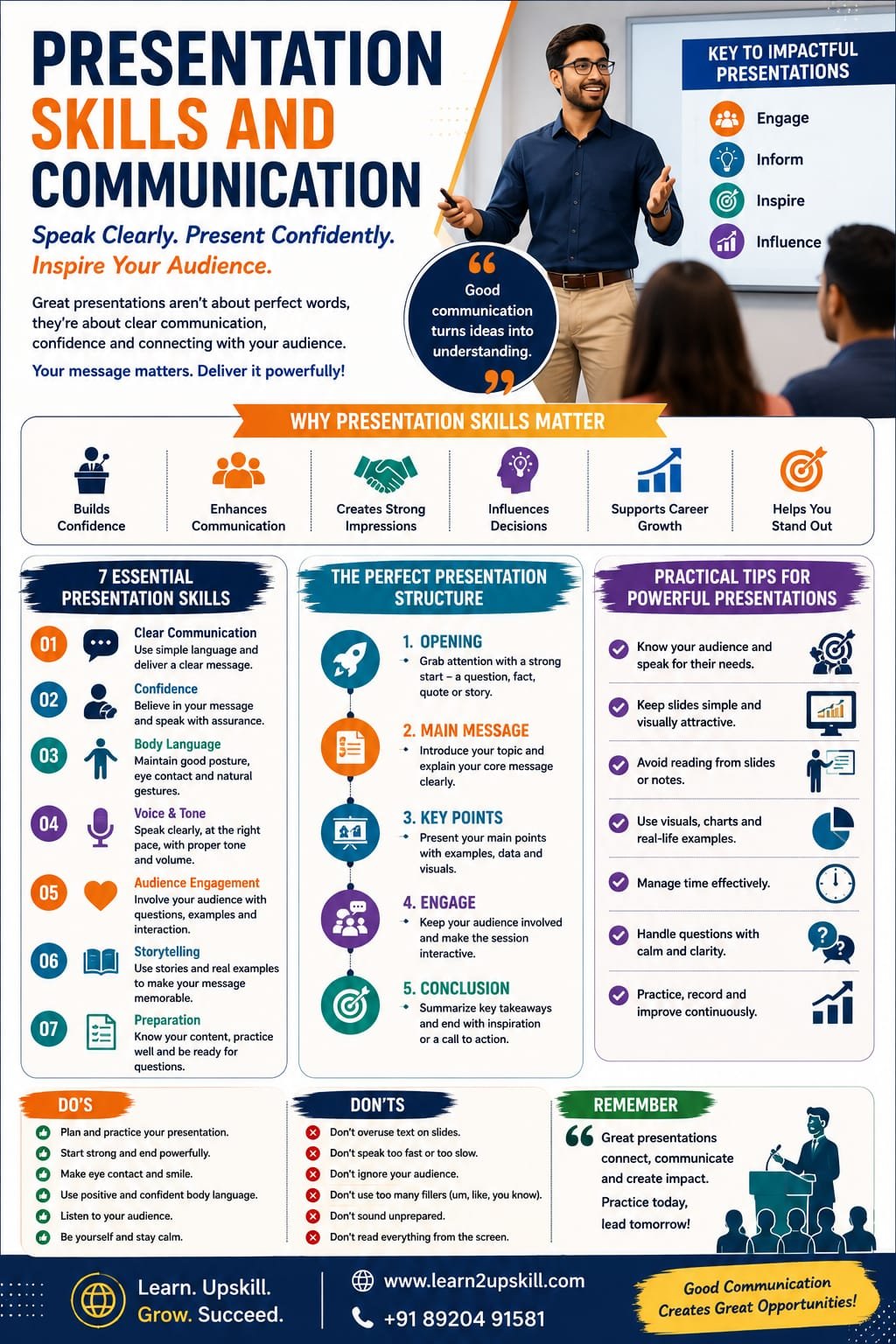
Presentation Skills and Communication: How to Deliver Powerful and Confident Presentations
Description: Learn how to improve presentation skills and communication. Discover practical techniques to speak confidently, engage your audience, structure presentations and deliver powerful messages.
Suggested URL Slug:
“/presentation-skills-and-communication/”
—
Presentation Skills and Communication: How to Deliver Powerful and Confident Presentations
Imagine standing in front of a classroom, meeting room or online audience.
Everyone is looking at you.
Your presentation is about to begin.
You know your topic—but suddenly, your hands feel nervous, your voice becomes uncertain and you forget what you planned to say.
This is a situation many students and professionals experience.
The good news is that great presentation skills are not something that only a few people are born with.
They can be learned.
They can be practiced.
And they can be improved.
Strong presentation skills combine several important abilities:
«Clear Communication + Confidence + Preparation + Body Language + Audience Engagement»
Whether you are a student presenting a project, a professional speaking in a meeting, a manager explaining a strategy or an entrepreneur presenting an idea, your ability to communicate clearly can influence how people understand and respond to your message.
In today’s workplace, presentation skills are becoming increasingly valuable.
Having a great idea is important.
But being able to explain that idea clearly and confidently is equally important.
This guide will help you understand the connection between presentation skills and communication and provide practical techniques to deliver more powerful and effective presentations.
—
What Are Presentation Skills?
Presentation skills are the abilities that help you communicate information, ideas or messages effectively to an audience.
They include:
– Verbal communication
– Non-verbal communication
– Public speaking
– Confidence
– Body language
– Active audience engagement
– Storytelling
– Visual communication
– Preparation
– Listening and responding to questions
A good presentation is not simply reading information from slides.
It is about helping your audience:
– Understand your message
– Remember important ideas
– Stay interested
– Take action when necessary
The goal is not to impress people with complicated words.
The goal is to communicate clearly.
—
Why Are Presentation Skills Important?
Presentation skills are useful in almost every stage of education and professional life.
Students may need to present:
– Projects
– Research
– Assignments
– Group activities
Professionals may need to present:
– Business ideas
– Reports
– Sales proposals
– Project updates
– Training sessions
– Strategies
Leaders may need to present:
– Vision
– Goals
– Decisions
– Organizational changes
Strong presentation skills can help you:
Build Confidence
Regular practice helps you become more comfortable speaking in front of others.
Communicate Ideas Clearly
A structured presentation makes complex information easier to understand.
Create Professional Credibility
Clear and confident communication can improve how others perceive your professionalism.
Influence Decisions
A well-presented idea is more likely to receive attention and consideration.
Advance Your Career
Professionals who can communicate effectively are often better prepared for leadership and client-facing opportunities.
—
The Connection Between Presentation Skills and Communication
A presentation is essentially a form of communication.
But it involves more than words.
A powerful presentation combines:
What You Say
Your message and the words you choose.
How You Say It
Your tone, pace, volume and confidence.
What Your Body Communicates
Your facial expressions, posture and gestures.
How You Engage the Audience
Your ability to maintain attention and respond to reactions.
This means a presentation can fail even when the information is correct.
For example, a person may have excellent research but:
– Speak too quietly
– Read directly from slides
– Use confusing language
– Avoid eye contact
– Speak too quickly
Communication skills help solve these problems.
—
The 7 Essential Presentation Skills
- Clear Communication
Your audience should understand your main message.
Avoid making your presentation unnecessarily complicated.
Instead of using long and confusing explanations, focus on:
– Simple language
– Clear examples
– Short sentences
– Logical structure
Ask yourself:
«If someone remembers only one thing from my presentation, what should it be?»
That question can help you focus your message.
—
- Confidence
Confidence does not mean you never feel nervous.
Even experienced speakers can feel nervous.
Confidence means continuing to communicate effectively despite nervousness.
Preparation is one of the best ways to build confidence.
The better you understand your topic, the more comfortable you will feel discussing it.
—
- Body Language
Your body communicates even when you are not speaking.
Positive body language can include:
– Standing with good posture
– Natural hand gestures
– Appropriate eye contact
– A calm facial expression
– Controlled movement
Try to avoid:
– Constantly looking at the floor
– Crossing your arms defensively
– Repeatedly touching your face
– Moving nervously from side to side
You don’t need to become completely still.
Natural movement is often better.
—
- Voice and Tone
Your voice is one of your most important presentation tools.
Consider:
Volume
Can everyone hear you?
Pace
Are you speaking too quickly?
Tone
Does your voice sound interested and confident?
Pauses
Are you giving the audience time to understand important points?
A useful technique is to pause after an important idea.
For example:
«”Communication is not just about speaking.”»
Pause.
«”It’s about making sure your message is understood.”»
The pause creates emphasis.
—
- Storytelling
People often remember stories better than lists of facts.
Instead of beginning with:
«”Today I will discuss the importance of communication.”»
You could begin with a situation:
«”Imagine having a brilliant idea—but being unable to explain it clearly to anyone.”»
This immediately creates interest.
Stories can help your audience:
– Connect emotionally
– Understand complex ideas
– Remember your message
You don’t need to tell a long story.
Even a short example can make a presentation more engaging.
—
- Audience Engagement
A presentation should not always feel like a one-way lecture.
Find ways to involve your audience.
You can:
– Ask questions
– Use examples
– Tell short stories
– Ask for opinions
– Use relatable situations
For example:
«”How many of you have ever felt nervous before giving a presentation?”»
This simple question creates connection.
—
- Preparation
Good presentations rarely happen by accident.
Preparation includes:
– Understanding your topic
– Researching information
– Organizing your ideas
– Creating slides
– Practicing your delivery
– Preparing for questions
The more prepared you are, the more confident you are likely to feel.
—
How to Structure a Powerful Presentation
One of the easiest ways to improve your presentation is to organize it clearly.
A simple structure is:
- Opening
Capture attention and introduce your topic.
You can begin with:
– A question
– A surprising fact
– A short story
– A relatable situation
—
- Main Message
Explain the most important idea.
Tell the audience:
«What is the key message?»
—
- Supporting Points
Provide your main arguments, examples or evidence.
Try to keep the number of major points manageable.
Three strong points are often easier to remember than ten weak ones.
—
- Conclusion
Summarize the most important message.
End with something memorable.
For example:
«”Great presentations don’t require perfect speakers. They require clear thinking, preparation and the courage to communicate.”»
—
The Power of the First 60 Seconds
The beginning of your presentation matters.
Your opening should answer:
– Why should the audience listen?
– What will they learn?
– Why does this topic matter?
Avoid starting with:
«”Good morning. My name is…”»
and immediately reading the title.
Instead, create interest.
For example:
«”You may have the best idea in the room. But if you cannot communicate it clearly, people may never understand its value.”»
Then introduce your topic.
—
How to Overcome Presentation Nervousness
Feeling nervous before a presentation is normal.
The goal is not necessarily to eliminate nervousness completely.
The goal is to manage it.
Practice Your Opening
The first few seconds are often the most difficult.
Practice your opening several times.
—
Take Deep Breaths
Slow breathing can help you feel calmer.
—
Focus on Your Message
Instead of thinking:
«”What if people judge me?”»
Think:
«”How can I help the audience understand this topic?”»
—
Don’t Try to Memorize Every Word
Memorizing every sentence can make you panic if you forget one word.
Instead, understand your key points.
—
Practice in Front of Others
Ask a friend or family member to listen.
The more you practice speaking in front of people, the easier it can become.
—
How to Create Better Presentation Slides
Your slides should support your message—not replace you.
A common mistake is putting too much text on every slide.
Then the presenter simply reads the slide.
Instead:
Keep Slides Simple
Use short points instead of large paragraphs.
One Main Idea Per Slide
Avoid mixing too many concepts.
Use Visuals Carefully
Images, diagrams and charts can help explain ideas.
Make Text Easy to Read
Use clear and readable text.
Don’t Overuse Animations
Too many effects can distract the audience.
Remember:
«You are the presenter. The slides are your support.»
—
Verbal and Non-Verbal Communication in Presentations
A successful presentation uses both.
Verbal Communication
This includes:
– Words
– Tone
– Volume
– Pace
– Clarity
Non-Verbal Communication
This includes:
– Eye contact
– Facial expressions
– Gestures
– Posture
– Movement
Your verbal and non-verbal communication should support each other.
If you say:
«”I’m very excited about this idea.”»
But your voice sounds bored and you avoid eye contact, the audience may receive a different message.
—
How to Handle Questions During a Presentation
Questions can sometimes make presenters nervous.
But they can also show that the audience is engaged.
When someone asks a question:
Listen Completely
Don’t interrupt.
Take a Moment
You don’t need to answer immediately.
Clarify if Necessary
You can say:
«”Just to make sure I understand your question, are you asking…?”»
Answer Clearly
Keep your response focused.
Be Honest
If you don’t know the answer, don’t invent one.
You can say:
«”That’s a good question. I don’t have the exact information right now, but I can check and share it later.”»
Professional honesty builds trust.
—
Common Presentation Mistakes to Avoid
❌ Reading Every Word From the Slide
Your audience can read.
Focus on explaining the information.
—
❌ Speaking Too Quickly
Slow down and allow people to process important ideas.
—
❌ Using Too Much Information
Don’t try to explain everything.
Focus on your main message.
—
❌ Ignoring the Audience
Watch for reactions and engagement.
—
❌ Using Complicated Language
Simple communication is often more effective.
—
❌ Avoiding Practice
Practice improves timing, confidence and clarity.
—
Presentation Skills for Online Meetings
Virtual presentations require additional communication skills.
When presenting online:
Check Your Technology
Test your:
– Internet connection
– Microphone
– Camera
– Screen sharing
Look at the Camera
This can create a stronger sense of eye contact.
Reduce Distractions
Choose a professional and quiet environment when possible.
Engage Participants
Ask questions and encourage participation.
Keep Your Energy Up
Online audiences can become distracted more easily.
Use clear communication and engaging delivery.
—
Presentation Skills for Students
Students can develop presentation skills through:
– Classroom presentations
– Group projects
– Debates
– Competitions
– School activities
These experiences help build confidence before entering professional life.
Students should focus on:
– Understanding the topic
– Speaking clearly
– Organizing ideas
– Practicing regularly
– Using confident body language
Perfection is not the goal.
Improvement is the goal.
—
Presentation Skills for Professionals
For professionals, presentation skills can influence career growth.
Professionals may need to:
– Present ideas to managers
– Explain reports
– Train employees
– Speak with clients
– Lead meetings
– Present strategies
A professional presentation should be:
– Clear
– Structured
– Relevant
– Confident
– Audience-focused
Before presenting, ask:
«What does my audience need to understand or do after this presentation?»
This helps you design the presentation around the audience rather than around yourself.
—
Presentation Skills in the AI Era
Artificial intelligence can help professionals prepare presentations.
AI tools may assist with:
– Brainstorming ideas
– Organizing content
– Improving language
– Creating outlines
– Generating visual concepts
However, AI cannot completely replace human communication.
A successful presenter still needs:
– Judgment
– Confidence
– Empathy
– Audience awareness
– Authenticity
AI can help prepare your presentation.
But you still need to connect with your audience.
The future professional will increasingly combine:
«AI Skills + Presentation Skills + Communication Skills + Human Intelligence»
—
A Simple Formula for Better Presentations
Remember:
P-R-E-S-E-N-T
P — Prepare
Know your topic and audience.
R — Research
Use accurate and relevant information.
E — Engage
Keep the audience interested.
S — Simplify
Make complex ideas easy to understand.
E — Express
Use your voice and body language effectively.
N — Notice
Pay attention to audience reactions.
T — Tell a Story
Use examples that people can remember.
—
Frequently Asked Questions
What are presentation skills?
Presentation skills are the abilities needed to communicate ideas and information effectively to an audience using clear speech, confidence, body language and audience engagement.
How can I improve my presentation skills?
Practice regularly, understand your topic, organize your presentation, improve your body language and ask for feedback.
How can I speak confidently during a presentation?
Preparation and practice can improve confidence. Focus on communicating your message rather than trying to appear perfect.
What should I do if I forget something?
Pause and return to your key points. Avoid panicking. Most audiences may not know what you originally planned to say.
How important is body language?
Body language is an important part of communication and can influence how confident and engaged you appear.
Should I memorize my presentation?
It is usually better to understand your main points rather than memorizing every word.
—
Conclusion
Presentation skills are not just about standing in front of an audience and speaking.
They are about:
– Communicating clearly
– Connecting with people
– Explaining ideas
– Building confidence
– Creating understanding
You don’t need to become a perfect speaker.
You simply need to become a better communicator.
Start small.
Practice regularly.
Learn from every presentation.
And remember:
«Your audience does not need perfection. They need clarity, value and connection.»
Every presentation is an opportunity to improve.
The more you communicate, the more confident you can become.
So prepare your message.
Take a deep breath.
Stand with confidence.
And share your ideas.
Your voice deserves to be heard.
—
🌟 Develop Powerful Presentation and Communication Skills With Learn2Upskill
Strong communication can create stronger opportunities.
Develop practical skills in presentation, communication, public speaking, leadership and professional development with Learn2Upskill.
🌐 www.coral-kudu-326218.hostingersite.com
📞 Contact Us: +91 89204 91581
Learn. Upskill. Grow. Succeed.
—
Leave a Reply