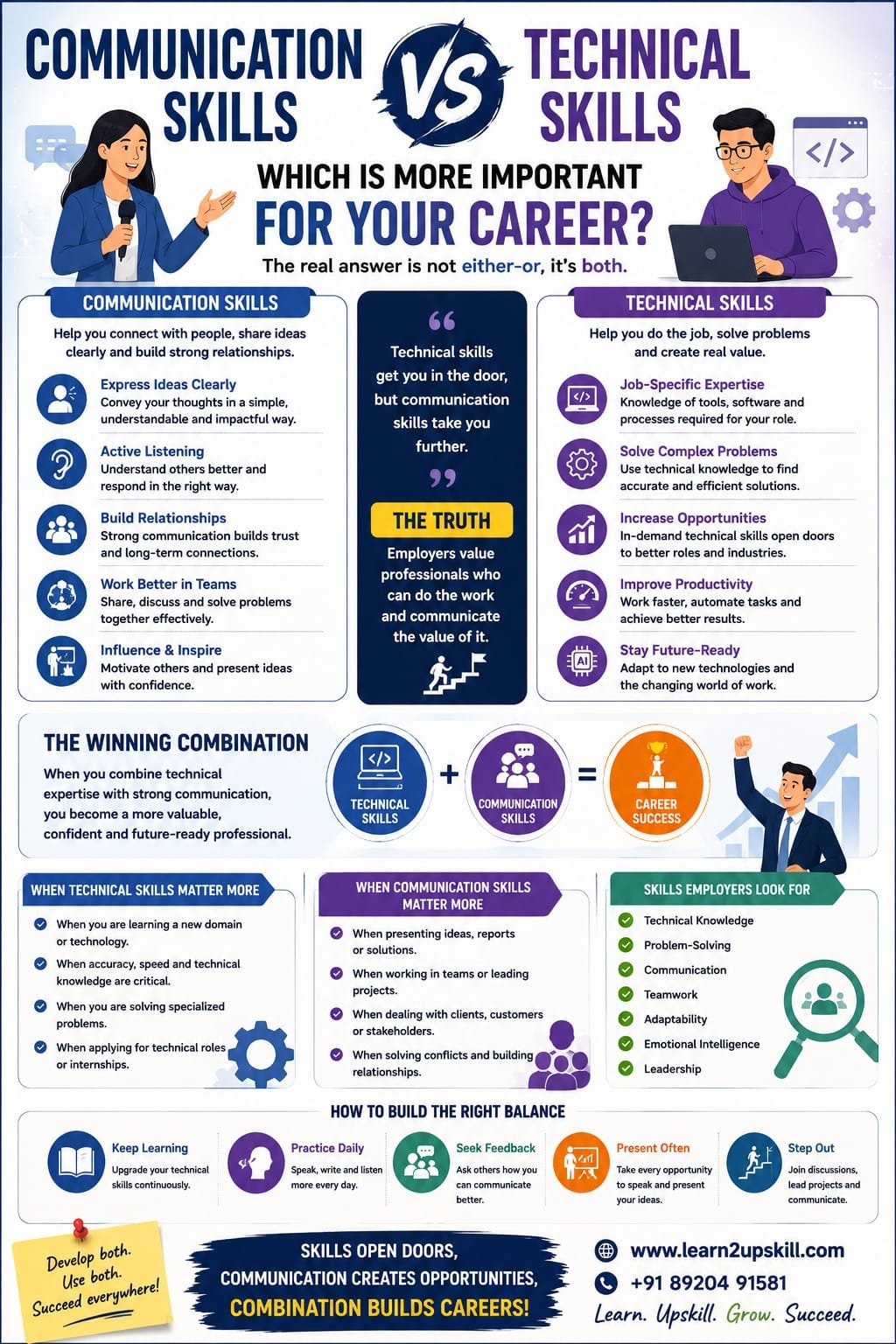
Communication Skills vs Technical Skills: Which Is More Important for Your Career?
Description: Communication skills vs technical skills—which matters more for career success? Discover the differences, why both are important and how to build the right balance for professional growth.
Suggested URL Slug:
“/communication-skills-vs-technical-skills-career/”
—
Communication Skills vs Technical Skills: Which Is More Important for Your Career?
Imagine two professionals.
The first person has excellent technical knowledge. They understand the tools, software and processes required for their job and can solve complex technical problems.
The second person communicates clearly, works well with others, explains ideas effectively and builds strong professional relationships.
Now imagine a third professional.
This person has both technical knowledge and strong communication skills.
Who is likely to have the strongest advantage?
In many careers, the answer is the third professional.
The debate between communication skills vs technical skills often creates the wrong question.
It is not always about choosing one over the other.
Modern careers increasingly require professionals to combine:
«Technical Skills + Communication Skills = Stronger Career Potential»
Technical skills may help you get the job.
Communication skills can help you perform effectively, collaborate with others, explain your work and grow into new opportunities.
As workplaces continue to change, professionals need more than knowledge of tools and technology. They also need the ability to communicate, collaborate, solve problems and work effectively with people.
So, which is more important for your career—communication skills or technical skills?
Let’s explore the answer.
—
What Are Technical Skills?
Technical skills are the specific abilities and knowledge required to perform particular tasks.
They are often learned through:
– Education
– Training
– Certifications
– Courses
– Practical experience
– On-the-job learning
Technical skills depend on the profession.
For example:
A Data Analyst May Need:
– Excel
– SQL
– Power BI
– Data visualization
– Basic statistics
A Digital Marketer May Need:
– SEO
– Social media marketing
– Google Analytics
– Content marketing
– Advertising platforms
A Software Developer May Need:
– Programming languages
– Databases
– Web development
– Cloud technologies
A Finance Professional May Need:
– Financial analysis
– Excel
– Financial modelling
– Accounting knowledge
Technical skills help professionals perform the specific responsibilities of their jobs.
—
What Are Communication Skills?
Communication skills are the abilities that help you share and receive information effectively.
They include:
– Verbal communication
– Written communication
– Active listening
– Presentation skills
– Non-verbal communication
– Professional communication
– Email communication
– Giving and receiving feedback
Good communication is not simply about speaking a lot.
It is about making sure your message is:
– Clear
– Relevant
– Respectful
– Appropriate for the audience
Communication skills also involve listening.
A professional who speaks clearly but never listens is not necessarily an effective communicator.
—
Technical Skills vs Communication Skills: The Key Difference
Technical Skills| Communication Skills
Help you perform specific tasks| Help you interact and work effectively with people
Often job-specific| Useful across almost every career
May involve tools and technology| Focus on sharing and understanding information
Can be measured through practical ability| Often demonstrated through behavior and interaction
Examples: Excel, Python, SEO| Examples: speaking, listening, presenting
Both are important—but they serve different purposes.
—
Why Technical Skills Are Important for Your Career
Technical skills provide the foundation for your professional work.
- They Help You Qualify for Jobs
Employers often look for specific skills when hiring.
For example, a company hiring a data analyst may expect knowledge of:
– Excel
– SQL
– Data visualization tools
Without relevant technical knowledge, it may be difficult to perform the role.
—
- They Help You Perform Your Job
Technical skills allow you to complete professional tasks effectively.
The more capable you become, the more value you may be able to provide.
—
- They Can Increase Career Opportunities
Learning new technical skills can open doors to new roles and industries.
For example:
– Learning data analytics can create opportunities in business analysis.
– Learning AI tools can improve productivity across many professions.
– Learning cybersecurity can create opportunities in digital security roles.
—
- Technology Is Changing Quickly
Many technical skills need regular updating.
Professionals must continue learning to remain relevant.
This is why upskilling and reskilling are becoming increasingly important.
—
Why Communication Skills Are Important for Your Career
Technical knowledge alone does not guarantee career success.
You may have a brilliant idea—but can you explain it?
You may discover an important problem—but can you communicate it to your manager?
You may create an excellent report—but can your audience understand it?
This is where communication skills become essential.
—
- Communication Helps You Explain Technical Work
Imagine a data analyst discovers an important trend.
The analysis is excellent.
But the presentation is confusing.
Decision-makers may not understand what action they should take.
A professional with strong communication skills can explain:
– What happened
– Why it happened
– Why it matters
– What should happen next
This makes technical work more valuable to the organization.
—
- Communication Improves Teamwork
Most professionals do not work alone.
They collaborate with:
– Managers
– Colleagues
– Clients
– Customers
– Different departments
Clear communication helps teams:
– Avoid misunderstandings
– Share information
– Solve problems
– Complete projects
—
- Communication Builds Professional Relationships
Career growth often involves working effectively with people.
Strong communication can help build:
– Trust
– Professional credibility
– Collaboration
– Stronger networks
—
- Communication Is Essential for Leadership
As professionals move into leadership roles, their responsibilities often change.
They may spend less time completing individual technical tasks and more time:
– Leading teams
– Explaining strategies
– Giving feedback
– Making decisions
– Managing stakeholders
Communication becomes increasingly important.
—
So, Which Skill Is More Important?
The honest answer is:
«It depends on your career stage, role and goals—but the strongest professionals develop both.»
Technical skills are often essential for entering and performing a specific profession.
Communication skills help you apply that knowledge effectively in the real world.
Think of it this way:
Technical Skills Help You Do the Work
Communication Skills Help You Share the Value of Your Work
Both are powerful.
—
A Simple Example: The Skilled Professional
Imagine two employees create the same excellent report.
Employee A
Creates a highly accurate report but sends it without explanation.
The manager struggles to understand the main findings.
Employee B
Creates the same quality report and clearly explains:
– The key findings
– Important trends
– Business impact
– Recommended actions
Which report is likely to create more impact?
Employee B’s work is easier to understand and use.
The technical skill produced the report.
The communication skill made the report useful to others.
—
The Growing Importance of Hybrid Skills
The future workplace increasingly values hybrid professionals.
These are people who combine different abilities.
For example:
Data + Communication
A professional who can analyze data and explain it clearly.
AI + Business Understanding
A professional who understands AI tools and business needs.
Technology + Leadership
A professional who understands technical systems and can lead people.
Finance + Presentation Skills
A finance professional who can explain complex information to decision-makers.
The ability to combine skills can create a strong professional advantage.
—
Communication Skills in Technical Careers
Some people believe technical professionals do not need strong communication skills.
This is a myth.
Technical professionals regularly communicate with:
– Team members
– Managers
– Clients
– Non-technical stakeholders
For example, a software developer may need to explain a technical problem to a manager who does not understand programming.
A cybersecurity professional may need to explain a security risk to business leaders.
A data analyst may need to present insights to executives.
The ability to simplify complex information is a valuable communication skill.
—
Technical Skills in Non-Technical Careers
The opposite is also true.
Even professionals in traditionally non-technical careers increasingly need digital skills.
For example:
Marketing Professionals
May need analytics and AI tools.
HR Professionals
May need HR technology and data analysis.
Finance Professionals
May need advanced Excel and automation tools.
Sales Professionals
May need CRM systems and data analysis.
This means the line between technical and non-technical careers is becoming less clear.
—
Communication Skills vs Technical Skills in the AI Era
Artificial intelligence is changing the workplace.
AI can help professionals:
– Write drafts
– Analyze information
– Create summaries
– Automate tasks
– Generate ideas
This makes technical and digital skills increasingly important.
But AI also highlights the importance of human skills.
AI may help generate information.
Humans still need to:
– Communicate
– Build relationships
– Show empathy
– Make judgments
– Lead teams
– Resolve conflicts
The future professional will need a combination of:
«Technical Knowledge + AI Skills + Communication + Critical Thinking + Emotional Intelligence»
This combination can help professionals adapt to changing careers.
—
Skills Employers Look For
Employers often look for a combination of hard and soft skills.
Technical and Professional Skills:
– Digital literacy
– Industry knowledge
– Data skills
– AI awareness
– Software knowledge
Human and Communication Skills:
– Communication
– Teamwork
– Problem-solving
– Adaptability
– Leadership
– Emotional intelligence
The strongest candidates are often those who can demonstrate both categories.
—
How to Develop Technical Skills
Here are practical ways to improve your technical abilities.
- Take Structured Courses
Online and offline courses can provide a clear learning path.
—
- Practice Regularly
Knowledge becomes stronger through practical use.
—
- Work on Projects
Projects help demonstrate your skills.
—
- Earn Relevant Certifications
Certifications can demonstrate structured learning.
—
- Stay Updated
Technology and tools continue to change.
Make learning a regular habit.
—
How to Improve Communication Skills
Communication skills also require practice.
- Practice Active Listening
Focus on understanding before responding.
—
- Improve Your Writing
Practice writing:
– Emails
– Reports
– Professional messages
—
- Practice Public Speaking
Look for opportunities to present.
—
- Ask for Feedback
Ask trusted colleagues:
«”How can I communicate more effectively?”»
—
- Learn to Simplify
Practice explaining complex ideas in simple language.
A good test is:
«Can someone outside your industry understand your explanation?»
—
A Career Development Plan: Build Both Skills
Instead of choosing between technical and communication skills, create a balanced learning plan.
For example:
Month 1
Learn a technical skill relevant to your career.
Month 2
Practice communication through presentations and writing.
Month 3
Complete a practical project.
Month 4
Present or explain your project to others.
This approach helps you develop both your ability to do the work and communicate the value of that work.
—
Common Mistakes Professionals Make
❌ Focusing Only on Technical Skills
Technical expertise is important, but your work often needs to be understood by others.
—
❌ Ignoring Continuous Learning
Skills can become outdated.
Continue developing yourself.
—
❌ Thinking Communication Is Only for Managers
Every professional communicates.
—
❌ Collecting Certificates Without Practice
Skills become stronger when applied.
—
❌ Using Complicated Language to Sound Smart
Clear communication is often more impressive than complicated communication.
—
The Ideal Balance for Career Success
The ideal professional is not necessarily the person with the most certificates.
And it is not necessarily the person who talks the most.
A strong professional can:
✅ Perform their work effectively.
✅ Learn new tools and technologies.
✅ Communicate ideas clearly.
✅ Work well with others.
✅ Solve problems.
✅ Adapt to change.
The goal is balance.
—
Frequently Asked Questions
Are communication skills more important than technical skills?
Both are important. Technical skills help professionals perform specific job responsibilities, while communication skills help them explain ideas, collaborate and build relationships.
Can I get a job with good communication skills but no technical skills?
This depends on the role. Some jobs require specific technical knowledge, while others place greater emphasis on communication and interpersonal abilities.
Do technical professionals need communication skills?
Yes. Technical professionals often need to explain complex ideas, work with teams and communicate with non-technical stakeholders.
Which skills should students focus on?
Students should develop a combination of technical knowledge, communication, critical thinking, digital literacy and problem-solving skills.
How is AI changing the importance of skills?
AI is increasing the importance of digital and AI literacy while also highlighting human skills such as communication, judgment, creativity and emotional intelligence.
—
Conclusion
The question should not be:
«Communication Skills or Technical Skills?»
A better question is:
«How can I develop both?»
Technical skills can help you perform your job.
Communication skills can help people understand your ideas and recognize the value of your work.
In the modern workplace, success increasingly depends on combining:
💻 Technical Skills
💬 Communication Skills
🤖 AI and Digital Skills
🧠 Critical Thinking
🤝 Human Skills
Your technical knowledge gives you the ability to create value.
Your communication skills help you share that value with the world.
The strongest career strategy is simple:
«Learn continuously. Communicate clearly. Apply your skills confidently.»
—
🚀 Build Career-Ready Skills With Learn2Upskill
The future belongs to professionals who combine technical knowledge with strong communication and professional skills.
Develop practical, career-focused skills with Learn2Upskill.
🌐 www.coral-kudu-326218.hostingersite.com
📞 Contact Us: +91 89204 91581
Learn. Upskill. Grow. Succeed.
—
Leave a Reply