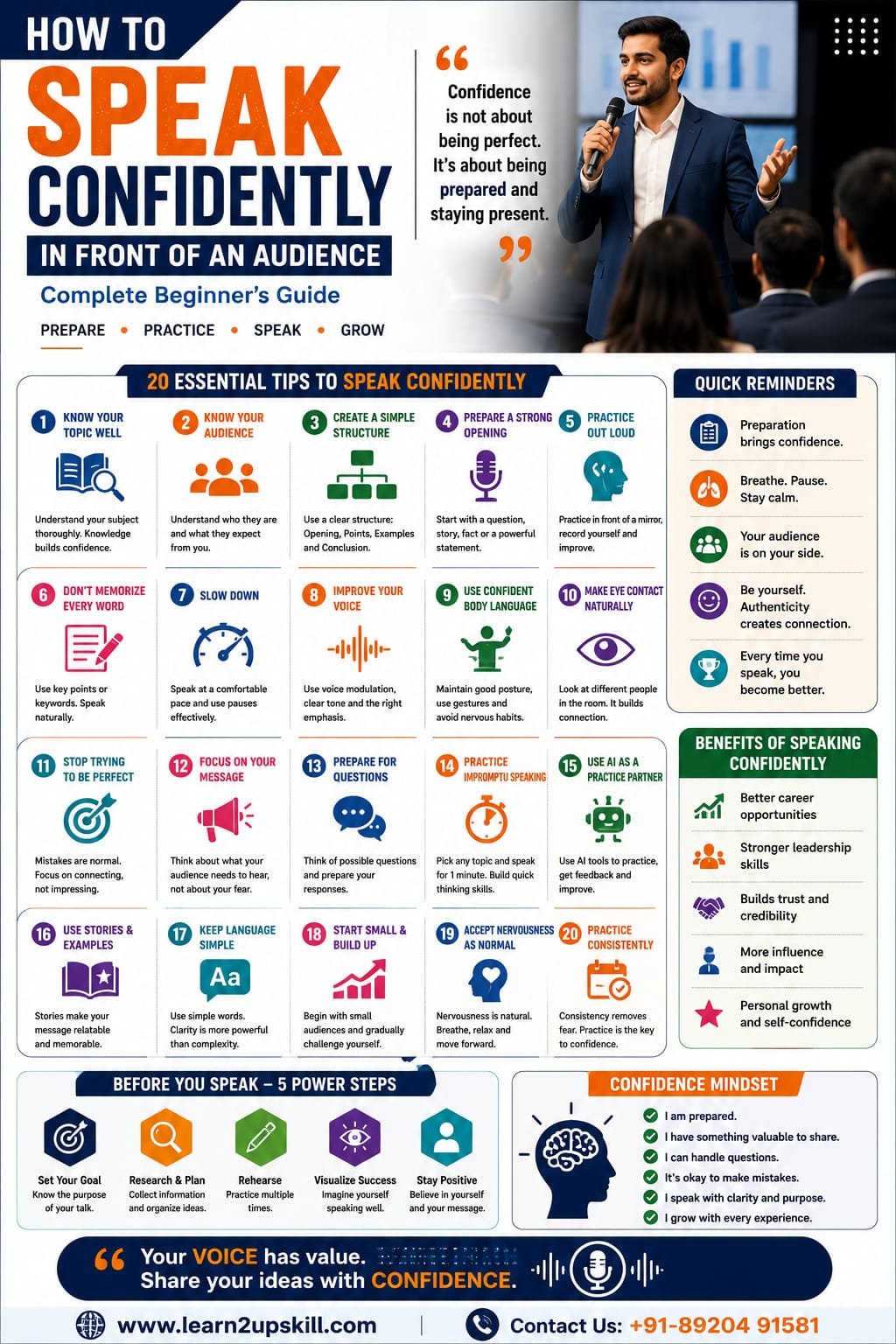
How to Speak Confidently in Front of an Audience
Learn how to speak confidently in front of an audience with practical tips for preparation, body language, voice, storytelling, presentations, Q&A, and overcoming nervousness.
Suggested URL Slug: /how-to-speak-confidently-in-front-of-an-audience/
How to Speak Confidently in Front of an Audience: Complete Beginner’s Guide
Standing in front of an audience and speaking confidently can feel intimidating.
Your heart may beat faster. Your hands may become sweaty. You may suddenly forget what you wanted to say.
And sometimes, even when you know your subject extremely well, speaking in front of others can feel difficult.
The good news is that confidence in public speaking is not something you either have or don’t have. It is a skill you can develop.
You don’t need to be naturally outgoing.
You don’t need to have a powerful voice.
You don’t need to become a professional motivational speaker.
You simply need the right preparation, regular practice, and a willingness to improve.
Whether you’re a student preparing for a school presentation, a professional presenting to management, a job seeker attending an interview, or someone who simply wants to communicate more confidently, this beginner’s guide will help you get started.
What Does It Mean to Speak Confidently?
Speaking confidently doesn’t mean speaking loudly or talking continuously.
A confident speaker is someone who can:
Communicate ideas clearly
Maintain comfortable eye contact
Speak at a controlled pace
Use appropriate body language
Organize thoughts logically
Handle questions calmly
Recover from mistakes
Connect with the audience
Express opinions respectfully
Adapt to different audiences
Most importantly, confidence doesn’t mean never feeling nervous.
You can feel nervous and still speak well.
Real confidence is the ability to communicate effectively even when you feel some pressure.
Why Do People Lose Confidence While Speaking?
Before improving your confidence, understand what may be holding you back.
Common causes include:
Lack of preparation
Fear of being judged
Fear of making mistakes
Lack of speaking experience
Poor knowledge of the topic
Trying to memorize everything
Speaking too quickly
Comparing yourself with experienced speakers
Negative self-talk
Fear of difficult questions
Sometimes the biggest obstacle is not the audience.
It’s the conversation happening inside your own head.
You may think:
“Everyone is going to notice I’m nervous.”
“What if I forget everything?”
“What if someone asks me something I don’t know?”
Instead of trying to eliminate every possible problem, prepare yourself to handle these situations.
- Know Your Topic
The foundation of confident speaking is preparation.
You don’t have to know every possible detail about your subject.
But you should understand your key points.
Before speaking, ask:
What is my main message?
What are the three most important points?
Who is my audience?
What examples can I use?
What questions might people ask?
What should the audience remember?
When you understand your topic, you don’t have to depend completely on notes.
That makes you more flexible and confident.
Remember:
Understand your message instead of memorizing every sentence.
- Know Your Audience
A confident speaker doesn’t simply think about what they want to say.
They think about what the audience needs to hear.
For example, you wouldn’t explain artificial intelligence in exactly the same way to:
School students
Business executives
Software developers
Marketing professionals
Senior citizens
Before your presentation, understand:
Who is listening?
What do they already know?
What do they want to learn?
Why should they care?
This allows you to adjust your language, examples and level of detail.
- Create a Simple Structure
A complicated speech is difficult to remember.
Use a simple structure.
Opening
Introduce the topic and capture attention.
Main Point 1
Explain the first important idea.
Main Point 2
Provide another important idea or example.
Main Point 3
Give a practical takeaway.
Conclusion
Summarize your message and end strongly.
This structure gives your brain a roadmap.
If you forget a sentence, you can simply return to the next key point.
- Prepare a Strong Opening
The beginning of your speech can determine how comfortable you feel during the rest of the presentation.
Instead of starting with:
“Good morning everyone. Today I am going to talk about…”
try something more engaging.
Ask a question
“How many of you have ever been nervous before speaking in public?”
Tell a short story
“Three years ago, I was terrified of speaking in front of five people.”
Share a surprising fact
“We communicate every day, but most of us rarely receive formal training in communication.”
Make a strong statement
“Confidence isn’t something you’re born with. It’s something you build.”
A strong opening immediately gives you direction.
- Practice Out Loud
Reading your speech silently is not enough.
Your brain needs to experience the actual speaking process.
Practice aloud.
You can speak:
In front of a mirror
In front of family
In front of friends
In front of colleagues
Into your phone camera
Recording yourself is particularly useful.
Watch the recording and notice:
Speaking speed
Voice clarity
Eye contact
Facial expressions
Body movement
Filler words
Long pauses
Don’t criticize everything you do.
Choose one or two things to improve at a time.
- Don’t Memorize Every Word
Memorizing a complete speech can actually increase anxiety.
Imagine you’ve memorized:
“There are three major reasons why communication skills…”
Then you forget the next sentence.
Your brain may freeze because you’re trying to remember the exact wording.
Instead, use keywords.
For example:
Communication → AI → Leadership → Career Growth
These four words can remind you what you want to discuss.
Speak naturally around the key ideas.
This makes your delivery sound more authentic.
- Slow Down When You Speak
Nervous speakers often speak too quickly.
You may feel that finishing quickly will make the nervousness disappear.
Usually, the opposite happens.
Speaking too quickly can:
Make your message difficult to understand
Increase mistakes
Make you appear more nervous
Reduce audience engagement
Instead, deliberately slow down.
Use pauses.
For example:
“AI is changing the workplace.”
Pause.
“But technology isn’t the only skill professionals need.”
Pause.
“Human communication still matters.”
Pauses can make your speech more powerful.
- Improve Your Voice
Your voice is an important part of communication.
Avoid speaking in exactly the same tone from beginning to end.
Use voice modulation.
Change:
Pitch
Speed
Volume
Pauses
Emphasis
For example, emphasize an important word:
“The most important skill is communication.”
Your voice should support your message.
You don’t need a dramatic speaker’s voice.
You simply need a clear and natural one.
- Use Confident Body Language
Your audience notices your body language even when you’re not thinking about it.
Focus on:
Posture
Stand comfortably upright.
Eye contact
Look at different people naturally.
Hands
Use natural gestures when appropriate.
Facial expression
Allow your expression to match your message.
Movement
Move purposefully rather than constantly walking around.
Avoid repeatedly:
Looking at the floor
Touching your face
Playing with objects
Crossing your arms
Hiding behind a podium
Checking your notes every few seconds
Your body should support your words.
- Make Eye Contact Naturally
You don’t need to stare at one person throughout your presentation.
Instead, move your attention around the room.
Try looking toward:
Left → Centre → Right → Centre
Spend a few seconds with each area.
If direct eye contact feels uncomfortable initially, look near people’s eyes.
With practice, natural eye contact becomes easier.
Eye contact helps create connection and makes your presentation feel more like a conversation.
- Stop Trying to Be Perfect
Perfectionism is one of the biggest confidence killers.
You may think:
“I cannot make any mistakes.”
But experienced speakers make mistakes too.
They may:
Forget a word
Mispronounce something
Lose their place
Need to restart a sentence
Receive an unexpected question
What matters is how they recover.
If you make a mistake, pause.
Take a breath.
Correct yourself if necessary.
Continue.
Most audiences are far more forgiving than nervous speakers imagine.
- Focus on Your Message, Not Your Nervousness
Instead of constantly thinking:
“Am I looking nervous?”
focus on:
“Am I helping my audience understand this?”
This small mental shift can make a major difference.
Think about your audience as people who have come to hear something useful.
Your job is not to prove that you’re perfect.
Your job is to communicate something valuable.
- Learn to Handle Questions
Many beginners fear the Q&A session more than the presentation.
Prepare beforehand.
Think of five to ten questions someone might ask.
Prepare your responses.
But don’t feel pressured to know everything.
If you don’t know an answer, say:
“That’s a good question. I don’t have enough information to answer that accurately right now, but I can look into it.”
This is better than giving incorrect information.
A confident speaker knows that saying “I don’t know” when appropriate is not a weakness.
It’s professionalism.
- Practice Impromptu Speaking
Not every speaking situation gives you time to prepare.
Your manager may suddenly ask for your opinion.
A client may ask an unexpected question.
A teacher may ask you to explain something.
A colleague may ask:
“Can you quickly present this?”
Practice impromptu speaking.
Choose a random topic and speak for one minute.
Try topics such as:
Social media
AI
Education
Your favorite book
Your career goals
Remote work
A recent project
Your favorite technology
This exercise trains your brain to organize thoughts quickly.
- Use AI as a Practice Partner
AI can be a useful tool for developing speaking confidence.
You can ask AI to:
Create a speech outline
“Create a five-minute presentation outline about digital marketing for beginners.”
Generate questions
“Act as an audience member and ask me 10 difficult questions about my presentation.”
Improve your language
“Make this speech clearer and easier for a beginner audience to understand.”
Practice interviews
“Act as a job interviewer and ask me five communication-related questions.”
Find weak points
“Review this presentation and identify areas where the message is unclear or repetitive.”
AI can help you prepare.
But remember:
AI should support your voice—not replace it.
Add your own experiences, examples and personality.
- Use Stories to Make Your Speech Memorable
People often remember stories better than lists of facts.
Suppose you’re presenting about time management.
Instead of saying:
“Time management improves productivity.”
tell a short story:
“Last year, I noticed that I was spending almost an hour every morning simply deciding what to work on. I started planning my top three priorities the night before, and my mornings became much more productive.”
The story gives the idea context.
You don’t need dramatic stories.
Even simple personal experiences can make your presentation more human.
- Use Simple Language
Confident speakers don’t necessarily use complicated vocabulary.
In fact, simple language often makes communication stronger.
Instead of:
“We need to optimize our organizational operational efficiency.”
say:
“We need to improve how efficiently our team works.”
Simple language is easier to understand.
Your goal is not to impress people with vocabulary.
Your goal is to make your message clear.
- Practice With Smaller Audiences
If speaking in front of a large audience scares you, start small.
Try:
1 person → 3 people → 5 people → 10 people → larger audience
Each successful experience builds evidence that you can do it.
Confidence grows through experience.
You don’t have to wait until you “feel confident” before speaking.
Often, speaking creates confidence.
- Prepare for Different Speaking Situations
Public speaking isn’t limited to formal speeches.
Practice speaking confidently in:
Meetings
Share your opinion clearly.
Interviews
Explain your achievements confidently.
Presentations
Organize your message logically.
Networking
Introduce yourself naturally.
Group discussions
Listen and contribute thoughtfully.
Client meetings
Explain solutions clearly.
Webinars
Maintain energy even when speaking online.
Everyday communication creates public-speaking confidence.
- Create a 7-Day Confidence Challenge
Want to start immediately?
Try this:
Day 1
Record yourself speaking for two minutes.
Day 2
Practice your body language.
Day 3
Give a three-minute presentation.
Day 4
Practice answering five unexpected questions.
Day 5
Speak for five minutes using only keywords.
Day 6
Present to a friend or family member.
Day 7
Record yourself again and compare it with Day 1.
Look for improvement rather than perfection.
Common Mistakes Beginners Should Avoid
❌ Reading every word from your slides
Use slides as visual support.
❌ Speaking too quickly
Slow down.
❌ Using too much text
Keep your presentation simple.
❌ Avoiding eye contact
Connect naturally with the audience.
❌ Memorizing everything
Remember key ideas instead.
❌ Using complicated language
Keep your message clear.
❌ Ignoring questions
Prepare for likely questions.
❌ Comparing yourself with expert speakers
Everyone starts somewhere.
❌ Avoiding speaking opportunities
Practice requires participation.
❌ Expecting instant confidence
Confidence develops over time.
Public Speaking and Career Growth
Speaking confidently can influence your professional development.
It can help you:
Perform better in interviews
Present ideas to management
Lead meetings
Communicate with clients
Explain technical concepts
Build professional relationships
Participate in discussions
Lead teams
Deliver training
Represent your organization
In an AI-powered workplace, technical skills are increasingly important—but human communication remains essential.
A professional who can use technology and communicate effectively can bring a powerful combination of skills to the workplace.
Public Speaking for Students
Students can start developing speaking confidence early.
Practice through:
Classroom presentations
Debates
Group discussions
School events
Seminars
Project presentations
Competitions
Interviews
Start with small opportunities.
Don’t worry about sounding perfect.
Every presentation gives you another chance to improve.
Public Speaking for Professionals
Professionals can build confidence through everyday workplace situations.
Try volunteering to:
Present a project update
Explain a report
Lead a short meeting
Demonstrate a new process
Train a colleague
Present an idea
Speak during a team discussion
Small opportunities eventually prepare you for bigger ones.
What If You Still Feel Nervous?
You may practice regularly and still feel nervous.
That’s completely normal.
The goal isn’t:
“I must never feel nervous.”
Instead, aim for:
“I can feel nervous and still communicate effectively.”
That is real confidence.
Your heart may beat faster.
Your hands may feel slightly shaky.
You may need to pause.
And you can still deliver a successful presentation.
Final Thoughts
Learning how to speak confidently in front of an audience takes time.
You don’t need to transform yourself overnight.
Start with small steps.
Know your topic.
Prepare your structure.
Practice out loud.
Slow down.
Use natural eye contact.
Improve your body language.
Prepare for questions.
Use AI as a practice partner.
Accept mistakes.
Keep practicing.
Most importantly, remember that confidence isn’t about becoming someone else.
It’s about becoming comfortable expressing your own ideas, knowledge and personality.
Your voice has value.
Your ideas deserve to be heard.
And with consistent practice, you can become a much more confident speaker.
Prepare. Practice. Speak. Grow.
Quick Confident Speaking Checklist
[ ] Know your topic.
[ ] Understand your audience.
[ ] Create a simple structure.
[ ] Prepare a strong opening.
[ ] Practice out loud.
[ ] Don’t memorize every word.
[ ] Slow down.
[ ] Use pauses.
[ ] Improve voice modulation.
[ ] Maintain natural eye contact.
[ ] Use confident body language.
[ ] Prepare for questions.
[ ] Practice impromptu speaking.
[ ] Use AI as a practice partner.
[ ] Use stories and examples.
[ ] Keep your language simple.
[ ] Start with small audiences.
[ ] Accept mistakes.
[ ] Practice consistently.
Build Your Communication Skills With Learn2upskill
Public speaking is not just a presentation skill. It is a valuable career and workplace communication skill.
At Learn2upskill, we help students, professionals, job seekers and career changers develop practical skills for today’s changing workplace.
Explore learning opportunities in:
Public Speaking • Communication • AI • Excel • Business Analysis • Digital Marketing • Cybersecurity • Professional Development
Don’t let nervousness stop you from sharing your ideas.
Learn. Upskill. Grow.
🌐 www.coral-kudu-326218.hostingersite.com�
Contact Us: +91-89204 91581
Leave a Reply