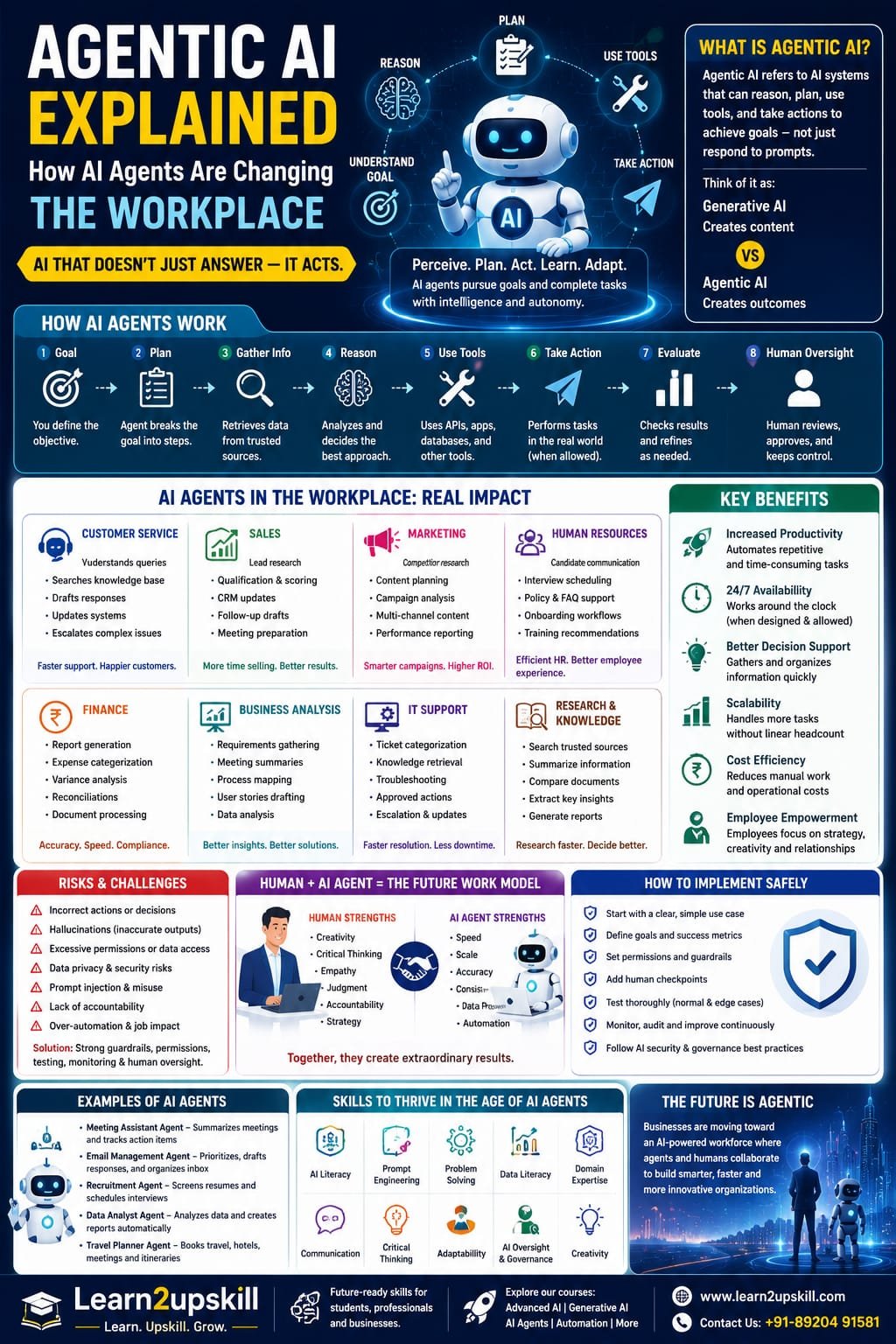
Agentic AI Explained: How AI Agents Are Changing the Workplace
Learn what Agentic AI is, how AI agents work, workplace examples, benefits, risks, skills to learn, and how AI agents are transforming business and careers in 2026.
Suggested URL Slug: /agentic-ai-explained-ai-agents-workplace/
Agentic AI Explained: How AI Agents Are Changing the Workplace
Artificial intelligence has entered a new phase.
First, businesses used AI primarily for prediction and automation.
Then came Generative AI, which made it possible to create text, images, code, summaries and other content using natural-language instructions.
Now another shift is taking place:
Agentic AI.
Instead of simply answering a question, an AI agent can be designed to reason about a goal, plan multiple steps, use tools, retrieve information and take actions with varying degrees of human supervision.
Google Cloud describes AI agents as software systems that use AI to pursue goals and complete tasks on behalf of users, with capabilities such as reasoning, planning, memory and tool use. �
Google Cloud
MIT Sloan similarly describes agentic AI as a newer generation of AI systems capable of perceiving, reasoning and acting, including completing complex, multistep workflows with limited supervision. �
MIT Sloan
This could significantly change how work is organized.
But what exactly is Agentic AI?
How is it different from ChatGPT or a traditional chatbot?
And what does it mean for employees, businesses and future careers?
Let’s explore.
What Is Agentic AI?
Agentic AI refers to AI systems designed to pursue goals and perform actions rather than simply generate a response.
A traditional chatbot might answer:
“What are our sales numbers this month?”
An AI agent could potentially:
Access an authorized sales database.
Retrieve the latest figures.
Analyze the numbers.
Compare them with previous months.
Identify unusual changes.
Create a summary.
Prepare a report.
Send it to the appropriate person—if permitted by its workflow and access controls.
The important difference is action.
Generative AI
You ask → AI generates
Agentic AI
You define a goal → AI plans → uses tools → performs tasks → reports results
The exact level of autonomy depends on how the agent is designed.
What Is an AI Agent?
An AI agent is a software system that combines an AI model with other components that allow it to work toward a goal.
Depending on the application, an agent may have access to:
Large language models
Company databases
Documents
APIs
Web resources
Business applications
Search systems
Calculators
Code execution
Email systems
Calendar systems
CRM platforms
Other AI agents
NIST describes today’s agent paradigm as general-purpose AI models combined with software components that allow models to interact with tools and take actions beyond simply producing text. �
NIST
This is what makes agents different from basic chat interfaces.
Generative AI vs Agentic AI
These terms are related but not identical.
Generative AI
Agentic AI
Generates content
Pursues a goal
Responds to prompts
Can execute multistep tasks
Often produces an answer
Can take actions
Usually user-directed
Can have greater autonomy
Creates text, images, code, etc.
Uses AI + tools + workflows
Great for creation
Great for execution and automation
Example: writing an email
Example: managing an email workflow
An agent may use a Generative AI model as its “brain.”
So think of it this way:
Generative AI = intelligence for generating and reasoning
Agentic AI = intelligence + tools + planning + action
How Do AI Agents Work?
A simplified AI-agent workflow looks like this:
- Goal
The user provides an objective.
“Prepare a weekly sales report.”
- Planning
The agent determines what steps may be required.
- Information Gathering
It retrieves relevant data from authorized sources.
- Reasoning
It analyzes the available information.
- Tool Use
It may interact with software, databases or APIs.
- Action
It performs permitted tasks.
- Evaluation
It checks whether the result meets the defined requirements.
- Human Review
For important actions, a human may approve or modify the result.
- Completion
The agent reports what it did and what happened.
This process can vary considerably between systems.
Key Components of Agentic AI
A workplace AI agent may contain several components.
AI Model
The underlying model interprets instructions and helps reason through tasks.
Memory or State
The system may maintain relevant information about the current task or workflow.
Tools
The agent can interact with external systems.
Examples:
Search
Databases
APIs
Spreadsheets
CRM
Calendar
Knowledge Sources
The agent may retrieve information from:
Company documents
Knowledge bases
Databases
Approved websites
Orchestration
Software determines how the different components work together.
Guardrails
Rules limit what the agent is allowed to do.
Human Oversight
People can review or approve important actions.
Why Is Agentic AI Important in 2026?
AI is increasingly moving from content generation to workflow execution.
A chatbot might help you draft an email.
An agent could potentially:
Read incoming messages
Categorize them
Identify priority
Retrieve relevant customer information
Draft a response
Route complex cases
Update a system
The technology is therefore becoming more connected to business processes.
Google Cloud’s 2026 discussion of the “agentic enterprise” describes organizations redesigning operations so AI agents and human experts can work together inside business processes. �
Google Cloud
How Agentic AI Is Changing the Workplace
- Customer Service
Customer service is one of the obvious use cases.
An AI agent could potentially:
Receive a customer request.
Identify the issue.
Retrieve account information.
Search approved knowledge sources.
Suggest or provide an answer.
Update the relevant system.
Escalate complicated cases to a human.
The human employee receives the case with more context instead of starting from scratch.
- Sales
Sales teams spend significant time on repetitive activities.
Agents can potentially support:
Lead research
Lead qualification
CRM updates
Follow-up preparation
Meeting preparation
Proposal drafts
Customer research
Sales reporting
For example:
New lead → Research → Qualification → CRM update → Follow-up draft → Human approval
This can reduce administrative work.
- Marketing
Marketing teams can use agentic workflows for:
Competitor research
Content planning
Campaign analysis
SEO research
Audience analysis
Social media planning
Reporting
Content repurposing
Imagine an AI workflow that takes a completed blog and creates:
Blog → LinkedIn post → Instagram caption → Email draft → Short-video script
A human can then review the outputs before publishing.
- Human Resources
HR teams handle large amounts of repetitive information.
AI agents could assist with:
Candidate communication
Interview scheduling
Employee FAQs
Training recommendations
Policy retrieval
Onboarding workflows
HR document organization
However, high-impact decisions involving employment should receive appropriate human oversight.
AI should support HR professionals—not become an unchecked decision-maker.
- Finance
Finance teams can potentially use agents for:
Report preparation
Data collection
Expense categorization
Document processing
Variance analysis
Reconciliation support
Financial research
Management summaries
For example:
Financial data → Analysis → Variance identification → Explanation → Report draft
A finance professional can review the result before it becomes part of an official report.
- Business Analysis
Agentic AI could be particularly useful for Business Analysts.
An AI agent might assist with:
Requirements gathering
Document analysis
Meeting summaries
Process mapping
User-story drafting
Data analysis
Report generation
Stakeholder communication
For example:
Meeting transcript → Extract requirements → Identify gaps → Draft user stories → Create questions for stakeholders
This doesn’t eliminate the Business Analyst.
Instead, it can reduce administrative work and leave more time for problem-solving and stakeholder engagement.
- Software Development
AI agents are increasingly being explored for software-development workflows.
Agents can potentially help:
Understand requirements
Generate code
Review code
Run tests
Debug problems
Create documentation
Investigate issues
NIST notes that AI agents are already being experimented with for tasks such as building software applications and browsing the internet. �
NIST
However, software engineers still need to review architecture, security, correctness and business requirements.
- IT Support
An AI agent could potentially:
Receive support tickets
Categorize incidents
Search troubleshooting documentation
Recommend solutions
Perform approved diagnostic actions
Escalate serious issues
Update tickets
This creates a workflow such as:
Ticket → Diagnosis → Knowledge retrieval → Suggested solution → Action → Escalation
- Research and Knowledge Work
Research is another promising area.
An agent can potentially:
Search approved sources
Gather information
Compare documents
Extract key points
Organize findings
Produce a research summary
But research agents must be carefully designed to distinguish reliable information from unsupported claims.
For important decisions, humans should verify critical evidence.
AI Agents and Employee Productivity
One of the biggest promises of Agentic AI is that it can reduce repetitive, high-volume work.
Consider an employee who spends two hours every day:
Reading emails
Copying information
Updating spreadsheets
Creating reports
Searching documents
Scheduling meetings
An agentic workflow could potentially automate parts of these processes.
The employee could then spend more time on:
Strategy
Problem-solving
Creativity
Customer relationships
Decision-making
Collaboration
IDC emphasizes that the value of AI agents depends not just on technical capability but on the human systems, processes, accountability and oversight surrounding them. �
IDC
Will AI Agents Replace Jobs?
This is one of the biggest questions.
The more realistic answer is:
AI agents are likely to change tasks and jobs rather than simply eliminate every job.
Some repetitive tasks may become highly automated.
Some roles may shrink.
Other roles may grow.
New responsibilities may appear.
McKinsey describes the future of work as increasingly involving partnerships among people, AI agents and robots, while noting that automation potential is not the same thing as predicted job loss. �
McKinsey & Company
This distinction is important.
Instead of asking:
“Will AI take my job?”
A better question is:
“Which parts of my job can AI do, and which human skills will become more valuable?”
Skills Employees Should Develop
As AI agents take on more routine work, employees can strengthen skills that are harder to automate completely.
- Critical Thinking
Evaluate AI-generated recommendations.
- Communication
Explain ideas clearly to people and AI systems.
- Problem-Solving
Define problems that AI should solve.
- Domain Expertise
Understand the business or industry deeply.
- AI Literacy
Know what AI can and cannot do.
- Data Literacy
Understand data quality and interpretation.
- Leadership
Coordinate people and technology.
- Creativity
Generate new approaches and ideas.
- Decision-Making
Make judgments when information is incomplete.
- AI Oversight
Review AI actions and results.
The goal is to become someone who can work with AI agents effectively.
Human + AI Agent: The New Workplace Model
The future workplace may not be:
Humans OR AI
It may increasingly be:
Humans + AI Agents
Consider a marketing manager.
The AI agent handles:
Data collection
Research
Drafting
Reporting
Repetitive updates
The human handles:
Strategy
Brand decisions
Creativity
Relationships
Final approval
This is a powerful division of labor.
Humans provide judgment, context, empathy and accountability.
Agents provide speed, scale and continuous execution.
Benefits of Agentic AI
When appropriately designed, AI agents can offer several potential benefits.
Increased Productivity
Automate repetitive workflows.
Faster Execution
Complete routine tasks more quickly.
24/7 Availability
Software agents can operate outside traditional working hours.
Scalability
One workflow can potentially support many users or tasks.
Better Information Flow
Agents can connect information across systems.
Reduced Administrative Work
Employees can spend less time on repetitive tasks.
Faster Decision Support
Agents can gather and organize information quickly.
However, these benefits aren’t automatic. Good data, workflow design, integrations, testing and governance are essential.
Risks and Challenges of Agentic AI
Greater autonomy also creates greater risk.
- Incorrect Actions
If an agent misunderstands a task, it could take the wrong action.
- Hallucinations
AI-generated information may be inaccurate.
- Excessive Permissions
An agent with too much system access could cause serious problems.
- Data Privacy
Agents may process sensitive information.
- Prompt Injection
Malicious instructions embedded in external content can potentially manipulate an agent.
NIST specifically highlights agent hijacking/indirect prompt injection as a security concern when malicious instructions are inserted into information an agent processes. �
NIST +1
- Lack of Accountability
Organizations need to know:
Who approved the agent?
What was the agent allowed to do?
What action did it take?
Why did it take that action?
- Over-Automation
Not every process should be automated.
Some decisions require human judgment.
How Businesses Can Implement Agentic AI Safely
Businesses shouldn’t begin with:
“Where can we put an AI agent?”
Instead ask:
“Which business problem is worth solving?”
A practical approach is:
Step 1: Identify a repetitive workflow
Choose a process with clear inputs and outputs.
Step 2: Start small
Don’t automate an entire department immediately.
Step 3: Define permissions
Specify exactly what the agent can access and change.
Step 4: Add human checkpoints
Require approval for sensitive actions.
Step 5: Test extensively
Try normal and unexpected scenarios.
Step 6: Monitor performance
Track errors, outcomes and unusual behavior.
Step 7: Improve continuously
Update prompts, workflows, tools and guardrails.
NIST’s 2026 work on AI-agent security emphasizes that agents introduce novel security risks and that traditional cybersecurity practices may need adaptation for agentic systems. �
NIST +1
Agentic AI vs Automation
These concepts are related but different.
Traditional Automation
A predefined workflow:
If A happens → Do B
Agentic AI
The system may interpret a goal and determine which steps to take within defined constraints.
For example:
Automation:
If a customer submits a form → send confirmation email.
Agentic workflow:
Review the customer request → determine the issue → retrieve relevant information → draft a response → escalate if necessary.
Agentic systems can therefore handle more variable workflows, although their flexibility also increases the need for testing and controls.
Agentic AI vs Chatbots
Chatbot
Primarily designed to interact conversationally.
AI Agent
Designed to pursue goals and perform actions.
For example:
Chatbot:
“Here is the company’s leave policy.”
Agent:
“You have 12 days of leave remaining. I’ve checked your requested dates, prepared the leave request and sent it for manager approval.”
The second system is doing more than answering a question.
It is interacting with business systems and carrying out a workflow.
What Should Students Learn About Agentic AI?
Students don’t necessarily need to become AI engineers.
A practical learning path could be:
Foundation
AI fundamentals
Generative AI
LLMs
Next Level
Prompt engineering
APIs
Context engineering
RAG
Advanced
AI agents
Tool use
Workflow orchestration
Agent evaluation
Multi-agent concepts
Professional
AI automation
AI security
AI governance
Industry applications
Final Step
Build a practical AI-agent project.
Example Agentic AI Projects for Learners
Project 1: AI Research Agent
Input:
Research topic
Output:
Sources
Key findings
Summary
Research questions
Project 2: Customer Support Agent
Input:
Customer query
Agent:
Classifies issue
Retrieves information
Drafts response
Escalates complex cases
Project 3: AI Meeting Assistant
Input:
Meeting transcript
Output:
Summary
Decisions
Action items
Owners
Follow-up questions
Project 4: AI Marketing Agent
Input:
Campaign objective
Output:
Audience ideas
Content plan
Draft content
Performance-analysis framework
Project 5: AI Career Agent
Input:
Job description + candidate profile
Output:
Required skills
Skill gaps
Resume suggestions
Interview questions
Learning recommendations
These projects help learners understand the difference between using AI and building AI-powered workflows.
The Future of Agentic AI
Agentic AI is likely to become increasingly integrated into business software.
We may see more systems where:
CRM + AI Agent
Email + AI Agent
HR Platform + AI Agent
Finance Software + AI Agent
Project Management + AI Agent
Customer Support + AI Agent
Analytics + AI Agent
At the same time, interoperability is becoming important. NIST launched an AI Agent Standards Initiative in February 2026 focused on secure adoption and interoperability, while industry efforts such as the Agent2Agent protocol are addressing communication between agents. �
NIST +1
This suggests that the future may involve not just individual agents, but networks of AI systems working across business applications.
The Most Important Skill: Knowing When NOT to Use AI
Advanced AI literacy isn’t about automating everything.
Sometimes the correct decision is:
“A human should handle this.”
Examples might include:
Sensitive employee decisions
High-stakes financial decisions
Complex legal judgments
Critical security incidents
Highly personal customer situations
Responsible AI means understanding the boundaries.
The best organizations won’t simply maximize automation.
They’ll design the right balance between:
Automation + Human Judgment + Accountability
Final Thoughts
Agentic AI represents an important shift in the evolution of artificial intelligence.
Traditional AI could predict.
Generative AI could create.
Agentic AI adds another dimension:
AI can increasingly be designed to act.
That doesn’t mean AI should operate without boundaries.
The future of work will depend on how organizations combine:
AI agents + people + data + software + governance
Employees who understand this shift will be better positioned to adapt.
Students can learn how agents work.
Professionals can identify useful workflows.
Managers can learn how to govern AI systems.
Businesses can begin with small, measurable use cases.
And everyone can develop the human skills that remain essential.
The goal isn’t to compete against every AI system.
It’s to learn how to work intelligently alongside AI.
Learn AI. Understand agents. Automate wisely. Keep humans in the loop.
Quick Agentic AI Checklist
[ ] Understand Generative AI
[ ] Learn what an AI agent is
[ ] Understand LLMs
[ ] Learn tool use
[ ] Understand APIs
[ ] Explore RAG
[ ] Learn workflow automation
[ ] Understand AI-agent planning
[ ] Explore multi-agent systems
[ ] Learn AI evaluation
[ ] Understand agent security
[ ] Learn prompt-injection risks
[ ] Understand permissions and access control
[ ] Learn AI governance
[ ] Practice human-in-the-loop design
[ ] Build a real-world AI-agent project
Build Advanced AI Skills With Learn2upskill
The next generation of AI isn’t only about generating content.
It’s about solving problems, automating workflows and helping people work more effectively.
At Learn2upskill, we help students, professionals, job seekers and career changers develop practical skills for the changing workplace.
Explore learning opportunities in:
Advanced AI • Generative AI • AI Agents • ChatGPT • Prompt Engineering • AI Automation • Business Analysis • Excel • Digital Marketing • Cybersecurity • Professional Development
Don’t just learn how to use AI.
Learn how to work with AI.
Learn. Upskill. Grow.
🌐 www.coral-kudu-326218.hostingersite.com�
Contact Us: +91-89204 91581
Leave a Reply