Generative AI vs Traditional AI: Key Differences Explained
Learn the difference between Generative AI and Traditional AI, how they work, their use cases, benefits, limitations, and which AI approach businesses and professionals should learn.
Suggested URL Slug: /generative-ai-vs-traditional-ai/
Generative AI vs Traditional AI: What’s the Difference?
Artificial intelligence has been around for decades, but the rise of Generative AI has changed how people think about what AI can do.
Traditional AI systems have been used for years to classify information, detect patterns, make predictions, recommend products, identify fraud and automate specific decisions.
Generative AI introduced a different capability: instead of simply analyzing existing information or predicting an outcome, it can generate new content, including text, images, audio, video and software code.
The National Institute of Standards and Technology (NIST) defines Generative AI as a class of AI models that can generate derived synthetic content such as images, video, audio and text. �
NIST Computer Security Resource Center +1
This leads to an important question:
What is the difference between Traditional AI and Generative AI—and which one should you learn?
The short answer is:
Traditional AI is often designed to analyze, classify, predict or optimize.
Generative AI is designed to create new content based on learned patterns and user input.
But the real difference is more interesting than that.
Let’s explore it step by step.
What Is Traditional AI?
Traditional AI is a broad term commonly used to describe AI and machine-learning systems designed for specific analytical, predictive or decision-support tasks.
These systems can learn patterns from data and use those patterns to produce predictions, classifications or recommendations.
For example:
Email spam detection
AI analyzes an email and determines whether it is likely to be spam.
Fraud detection
AI identifies unusual transaction patterns that could indicate fraud.
Product recommendations
AI analyzes customer behavior and recommends products.
Sales forecasting
AI analyzes historical data to estimate future sales.
Image classification
AI determines whether an image belongs to a particular category.
Customer churn prediction
AI estimates which customers may be likely to leave a service.
IBM describes traditional machine-learning models as typically specialized for particular tasks, often using targeted datasets to learn patterns and make predictions. �
IBM
In simple terms:
Traditional AI is often focused on understanding data and producing a specific result.
What Is Generative AI?
Generative AI is a category of AI that can create new content in response to an instruction or prompt.
It can generate:
Text
Images
Audio
Video
Software code
Summaries
Presentations
Ideas
Synthetic data
For example, you can ask a generative AI system:
“Write a blog introduction about digital marketing.”
And it can generate the text.
You could ask:
“Create an image of a futuristic classroom.”
And an image-generation model can produce an image.
Or:
“Explain this Excel formula in simple language.”
A language model can generate an explanation.
IBM describes Generative AI as AI capable of creating original content such as text, images, video, audio and code in response to prompts. �
IBM
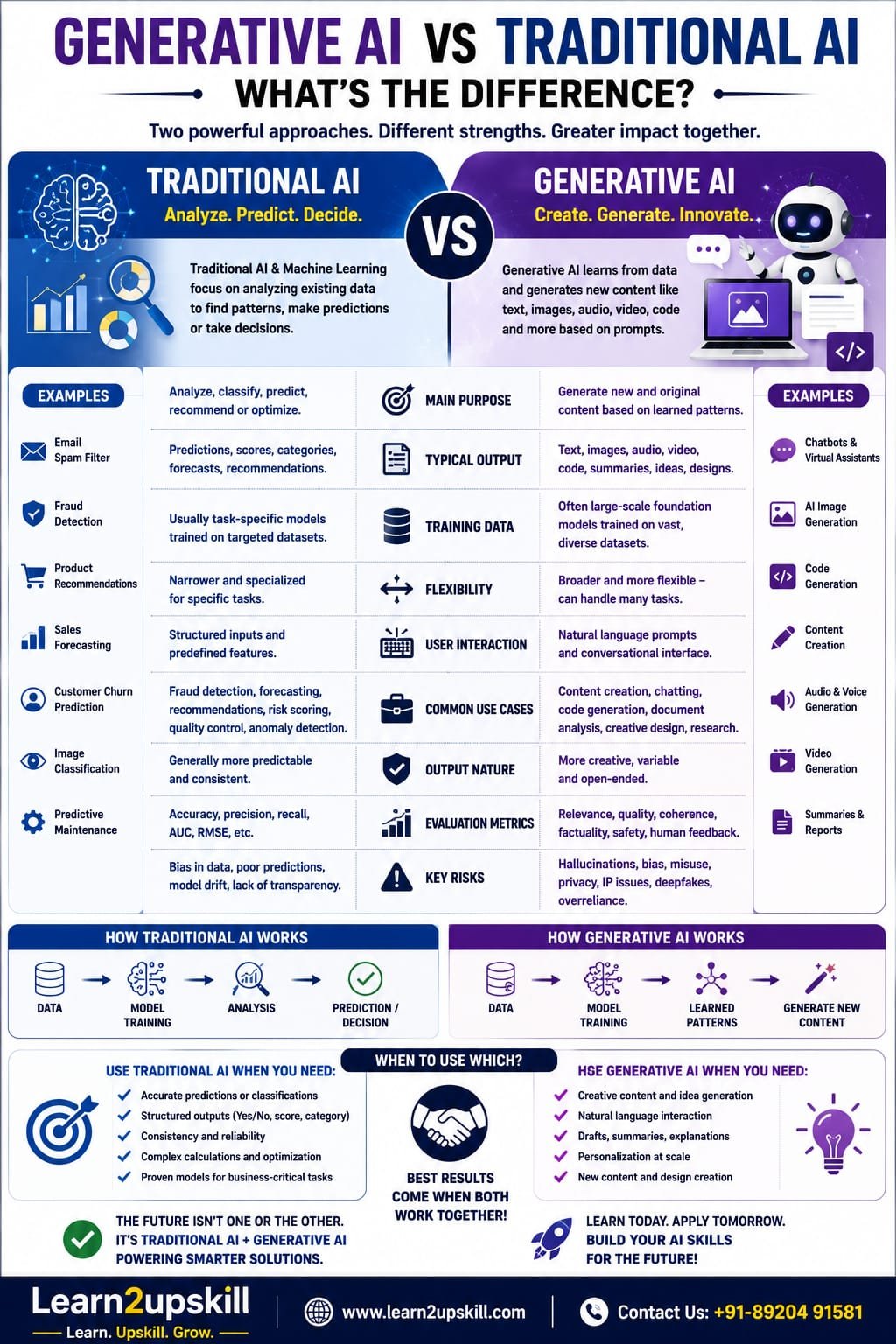
Traditional AI vs Generative AI: The Simple Difference
The easiest way to understand the difference is:
Traditional AI
Input → Analysis → Prediction/Classification/Decision
Generative AI
Input/Prompt → Learned Patterns → New Content
For example:
Traditional AI
“Is this transaction fraudulent?”
Output: Probably fraudulent / probably legitimate.
Generative AI
“Explain why this transaction pattern might indicate fraud.”
Output: A natural-language explanation.
The two approaches can even be used together.
Generative AI vs Traditional AI: Key Differences
Feature
Traditional AI
Generative AI
Main purpose
Analyze, classify, predict or optimize
Generate new content
Typical output
Prediction, score, classification or recommendation
Text, image, audio, video, code or other content
Training approach
Often task-specific datasets
Often large-scale foundation-model training
Flexibility
Usually narrower
Often broader
User interaction
Often structured inputs
Frequently natural-language prompts
Examples
Fraud detection, forecasting, recommendations
Chatbots, image generation, code generation
Typical use
Decision support
Creation + assistance
Output variability
Often more constrained
Can vary significantly
Evaluation
Accuracy and task performance
Quality, factuality, relevance, safety and other criteria
Human review
Depends on application
Often important, especially for high-impact uses
The exact distinction isn’t absolute: modern AI systems can combine predictive, analytical and generative capabilities.
- Difference in Purpose
The biggest difference is what the system is designed to accomplish.
Traditional AI is frequently built around a specific objective.
For example:
“Predict whether this customer will cancel.”
Generative AI is designed to produce something new.
For example:
“Write a personalized message for this customer.”
So:
Traditional AI → What is likely to happen?
Generative AI → What can we create based on this information?
- Difference in Output
Traditional AI often produces outputs such as:
Yes/No
Probability
Score
Category
Recommendation
Forecast
Ranking
Generative AI can produce:
Paragraphs
Reports
Images
Presentations
Videos
Audio
Code
Summaries
This doesn’t mean traditional AI cannot generate information or that generative AI cannot classify information.
The distinction is primarily about the model’s intended function and how it produces results.
- Difference in Training Data
Traditional machine-learning systems often use datasets designed for a particular task.
For example, a fraud-detection model might be trained using historical transactions labeled as fraudulent or legitimate.
Generative AI foundation models are typically trained on much broader datasets and can be adapted for many tasks.
IBM notes that traditional machine-learning models are often specialized for a specific task, while foundation models are trained on large, diverse datasets and can support multiple applications. �
IBM
This flexibility is one reason Generative AI has become so powerful.
- Difference in Flexibility
Traditional AI is often highly specialized.
A model trained specifically for credit-risk prediction isn’t automatically a good email-writing system.
Generative AI foundation models can often perform many different tasks through prompting or additional adaptation.
For example, a single language model might help with:
Writing
Summarization
Translation
Coding
Brainstorming
Question answering
Data interpretation
This doesn’t mean the model will perform every task perfectly.
It means the same underlying model can support a much wider range of applications.
- Difference in User Interaction
Traditional AI applications often require structured inputs.
For example:
Customer age → Income → Purchase history → Model → Risk score
Generative AI often allows users to communicate using natural language.
For example:
“Analyze this customer feedback and summarize the three biggest complaints.”
That conversational interface has made AI accessible to people without technical backgrounds.
- Difference in Business Applications
Traditional AI has long been used in areas such as:
Fraud detection
Demand forecasting
Predictive maintenance
Recommendation systems
Risk scoring
Customer segmentation
Quality control
Search ranking
Generative AI has expanded into:
Content creation
Marketing
Customer support
Software development
Document analysis
Research assistance
Training
Design
Knowledge management
Many businesses can use both.
- Generative AI Can Create Multiple Outputs
Suppose you ask a generative AI tool:
“Write a social media post about cybersecurity awareness.”
You might receive several different versions.
One could be:
Professional
Educational
Conversational
Short
Long
LinkedIn-focused
Instagram-focused
This creative flexibility is one of the major advantages of Generative AI.
- Traditional AI Can Be More Predictable
For certain business applications, predictable output is extremely important.
Consider:
Fraud detection
A company may want a consistent scoring system.
Quality inspection
A manufacturer may want a model to classify products as acceptable or defective.
Forecasting
A business may need a numerical prediction.
Traditional machine-learning models can therefore remain highly valuable even while Generative AI becomes more popular.
The rise of Generative AI doesn’t mean traditional AI has become obsolete.
- Generative AI Has New Risks
Generative AI introduces risks that organizations need to understand.
These include:
Incorrect information
Hallucinations
Bias
Privacy concerns
Intellectual-property questions
Misuse
Deepfakes
Prompt injection
Security risks
Overreliance on AI-generated content
NIST has specifically developed a Generative AI profile for its AI Risk Management Framework to address risks that are new or intensified by Generative AI. �
NIST Publications
This is why AI literacy should include responsible AI, not just tool usage.
- Traditional AI Has Risks Too
It’s important not to assume that Traditional AI is automatically safe.
Traditional AI can also have:
Biased data
Incorrect predictions
Poor-quality training data
Privacy problems
Model drift
Lack of transparency
Incorrect classifications
For example, if a hiring model is trained using biased historical data, its recommendations may reproduce those biases.
So both types of AI require:
Good data + appropriate design + testing + monitoring + human oversight.
Real-World Example: E-Commerce
Imagine an online shopping company.
Traditional AI
The system predicts:
“This customer is likely to purchase running shoes.”
It can then recommend relevant products.
Generative AI
The system could generate:
“Based on your interest in fitness, here are three running shoes that may suit your needs…”
It could also create product descriptions or answer customer questions.
Combined approach
Traditional AI → Predict customer interest
Generative AI → Create personalized communication
Together, they can provide a more complete AI-powered customer experience.
Real-World Example: Marketing
Marketing is another excellent example.
Traditional AI can help with:
Customer segmentation
Campaign prediction
Lead scoring
Conversion forecasting
Recommendation systems
Generative AI can help with:
Blog ideas
Ad copy
Social media posts
Email drafts
Product descriptions
Creative concepts
The best marketing teams don’t necessarily choose one over the other.
They can combine them.
Real-World Example: Finance
Traditional AI
Can support:
Fraud detection
Risk analysis
Forecasting
Customer segmentation
Anomaly detection
Generative AI
Can support:
Report summaries
Document analysis
Research assistance
Natural-language explanations
Drafting communications
Human professionals still need to review important outputs and make appropriate decisions.
Real-World Example: Healthcare
AI can support healthcare in different ways.
Traditional AI
Can assist with:
Pattern recognition
Risk prediction
Medical-image analysis
Patient-risk assessment
Generative AI
Can assist with:
Summarizing documents
Drafting administrative content
Patient communication
Research assistance
Knowledge retrieval
Healthcare is a high-impact environment, so AI outputs require appropriate professional oversight and validation.
Is Generative AI Better Than Traditional AI?
No.
This is one of the biggest misconceptions.
Generative AI isn’t a replacement for every other type of AI.
The better question is:
Which type of AI is appropriate for the problem?
If you need to predict customer churn, a specialized predictive model may be appropriate.
If you need to generate a marketing draft, Generative AI may be more useful.
If you need both prediction and communication, you might combine them.
The technology should follow the business problem—not the other way around.
Traditional AI + Generative AI: The Future
The future isn’t necessarily:
Traditional AI vs Generative AI
It’s increasingly:
Traditional AI + Generative AI
Imagine a business system that:
Collects customer data.
Uses predictive AI to identify customers at risk of leaving.
Uses Generative AI to draft personalized retention messages.
Sends the message for human approval.
Tracks the response.
Uses the results to improve future decisions.
This combines:
Prediction + Generation + Automation + Human Judgment
That’s where AI becomes especially powerful.
What Should Students Learn?
Students don’t necessarily need to become AI engineers.
A strong AI learning path can include:
Foundation
AI basics
Machine learning basics
Data literacy
Generative AI
ChatGPT
AI prompting
Content generation
AI research
Advanced skills
LLMs
RAG
AI agents
AI automation
Multimodal AI
Human skills
Communication
Critical thinking
Problem-solving
Creativity
Presentation skills
This combination prepares students for a workplace where AI is increasingly integrated into everyday tasks.
What Should Professionals Learn?
Professionals should focus on applying AI to their existing expertise.
Marketing professionals
Learn:
Generative AI + analytics + automation
Finance professionals
Learn:
AI + data analysis + reporting
Business analysts
Learn:
AI + requirements + data + automation
HR professionals
Learn:
AI + workforce analytics + communication
Cybersecurity professionals
Learn:
AI + security + threat analysis
Managers
Learn:
AI strategy + productivity + governance
The most valuable skill isn’t simply knowing an AI tool.
It’s understanding how AI can solve problems in your profession.
Generative AI vs Traditional AI: Which Should You Learn First?
If you’re new to AI, start with the fundamentals.
Step 1
Understand basic AI concepts.
↓
Step 2
Learn machine-learning fundamentals.
↓
Step 3
Learn Generative AI.
↓
Step 4
Learn prompt engineering.
↓
Step 5
Understand LLMs.
↓
Step 6
Explore RAG and AI agents.
↓
Step 7
Learn AI automation.
↓
Step 8
Apply AI to your industry.
This gives you a balanced understanding rather than focusing on a single tool.
A Simple Way to Remember the Difference
Here’s an easy memory trick:
Traditional AI
“What is likely to happen?”
Generative AI
“What can we create?”
Predictive AI
“What might happen next?”
AI Agents
“What actions can the system take toward a goal?”
These categories can overlap in real-world systems, but the simplified framework is useful for beginners.
Common Misconceptions
Myth 1: Traditional AI is outdated.
Reality: Traditional AI remains valuable for prediction, classification and optimization.
Myth 2: Generative AI can do everything.
Reality: Generative AI has powerful capabilities but also limitations and risks.
Myth 3: Generative AI is completely separate from machine learning.
Reality: Generative AI is built using machine-learning and deep-learning techniques. �
IBM
Myth 4: AI always gives accurate answers.
Reality: AI outputs need appropriate validation, particularly for important decisions.
Myth 5: You need to be a programmer to learn AI.
Reality: There are AI skills for both technical and non-technical professionals.
Why Learn Both?
Learning both Traditional AI and Generative AI gives you a broader perspective.
You’ll understand:
How AI analyzes data
How AI generates content
How AI can automate workflows
How AI can support decisions
Where humans need to remain involved
That’s a much stronger foundation than simply learning how to write prompts.
Final Thoughts
The debate around Generative AI vs Traditional AI isn’t really about deciding which technology will “win.”
Both have important roles.
Traditional AI remains powerful for:
Prediction
Classification
Detection
Recommendation
Optimization
Decision support
Generative AI is powerful for:
Content creation
Summarization
Brainstorming
Natural-language interaction
Code generation
Document assistance
Creative workflows
And increasingly, businesses can combine both.
The most valuable AI professionals will understand not just how AI works, but when to use which approach.
So if you’re learning AI in 2026, don’t limit yourself to one category.
Build a foundation.
Understand Traditional AI.
Learn Generative AI.
Explore LLMs, RAG, AI agents and automation.
And most importantly, learn how to apply these technologies to real-world problems.
Don’t just learn AI tools.
Learn how AI works—and how to use the right AI for the right problem.
Quick Comparison Checklist
Traditional AI
[ ] Prediction
[ ] Classification
[ ] Recommendation
[ ] Fraud detection
[ ] Forecasting
[ ] Anomaly detection
[ ] Optimization
[ ] Specialized models
Generative AI
[ ] Text generation
[ ] Image generation
[ ] Audio generation
[ ] Video generation
[ ] Code generation
[ ] Summarization
[ ] Brainstorming
[ ] Conversational AI
[ ] Multimodal applications
Advanced AI
[ ] LLMs
[ ] Prompt engineering
[ ] Context engineering
[ ] RAG
[ ] AI agents
[ ] AI automation
[ ] AI APIs
[ ] AI evaluation
[ ] AI security
[ ] AI governance
Learn AI Skills With Learn2upskill
AI is changing the way people work, learn and solve problems.
At Learn2upskill, we help students, professionals, job seekers and career changers develop practical skills for the modern workplace.
Explore learning opportunities in:
Advanced AI • Generative AI • ChatGPT • Prompt Engineering • AI Automation • Business Analysis • Excel • Digital Marketing • Cybersecurity • Professional Development
Don’t just learn the latest AI tool.
Build skills that stay useful as technology evolves.
Learn. Upskill. Grow.
🌐 www.coral-kudu-326218.hostingersite.com�
Contact Us: +91-89204 91581
Leave a Reply