Category: Uncategorized

  • Career Switching in 2027: How to Move Into a New Industry

    Career Switching in 2027: How to Move Into a New Industry

    Career Switching in 2027: How to Move Into a New Industry

    Planning a career switch in 2027? Learn how to change industries successfully, identify transferable skills, gain new qualifications, build experience and prepare for a new career.

    Suggested URL Slug:

    “/career-switching-in-2027-how-to-move-into-a-new-industry/”

    —

    Career Switching in 2027: How to Move Into a New Industry

    Changing careers is no longer as unusual as it once was.

    In the past, many people chose one profession and expected to remain in the same industry for most of their working lives. Today, the world of work is changing much faster. New technologies are transforming industries, artificial intelligence is changing job roles, businesses are creating new types of positions, and professionals are increasingly looking for careers that offer better opportunities, flexibility and long-term growth.

    As we move towards 2027, career switching is likely to become an increasingly important part of professional development.

    You may be thinking:

    – Should I change my career?

    – Can I move into a completely different industry?

    – Do I need another degree?

    – How can I get a job without experience in the new field?

    – Am I too late to start again?

    – Which skills should I learn before switching careers?

    The good news is that a successful career switch does not always mean starting from zero.

    You already have experience.

    You already have skills.

    The key is learning how to identify your transferable skills, develop the right new capabilities and position yourself effectively for a different industry.

    This guide will help you understand how to plan and successfully manage a career transition in 2027.

    —

    What Does Career Switching Mean?

    Career switching means moving from your current career, profession or industry into a different professional field.

    For example:

    – A teacher moving into corporate training

    – A customer service professional moving into HR

    – An accountant moving into financial analysis

    – A sales professional moving into digital marketing

    – An IT professional moving into cybersecurity

    – A finance professional moving into data analytics

    – A journalist moving into content marketing

    – An administrative professional moving into project management

    Some career changes are closely related to your previous work.

    Others may involve moving into a completely new industry.

    The important thing to remember is this:

    «A career switch does not mean your previous experience becomes useless.»

    Many of your existing skills can be valuable in your next career.

    —

    Why Are More Professionals Considering Career Changes?

    There are many reasons why professionals decide to switch careers.

    1. Technology Is Changing Jobs

    Artificial intelligence, automation and digital transformation are changing how businesses operate.

    Some jobs are evolving.

    Some tasks are becoming automated.

    At the same time, completely new opportunities are being created.

    Professionals who continue learning and adapting may find new career paths opening up.

    —

    1. People Want Better Career Opportunities

    Sometimes a person enjoys their work but sees limited opportunities for growth.

    A career switch may offer:

    – Better job opportunities

    – Higher earning potential

    – More flexibility

    – Greater career growth

    – New learning opportunities

    – More interesting work

    —

    1. Professionals Want New Challenges

    Doing the same type of work for many years can sometimes lead to boredom or a lack of motivation.

    Learning something new can provide fresh challenges and renewed professional energy.

    —

    1. Skills Are Becoming More Transferable

    Many modern careers require similar core abilities.

    For example:

    – Communication

    – Problem-solving

    – Critical thinking

    – Data analysis

    – Digital skills

    – Project management

    – Collaboration

    – Adaptability

    These skills can often be transferred between industries.

    —

    How to Know If It’s Time to Change Your Career

    A difficult week at work does not necessarily mean you should change your entire career.

    Before making a major decision, take time to understand what you really want.

    Ask yourself:

    Do I dislike my job or my entire industry?

    Sometimes the problem is your current company, manager or work environment—not your profession.

    Do I want better growth opportunities?

    If your current industry has limited opportunities, exploring a related field may make sense.

    What type of work interests me?

    Think about the activities you genuinely enjoy.

    What skills do I want to use?

    Your ideal career should make use of your strengths while giving you opportunities to develop new ones.

    Where do I see myself in five years?

    This question can help you identify whether your current career is moving in the right direction.

    —

    Step 1: Choose Your New Career Direction

    The first step in a successful career switch is choosing a realistic direction.

    Don’t simply choose an industry because it is popular on social media.

    Research the career carefully.

    Consider:

    – Job opportunities

    – Required skills

    – Entry-level requirements

    – Long-term growth

    – Your interests

    – Your existing experience

    – Your financial situation

    For example, if you want to move into data analytics, learn about:

    – Excel

    – SQL

    – Data visualization

    – Power BI

    – Statistics

    – Business analysis

    – AI tools for data analysis

    You don’t necessarily need to learn everything at once.

    Start by understanding what employers expect.

    —

    Step 2: Identify Your Transferable Skills

    This is one of the most important steps in career switching.

    Transferable skills are abilities you can take from one career and use in another.

    For example, a teacher may have:

    – Presentation skills

    – Communication skills

    – Training skills

    – Planning skills

    – Leadership skills

    These abilities could be valuable in:

    – Corporate training

    – Learning and development

    – HR

    – Content development

    – Education technology

    Similarly, a sales professional may have:

    – Communication

    – Negotiation

    – Customer relationship management

    – Presentation

    – Problem-solving

    These skills could transfer to:

    – Marketing

    – Business development

    – Customer success

    – Account management

    – Consulting

    Create a list of everything you already know how to do.

    You may discover that you are much closer to your new career than you think.

    —

    Step 3: Identify Your Skills Gap

    Once you know where you want to go, compare your current skills with the skills required for your target career.

    Ask:

    What do I already know?

    What do I need to learn?

    For example, imagine you are moving from finance into data analytics.

    You may already understand:

    – Business processes

    – Financial data

    – Reporting

    – Problem-solving

    But you may need to develop:

    – Advanced Excel

    – SQL

    – Power BI

    – Data visualization

    – Basic Python

    – AI-assisted data analysis

    This is called your skills gap.

    The goal is to close that gap through focused learning.

    —

    Step 4: Upskill and Reskill Strategically

    One of the biggest mistakes career changers make is trying to learn everything.

    You don’t need 25 certificates.

    You need the right skills for your target role.

    Create a focused learning plan.

    For example:

    Month 1

    Learn the fundamentals of your new industry.

    Month 2

    Develop essential technical or professional skills.

    Month 3

    Practice through projects.

    Month 4

    Build a portfolio and update your professional profile.

    Month 5

    Start networking and applying for opportunities.

    The exact timeline will depend on your career goals, but having a structured plan can make the transition feel more manageable.

    —

    Step 5: Gain Experience Before You Get the Job

    One of the biggest challenges career changers face is:

    «”How can I get experience if nobody gives me a job?”»

    The answer is to create experience wherever possible.

    You can gain relevant experience through:

    – Personal projects

    – Freelance work

    – Volunteer opportunities

    – Internships

    – Case studies

    – Online projects

    – Simulations

    – Portfolio work

    For example, if you want to become a data analyst, you can analyze publicly available datasets and create dashboards.

    If you want to move into digital marketing, you can create sample campaigns and analyze marketing strategies.

    If you want to become a project manager, you can demonstrate how you planned and managed a project.

    Experience does not always have to come from a traditional full-time job.

    —

    Step 6: Build a Strong Portfolio

    A portfolio can be especially valuable when switching careers.

    Your portfolio shows employers:

    «”I may be new to this industry, but I can demonstrate my abilities.”»

    Depending on your career, your portfolio could include:

    – Projects

    – Case studies

    – Reports

    – Dashboards

    – Presentations

    – Marketing campaigns

    – Writing samples

    – Business analyses

    – Websites

    – Certifications

    Focus on quality rather than quantity.

    Three strong projects can be more valuable than twenty incomplete ones.

    —

    Step 7: Update Your Resume for Your New Career

    Do not simply send your old resume to employers in a new industry.

    Your resume should reflect your new career direction.

    Highlight:

    – Transferable skills

    – Relevant projects

    – New certifications

    – Industry-related learning

    – Achievements

    – Relevant experience

    For example, instead of only writing your previous job title, explain the skills you used.

    Traditional approach:

    Sales Executive

    Better career-transition approach:

    Sales Executive

    – Analyzed customer requirements and business needs

    – Prepared presentations and proposals

    – Managed client relationships

    – Used data to identify sales opportunities

    – Collaborated with cross-functional teams

    Now, if you are applying for a business analyst or customer success role, your transferable experience becomes easier to understand.

    —

    Step 8: Rewrite Your LinkedIn Profile

    Your LinkedIn profile should also reflect where you are going—not only where you have been.

    Your headline could include your new professional direction.

    For example:

    Finance Professional | Learning Data Analytics | Excel, SQL & Power BI

    As you gain experience, your profile can evolve.

    Share useful content related to your target industry.

    You can post about:

    – What you are learning

    – Projects you have completed

    – Industry insights

    – Professional achievements

    – Lessons from your career transition

    This can help demonstrate genuine interest and professional development.

    —

    Step 9: Network With People in Your Target Industry

    Networking is not simply asking strangers for jobs.

    It is about learning from people.

    Connect with:

    – Professionals in your target field

    – Recruiters

    – Industry experts

    – Alumni

    – Career communities

    – Professional groups

    Ask thoughtful questions such as:

    – What skills are most important in this field?

    – What challenges do beginners face?

    – What would you recommend learning first?

    – How did you enter this industry?

    The information you gain can help you make better career decisions.

    —

    Step 10: Prepare Your Career Change Story

    During interviews, employers will probably ask:

    «”Why are you changing careers?”»

    This question is important.

    Your answer should be positive and professional.

    Avoid saying:

    «”I hated my previous job.”»

    Instead, focus on your future.

    For example:

    «”My previous role helped me develop strong business and communication skills. Over time, I became increasingly interested in data analysis and how organizations use data to make decisions. I started developing skills in Excel, SQL and Power BI and completed several practical projects. Now I am ready to apply my previous professional experience and new analytical skills in a data-focused role.”»

    This answer shows:

    – Professional maturity

    – Clear motivation

    – Relevant preparation

    – Career direction

    —

    Common Career Switching Mistakes to Avoid

    ❌ Changing Careers Without Research

    Don’t choose a career only because someone online says it pays well.

    Research the actual work.

    —

    ❌ Trying to Learn Everything

    Focus on the skills required for your target role.

    —

    ❌ Ignoring Transferable Skills

    Your previous career has given you valuable experience.

    Use it.

    —

    ❌ Waiting Until You Feel Completely Ready

    You may never feel 100% ready.

    Start applying when you have developed a realistic foundation.

    —

    ❌ Applying With the Same Resume Everywhere

    Customize your resume for your target role.

    —

    ❌ Expecting an Immediate Salary Increase

    Some career transitions may involve starting at a different level.

    Think about long-term growth as well as short-term income.

    —

    Career Switching in the AI Era

    As we prepare for 2027, professionals should understand that AI is becoming part of many industries.

    This doesn’t mean everyone needs to become an AI engineer.

    However, professionals in many fields can benefit from learning:

    – How AI tools work

    – How to use AI responsibly

    – Prompting and communication with AI tools

    – AI-assisted productivity

    – Data literacy

    – Critical thinking

    – Digital skills

    The strongest professionals may increasingly combine:

    Industry Knowledge + Technical Skills + AI Literacy + Human Skills

    For example:

    A marketer who understands AI.

    A finance professional who understands data.

    An HR professional who understands digital tools.

    A business professional who understands automation.

    This combination can create new career opportunities.

    —

    A Simple Career Switching Plan for 2027

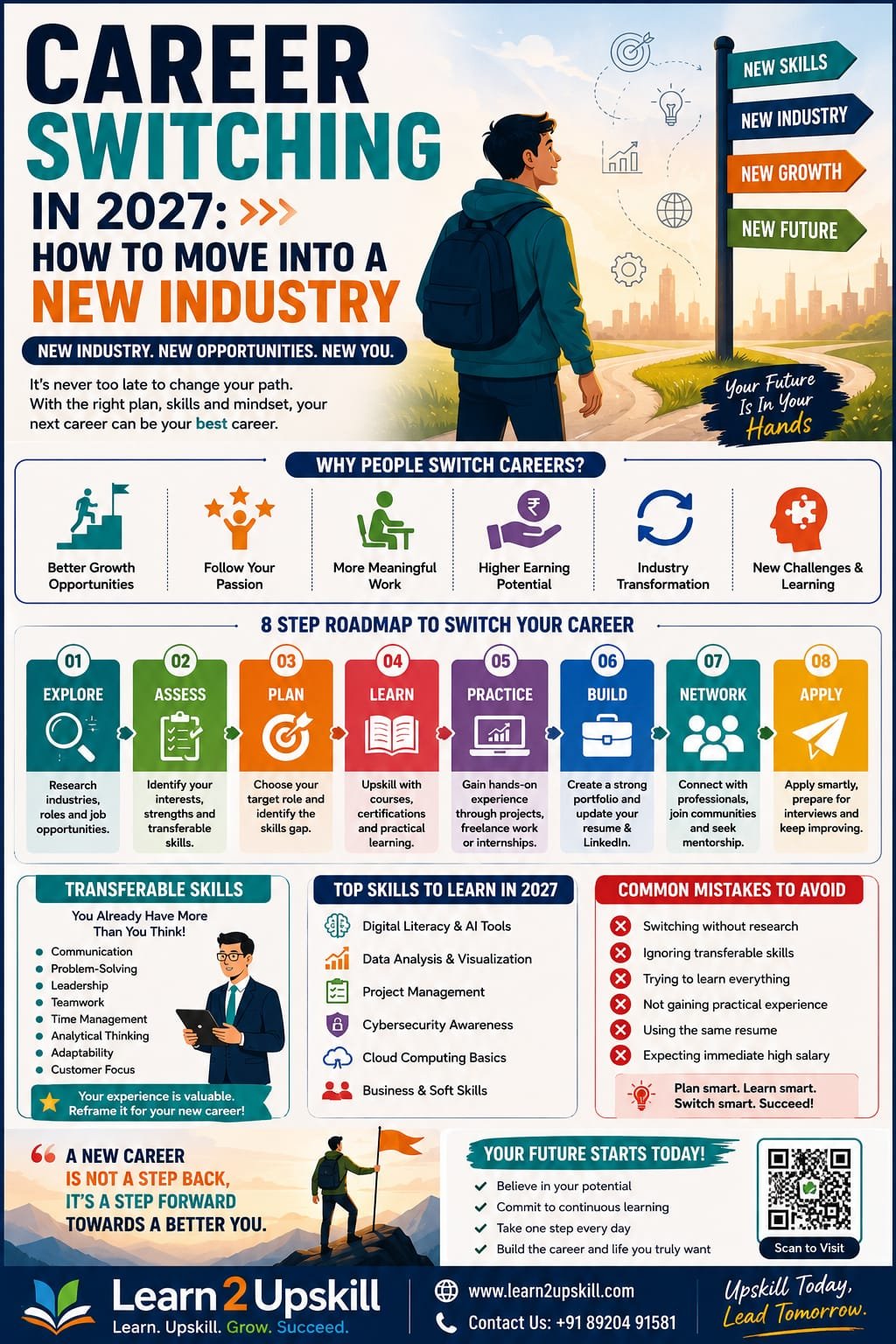
    Here is a practical roadmap.

    Phase 1: Explore

    Research industries and identify possible career paths.

    Phase 2: Assess

    Identify your transferable skills and skills gaps.

    Phase 3: Learn

    Develop the essential skills for your new career.

    Phase 4: Practice

    Complete projects and gain practical experience.

    Phase 5: Build

    Create a portfolio, resume and LinkedIn profile.

    Phase 6: Connect

    Network with professionals in your target industry.

    Phase 7: Apply

    Start applying strategically for relevant opportunities.

    Phase 8: Improve

    Learn from interviews, feedback and experience.

    Career switching is a process—not a single decision.

    —

    Frequently Asked Questions

    Is 2027 a good time to change careers?

    The right time depends on your personal situation, financial responsibilities, career goals and preparation. However, professionals who continuously develop relevant skills can position themselves more effectively for changing opportunities.


    Can I change careers without going back to university?

    In many fields, yes. Depending on the career, practical skills, certifications, projects and experience may help demonstrate your capabilities. Some professions, however, require formal qualifications or licenses.


    How long does a career change take?

    A career transition can take several months or longer depending on the industry, your existing skills and the amount of preparation required.


    Am I too old to change careers?

    There is no universal age limit for career change. Your experience can provide valuable transferable skills, professional maturity and industry knowledge.


    What are transferable skills?

    Transferable skills are abilities that can be useful across different jobs and industries, such as communication, leadership, problem-solving, project management and teamwork.


    Should I quit my current job before changing careers?


    This depends on your financial situation and personal circumstances. Many professionals choose to upskill and prepare for a new career while continuing in their current role.


    —

    Conclusion

    Career switching can feel challenging because it involves uncertainty.

    You may worry about starting again.

    You may worry about competition.

    You may worry about whether employers will accept your previous experience.

    But remember:

    «You are not starting from zero. You are starting with experience.»

    Your previous career has helped you develop knowledge, professional habits and transferable skills.

    The key is to combine that experience with the new skills required for your future.

    As we move towards 2027, adaptability and continuous learning will remain essential for career growth.

    Research your target industry.

    Identify your transferable skills.

    Close your skills gap.

    Build practical experience.

    Create a strong professional profile.

    And take the first step.

    A successful career change does not happen overnight.

    But with the right strategy and consistent effort, you can move towards a career that offers new opportunities, growth and professional satisfaction.

    Your career journey does not have to follow one straight line.

    Sometimes, changing direction can be the beginning of your next great opportunity.

    —

    🚀 Prepare for Your Next Career With Learn2Upskill

    Thinking about changing your career or learning new professional skills?

    Build practical, career-ready skills and prepare yourself for the changing world of work with Learn2Upskill.

    🌐 www.coral-kudu-326218.hostingersite.com

    📞 Contact Us: +91 89204 91581

    Learn. Upskill. Grow. Succeed.

    —

    🔗 Recommended Internal Links for Learn2Upskill

    For stronger SEO and internal linking, connect this article with related blogs such as:

    – The Top Skills Employers Are Looking for in 2026

    – How AI Is Changing Jobs—and How to Prepare Your Career

    – The Best Skills to Add to Your Resume

    – How Freshers Can Stay Competitive in the AI Job Market

    – 10 Effective Communication Skills Every Professional Needs

    – Critical Thinking in the AI Era

    – How to Build a Strong Resume With No Work Experience

    – How to Build a Professional LinkedIn Profile

    – AI for Non-Tech Professionals: How Anyone Can Start Using AI

    Suggested Featured Image Alt Text:

    “Career switching in 2027 guide for moving into a new industry”

    Suggested Image Caption:

    “Build new skills, use your transferable experience and confidently prepare for a successful career transition.”

    Suggested CTA:

    Ready to prepare for your next career opportunity? Visit www.coral-kudu-326218.hostingersite.com or contact us at +91 89204 91581.
  • Generative AI vs Traditional AI: Key Differences Explained

    Generative AI vs Traditional AI: Key Differences Explained

    Generative AI vs Traditional AI: Key Differences Explained

    Learn the difference between Generative AI and Traditional AI, how they work, their use cases, benefits, limitations, and which AI approach businesses and professionals should learn.

    Suggested URL Slug: /generative-ai-vs-traditional-ai/

    Generative AI vs Traditional AI: What’s the Difference?

    Artificial intelligence has been around for decades, but the rise of Generative AI has changed how people think about what AI can do.

    Traditional AI systems have been used for years to classify information, detect patterns, make predictions, recommend products, identify fraud and automate specific decisions.

    Generative AI introduced a different capability: instead of simply analyzing existing information or predicting an outcome, it can generate new content, including text, images, audio, video and software code.

    The National Institute of Standards and Technology (NIST) defines Generative AI as a class of AI models that can generate derived synthetic content such as images, video, audio and text. �

    NIST Computer Security Resource Center +1

    This leads to an important question:

    What is the difference between Traditional AI and Generative AI—and which one should you learn?

    The short answer is:

    Traditional AI is often designed to analyze, classify, predict or optimize.

    Generative AI is designed to create new content based on learned patterns and user input.

    But the real difference is more interesting than that.

    Let’s explore it step by step.

    What Is Traditional AI?

    Traditional AI is a broad term commonly used to describe AI and machine-learning systems designed for specific analytical, predictive or decision-support tasks.

    These systems can learn patterns from data and use those patterns to produce predictions, classifications or recommendations.

    For example:

    Email spam detection

    AI analyzes an email and determines whether it is likely to be spam.

    Fraud detection

    AI identifies unusual transaction patterns that could indicate fraud.

    Product recommendations

    AI analyzes customer behavior and recommends products.

    Sales forecasting

    AI analyzes historical data to estimate future sales.

    Image classification

    AI determines whether an image belongs to a particular category.

    Customer churn prediction

    AI estimates which customers may be likely to leave a service.

    IBM describes traditional machine-learning models as typically specialized for particular tasks, often using targeted datasets to learn patterns and make predictions. �

    IBM

    In simple terms:

    Traditional AI is often focused on understanding data and producing a specific result.

    What Is Generative AI?

    Generative AI is a category of AI that can create new content in response to an instruction or prompt.

    It can generate:

    Text

    Images

    Audio

    Video

    Software code

    Summaries

    Presentations

    Ideas

    Synthetic data

    For example, you can ask a generative AI system:

    “Write a blog introduction about digital marketing.”

    And it can generate the text.

    You could ask:

    “Create an image of a futuristic classroom.”

    And an image-generation model can produce an image.

    Or:

    “Explain this Excel formula in simple language.”

    A language model can generate an explanation.

    IBM describes Generative AI as AI capable of creating original content such as text, images, video, audio and code in response to prompts. �

    IBM

    Traditional AI vs Generative AI: The Simple Difference

    The easiest way to understand the difference is:

    Traditional AI

    Input → Analysis → Prediction/Classification/Decision

    Generative AI

    Input/Prompt → Learned Patterns → New Content

    For example:

    Traditional AI

    “Is this transaction fraudulent?”

    Output: Probably fraudulent / probably legitimate.

    Generative AI

    “Explain why this transaction pattern might indicate fraud.”

    Output: A natural-language explanation.

    The two approaches can even be used together.

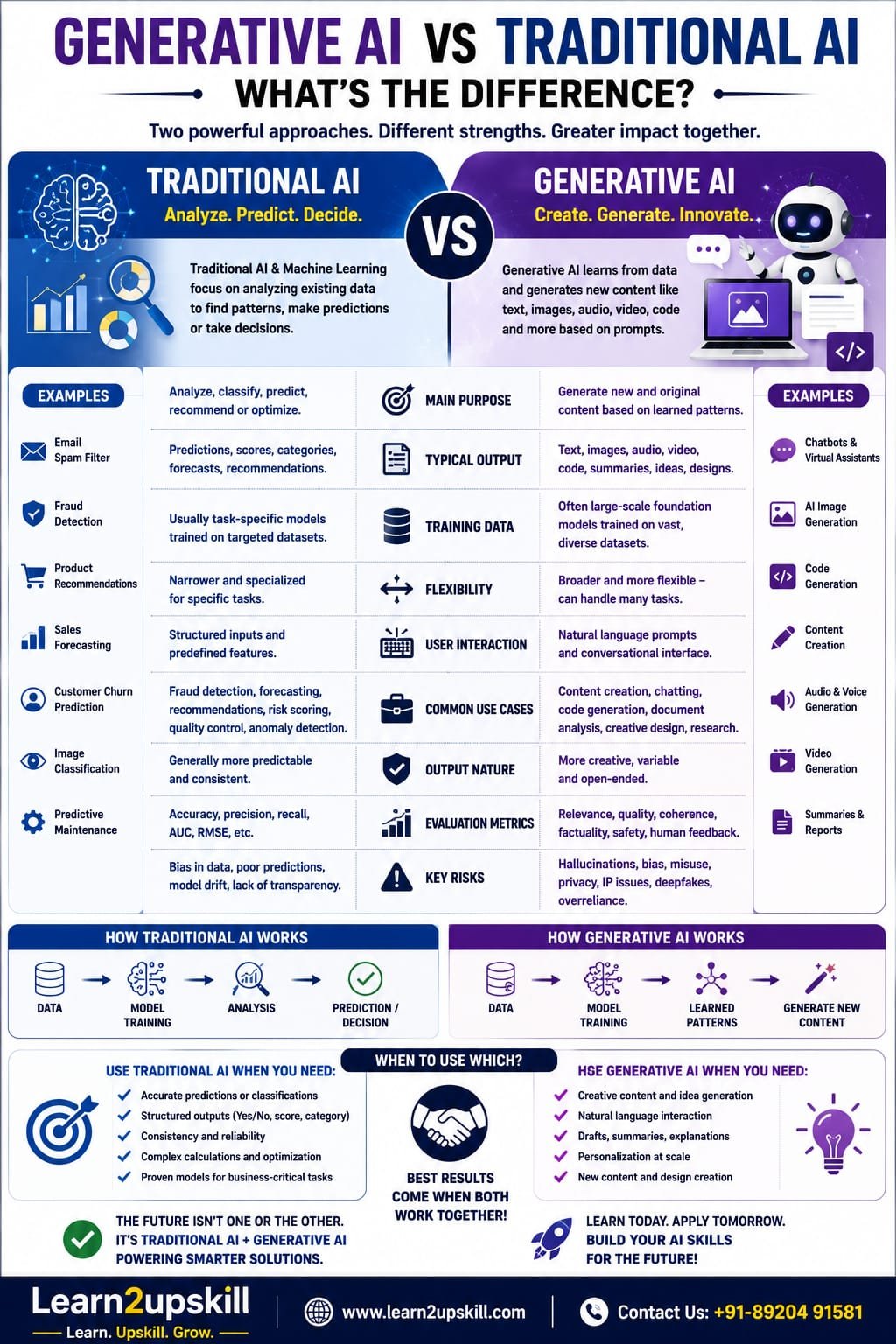
    Generative AI vs Traditional AI: Key Differences

    Feature

    Traditional AI

    Generative AI

    Main purpose

    Analyze, classify, predict or optimize

    Generate new content

    Typical output

    Prediction, score, classification or recommendation

    Text, image, audio, video, code or other content

    Training approach

    Often task-specific datasets

    Often large-scale foundation-model training

    Flexibility

    Usually narrower

    Often broader

    User interaction

    Often structured inputs

    Frequently natural-language prompts

    Examples

    Fraud detection, forecasting, recommendations

    Chatbots, image generation, code generation

    Typical use

    Decision support

    Creation + assistance

    Output variability

    Often more constrained

    Can vary significantly

    Evaluation

    Accuracy and task performance

    Quality, factuality, relevance, safety and other criteria

    Human review

    Depends on application

    Often important, especially for high-impact uses

    The exact distinction isn’t absolute: modern AI systems can combine predictive, analytical and generative capabilities.

    1. Difference in Purpose

    The biggest difference is what the system is designed to accomplish.

    Traditional AI is frequently built around a specific objective.

    For example:

    “Predict whether this customer will cancel.”

    Generative AI is designed to produce something new.

    For example:

    “Write a personalized message for this customer.”

    So:

    Traditional AI → What is likely to happen?

    Generative AI → What can we create based on this information?

    1. Difference in Output

    Traditional AI often produces outputs such as:

    Yes/No

    Probability

    Score

    Category

    Recommendation

    Forecast

    Ranking

    Generative AI can produce:

    Paragraphs

    Reports

    Images

    Presentations

    Videos

    Audio

    Code

    Summaries

    This doesn’t mean traditional AI cannot generate information or that generative AI cannot classify information.

    The distinction is primarily about the model’s intended function and how it produces results.

    1. Difference in Training Data

    Traditional machine-learning systems often use datasets designed for a particular task.

    For example, a fraud-detection model might be trained using historical transactions labeled as fraudulent or legitimate.

    Generative AI foundation models are typically trained on much broader datasets and can be adapted for many tasks.

    IBM notes that traditional machine-learning models are often specialized for a specific task, while foundation models are trained on large, diverse datasets and can support multiple applications. �

    IBM

    This flexibility is one reason Generative AI has become so powerful.

    1. Difference in Flexibility

    Traditional AI is often highly specialized.

    A model trained specifically for credit-risk prediction isn’t automatically a good email-writing system.

    Generative AI foundation models can often perform many different tasks through prompting or additional adaptation.

    For example, a single language model might help with:

    Writing

    Summarization

    Translation

    Coding

    Brainstorming

    Question answering

    Data interpretation

    This doesn’t mean the model will perform every task perfectly.

    It means the same underlying model can support a much wider range of applications.

    1. Difference in User Interaction

    Traditional AI applications often require structured inputs.

    For example:

    Customer age → Income → Purchase history → Model → Risk score

    Generative AI often allows users to communicate using natural language.

    For example:

    “Analyze this customer feedback and summarize the three biggest complaints.”

    That conversational interface has made AI accessible to people without technical backgrounds.

    1. Difference in Business Applications

    Traditional AI has long been used in areas such as:

    Fraud detection

    Demand forecasting

    Predictive maintenance

    Recommendation systems

    Risk scoring

    Customer segmentation

    Quality control

    Search ranking

    Generative AI has expanded into:

    Content creation

    Marketing

    Customer support

    Software development

    Document analysis

    Research assistance

    Training

    Design

    Knowledge management

    Many businesses can use both.

    1. Generative AI Can Create Multiple Outputs

    Suppose you ask a generative AI tool:

    “Write a social media post about cybersecurity awareness.”

    You might receive several different versions.

    One could be:

    Professional

    Educational

    Conversational

    Short

    Long

    LinkedIn-focused

    Instagram-focused

    This creative flexibility is one of the major advantages of Generative AI.

    1. Traditional AI Can Be More Predictable

    For certain business applications, predictable output is extremely important.

    Consider:

    Fraud detection

    A company may want a consistent scoring system.

    Quality inspection

    A manufacturer may want a model to classify products as acceptable or defective.

    Forecasting

    A business may need a numerical prediction.

    Traditional machine-learning models can therefore remain highly valuable even while Generative AI becomes more popular.

    The rise of Generative AI doesn’t mean traditional AI has become obsolete.

    1. Generative AI Has New Risks

    Generative AI introduces risks that organizations need to understand.

    These include:

    Incorrect information

    Hallucinations

    Bias

    Privacy concerns

    Intellectual-property questions

    Misuse

    Deepfakes

    Prompt injection

    Security risks

    Overreliance on AI-generated content

    NIST has specifically developed a Generative AI profile for its AI Risk Management Framework to address risks that are new or intensified by Generative AI. �

    NIST Publications

    This is why AI literacy should include responsible AI, not just tool usage.

    1. Traditional AI Has Risks Too

    It’s important not to assume that Traditional AI is automatically safe.

    Traditional AI can also have:

    Biased data

    Incorrect predictions

    Poor-quality training data

    Privacy problems

    Model drift

    Lack of transparency

    Incorrect classifications

    For example, if a hiring model is trained using biased historical data, its recommendations may reproduce those biases.

    So both types of AI require:

    Good data + appropriate design + testing + monitoring + human oversight.

    Real-World Example: E-Commerce

    Imagine an online shopping company.

    Traditional AI

    The system predicts:

    “This customer is likely to purchase running shoes.”

    It can then recommend relevant products.

    Generative AI

    The system could generate:

    “Based on your interest in fitness, here are three running shoes that may suit your needs…”

    It could also create product descriptions or answer customer questions.

    Combined approach

    Traditional AI → Predict customer interest

    Generative AI → Create personalized communication

    Together, they can provide a more complete AI-powered customer experience.

    Real-World Example: Marketing

    Marketing is another excellent example.

    Traditional AI can help with:

    Customer segmentation

    Campaign prediction

    Lead scoring

    Conversion forecasting

    Recommendation systems

    Generative AI can help with:

    Blog ideas

    Ad copy

    Social media posts

    Email drafts

    Product descriptions

    Creative concepts

    The best marketing teams don’t necessarily choose one over the other.

    They can combine them.

    Real-World Example: Finance

    Traditional AI

    Can support:

    Fraud detection

    Risk analysis

    Forecasting

    Customer segmentation

    Anomaly detection

    Generative AI

    Can support:

    Report summaries

    Document analysis

    Research assistance

    Natural-language explanations

    Drafting communications

    Human professionals still need to review important outputs and make appropriate decisions.

    Real-World Example: Healthcare

    AI can support healthcare in different ways.

    Traditional AI

    Can assist with:

    Pattern recognition

    Risk prediction

    Medical-image analysis

    Patient-risk assessment

    Generative AI

    Can assist with:

    Summarizing documents

    Drafting administrative content

    Patient communication

    Research assistance

    Knowledge retrieval

    Healthcare is a high-impact environment, so AI outputs require appropriate professional oversight and validation.

    Is Generative AI Better Than Traditional AI?

    No.

    This is one of the biggest misconceptions.

    Generative AI isn’t a replacement for every other type of AI.

    The better question is:

    Which type of AI is appropriate for the problem?

    If you need to predict customer churn, a specialized predictive model may be appropriate.

    If you need to generate a marketing draft, Generative AI may be more useful.

    If you need both prediction and communication, you might combine them.

    The technology should follow the business problem—not the other way around.

    Traditional AI + Generative AI: The Future

    The future isn’t necessarily:

    Traditional AI vs Generative AI

    It’s increasingly:

    Traditional AI + Generative AI

    Imagine a business system that:

    Collects customer data.

    Uses predictive AI to identify customers at risk of leaving.

    Uses Generative AI to draft personalized retention messages.

    Sends the message for human approval.

    Tracks the response.

    Uses the results to improve future decisions.

    This combines:

    Prediction + Generation + Automation + Human Judgment

    That’s where AI becomes especially powerful.

    What Should Students Learn?

    Students don’t necessarily need to become AI engineers.

    A strong AI learning path can include:

    Foundation

    AI basics

    Machine learning basics

    Data literacy

    Generative AI

    ChatGPT

    AI prompting

    Content generation

    AI research

    Advanced skills

    LLMs

    RAG

    AI agents

    AI automation

    Multimodal AI

    Human skills

    Communication

    Critical thinking

    Problem-solving

    Creativity

    Presentation skills

    This combination prepares students for a workplace where AI is increasingly integrated into everyday tasks.

    What Should Professionals Learn?

    Professionals should focus on applying AI to their existing expertise.

    Marketing professionals

    Learn:

    Generative AI + analytics + automation

    Finance professionals

    Learn:

    AI + data analysis + reporting

    Business analysts

    Learn:

    AI + requirements + data + automation

    HR professionals

    Learn:

    AI + workforce analytics + communication

    Cybersecurity professionals

    Learn:

    AI + security + threat analysis

    Managers

    Learn:

    AI strategy + productivity + governance

    The most valuable skill isn’t simply knowing an AI tool.

    It’s understanding how AI can solve problems in your profession.

    Generative AI vs Traditional AI: Which Should You Learn First?

    If you’re new to AI, start with the fundamentals.

    Step 1

    Understand basic AI concepts.

    ↓

    Step 2

    Learn machine-learning fundamentals.

    ↓

    Step 3

    Learn Generative AI.

    ↓

    Step 4

    Learn prompt engineering.

    ↓

    Step 5

    Understand LLMs.

    ↓

    Step 6

    Explore RAG and AI agents.

    ↓

    Step 7

    Learn AI automation.

    ↓

    Step 8

    Apply AI to your industry.

    This gives you a balanced understanding rather than focusing on a single tool.

    A Simple Way to Remember the Difference

    Here’s an easy memory trick:

    Traditional AI

    “What is likely to happen?”

    Generative AI

    “What can we create?”

    Predictive AI

    “What might happen next?”

    AI Agents

    “What actions can the system take toward a goal?”

    These categories can overlap in real-world systems, but the simplified framework is useful for beginners.

    Common Misconceptions

    Myth 1: Traditional AI is outdated.

    Reality: Traditional AI remains valuable for prediction, classification and optimization.

    Myth 2: Generative AI can do everything.

    Reality: Generative AI has powerful capabilities but also limitations and risks.

    Myth 3: Generative AI is completely separate from machine learning.

    Reality: Generative AI is built using machine-learning and deep-learning techniques. �

    IBM

    Myth 4: AI always gives accurate answers.

    Reality: AI outputs need appropriate validation, particularly for important decisions.

    Myth 5: You need to be a programmer to learn AI.

    Reality: There are AI skills for both technical and non-technical professionals.

    Why Learn Both?

    Learning both Traditional AI and Generative AI gives you a broader perspective.

    You’ll understand:

    How AI analyzes data


    How AI generates content


    How AI can automate workflows


    How AI can support decisions


    Where humans need to remain involved

    That’s a much stronger foundation than simply learning how to write prompts.

    Final Thoughts

    The debate around Generative AI vs Traditional AI isn’t really about deciding which technology will “win.”

    Both have important roles.

    Traditional AI remains powerful for:

    Prediction

    Classification

    Detection

    Recommendation

    Optimization

    Decision support

    Generative AI is powerful for:

    Content creation

    Summarization

    Brainstorming

    Natural-language interaction

    Code generation

    Document assistance

    Creative workflows

    And increasingly, businesses can combine both.

    The most valuable AI professionals will understand not just how AI works, but when to use which approach.

    So if you’re learning AI in 2026, don’t limit yourself to one category.

    Build a foundation.

    Understand Traditional AI.

    Learn Generative AI.

    Explore LLMs, RAG, AI agents and automation.

    And most importantly, learn how to apply these technologies to real-world problems.

    Don’t just learn AI tools.

    Learn how AI works—and how to use the right AI for the right problem.

    Quick Comparison Checklist

    Traditional AI

    [ ] Prediction

    [ ] Classification

    [ ] Recommendation

    [ ] Fraud detection

    [ ] Forecasting

    [ ] Anomaly detection

    [ ] Optimization

    [ ] Specialized models

    Generative AI

    [ ] Text generation

    [ ] Image generation

    [ ] Audio generation

    [ ] Video generation

    [ ] Code generation

    [ ] Summarization

    [ ] Brainstorming

    [ ] Conversational AI

    [ ] Multimodal applications

    Advanced AI

    [ ] LLMs

    [ ] Prompt engineering

    [ ] Context engineering

    [ ] RAG

    [ ] AI agents

    [ ] AI automation

    [ ] AI APIs

    [ ] AI evaluation

    [ ] AI security

    [ ] AI governance

    Learn AI Skills With Learn2upskill

    AI is changing the way people work, learn and solve problems.

    At Learn2upskill, we help students, professionals, job seekers and career changers develop practical skills for the modern workplace.

    Explore learning opportunities in:

    Advanced AI • Generative AI • ChatGPT • Prompt Engineering • AI Automation • Business Analysis • Excel • Digital Marketing • Cybersecurity • Professional Development

    Don’t just learn the latest AI tool.

    Build skills that stay useful as technology evolves.

    Learn. Upskill. Grow.

    🌐 www.coral-kudu-326218.hostingersite.com⁠�

    Contact Us: +91-89204 91581


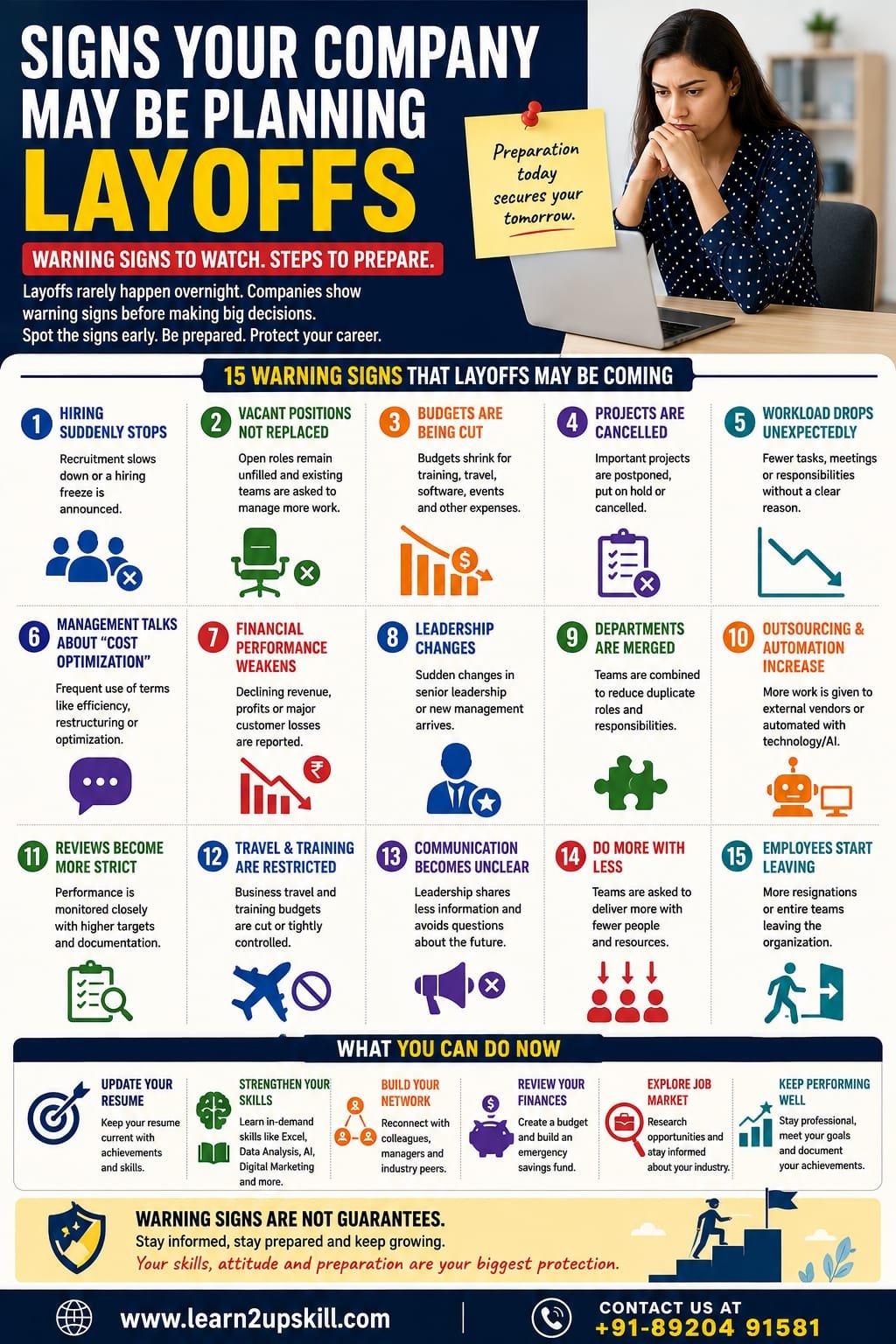
  • Signs Your Company May Be Planning Layoffs: 15 Warning Signs to Watch

    Signs Your Company May Be Planning Layoffs: 15 Warning Signs to Watch

    Signs Your Company May Be Planning Layoffs: 15 Warning Signs to Watch

    Learn the common signs your company may be planning layoffs, from hiring freezes and budget cuts to restructuring and reduced workloads—and what you can do to prepare.

    —

    Signs Your Company May Be Planning Layoffs

    Nobody wants to hear the words “workforce reduction” or “organizational restructuring.”

    But when a company starts experiencing financial pressure or changing its business strategy, there may be warning signs before layoffs are officially announced.

    The important thing to remember is that one warning sign does not automatically mean layoffs are coming. Companies make changes for many reasons, and some restructuring decisions have nothing to do with job cuts.

    However, if several signs appear at the same time, it may be sensible to start preparing for different career scenarios.

    The goal isn’t to panic or spread workplace rumors.

    The goal is simple:

    «Stay informed, stay professional, and make sure you are prepared.»

    Here are 15 signs that may indicate your company is considering layoffs—and what you can do about them.

    —

    1. Hiring Suddenly Stops

    A company that was previously hiring aggressively may suddenly announce a hiring freeze.

    Open positions may disappear from the careers page, recruitment may slow down, or managers may be told not to replace employees who leave.

    A hiring freeze doesn’t necessarily mean layoffs are coming. It can simply mean the company wants to control costs.

    However, if a hiring freeze appears alongside other cost-cutting measures, it is worth paying attention.

    What you can do:

    – Keep your resume updated.

    – Monitor your industry’s job market.

    – Strengthen your professional network.

    – Continue developing relevant skills.

    —

    1. Vacant Positions Are Not Being Replaced

    Imagine someone leaves your department and management decides not to hire a replacement.

    Instead, their responsibilities are distributed among existing employees.

    If this happens repeatedly, it may indicate that management is trying to reduce staffing costs.

    You may notice phrases such as:

    – “We’ll manage with the current team.”

    – “Let’s see if we can absorb the workload.”

    – “This position is on hold.”

    Pay attention to patterns rather than one isolated vacancy.

    —

    1. Budgets Are Being Cut

    Budget reductions can be an early warning sign of financial pressure.

    You may notice:

    – Training budgets being reduced

    – Business travel restricted

    – Office events cancelled

    – Software subscriptions being reviewed

    – Team-building activities reduced

    – Equipment purchases delayed

    – Department budgets frozen

    Some cost-cutting is completely normal.

    But when multiple departments are being asked to reduce expenses at the same time, employees should take notice.

    —

    1. Projects Are Suddenly Cancelled

    If important projects are repeatedly postponed, cancelled, or put “on hold,” it may indicate changing business priorities.

    This can happen because of:

    – Lower revenue

    – Loss of customers

    – Changing market conditions

    – New leadership

    – Budget restrictions

    – Strategic restructuring

    If your role depends heavily on a project that has been cancelled, think about how your skills can transfer to other areas.

    —

    1. Your Workload Drops Unexpectedly

    A sudden and unexplained reduction in workload can sometimes be concerning.

    For example, you may notice:

    – Fewer projects

    – Fewer meetings

    – Reduced responsibilities

    – Important tasks being reassigned

    – Long-term projects disappearing

    However, don’t immediately assume you’re being targeted.

    Workloads naturally change.

    The important question is whether the reduction is part of a broader organizational pattern.

    —

    1. Senior Management Starts Talking About “Cost Optimization”

    Pay attention to the language used by leadership.

    Terms such as:

    – Cost optimization

    – Efficiency

    – Restructuring

    – Operational efficiency

    – Organizational redesign

    – Business transformation

    – Workforce optimization

    – Strategic realignment

    can sometimes indicate that management is reviewing staffing and operating costs.

    These phrases do not automatically mean layoffs.

    But if they’re repeatedly mentioned alongside declining business performance or budget cuts, employees should prepare themselves.

    —

    1. Your Company Reports Financial Problems

    Financial difficulties can increase the possibility of workforce reductions.

    Watch for official announcements about:

    – Declining revenue

    – Losses

    – Falling profits

    – Major customer losses

    – Debt problems

    – Reduced forecasts

    – Store or office closures

    – Business-unit restructuring

    Public companies usually provide financial information through official disclosures and investor communications.

    Don’t rely solely on workplace gossip.

    —

    1. Leadership Changes Suddenly Increase

    A sudden change in senior leadership can sometimes lead to restructuring.

    A new CEO, CFO, business head, or department leader may review:

    – Teams

    – Budgets

    – Projects

    – Processes

    – Organizational structures

    – Performance

    This doesn’t mean layoffs will definitely happen.

    But leadership transitions can create changes in priorities, and some roles may be affected.

    If your company has recently undergone major leadership changes, stay informed about its strategic direction.

    —

    1. Departments Start Getting Merged

    If two departments are suddenly combined, management may be looking for ways to eliminate duplicated responsibilities.

    For example:

    Marketing + Communications

    or

    Customer Support + Operations

    When two teams perform overlapping functions, some roles may be redesigned or eliminated.

    If your department is being merged with another, focus on demonstrating the skills that make you valuable to the combined team.

    —

    1. Outsourcing and Automation Increase

    Companies often adopt technology, automation, or outsourcing to reduce costs or improve efficiency.

    You may notice:

    – Repetitive work being automated

    – External vendors taking over certain tasks

    – AI tools replacing manual processes

    – Customer service moving to external providers

    – Finance or HR processes being outsourced

    – New software reducing manual work

    This doesn’t necessarily mean everyone performing those tasks will lose their jobs.

    It does mean your skills may need to evolve.

    The smart response:

    Don’t compete with technology by refusing to use it.

    Learn how to work with technology.

    For example, an employee who understands both business processes and AI automation may become more valuable than someone who only performs manual tasks.

    —

    1. Performance Reviews Become More Frequent or Strict

    Changes in performance management can sometimes accompany restructuring.

    You may notice:

    – More frequent performance reviews

    – New performance targets

    – Increased documentation

    – Tighter deadlines

    – New productivity measurements

    – More formal performance improvement processes

    This doesn’t automatically indicate layoffs.

    Companies may simply be improving performance management.

    However, if these changes happen at the same time as cost reductions and restructuring, employees should take them seriously.

    —

    1. Travel and Training Are Suddenly Restricted

    Training and business travel are often among the first discretionary expenses companies reduce when budgets become tighter.

    You might hear:

    «“Only essential travel is approved.”»

    or:

    «“Training budgets are temporarily frozen.”»

    Again, this isn’t proof that layoffs are coming.

    But if travel restrictions appear together with hiring freezes, project cancellations, and other cost-cutting measures, the overall picture becomes more important.

    —

    1. Communication From Leadership Becomes Less Clear

    Employees sometimes notice a change in communication before major organizational decisions are announced.

    For example:

    – Town halls become less frequent.

    – Questions about future plans receive vague answers.

    – Meetings are cancelled.

    – Leadership avoids discussing budgets.

    – Managers appear unable to provide clear information.

    This can happen for innocent reasons too.

    Management may simply be waiting for decisions to be finalized.

    Avoid filling information gaps with rumors.

    Instead, rely on official communication.

    —

    1. Employees Are Being Asked to Do More With Less

    If teams are repeatedly told to:

    «“Do more with fewer resources.”»

    it may indicate that management is trying to improve productivity without increasing headcount.

    This can lead to:

    – Increased workloads

    – Hiring restrictions

    – Role consolidation

    – Process automation

    – Reduced team sizes

    If you find yourself taking on additional responsibilities, document what you’re doing.

    Those responsibilities can strengthen your resume and demonstrate your adaptability.

    —

    1. Former Colleagues or Entire Teams Start Leaving

    If experienced employees begin leaving unexpectedly—or entire teams are being reorganized—pay attention.

    Sometimes employees leave because they see changes coming.

    But don’t assume that every resignation is connected to layoffs.

    Instead, look for the broader pattern:

    Are people leaving? Are vacancies being replaced? Are budgets shrinking? Are projects disappearing? Is management restructuring teams?

    The combination matters more than any single event.

    —

    What Should You Do If You Notice Several Warning Signs?

    Seeing multiple warning signs can be stressful.

    But panic isn’t productive.

    Instead, take practical steps.

    1. Update Your Resume

    Don’t wait until you’re unemployed.

    Add:

    – Recent achievements

    – New skills

    – Projects

    – Certifications

    – Measurable results

    —

    1. Update LinkedIn

    Make sure recruiters can understand your professional background quickly.

    Highlight your strongest skills and achievements.

    —

    1. Build Your Professional Network

    Reconnect with:

    – Former colleagues

    – Managers

    – College friends

    – Recruiters

    – Industry professionals

    – Mentors

    Networking is much easier when you’re still employed.

    —

    1. Strengthen Your Skills

    Look at current job descriptions and identify the skills employers want.

    Consider learning:

    – AI tools

    – Advanced Excel

    – Data analysis

    – Power BI

    – SQL

    – Digital marketing

    – Cybersecurity

    – Financial modelling

    – Business communication

    – Project management

    Choose skills that match your career goals rather than trying to learn everything.

    —

    1. Review Your Finances

    Calculate your essential monthly expenses.

    If your job security is uncertain, temporarily reduce unnecessary spending and work toward building an emergency financial buffer.

    —

    1. Start Exploring the Job Market

    You don’t necessarily need to resign.

    You can quietly research:

    – Available jobs

    – Companies hiring

    – Salary expectations

    – Required skills

    – Career opportunities

    This helps you understand your options.

    —

    1. Keep Doing Your Job Well

    This is extremely important.

    Don’t become disengaged simply because you are worried.

    Continue to:

    – Meet deadlines

    – Communicate professionally

    – Support your team

    – Deliver quality work

    – Document your achievements

    Your professional reputation can help you long after you leave your current employer.

    —

    What NOT to Do When You Suspect Layoffs

    Don’t spread rumors

    You may accidentally create unnecessary panic.

    Don’t confront management aggressively

    Ask professional questions through appropriate channels.

    Don’t stop working

    Keep maintaining your performance.

    Don’t post angry messages about your company online

    Social media posts can affect your future opportunities.

    Don’t share confidential information

    Protect your employer’s information and your own professional reputation.

    Don’t wait until the last minute

    Preparation is most powerful when you start early.

    —

    Remember: Warning Signs Are Not Guarantees

    It’s important to maintain perspective.

    A hiring freeze doesn’t automatically mean layoffs.

    A cancelled project doesn’t automatically mean layoffs.

    A new CEO doesn’t automatically mean layoffs.

    Budget cuts don’t automatically mean layoffs.

    Companies change their strategies all the time.

    The purpose of watching for warning signs isn’t to predict the future with certainty.

    It’s to make sure you aren’t caught completely unprepared if your situation changes.

    Think of it as career insurance.

    —

    Build a Career That Can Adapt

    The safest career isn’t necessarily the one with the most impressive job title.

    It’s the career built around valuable, transferable, and continuously updated skills.

    Ask yourself regularly:

    «“If my current job disappeared tomorrow, what could I offer another employer?”»


    If the answer is clear, you’re already in a stronger position.

    Keep learning.

    Keep networking.

    Keep documenting your achievements.

    Keep your resume updated.

    And learn how technology—including AI—is changing your industry.

    —

    Final Thoughts

    Corporate layoffs are difficult, but uncertainty doesn’t have to leave you powerless.

    If you notice several warning signs—such as hiring freezes, budget cuts, project cancellations, restructuring, outsourcing, or declining business performance—don’t panic.

    Instead, prepare quietly and professionally.

    Update your resume.

    Strengthen your network.

    Build in-demand skills.

    Review your finances.

    Explore the job market.

    And most importantly, continue doing good work.

    Your company may change its strategy.

    Your department may change.

    Your job title may change.

    But the skills and experience you build throughout your career belong to you.

    Don’t wait for a layoff announcement to start thinking about your next opportunity.

    Prepare today. Upskill today. Stay ready for tomorrow.

    —

    Quick Layoff Warning Signs Checklist

    – [ ] Hiring freeze

    – [ ] Vacant positions aren’t being replaced

    – [ ] Department budgets are being reduced

    – [ ] Projects are being cancelled

    – [ ] Workloads are declining

    – [ ] Management discusses cost optimization

    – [ ] Company financial performance is weakening

    – [ ] Senior leadership changes

    – [ ] Departments are being merged

    – [ ] Outsourcing or automation is increasing

    – [ ] Performance monitoring becomes stricter

    – [ ] Travel and training budgets are reduced

    – [ ] Leadership communication becomes unclear

    – [ ] Employees are asked to do more with fewer resources

    – [ ] Teams are being reorganized

    —

    Future-Proof Your Career With Learn2upskill

    The workplace is changing quickly. AI, automation, new technologies, and evolving business requirements are changing the skills employers need.

    At Learn2upskill, we help students and professionals develop practical skills for today’s changing workplace.

    Explore learning opportunities in areas such as:

    AI • Excel • Business Analysis • Digital Marketing • Cybersecurity • Data Skills • Professional Development

    Don’t wait for a career crisis to start learning.

    Learn. Upskill. Grow.

    🌐 www.coral-kudu-326218.hostingersite.com

    Contact Us: +91-89204 91581

    —


  • Top 10 Chat GPT Prompts Every Student Should Know

    Top 10 Chat GPT Prompts Every Student Should Know

    Top 10 Chat GPT Prompts Every Student Should Know

    Discover the best Chat GPT prompts for students. Learn how to study smarter, complete assignments, prepare for exams, improve writing, and boost productivity with AI.

    Top-10-chatgpt-prompts-for-students

    Top 10 Chat GPT Prompts

    Artificial Intelligence is changing the way students learn, study, and complete academic tasks. Among the many AI tools available today, Chat GPT has become one of the most useful learning assistants. Whether you’re preparing for exams, writing assignments, or improving your communication skills, the right prompts can help you save time and learn more effectively.

    In this guide, you’ll discover 10 powerful Chat GPT prompts that every student should know, along with tips on how to use them responsibly.

    What Is a Chat GPT Prompt?

    A prompt is simply the instruction or question you give Chat GPT. The more specific your prompt is, the more useful the response is likely to be.

    For example:

    ❌ Weak Prompt:

    “Teach me science.”

    ✅ Better Prompt:

    “Explain Newton’s Laws of Motion in simple language with real-life examples suitable for a Class 10 student.”

    The second prompt gives Chat GPT enough context to provide a much more helpful answer.

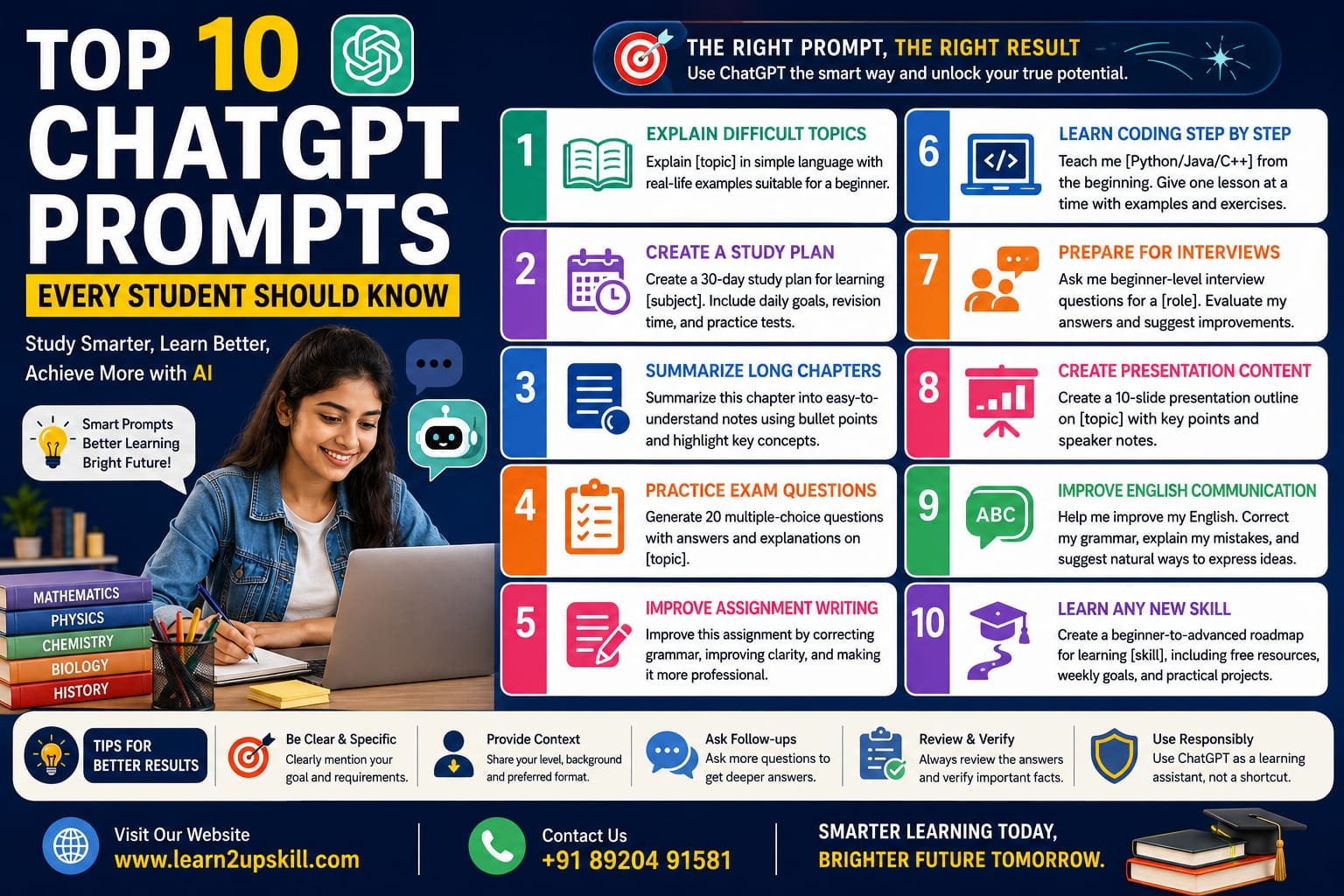
    1. Explain Difficult Topics in Simple Language

    Prompt:

    Explain [topic] in simple language with real-life examples suitable for a beginner.

    Best For

    Science

    Mathematics

    Economics

    Computer Science

    History

    Example:

    Explain Artificial Intelligence in simple language with examples that a school student can understand.

    1. Create a Personalized Study Plan

    Prompt:

    Create a 30-day study plan for learning [subject]. Include daily goals, revision time, and practice tests.

    This helps students stay organized and avoid last-minute exam preparation.

    1. Summarize Long Chapters

    Prompt:

    Summarize this chapter into easy-to-understand notes using bullet points and highlight the most important concepts.

    Perfect for revision before exams.

    1. Practice Exam Questions

    Prompt:

    Generate 20 multiple-choice questions with answers and explanations on [topic].

    This allows you to test your knowledge and identify areas where you need more practice.

    1. Improve Assignment Writing

    Prompt:

    Improve this assignment by correcting grammar, improving clarity, and making it more professional while keeping the original meaning.

    Remember to review the output and ensure it reflects your own understanding.

    1. Learn Coding Step by Step

    Prompt:

    Teach me Python/Java/C++ from the beginning. Give one lesson at a time with examples and practice exercises.

    This prompt is ideal for students who are new to programming.

    1. Prepare for Interviews

    Prompt:

    Ask me beginner-level interview questions for a Digital Marketing / Software Developer / Data Analyst role. Evaluate my answers and suggest improvements.

    This helps build confidence before internships or job interviews.

    1. Create Presentation Content

    Prompt:

    Create a 10-slide presentation outline on [topic] with key points and speaker notes.

    A great way to organize ideas before creating your slides.

    1. Improve English Communication

    Prompt:

    Help me improve my English. Correct my grammar, explain my mistakes, and suggest more natural ways to express my ideas.

    Practicing regularly can improve both written and spoken communication.

    1. Learn Any New Skill

    Prompt:

    Create a beginner-to-advanced roadmap for learning [skill], including free resources, weekly goals, and practical projects.

    Examples:

    Digital Marketing

    Data Analytics

    Graphic Design

    Excel

    Cybersecurity

    Artificial Intelligence

    Tips for Writing Better Chat GPT Prompts

    To get better answers:

    Be clear about your goal.

    Mention your education level or experience.

    Specify the format you want (table, bullet points, essay, quiz, etc.).

    Include any word limit or deadline.

    Ask follow-up questions if you need more detail.

    Best Practices for Students

    Use Chat GPT as a learning partner—not a shortcut.

    Understand the concepts instead of copying answers.

    Verify important facts from trusted textbooks or official sources.

    Edit AI-generated content before submitting assignments.

    Follow your school’s academic integrity rules.

    Conclusion

    Chat GPT can become one of the most valuable learning tools for students when used thoughtfully. The right prompts can help you understand difficult subjects, organize your studies, improve your writing, prepare for interviews, and learn new skills faster.

    The goal isn’t to let AI do all the work—it’s to use AI to become a better learner. Combine Chat GPT with curiosity, critical thinking, and consistent practice, and you’ll be better prepared for academic and career success.

  • How to Build Self-Confidence as a Student

    How to Build Self-Confidence as a Student

    How to Build Self-Confidence as a Student

    Introduction

    Self-confidence is one of the most valuable qualities a student can develop. It helps you participate actively in class, perform better in exams, communicate effectively, make informed decisions, and overcome challenges with a positive attitude. Confidence is not something people are born with—it is a skill that can be developed through consistent effort and practice.

    Many students struggle with self-doubt, fear of failure, and comparison with others. The good news is that confidence grows with every small achievement and every new experience.

    At Learn2Upskill, we believe that building self-confidence is just as important as gaining academic knowledge. A confident student is better prepared to face future opportunities and succeed in both personal and professional life.

    —

    What Is Self-Confidence?

    Self-confidence is the belief in your own abilities, strengths, and potential. It means trusting yourself to handle challenges, learn from mistakes, and keep moving forward even when things become difficult.

    Confidence is not about being perfect. It is about believing that you can learn, improve, and grow.

    —

    Why Is Self-Confidence Important for Students?

    A confident student is more likely to:

    – Participate actively in classroom discussions.

    – Perform better in exams and presentations.

    – Develop leadership qualities.

    – Communicate effectively with teachers and classmates.

    – Handle criticism positively.

    – Take on new challenges without fear.

    – Build healthy relationships.

    – Stay motivated and focused on goals.

    Confidence creates a strong foundation for lifelong success.

    —

    Common Reasons Students Lack Confidence

    Many students lose confidence because of:

    – Fear of failure

    – Comparing themselves with others

    – Negative self-talk

    – Lack of preparation

    – Poor communication skills

    – Fear of public speaking

    – Past failures

    – Bullying or criticism

    – Unrealistic expectations

    Recognizing these causes is the first step toward overcoming them.

    —

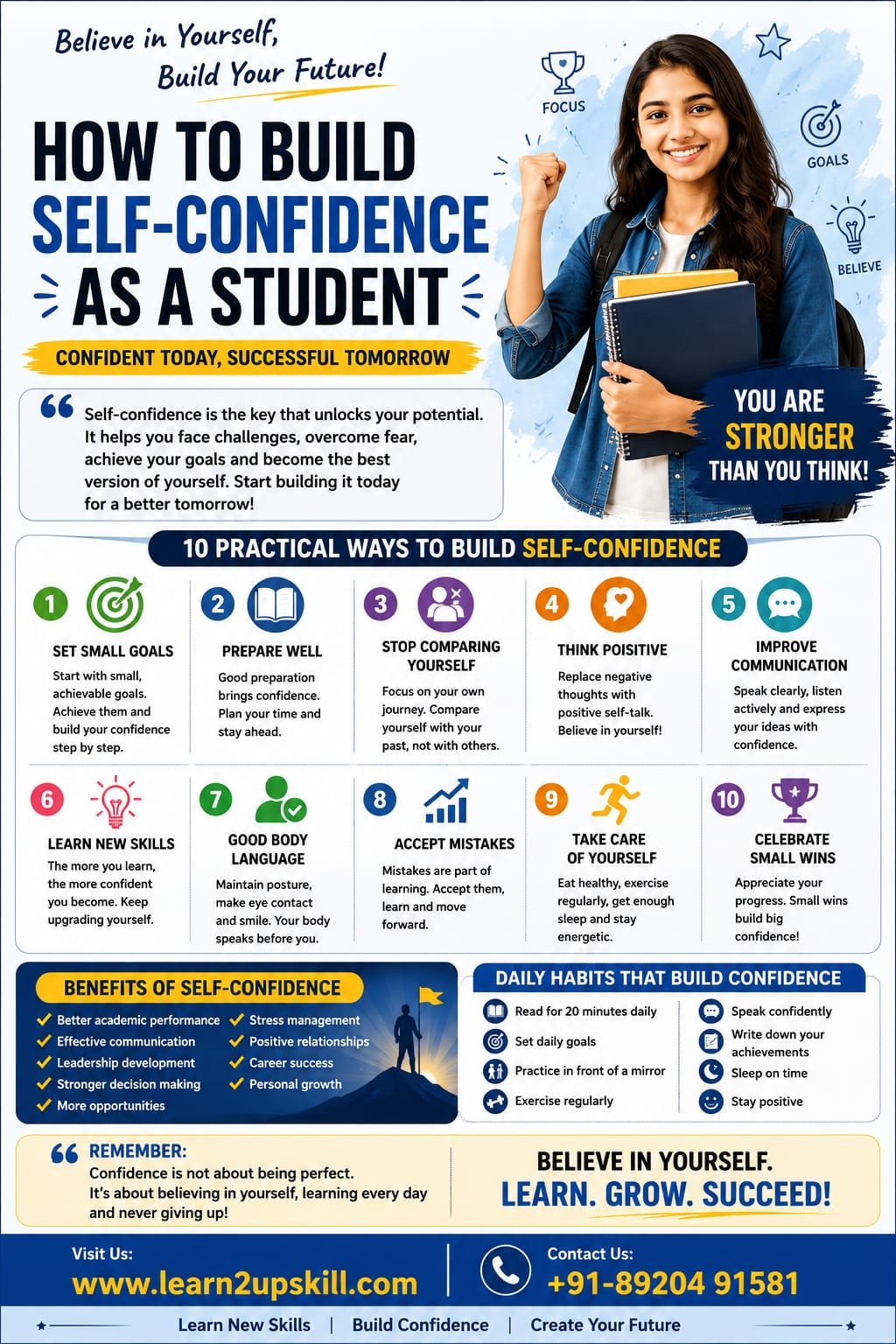
    Practical Ways to Build Self-Confidence

    1. Set Small and Achievable Goals

    Break large goals into smaller tasks. Every completed task gives you a sense of achievement and motivates you to keep improving.

    —

    1. Prepare Well

    Confidence comes from preparation. Whether it is an exam, presentation, or interview, proper preparation reduces anxiety and improves performance.

    —

    1. Stop Comparing Yourself with Others

    Everyone has a unique learning journey. Instead of comparing yourself with classmates, focus on improving your own skills and celebrating your progress.

    —

    1. Develop Positive Self-Talk

    Replace negative thoughts like “I can’t do this” with positive ones such as:

    – I am learning every day.

    – I can improve with practice.

    – I believe in my abilities.

    – Every mistake helps me grow.

    Positive thinking builds inner confidence.

    —

    1. Improve Your Communication Skills

    Practice speaking clearly and confidently. Participate in classroom discussions, group activities, debates, and presentations to improve your communication.

    —

    1. Learn New Skills

    Every new skill you learn increases your confidence. Explore areas like:

    – Public speaking

    – Digital skills

    – Artificial Intelligence (AI)

    – Coding

    – Digital marketing

    – Graphic design

    – Microsoft Excel

    – Leadership skills

    Learning keeps you motivated and future-ready.

    —

    1. Practice Good Body Language

    Your body language affects how you feel and how others perceive you.

    Maintain:

    – Good posture

    – Eye contact

    – A genuine smile

    – Calm gestures

    – Confident walking style

    Positive body language reflects confidence.

    —

    1. Accept Mistakes as Learning Opportunities

    No one succeeds without making mistakes. Instead of fearing failure, treat every setback as a lesson that helps you become stronger and wiser.

    —

    1. Take Care of Your Health

    A healthy body supports a confident mind.

    Make sure to:

    – Sleep 7–8 hours.

    – Eat nutritious food.

    – Exercise regularly.

    – Stay hydrated.

    – Limit excessive screen time.

    Good health improves concentration, energy, and confidence.

    —

    1. Celebrate Small Wins

    Every achievement matters, whether it’s completing an assignment, improving your grades, or speaking confidently in class. Celebrate your progress to stay motivated.

    —

    Daily Habits That Build Confidence

    Develop these simple habits:

    – Read for 20 minutes every day.

    – Learn one new skill each month.

    – Speak in English or your preferred language confidently.

    – Practice in front of a mirror.

    – Exercise regularly.

    – Maintain personal grooming.

    – Write down three achievements every evening.

    – Stay away from negative influences.

    Consistency is the key to lasting confidence.

    —

    Confidence During Exams

    To stay confident during exams:

    – Create a study timetable.

    – Revise regularly.

    – Solve previous years’ question papers.

    – Avoid last-minute cramming.

    – Stay calm and trust your preparation.

    – Get enough sleep before the exam.

    Remember, confidence comes from consistent preparation.

    —

    Confidence During Interviews

    If you’re preparing for college admissions, internships, or jobs:

    – Research the organization.

    – Practice common interview questions.

    – Dress neatly and professionally.

    – Speak clearly and confidently.

    – Maintain eye contact.

    – Smile naturally.

    – Believe in your abilities.

    Interview confidence improves with practice.

    —

    Mistakes That Reduce Confidence

    Avoid these common habits:

    – Comparing yourself constantly

    – Negative thinking

    – Fear of asking questions

    – Avoiding challenges

    – Giving up after one failure

    – Poor time management

    – Ignoring feedback

    – Lack of preparation

    Replacing these habits with positive actions can make a big difference.

    —

    Benefits of Self-Confidence

    Strong self-confidence helps students:

    – Improve academic performance

    – Build leadership skills

    – Communicate effectively

    – Make better decisions

    – Reduce stress and anxiety

    – Face challenges with courage

    – Perform better in interviews

    – Build stronger relationships

    – Achieve personal and career goals

    —

    Conclusion

    Self-confidence is not built overnight. It develops through continuous learning, practice, preparation, and a positive mindset. Every student has the potential to become confident by believing in themselves and taking small, consistent steps toward improvement.

    Remember, success does not come from never making mistakes—it comes from learning, growing, and never giving up.

    At Learn2Upskill, we are committed to helping students build confidence, develop essential life skills, improve communication, and prepare for successful careers through expert training and career guidance.

    —

    Contact Learn2Upskill

    Website: www.coral-kudu-326218.hostingersite.com

    Contact Us: +91-89204 91581

    Learn2Upskill – Learn. Grow. Succeed.