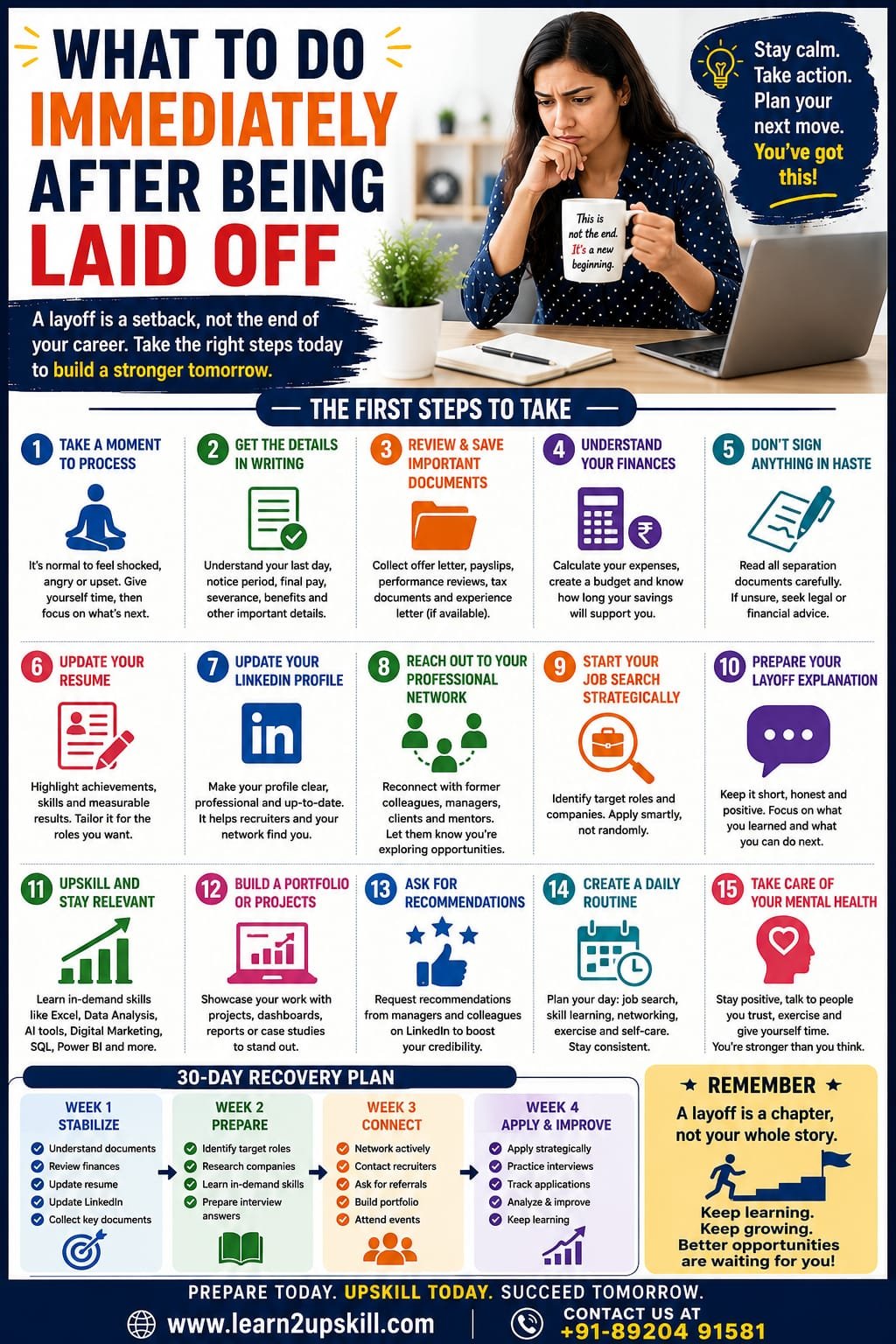
What to Do Immediately After Being Laid Off
Just been laid off? Learn what to do immediately after losing your job, from reviewing documents and finances to updating your resume, networking, applying for jobs, and planning your next career move.
—
What to Do Immediately After Being Laid Off
Being laid off can feel overwhelming.
One moment, you have a regular job, income, routine, and professional identity. The next, you are suddenly expected to figure out what comes next.
You may feel angry, worried, confused, or even relieved. All of these reactions are understandable.
But after the initial shock, the most important thing is to slow down, understand your situation, and take practical steps.
A layoff is a major career transition, but it does not have to become a career setback.
The experience, skills, knowledge, and professional relationships you built in your previous role still belong to you.
This guide explains what you should do immediately after being laid off—and how to turn an uncertain situation into a structured career recovery plan.
—
- Take a Moment Before Making Major Decisions
Your first reaction may be emotional.
You might want to immediately call everyone you know, post about the situation online, or accept the first job opportunity you see.
Don’t rush.
Give yourself some time to process what happened.
You don’t need to solve your entire career on the same day.
Take a breath, talk to someone you trust, and then start working through the practical steps.
Your first goal is stability, not speed.
—
- Get the Layoff Details in Writing
Before leaving the company, make sure you understand exactly what is happening.
Ask HR or your manager for written information about:
– Your official last working day
– Notice period
– Final salary
– Severance or separation benefits, if applicable
– Unused leave
– Bonus or incentive payments
– Insurance and other benefits
– Retirement-related benefits
– Provident fund procedures, where applicable
– Stock or equity arrangements, if applicable
– Company property that must be returned
– Experience and relieving letters
– Final settlement procedures
Don’t rely only on verbal explanations.
Keep copies of documents that you are legally entitled to retain.
If you don’t understand a separation document, ask HR for clarification and consider qualified legal or financial advice where necessary.
Employment rules differ by country, state, contract, and circumstances.
—
- Don’t Sign Something You Don’t Understand
You may be asked to sign a separation agreement, acknowledgment, settlement document, or other paperwork.
Read it carefully.
Pay attention to:
– Payment terms
– Notice provisions
– Confidentiality clauses
– Non-compete or non-solicitation provisions
– Benefits
– Claims or waivers
– Deadlines
– Return-of-property requirements
If you’re unsure about your rights or obligations, get appropriate professional advice before signing.
A few minutes of careful review can prevent significant problems later.
—
- Secure Your Important Personal Employment Documents
Before your access to company systems ends, make sure you have legitimate copies of documents you are entitled to keep.
These may include:
– Offer letter
– Employment contract
– Salary documents
– Payslips
– Promotion letters
– Performance reviews
– Training certificates
– Experience letter
– Tax documents
– Benefits information
However, be extremely careful about company information.
Never take confidential or proprietary company data.
Do not copy:
– Customer databases
– Internal financial information
– Passwords
– Confidential presentations
– Proprietary software
– Trade secrets
– Private company documents
Keep your personal employment records—but respect company confidentiality.
—
- Understand Your Financial Situation
This should be one of your immediate priorities.
Your income may have stopped or may stop soon, so calculate how much money you need each month.
Separate your expenses into two categories.
Essential expenses
– Rent or home loan
– Food
– Utilities
– Education
– Insurance
– Transportation
– Loan payments
– Other essential commitments
Non-essential expenses
– Shopping
– Dining out
– Entertainment
– Subscriptions
– Luxury purchases
– Unplanned spending
Temporarily reducing non-essential expenses can give you more financial breathing room.
The goal isn’t to panic.
The goal is to understand how long your current financial resources can support you.
—
- Create a Temporary Budget
Once you understand your expenses, create a realistic short-term budget.
For example:
Monthly income: ₹0 or reduced income
Essential expenses: ₹X
Available savings: ₹X
Expected payments: ₹X
Emergency buffer: ₹X
This gives you a clearer picture of your situation.
If you have outstanding loans or major financial commitments, contact the relevant institution if necessary rather than ignoring the problem.
Financial uncertainty becomes much easier to manage when you know the numbers.
—
- Don’t Hide the Layoff From Everyone
You don’t need to announce your situation to the entire internet.
But don’t isolate yourself either.
Tell people you trust.
Your family and close friends may provide emotional support.
Former colleagues may know about job openings.
Professional contacts may introduce you to recruiters.
A simple message can be enough:
«“I’ve recently been affected by a company restructuring and am now exploring opportunities in my field. I’d appreciate it if you could keep me in mind for relevant roles.”»
You don’t need to sound desperate.
You need to make people aware that you’re available.
—
- Update Your Resume Immediately
Don’t wait until you find a job opening.
Update your resume while your previous role is still fresh in your mind.
Focus on:
– Achievements
– Projects
– Skills
– Certifications
– Responsibilities
– Measurable results
For example:
Instead of:
«Managed social media accounts.»
Write:
«Managed social media campaigns across multiple platforms and improved audience engagement through data-driven content strategies.»
Instead of:
«Prepared reports.»
Write:
«Automated recurring business reports using Excel, reducing manual reporting time and improving reporting accuracy.»
Your resume should show what you contributed, not just what your job title was.
—
- Update Your LinkedIn Profile
Your LinkedIn profile is an important part of your professional identity.
Review your:
– Headline
– About section
– Experience
– Skills
– Certifications
– Projects
– Profile photograph
Make your professional direction clear.
For example:
«Business Analyst | Excel | SQL | Power BI | Business Intelligence»
is more useful than:
«Open to Work | Looking for a Job»
If you’re comfortable using LinkedIn’s job-seeking features, make sure your profile communicates the types of opportunities you’re interested in.
—
- Reconnect With Your Professional Network
Networking should become part of your job search.
Contact:
– Former colleagues
– Former managers
– College classmates
– Clients
– Mentors
– Industry professionals
– Recruiters
Don’t send the exact same generic message to everyone.
Personalize your conversations.
For example:
«“Hi, I hope you’re doing well. I recently completed my role at [company] following a restructuring and I’m exploring opportunities in business analysis. Since you’ve worked in this area, I wanted to reconnect and stay in touch.”»
Professional relationships can lead to opportunities that never appear on job portals.
—
- Start Searching for Jobs—but Don’t Apply Randomly
Once your basic preparation is complete, begin your job search.
But don’t apply to every vacancy you see.
Identify:
Your target roles
For example:
– Business Analyst
– Data Analyst
– Digital Marketing Executive
– Financial Analyst
– Project Coordinator
Your target industries
Identify industries where your experience is relevant.
Your target companies
Create a list of companies where you’d genuinely like to work.
Then customize your resume and application for relevant positions.
Quality applications are generally more useful than sending hundreds of generic applications.
—
- Prepare an Answer for “Why Did You Leave Your Last Job?”
This question can make candidates nervous.
You don’t need to be embarrassed about a layoff.
Keep your answer short and professional.
For example:
«“My previous company underwent a restructuring that resulted in workforce reductions, and my position was affected. I’m now looking for an opportunity where I can apply my experience in business analysis and continue developing professionally.”»
Then move the conversation toward your strengths.
Avoid criticizing your previous employer.
Don’t blame your manager.
Don’t share confidential information.
And don’t spend ten minutes explaining everything that happened.
State the situation, then focus on the future.
—
- Start Upskilling
A job search doesn’t mean learning should stop.
In fact, this may be one of the best times to upgrade your skills.
Look at job descriptions for your target roles.
Identify the skills employers repeatedly request.
Depending on your career, consider learning:
Business & Analytics
– Advanced Excel
– SQL
– Power BI
– Data analysis
– Business intelligence
Digital Marketing
– SEO
– Google Ads
– Social media marketing
– Analytics
– AI marketing tools
Finance
– Financial modelling
– Advanced Excel
– Power BI
– Data analytics
– AI tools for finance
Technology
– AI
– Automation
– Cloud
– Cybersecurity
– Software development
Don’t try to learn everything.
Choose one or two relevant skills and build practical knowledge.
—
- Learn How AI Can Help Your Career
AI is becoming part of everyday work across many industries.
Instead of simply worrying about whether AI will replace certain tasks, learn how to use it to improve your productivity.
Depending on your role, AI can help with:
– Research
– Data analysis
– Content creation
– Presentations
– Brainstorming
– Reporting
– Customer communication
– Marketing
– Automation
– Administrative work
However, always review AI-generated output and follow the rules of your future employer regarding confidential information and approved tools.
A professional who understands both their industry and modern AI tools can become more adaptable in a changing job market.
—
- Build a Daily Job-Search Routine
Job searching without structure can quickly become exhausting.
Create a daily routine.
For example:
Morning
– Review job openings
– Submit targeted applications
Afternoon
– Skill development
– Portfolio or project work
Evening
– Networking
– Interview preparation
Night
– Disconnect from job searching
You don’t need to spend 12 hours every day applying for jobs.
Consistent, focused effort is more sustainable.
—
- Build or Improve Your Professional Portfolio
A portfolio can help demonstrate your skills, especially if you’re moving into a new role.
Depending on your profession, you could create:
– Excel dashboards
– Power BI reports
– Data analysis projects
– Marketing campaigns
– SEO case studies
– Writing samples
– Business presentations
– Financial models
– AI productivity examples
– Project management case studies
A practical project can sometimes communicate your ability better than a list of certificates.
—
- Ask for Recommendations
If you had a positive relationship with former managers, colleagues, or clients, consider asking for professional recommendations.
You can also request LinkedIn recommendations from people familiar with your work.
A recommendation that describes your:
– Reliability
– Problem-solving
– Leadership
– Communication
– Technical skills
– Teamwork
can strengthen your professional profile.
Ask respectfully, and don’t pressure anyone.
—
- Take Care of Your Mental Health
Being laid off can affect more than your finances.
It can affect your:
– Confidence
– Sleep
– Motivation
– Relationships
– Sense of identity
Don’t judge yourself for feeling upset.
Give yourself permission to process the experience.
Maintain basic routines:
– Sleep properly
– Exercise
– Eat regularly
– Spend time with supportive people
– Take breaks from job searching
– Avoid constantly checking job portals
If stress becomes overwhelming or seriously interferes with daily life, consider talking with a qualified mental-health professional.
Taking care of yourself is part of your career recovery.
—
- Don’t Rush Into the Wrong Job
Financial pressure can make you want to accept the first offer available.
Sometimes accepting a temporary role is completely reasonable.
But if you have enough financial flexibility, evaluate opportunities carefully.
Consider:
– Salary
– Role responsibilities
– Career growth
– Learning opportunities
– Work culture
– Location
– Working hours
– Stability
– Management
– Long-term career value
Your next job doesn’t have to be perfect.
But it should ideally help you move forward.
—
- Create a 30-Day Recovery Plan
Having a plan can make a difficult period feel more manageable.
Week 1: Stabilize
– Understand your separation documents.
– Review your finances.
– Update your resume.
– Update LinkedIn.
– Collect legitimate employment records.
Week 2: Prepare
– Identify target roles.
– Research companies.
– Identify skill gaps.
– Begin learning one relevant skill.
– Prepare interview answers.
Week 3: Connect
– Contact former colleagues.
– Reach out to recruiters.
– Ask for referrals.
– Attend relevant professional events.
– Build your professional portfolio.
Week 4: Apply and Improve
– Submit targeted applications.
– Practice interviews.
– Continue upskilling.
– Track applications.
– Review your results.
– Improve your strategy.
—
Common Mistakes to Avoid After a Layoff
- Panicking
Don’t make major decisions while overwhelmed.
- Spending savings without a plan
Know your financial runway.
- Applying for every job
Focus on relevant opportunities.
- Ignoring skill development
Use the transition period to become more employable.
- Criticizing your former employer publicly
Protect your professional reputation.
- Isolating yourself
Your network can become an important source of support.
- Giving up after a few rejections
Job searches can take time.
- Comparing yourself with former colleagues
Everyone’s career timeline is different.
- Ignoring your mental well-being
Career recovery requires emotional as well as professional resilience.
—
Final Thoughts
Being laid off can feel like your career has suddenly been put on pause.
But a pause isn’t the same as an ending.
Your experience is still valuable.
Your skills are still valuable.
Your professional relationships are still valuable.
And you can continue building new skills and creating new opportunities.
The most important thing is to move from panic to preparation.
Take care of your finances.
Understand your employment documents.
Update your resume.
Strengthen your network.
Improve your LinkedIn profile.
Learn in-demand skills.
Prepare for interviews.
And keep moving forward one step at a time.
A layoff may have changed your current situation, but it does not have to determine your future.
Your next opportunity may be closer than you think.
—
Quick “What to Do After Being Laid Off” Checklist
– [ ] Take time to process the situation.
– [ ] Get layoff details in writing.
– [ ] Review your employment documents.
– [ ] Understand your final payments and benefits.
– [ ] Save legitimate personal employment records.
– [ ] Review your finances.
– [ ] Create a temporary budget.
– [ ] Update your resume.
– [ ] Update LinkedIn.
– [ ] Contact your professional network.
– [ ] Start a targeted job search.
– [ ] Prepare for interviews.
– [ ] Identify skill gaps.
– [ ] Start learning relevant skills.
– [ ] Build a professional portfolio.
– [ ] Ask for recommendations.
– [ ] Maintain a healthy daily routine.
– [ ] Track your job-search progress.
—
Ready to Build Your Next Career Chapter?
A job loss can be a difficult transition, but it can also be an opportunity to learn something new and strengthen your professional skills.
At Learn2upskill, we provide practical learning resources for students, professionals, job seekers, and career changers.
Explore skills in areas such as:
AI • Excel • Business Analysis • Digital Marketing • Cybersecurity • Data Skills • Professional Development
Don’t wait for your next job to teach you what you need to know.
Learn. Upskill. Grow.
🌐 www.coral-kudu-326218.hostingersite.com
Contact Us: +91-89204 91581
–
Leave a Reply