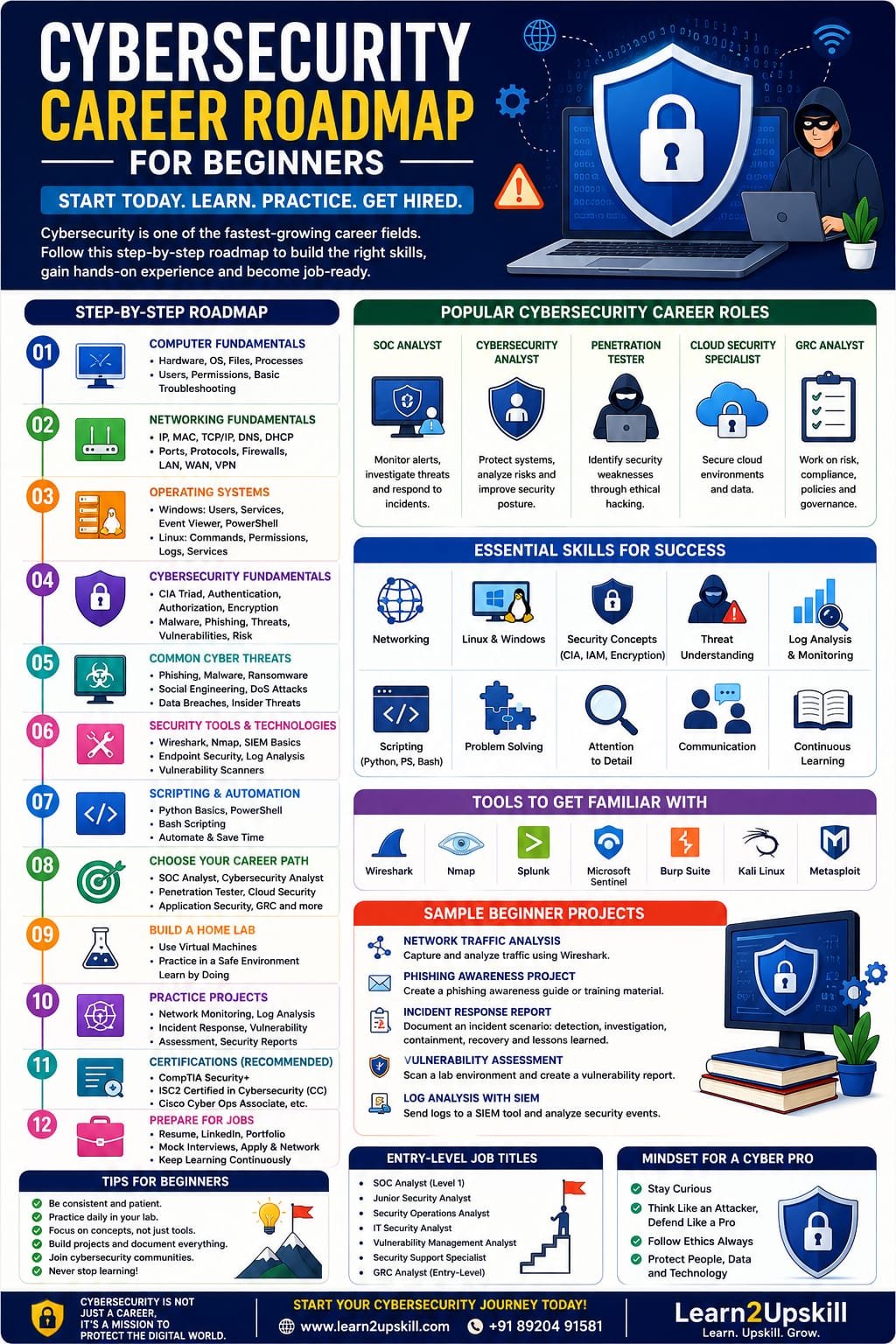
Cybersecurity Career Roadmap for Beginners: From Zero to Job-Ready
Learn the complete cybersecurity career roadmap for beginners. Discover essential skills, tools, certifications, projects and entry-level cybersecurity jobs.
Suggested URL Slug:
cybersecurity-career-roadmap-for-beginners
Introduction
Cybersecurity has become an important part of almost every modern organization.
Businesses depend on computers, cloud services, applications, networks, databases and digital communication. As organizations become more connected, they also need professionals who can help protect systems, information and users.
This creates opportunities for people interested in building a career in cybersecurity.
But there’s one major problem for beginners:
Where do you start?
Should you learn networking first?
Should you learn ethical hacking?
Do you need programming?
Which certification should you take?
How do you get your first cybersecurity job?
The cybersecurity field is also much broader than many beginners realize. NIST’s NICE Framework provides a common language for describing cybersecurity work, including tasks, knowledge, skills, competencies and work roles. Its current framework has continued to evolve, including updates in 2026. �
NIST +1
This means there isn’t one single “cybersecurity career.”
There are many possible paths.
In this guide, we’ll create a practical cybersecurity career roadmap for beginners, starting with the fundamentals and progressing toward job-ready skills.
What Is a Cybersecurity Career?
Cybersecurity is the practice of protecting digital systems, networks, applications, devices and information from unauthorized access, attacks, disruption and misuse.
Cybersecurity professionals may work in areas such as:
Security operations
Network security
Cloud security
Application security
Incident response
Digital forensics
Risk management
Governance and compliance
Penetration testing
Security engineering
Threat intelligence
Identity and access management
Security awareness
The NIST NICE Framework organizes cybersecurity work into work roles and the knowledge and skills needed to perform them. �
NIST
So don’t think:
“I need to learn everything about cybersecurity.”
Think:
“I need to build the skills required for the cybersecurity role I want.”
That’s a much more realistic approach.
Step 1: Understand Computer Fundamentals
If you’re completely new to technology, start here.
Before learning advanced cybersecurity concepts, understand how computers work.
Learn the basics of:
Hardware
Operating systems
Files and folders
Applications
Processes
Users and permissions
Storage
Memory
Basic troubleshooting
You don’t need to become a computer engineer.
You simply need enough knowledge to understand what you’re protecting.
Step 2: Learn Networking Fundamentals
Networking is one of the most important foundations for cybersecurity.
Why?
Because many security problems involve communication between:
Devices → Networks → Servers → Applications → Users
Start by learning:
IP addresses
MAC addresses
TCP/IP
DNS
DHCP
HTTP and HTTPS
Ports
Protocols
Routers
Switches
Firewalls
VPNs
LAN and WAN
Subnets
Network traffic
For example, you should understand what happens when you type:
www.example.com�
into a browser.
You don’t need to become a network administrator first, but you should understand the basic journey of the request.
Beginner goal
Be able to explain:
How does a device communicate with another device over a network?
Once you understand that, cybersecurity concepts become much easier.
Step 3: Learn Operating Systems
You should become comfortable with both Windows and Linux.
Windows
Learn:
Users and groups
File permissions
Processes
Services
Event Viewer
Windows Defender
Basic PowerShell
System configuration
Linux
Learn:
Linux file system
Commands
Users
Groups
Permissions
Processes
Services
Package management
Logs
Shell basics
Linux is particularly useful because many security tools and servers use Linux-based environments.
Beginner Linux commands
Learn commands such as:
pwd
ls
cd
mkdir
cp
mv
rm
cat
grep
find
chmod
ps
top
You don’t need to memorize hundreds of commands.
Focus on understanding what they do.
Step 4: Learn Cybersecurity Fundamentals
Now you can start studying core cybersecurity concepts.
Begin with:
Confidentiality
Only authorized people should access information.
Integrity
Information should not be changed without authorization.
Availability
Systems and information should be available when needed.
Together, these are commonly known as the:
CIA Triad
Also learn about:
Authentication
Authorization
Access control
Encryption
Hashing
Malware
Phishing
Social engineering
Ransomware
Vulnerabilities
Threats
Risk
Security controls
These concepts form the foundation for many cybersecurity roles.
Step 5: Learn Common Cyber Threats
A cybersecurity professional needs to understand how attacks happen.
Study concepts such as:
Phishing
Credential theft
Malware
Ransomware
Password attacks
Social engineering
Denial-of-service attacks
Web application attacks
Insider threats
Data breaches
Vulnerability exploitation
You don’t need to learn how to attack real systems.
Instead, focus on understanding:
How the threat works → What it looks like → How to detect it → How to prevent or respond to it
This defensive mindset is extremely important.
Step 6: Learn Security Tools
Once you understand the fundamentals, start getting familiar with common cybersecurity tools.
Depending on your career path, these might include:
Network Analysis
Wireshark
Used to inspect and analyze network traffic.
Security Scanning
Nmap
Used for network discovery and security auditing in authorized environments.
SIEM
Security information and event management platforms help security teams collect and analyze logs and alerts.
Examples include:
Microsoft Sentinel
Splunk
IBM QRadar
Endpoint Security
Learn the basic concepts behind:
Endpoint detection and response
Antivirus
Endpoint monitoring
Device management
Don’t try to master every tool.
Learn the concept first and the tool second.
Step 7: Learn Basic Scripting
Do you need to become a programmer to work in cybersecurity?
No.
But basic scripting can be extremely useful.
Start with:
Python
Learn:
Variables
Conditions
Loops
Functions
Lists
Dictionaries
Reading files
Basic automation
PowerShell
Useful for Windows administration and automation.
Bash
Useful for Linux environments.
Your goal isn’t to become a software developer.
Your goal is to automate repetitive tasks and understand scripts.
For example:
Manually checking 500 files
vs.
Writing a script that checks them automatically
That’s where scripting becomes valuable.
Step 8: Choose Your Cybersecurity Career Path
This is one of the most important steps.
You don’t need to specialize immediately, but eventually you should choose a direction.
Path 1: SOC Analyst
A Security Operations Center analyst monitors security alerts and investigates suspicious activity.
You may work with:
Security alerts
Logs
SIEM platforms
Network traffic
Endpoint alerts
Incident investigations
Skills to develop
Networking + Windows/Linux + SIEM + Incident Response
Path 2: Cybersecurity Analyst
A cybersecurity analyst may work across multiple security functions.
Responsibilities can include:
Monitoring
Risk analysis
Security assessments
Incident response
Vulnerability management
Security reporting
This can be a good broad path for beginners.
Path 3: Penetration Tester / Ethical Hacker
Penetration testers assess systems for security weaknesses with authorization.
You may learn:
Networking
Linux
Web applications
Vulnerability assessment
Security testing
Scripting
Security tools
This path requires strong technical foundations.
Always practice only in authorized environments.
Path 4: Cloud Security
As businesses increasingly use cloud platforms, cloud security has become an important specialization.
Learn:
Cloud fundamentals
Identity and access management
Network security
Encryption
Cloud logging
Security monitoring
Secure configurations
You can then specialize in platforms such as:
AWS
Microsoft Azure
Google Cloud
Path 5: Application Security
Application security focuses on protecting software and applications.
Learn about:
Secure coding
Authentication
Authorization
Vulnerability management
Web application security
Security testing
Secure software development
Knowledge of programming becomes more useful in this path.
Path 6: Governance, Risk and Compliance
Not every cybersecurity career is deeply technical.
GRC professionals may work with:
Security policies
Risk assessments
Compliance
Audits
Security controls
Documentation
Governance
This can be suitable for professionals who enjoy:
Business + Security + Risk + Documentation
rather than hands-on technical testing.
Step 9: Build a Home Cybersecurity Lab
This is where your learning becomes practical.
Instead of only watching cybersecurity tutorials, build a safe practice environment.
For example, you can create a lab using virtual machines.
You might have:
Linux machine
Windows machine
Security tools
Network monitoring
Then practice authorized activities such as:
Log analysis
Network monitoring
System hardening
User permissions
Security configuration
Incident investigation
A lab gives you something valuable:
Hands-on experience.
Step 10: Build Cybersecurity Projects
Projects can make your learning more practical and give you something to discuss during interviews.
Beginner Project 1: Password Security Analysis
Create a project explaining:
Password risks
Password policies
MFA
Password managers
Security recommendations
Beginner Project 2: Phishing Awareness Project
Create:
Sample phishing indicators
Awareness checklist
Employee training material
Reporting process
Beginner Project 3: Network Monitoring
Use a lab environment to capture and analyze network traffic.
Document:
What you observed
What protocols appeared
What unusual activity could indicate
Security recommendations
Beginner Project 4: Security Incident Report
Create a fictional incident scenario.
Document:
Detection → Investigation → Containment → Recovery → Lessons Learned
Beginner Project 5: Vulnerability Assessment Report
Using an authorized lab environment, document:
Systems tested
Findings
Risk levels
Recommended remediation
These projects can become part of your portfolio.
Step 11: Consider Certifications
Certifications aren’t the only way to enter cybersecurity, but they can provide structured learning and help demonstrate foundational knowledge.
For beginners, possible certifications include:
CompTIA Security+
ISC2 Certified in Cybersecurity (CC)
Cisco Certified Support Technician Cybersecurity
Microsoft security-related fundamentals
ISC2 currently positions its Certified in Cybersecurity (CC) as an entry-level credential for people starting in the field, including those without prior cybersecurity experience. �
ISC2
ISC2’s 2026 career guidance also emphasizes that cybersecurity entry routes can include skills-focused learning, certifications, internships and apprenticeships—not only traditional four-year degrees. �
ISC2
Important
Don’t collect certifications just for the sake of collecting them.
A strong combination is:
Knowledge + Hands-on Practice + Projects + Certification
Step 12: Develop Soft Skills
Cybersecurity isn’t only about technical knowledge.
You also need to communicate.
NIST explicitly recognizes workplace skills such as teamwork, problem-solving and time management as important in cybersecurity work. �
NIST
ISC2’s 2025 workforce research similarly identified problem-solving, teamwork/collaboration and communication among the leading nontechnical skills needed in cybersecurity. �
ISC2
Develop:
Communication
Problem-solving
Critical thinking
Teamwork
Documentation
Time management
Attention to detail
Incident reporting
Presentation skills
Imagine detecting a security incident.
Knowing what happened is only half the job.
You also need to explain:
What happened?
How serious is it?
What systems are affected?
What should management do?
That’s why communication matters.
Step 13: Create a Cybersecurity Portfolio
Don’t rely only on your resume.
Create evidence of your skills.
Your portfolio could contain:
Project 1
Network Security Analysis
Project 2
Phishing Awareness Program
Project 3
Security Incident Investigation
Project 4
Vulnerability Assessment
Project 5
Linux Security Hardening
For each project include:
Objective
Environment
Tools
Process
Findings
Recommendations
Lessons learned
This makes your learning tangible.
Step 14: Prepare for Entry-Level Cybersecurity Jobs
Possible entry-level or early-career roles include:
SOC Analyst
Junior Cybersecurity Analyst
Security Operations Analyst
IT Security Analyst
Vulnerability Management Analyst
Security Support Specialist
Junior GRC Analyst
Security Administrator
IT Support with Security Responsibilities
Not every cybersecurity job is truly “entry-level,” and requirements vary by employer.
ISC2’s 2025 hiring research found that hiring managers continue to value hands-on experience and certifications, while also noting that entry-level candidates can bring useful perspectives and perform foundational tasks. �
ISC2
This is why practical projects matter.
Step 15: Don’t Ignore IT Experience
One of the biggest misconceptions among beginners is:
“I need a cybersecurity job before I can get cybersecurity experience.”
Not necessarily.
IT can be a useful pathway.
For example:
IT Support
↓
Network/System Administration
↓
Security Responsibilities
↓
Cybersecurity Analyst
ISC2’s 2025 workforce study found that IT experience remained the most commonly reported pathway into cybersecurity, although younger professionals also entered through education, certifications, internships, self-learning and other routes. �
ISC2
So don’t automatically reject an IT support or system administration opportunity if cybersecurity is your long-term goal.
A 6-Month Cybersecurity Roadmap for Beginners
Here’s a practical example.
Month 1: Computer + Networking Fundamentals
Learn:
Computer basics
Operating systems
TCP/IP
DNS
DHCP
Ports
Protocols
Firewalls
Goal: Understand how systems communicate.
Month 2: Cybersecurity Fundamentals
Learn:
CIA Triad
Authentication
Authorization
Encryption
Malware
Phishing
Vulnerabilities
Threats
Risk
Goal: Understand the cybersecurity landscape.
Month 3: Linux + Windows Security
Learn:
Linux commands
File permissions
Windows users
Processes
Services
Logs
Basic PowerShell
Goal: Understand operating-system security.
Month 4: Security Tools
Practice with authorized labs:
Wireshark
Nmap
SIEM concepts
Endpoint security
Log analysis
Goal: Learn how security professionals investigate activity.
Month 5: Specialization + Projects
Choose a direction:
SOC
Ethical Hacking
Cloud Security
Application Security
GRC
Then build 2–3 projects.
Month 6: Certification + Job Preparation
Work on:
Certification preparation
Resume
LinkedIn profile
Portfolio
Interview preparation
Job applications
Networking
Goal: Become job-ready.
Cybersecurity Skills Roadmap
Stage
Skills
Beginner
Computer fundamentals
Foundation
Networking
Foundation
Windows + Linux
Core
Cybersecurity concepts
Core
Threats and vulnerabilities
Technical
Security tools
Technical
SIEM and log analysis
Technical
Basic scripting
Advanced
Specialization
Career
Projects
Career
Certification
Career
Portfolio + interviews
Do You Need a Cybersecurity Degree?
Not necessarily.
A degree can be valuable for many employers and specialized paths, but it isn’t the only possible route into cybersecurity.
Current industry guidance recognizes multiple pathways, including skills-focused learning, certifications, internships, apprenticeships, university education and self-directed learning. �
ISC2
What matters is building demonstrable capability.
A strong beginner profile might combine:
Education
Cybersecurity training
Certification
Hands-on labs
Projects
Communication skills
Do You Need Coding for Cybersecurity?
It depends on your role.
Less coding-intensive paths
GRC
Security awareness
Some SOC roles
Risk management
Compliance
More technical paths
Penetration testing
Application security
Security engineering
Malware analysis
Security automation
Start with basic scripting.
Then increase your programming knowledge if your chosen career path requires it.
Cybersecurity + AI: A New Skill Combination
Cybersecurity is also being affected by artificial intelligence.
AI can assist defenders with:
Security monitoring
Alert analysis
Threat intelligence
Log analysis
Automation
Security research
Incident investigation
But attackers can also use AI to improve scams, social engineering and other malicious activity.
NIST’s NICE Framework has continued adding and updating cybersecurity competencies, including AI Security, and its 2026 update added a Cybersecurity Supply Chain Risk Management work role and a DevSecOps competency area. �
NIST
For beginners, this suggests an increasingly useful combination:
Cybersecurity + AI Literacy + Automation
You don’t need to become an AI researcher.
Understand how AI affects security—and how security professionals can use AI responsibly.
Common Mistakes Cybersecurity Beginners Should Avoid
Mistake 1: Trying to Learn Everything
Cybersecurity is huge.
Choose a direction.
Mistake 2: Only Watching Videos
Hands-on practice matters.
Mistake 3: Collecting Certifications
Knowledge matters more than certificates alone.
Mistake 4: Ignoring Networking
Networking is fundamental.
Mistake 5: Avoiding Linux
Linux knowledge can be extremely useful.
Mistake 6: Ignoring Communication
Security professionals must explain problems clearly.
Mistake 7: Practicing on Systems Without Permission
Only test systems and networks where you have explicit authorization.
Mistake 8: Not Building Projects
Projects demonstrate practical ability.
The Cybersecurity Career Formula
A simple way to think about your career development is:
Fundamentals
↓
Technical Skills
↓
Hands-on Practice
↓
Specialization
↓
Projects
↓
Certification
↓
Portfolio
↓
Job Applications
↓
Continuous Learning
This isn’t a rigid sequence.
You can work on several areas simultaneously as you progress.
Final Cybersecurity Career Checklist
Before applying for your first cybersecurity role, ask yourself:
☐ Do I understand networking fundamentals?
☐ Can I work with Windows and Linux?
☐ Do I understand common cyber threats?
☐ Can I explain authentication and access control?
☐ Have I practiced with security tools?
☐ Can I analyze basic logs?
☐ Have I completed hands-on labs?
☐ Have I built cybersecurity projects?
☐ Do I have a portfolio?
☐ Have I considered an entry-level certification?
☐ Can I explain cybersecurity concepts clearly?
☐ Do I understand the role I’m applying for?
If you can confidently answer most of these questions, you’re moving in the right direction.
Conclusion
Starting a cybersecurity career can seem overwhelming because the field is so broad.
You don’t need to learn everything at once.
Start with:
Computer Fundamentals
↓
Networking
↓
Windows + Linux
↓
Cybersecurity Fundamentals
↓
Security Tools
↓
Hands-on Labs
↓
Specialization
↓
Projects
↓
Certification
↓
Job Preparation
The most important lesson is this:
Don’t just learn cybersecurity. Practice cybersecurity.
Build labs.
Analyze logs.
Document projects.
Learn from mistakes.
Develop communication skills.
Understand the career path you’re targeting.
And keep learning as technology changes.
Cybersecurity is not a career where learning stops after your first job. The field evolves continuously, which makes continuous upskilling one of the most valuable habits you can develop.
Start with the fundamentals. Build practical skills. Create evidence of your ability. Then take the next step toward your cybersecurity career.
Frequently Asked Questions
- Can I start a cybersecurity career with no experience?
Yes. There are multiple entry pathways, including skills-focused training, certifications, internships, apprenticeships, education and self-directed learning. Practical projects and hands-on experience can help demonstrate your capabilities. �
ISC2
- What should I learn first for cybersecurity?
Start with computer fundamentals, networking, Windows/Linux, basic cybersecurity concepts and common threats.
- Do I need programming for cybersecurity?
Not for every role. Basic scripting is useful, while advanced programming becomes more important for areas such as application security, penetration testing, malware analysis and security engineering.
- Which cybersecurity certification should a beginner consider?
Options include entry-level certifications such as ISC2 Certified in Cybersecurity (CC) and CompTIA Security+, depending on your goals and budget. ISC2 specifically positions CC as an entry-level credential for newcomers. �
ISC2
- Is cybersecurity a good career for students?
It can be a strong career option for students interested in technology, problem-solving, investigation and continuous learning. Students can start with networking and security fundamentals and build practical projects.
- Can I move into cybersecurity from another career?
Yes. Career changers can build cybersecurity skills through training, certifications, labs and projects. Your previous experience can also be useful—for example, finance experience can complement GRC or security-risk roles.
- What is the easiest cybersecurity job to get?
There isn’t one universally easiest role. Entry requirements vary by employer. IT support, security operations, junior security analysis and GRC-related roles can be possible starting points depending on your skills and experience.
- How long does it take to become job-ready in cybersecurity?
It depends on your starting point, learning time and target role. A focused six-month roadmap can build a foundation, but becoming genuinely job-ready may take longer and requires hands-on practice.
- Is cybersecurity only for IT professionals?
No. Cybersecurity includes technical and nontechnical roles. Governance, risk, compliance, security awareness and policy work can suit people with strong business, communication or analytical backgrounds.
Start Your Cybersecurity Journey with Learn2Upskill
Want to build practical, future-focused cybersecurity skills?
Learn about:
Cybersecurity Fundamentals
Cybersecurity Awareness
Ethical Hacking
Network Security
AI & Cybersecurity
Data Protection
Cybersecurity Best Practices
🌐 www.coral-kudu-326218.hostingersite.com�
📞 Contact Us: +91 89204 91581
Learn. Upskill. Grow.
Leave a Reply