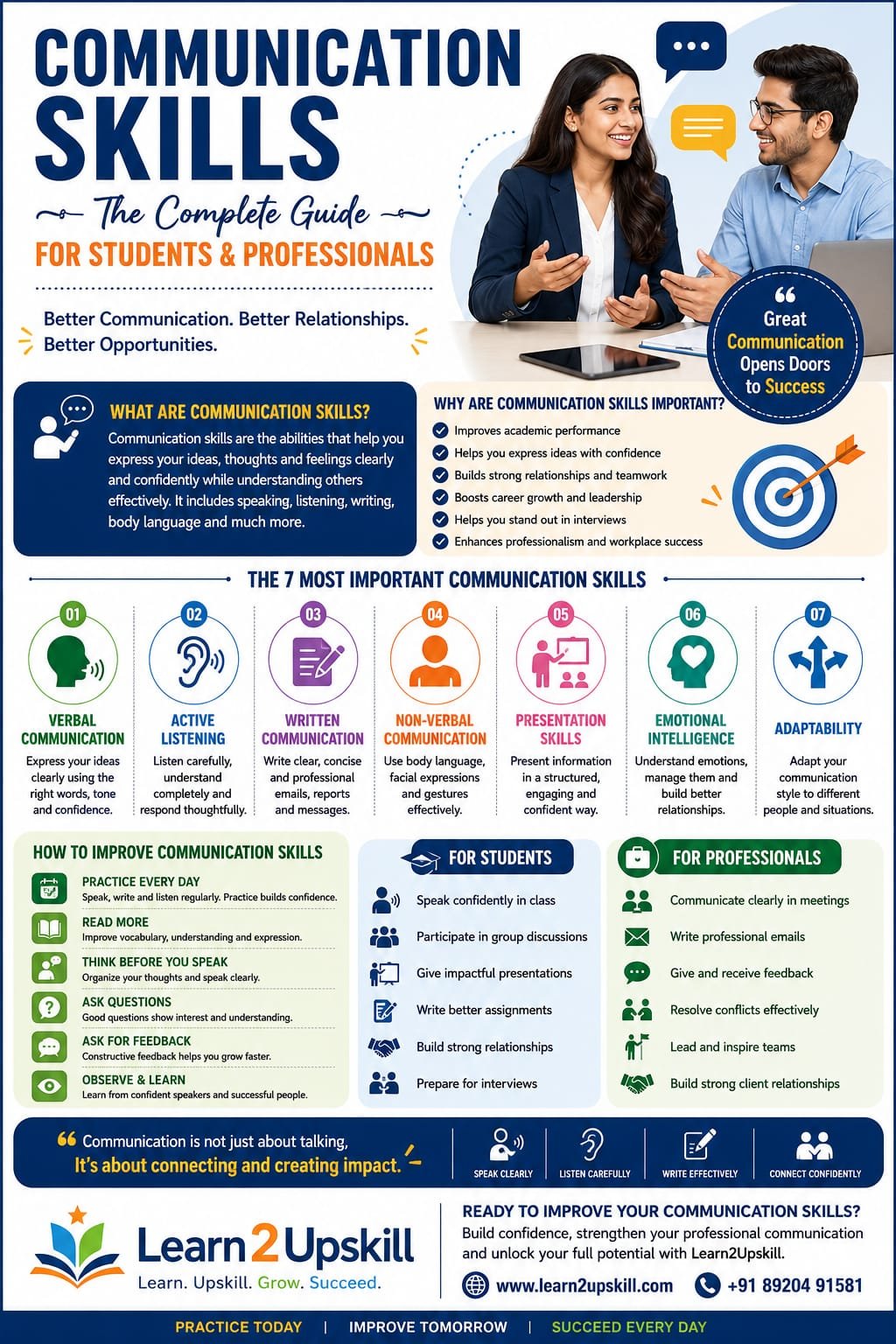
Communication Skills: The Complete Guide for Students and Professionals
Learn the importance of communication skills for students and professionals. Discover practical tips to improve speaking, listening, writing, body language and workplace communication.
Suggested URL Slug: /communication-skills-complete-guide/
What Are Communication Skills?
Communication skills are the abilities that help you share information, ideas, opinions and feelings clearly while understanding what other people are communicating.
Communication happens in many forms:
Speaking
Listening
Writing
Reading
Body language
Facial expressions
Presentations
Emails
Phone conversations
Video meetings
Workplace discussions
Interviews
Group discussions
Good communication is not simply about talking more. It is about communicating the right message to the right person at the right time and in the right way.
For example, imagine a student explaining a project to a teacher. Knowing the subject is important, but the student also needs to organize the explanation, speak clearly, listen to questions and respond appropriately.
The same principle applies at work.
Why Are Communication Skills Important?
Communication affects almost every part of education, career development and professional life.
Research published by NCERT’s Indian Journal of Vocational Education identifies communication, teamwork, problem-solving, critical thinking and other employability skills as highly valued in industry. �
E-Journals NCERT
Here are some major reasons communication skills matter.
- They Improve Academic Performance
Students regularly need to:
Ask questions
Participate in discussions
Give presentations
Write assignments
Work on group projects
Explain ideas
Communicate with teachers
Strong communication can make it easier to express what you know.
- They Help During Job Interviews
An interview is not only about what you know.
Recruiters also observe how you:
Answer questions
Explain your experience
Listen to the interviewer
Organize your thoughts
Maintain professional body language
Handle unexpected questions
Communication therefore becomes particularly important for freshers who may have limited work experience.
- They Improve Workplace Relationships
Good communication helps employees work with:
Managers
Colleagues
Customers
Clients
Vendors
Team members
Clear communication can reduce misunderstandings and help teams coordinate their work more effectively.
Indeed’s workplace guidance similarly highlights active listening, emotional management, non-verbal cues, soft skills and feedback as practical areas for improving workplace communication. �
Indeed
The 7 Most Important Communication Skills
Communication is a combination of several skills. Here are seven that students and professionals should develop.
- Verbal Communication
Verbal communication is the way you communicate through spoken words.
It includes:
Vocabulary
Pronunciation
Tone
Clarity
Pace
Confidence
Choice of words
Example
Instead of saying:
“I don’t know.”
You could say:
“I’m not completely sure, but I’ll check the information and get back to you.”
The second response communicates uncertainty while also demonstrating responsibility.
How to improve verbal communication
Speak slowly and clearly.
Avoid unnecessary filler words.
Organize your thoughts before speaking.
Use simple language.
Adjust your tone according to the situation.
Practice explaining complex ideas in simple terms.
- Active Listening
Communication is a two-way process.
Listening is just as important as speaking.
Active listening means paying attention to the speaker, understanding the message and responding thoughtfully instead of simply waiting for your turn to speak.
Active listening is also recognized as an important career-readiness skill. �
Career Resources Rutgers Newark
Active listening techniques
Try to:
Maintain appropriate eye contact.
Avoid interrupting.
Ask relevant questions.
Summarize important points.
Observe non-verbal signals.
Clarify anything you don’t understand.
Example
Instead of immediately replying:
“Okay.”
Try:
“So, if I understand correctly, you want the report completed by Friday. Is that right?”
This confirms your understanding and reduces mistakes.
- Written Communication
Written communication is especially important in the professional world.
It includes:
Emails
Reports
Messages
Proposals
Presentations
Assignments
Resumes
Cover letters
Professional writing should generally be clear, concise, accurate and appropriate for the audience.
Tips for better professional writing
Before sending an email or document, ask:
Is it clear?
Can the reader understand what I mean?
Is it concise?
Can I remove unnecessary words?
Is it professional?
Is the tone appropriate?
Is it accurate?
Have I checked grammar, spelling and facts?
Is there a clear action?
Does the reader know what they need to do next?
- Non-Verbal Communication
Sometimes your body communicates before you say a word.
Non-verbal communication includes:
Facial expressions
Eye contact
Posture
Gestures
Hand movements
Personal space
Tone of voice
Appearance
For example, looking at your phone while someone is speaking may communicate disinterest—even if you say, “I’m listening.”
That is why communication skills and body language should be developed together.
- Presentation Skills
Students and professionals frequently need to present information.
You may have to:
Present a college project
Explain a business proposal
Present sales results
Deliver a training session
Speak during a meeting
Give a seminar
A good presentation requires more than attractive slides.
You need to communicate your message clearly.
A simple presentation structure
Beginning:
Introduce the topic and explain why it matters.
Middle:
Present the key information, examples and evidence.
End:
Summarize the main points and explain the next step.
Presentation tip
Don’t fill every slide with text.
Use slides to support your explanation rather than reading every word from the screen.
- Emotional Intelligence
Communication isn’t only about words.
Your emotions—and your ability to understand other people’s emotions—can strongly influence conversations.
Emotional intelligence can help you:
Manage frustration
Respond calmly
Understand different perspectives
Handle disagreements
Give constructive feedback
Build professional relationships
For example, if a colleague criticizes your work, immediately becoming defensive may escalate the situation.
A more effective response could be:
“Thanks for pointing that out. Could you explain which part you think I should improve?”
This turns criticism into an opportunity to learn.
- Adaptability
Different people need different communication styles.
You may communicate differently with:
A close friend
A teacher
A manager
A customer
A senior executive
A new colleague
Effective communication means understanding your audience.
For example, a message to a friend might be informal, while an email to a client should be professional.
Communication Skills Every Student Should Develop
Students can start developing communication skills long before entering the workplace.
Here are some valuable skills to practice.
- Speaking confidently
Practice speaking for a few minutes every day.
Choose a topic and explain it without reading from a script.
- Listening carefully
Don’t interrupt unnecessarily. Focus on understanding the speaker.
- Asking questions
Don’t be afraid to ask for clarification.
A good question can demonstrate curiosity and critical thinking.
- Presentation skills
Volunteer for presentations and classroom activities whenever possible.
- Group discussion
Participate in discussions while allowing others to speak.
- Writing
Practice writing emails, summaries, essays and professional messages.
- Body language
Work on posture, facial expressions and appropriate eye contact.
Communication Skills Every Professional Should Develop
Professionals need communication skills across almost every stage of work.
Important areas include:
Professional email writing
Meeting communication
Presentation skills
Active listening
Giving feedback
Receiving feedback
Negotiation
Conflict resolution
Customer communication
Team communication
Leadership communication
Virtual communication
Communication also becomes particularly important as professionals move into leadership roles.
A manager needs to explain expectations, provide feedback, resolve disagreements and motivate employees—not simply complete technical tasks.
How to Improve Communication Skills
The good news is that communication is a learnable skill.
You don’t have to be naturally confident.
You can improve through deliberate practice.
- Read Regularly
Reading improves vocabulary, comprehension and your ability to organize ideas.
Read:
Books
Newspapers
Industry articles
Blogs
Business reports
After reading something, try explaining the main idea in your own words.
- Practice Speaking Every Day
Choose a topic and speak for 2–5 minutes.
For example:
My career goal
My favorite subject
A recent news story
A book I read
A business idea
A skill I want to learn
Record yourself and listen back.
Look for:
Repeated words
Long pauses
Unclear pronunciation
Speaking too quickly
Lack of structure
- Use the PREP Technique
The PREP technique is useful when you need to answer questions clearly.
P – Point
State your main idea.
R – Reason
Explain why.
E – Example
Give an example.
P – Point
Return to your main message.
Example
Question: Why are communication skills important?
Point: Communication skills are essential for career growth.
Reason: They help professionals explain ideas and collaborate effectively.
Example: During a team project, clear communication can prevent misunderstandings and improve coordination.
Point: Therefore, developing communication skills can make professionals more effective.
This simple structure is especially useful for interviews, presentations and group discussions.
- Think Before You Speak
You don’t need to respond immediately to every question.
Take a moment to understand the question and organize your answer.
A short pause can often make your answer clearer and more confident.
- Expand Your Vocabulary—But Don’t Overcomplicate It
A strong vocabulary can help, but using complicated words doesn’t automatically make you a better communicator.
The goal is clarity, not complexity.
Instead of trying to impress people with difficult vocabulary, focus on choosing words that your audience understands.
- Ask for Feedback
Ask a teacher, colleague, mentor or friend:
“What is one thing I could improve about my communication?”
Specific feedback can help you identify habits you don’t notice yourself.
- Practice Active Listening
During your next conversation, focus completely on the speaker.
Put away distractions.
Don’t prepare your response while they are still talking.
Listen first.
Respond second.
- Join Activities That Require Communication
You can improve through:
Debates
Public speaking
Group discussions
Presentations
Workshops
Volunteer activities
Networking
Team projects
Practice creates confidence.
Common Communication Mistakes to Avoid
Even strong communicators make mistakes.
Here are some common ones:
❌ Interrupting people
Allow people to finish their thoughts.
❌ Using too many filler words
Words such as “um,” “actually,” “like” and “basically” can distract from your message when overused.
❌ Speaking too quickly
Slow down so your audience can follow your ideas.
❌ Using unclear language
Avoid unnecessary jargon when simple language will work.
❌ Ignoring body language
Your facial expressions and posture can influence how your message is received.
❌ Not listening
Communication is not just about speaking.
❌ Becoming defensive
Constructive feedback can help you grow.
❌ Sending messages without proofreading
A quick review can prevent embarrassing mistakes in professional communication.
Communication Skills and Career Growth
Technical skills can help you qualify for a job, but communication skills can help you demonstrate your knowledge, collaborate with others and grow within an organization.
For students and freshers, this is particularly important because employers often assess communication alongside other employability skills. India’s National Careers Service describes communication as a soft skill used across many jobs, including writing emails, reading instructions and working with customers. �
National Careers Service
In India specifically, a 2026 ETS report highlighted the growing importance of English proficiency and communication in an increasingly global and AI-enabled workforce. �
ETS
However, remember one important point:
Good communication does not mean speaking perfect English.
Good communication means being able to express ideas clearly, understand others and adapt your message to the situation.
Communication Skills in the Age of AI
AI is changing how people work, but that doesn’t make human communication irrelevant.
In fact, as AI takes over more repetitive tasks, skills such as:
Critical thinking
Judgment
Problem framing
Collaboration
Communication
Leadership
Creativity
can become even more valuable.
The 2026 SPJIMR research on India’s workforce specifically discusses the growing importance of communication and other higher-order human capabilities in AI-enabled organizations. �
SPJIMR
So the future isn’t simply:
Technical skills OR communication skills
It is increasingly:
Technical skills + AI literacy + communication + human skills
A Simple 30-Day Communication Skills Challenge
Want to improve your communication? Try this simple plan.
Week 1 – Speaking
Speak for 5 minutes every day.
Record yourself.
Work on clarity and pace.
Week 2 – Listening
Practice active listening.
Don’t interrupt.
Ask follow-up questions.
Summarize what others say.
Week 3 – Writing
Write one professional email every day.
Practice short summaries.
Proofread everything before sending.
Week 4 – Confidence
Give a 5-minute presentation.
Practice answering interview questions.
Participate in a group discussion.
Ask someone for feedback.
By the end of 30 days, you’ll have created a consistent communication practice routine.
Quick Communication Skills Checklist
Before an important conversation, meeting, interview or presentation, ask yourself:
[ ] Do I know my main message?
[ ] Is my message clear?
[ ] Am I using language my audience understands?
[ ] Am I listening carefully?
[ ] Is my body language appropriate?
[ ] Am I speaking at a comfortable pace?
[ ] Have I prepared examples?
[ ] Am I open to questions and feedback?
[ ] Have I removed unnecessary information?
[ ] Do I know what action should happen next?
Frequently Asked Questions
What are the most important communication skills?
Some of the most important communication skills include speaking, active listening, writing, non-verbal communication, presentation skills, emotional intelligence and adaptability.
How can students improve communication skills?
Students can improve by reading regularly, practicing speaking, participating in presentations and group discussions, developing active listening habits and asking for constructive feedback.
How can I improve my communication skills at work?
Practice active listening, write clearer emails, participate in meetings, ask questions, adapt your communication style and regularly seek feedback from colleagues or managers.
Is English fluency the same as communication skills?
No. English fluency can be useful in many professional settings, but communication is broader. Effective communication includes clarity, listening, body language, writing, empathy and adapting your message to your audience.
Why are communication skills important for freshers?
Communication skills help freshers perform better in interviews, group discussions, presentations, teamwork and workplace interactions. They can also help candidates demonstrate their technical knowledge more effectively.
Can communication skills be learned?
Yes. Communication skills can be improved through regular practice, feedback, observation, reading, speaking exercises, presentations and real-world interactions.
Conclusion
Communication is not a single skill.
It is a combination of speaking, listening, writing, body language, presentation, emotional intelligence and adaptability.
For students, developing communication skills can improve classroom participation, presentations, interviews and confidence.
For professionals, strong communication can support teamwork, leadership, client relationships, presentations and career growth.
The best part?
You don’t have to become a perfect communicator overnight.
Start small.
Speak a little more clearly.
Listen a little more carefully.
Write a little more professionally.
Ask better questions.
Practice consistently.
Over time, these small improvements can make a significant difference.
🚀 Build Your Career-Ready Skills with Learn2Upskill
Ready to improve your communication, professional skills and career confidence?
Explore practical learning resources and career-focused courses at Learn2Upskill.
🌐 www.coral-kudu-326218.hostingersite.com�
📞 Contact Us: +91 89204 91581
Learn. Upskill. Grow. Succeed.
Leave a Reply