How AI Is Changing Jobs in Finance, HR, Marketing and IT
Discover how AI is changing jobs in finance, HR, marketing and IT, which tasks are being automated, what skills professionals need and how to prepare for the future of work.
Suggested URL Slug:
“how-ai-is-changing-jobs-finance-hr-marketing-it”
Introduction
Artificial intelligence is changing the way businesses operate—and the transformation is happening across almost every department.
Finance teams are using AI to analyze data, identify unusual transactions and automate repetitive processes. HR teams are using AI to support recruitment, employee analytics and workforce planning. Marketing professionals are using AI for content creation, customer insights and campaign optimization. IT teams are using AI for coding, cybersecurity, troubleshooting and automation.
This does not necessarily mean that AI will simply replace these professionals.
Instead, AI is changing what people do, how they work and which skills employers value.
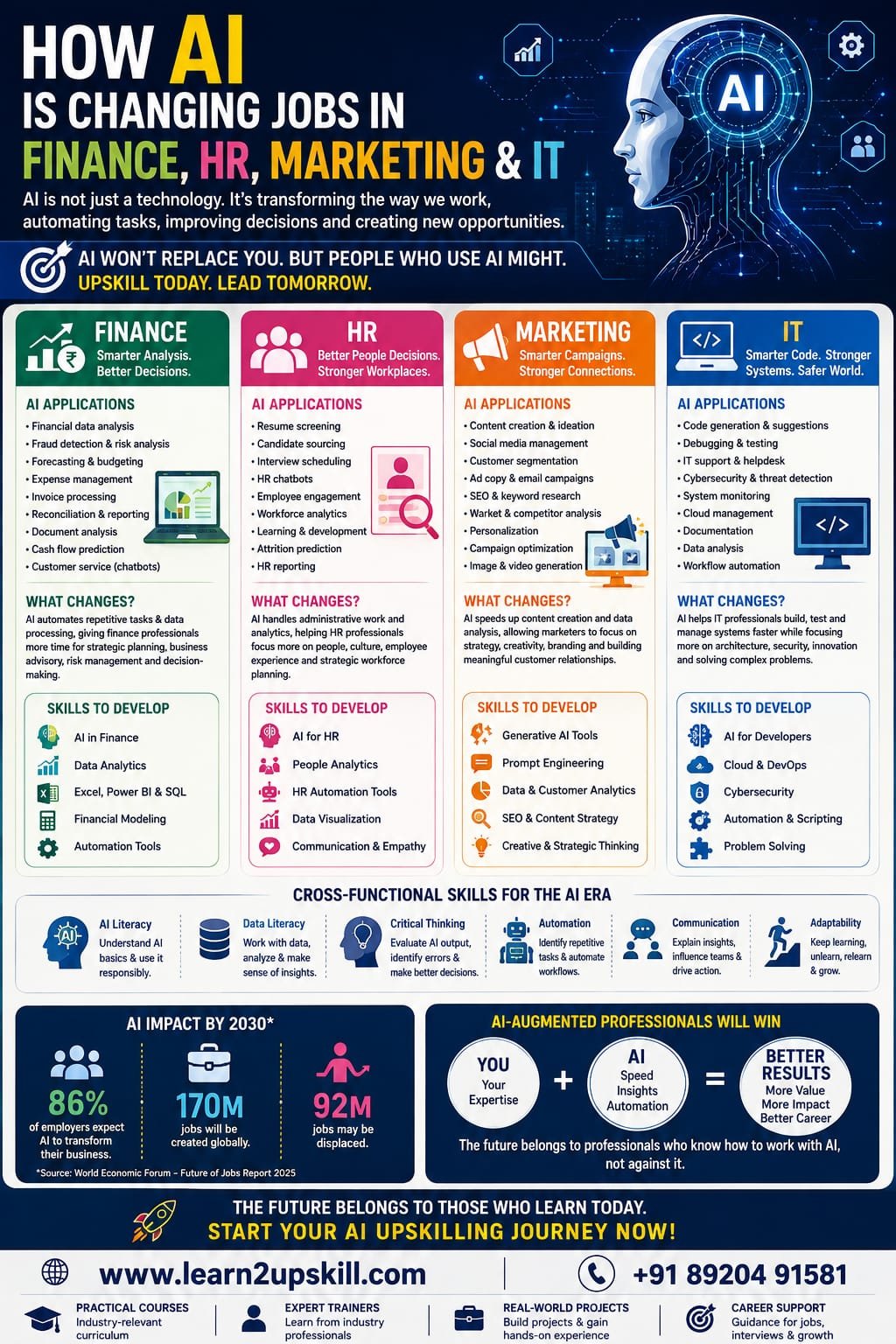
The World Economic Forum’s Future of Jobs Report 2025 found that 86% of surveyed employers expect AI and information-processing technologies to transform their businesses by 2030. The report also identifies AI and big data, networks and cybersecurity, and technological literacy among the fastest-growing skill areas.
The important question is therefore not:
“Will AI take my job?”
A better question is:
“How will AI change my job, and which skills should I develop?”
Let’s look at how AI is transforming four major professional areas: Finance, HR, Marketing and IT.
—
- How AI Is Changing Jobs in Finance
Finance is one of the industries where AI can have a significant impact because financial professionals work with large amounts of structured data, repetitive processes and analytical tasks.
The World Economic Forum reports particularly high expected AI exposure in financial services, with 97% of employers in the sector expecting AI to transform their business by 2030.
AI applications in finance
Finance teams can use AI for:
– Financial data analysis
– Expense categorization
– Fraud detection
– Risk analysis
– Forecasting
– Financial reporting
– Invoice processing
– Reconciliation support
– Document analysis
– Customer service
– Research and summarization
What changes for finance professionals?
Traditionally, finance employees may have spent significant time collecting information, preparing reports and performing repetitive calculations.
AI can increasingly assist with these activities.
This means finance professionals may have more time for:
– Financial planning
– Business advisory
– Strategic analysis
– Risk management
– Decision-making
– Scenario planning
– Communicating financial insights
Skills finance professionals should develop
Finance professionals should consider learning:
Finance + AI + Data Analytics + Excel/Power BI
This combination can help professionals move from purely transactional work toward more analytical and strategic responsibilities.
—
- How AI Is Changing Jobs in Human Resources
Human Resources is another field undergoing significant AI transformation.
HR teams manage large amounts of employee and candidate information, making many HR processes suitable for AI-assisted workflows.
AI applications in HR
AI can support:
– Resume screening
– Candidate sourcing
– Interview scheduling
– Employee communication
– HR chatbots
– Workforce analytics
– Employee engagement analysis
– Learning recommendations
– Job-description creation
– HR reporting
– Attrition analysis
– Workforce planning
Modern AI systems are also moving beyond basic HR chatbots toward decision-support applications that can help HR teams identify patterns in areas such as recruitment, employee retention and workforce planning.
Does AI replace HR professionals?
Not entirely.
HR involves highly human responsibilities such as:
– Employee relationships
– Conflict resolution
– Leadership
– Organizational culture
– Sensitive conversations
– Ethical decision-making
– Talent development
AI can provide information and recommendations, but organizations still need people to make responsible decisions.
The future HR professional
The HR professional of the future may need a combination of:
HR Expertise + AI Literacy + Data Analytics + Communication Skills
For example, instead of spending hours preparing a workforce report manually, an HR professional could use AI to analyze the information and then focus on interpreting the results and recommending actions to management.
—
- How AI Is Changing Jobs in Marketing
Marketing may be one of the most visible areas of AI adoption.
Generative AI can help marketing teams create content, analyze audiences and accelerate campaign development.
AI applications in marketing
Marketing professionals can use AI for:
– Blog outlines
– Social media content
– Email campaigns
– Market research
– Customer segmentation
– Ad copy
– SEO research
– Content personalization
– Competitor analysis
– Campaign analysis
– Image and video creation
– Customer sentiment analysis
AI can significantly reduce the time required to create initial drafts and analyze information.
But this does not mean marketers can simply let AI do everything.
The human role in AI-powered marketing
Human marketers still need to understand:
– Brand strategy
– Customer psychology
– Positioning
– Creativity
– Storytelling
– Market trends
– Business objectives
– Brand voice
– Ethical considerations
AI can generate ten marketing ideas in seconds.
The marketer still has to determine:
Which idea is actually worth using?
That is why creative thinking, strategic thinking and AI literacy are becoming an increasingly powerful combination.
—
- How AI Is Changing Jobs in IT
The IT industry is experiencing perhaps one of the most direct transformations from AI.
AI-assisted coding tools can help developers write, explain, test and debug code. AI can also assist IT teams with troubleshooting, documentation, cybersecurity and infrastructure management.
AI applications in IT
AI can support:
– Software development
– Code generation
– Code debugging
– Software testing
– Documentation
– IT support
– Cybersecurity monitoring
– Threat detection
– System troubleshooting
– Data analysis
– Cloud management
– Workflow automation
The World Economic Forum identifies AI and machine learning specialists, software developers and big data specialists among the fastest-growing technology-related roles through 2030.
Does AI make programmers unnecessary?
AI can automate parts of software development, but professional developers still need to understand:
– Software architecture
– Security
– Testing
– System design
– Business requirements
– Code quality
– Problem-solving
– Technical decision-making
The future may therefore favor developers who know how to work with AI coding tools rather than developers who ignore them.
—
- AI Is Automating Tasks—Not Simply Entire Jobs
One of the most important concepts to understand is the difference between job automation and task automation.
A job usually contains many different tasks.
AI may automate some of those tasks while leaving other responsibilities to humans.
For example:
Finance
AI: Data processing
Human: Financial decision-making
HR
AI: Resume screening
Human: Candidate evaluation and relationship building
Marketing
AI: Content drafts
Human: Strategy and creative direction
IT
AI: Code suggestions
Human: Architecture and technical decisions
This is why professionals should focus on understanding which parts of their work AI can improve.
The World Economic Forum expects both job creation and displacement from technological change, with its 2025 report projecting 170 million jobs created and 92 million displaced globally by 2030 across major macrotrends.
The takeaway isn’t that everyone should panic.
It is that skills are changing.
—
- The Rise of AI-Augmented Professionals
The future workplace is increasingly likely to include people working alongside AI systems.
Think of the difference between:
Employee → AI
and
Employee + AI → Better workflow
The second model is much more useful.
An AI-augmented finance professional may analyze larger datasets faster.
An AI-augmented HR professional may spend less time on administration.
An AI-augmented marketer may test more ideas.
An AI-augmented developer may build and test software more efficiently.
The value comes from combining human expertise with AI capabilities.
—
- Skills Professionals Need in the AI Era
Regardless of whether you work in Finance, HR, Marketing or IT, several skills are becoming increasingly important.
AI Literacy
Understand what AI can do, what it cannot do and how to use it responsibly.
Generative AI
Learn how to use AI tools for research, writing, analysis, productivity and problem-solving.
Prompt Engineering
Learn how to provide clear instructions and context to AI systems.
Data Literacy
Understand data, dashboards, analytics and how to interpret AI-generated insights.
Automation
Identify repetitive tasks and learn how AI and automation tools can improve workflows.
Critical Thinking
AI can make mistakes. Professionals must be able to evaluate AI-generated information.
Communication
People still need to explain recommendations, influence stakeholders and collaborate with teams.
Adaptability
AI tools will continue to change. Continuous learning will become increasingly important.
The World Economic Forum reports that, on average, 39% of workers’ existing skill sets are expected to be transformed or become outdated between 2025 and 2030.
—
- AI Skills by Profession
Here’s a simple roadmap.
Profession| AI Skills to Consider
Finance| AI analytics, Excel, Power BI, automation, forecasting
HR| AI recruitment, HR analytics, automation, workforce insights
Marketing| Generative AI, prompting, SEO, content automation, analytics
IT| AI coding, automation, cybersecurity, cloud, AI agents
Business| AI productivity, data analysis, automation, decision support
Students| AI literacy, prompting, research, communication, digital skills
The key is to avoid learning AI in isolation.
Instead, learn:
AI + Your Existing Profession
—
- Should Professionals Be Worried About AI?
Some concern is understandable.
AI will automate certain tasks, and some roles may change significantly.
The World Economic Forum reports that 41% of employers surveyed expect to reduce their workforce in areas where AI can automate tasks, while 77% plan to upskill workers in response to AI adoption.
This shows why upskilling is so important.
Instead of asking:
«”How do I protect my job from AI?”»
Ask:
«”How can I become the person in my organization who knows how to use AI effectively?”»
That shift in mindset can change your career strategy.
—
- How to Prepare for an AI-Powered Workplace
You don’t need to become an AI engineer overnight.
Start with a practical approach.
Step 1: Learn AI Fundamentals
Understand:
– Artificial intelligence
– Machine learning
– Generative AI
– Large language models
– AI agents
– Automation
Step 2: Learn AI Tools Relevant to Your Job
A finance professional does not need exactly the same tools as a marketer or developer.
Focus on tools that solve problems in your profession.
Step 3: Identify Repetitive Tasks
Make a list of tasks you perform repeatedly.
Then ask:
Can AI help me complete this faster?
Step 4: Build Practical Projects
Don’t only watch tutorials.
Create real examples such as:
– AI-powered financial report
– Automated HR workflow
– AI marketing campaign
– Data-analysis dashboard
– AI-assisted software project
Step 5: Develop Human Skills
Strengthen:
– Communication
– Leadership
– Critical thinking
– Creativity
– Problem-solving
– Collaboration
Step 6: Keep Learning
AI is evolving rapidly.
Your learning journey should evolve with it.
—
- The Future Belongs to AI-Ready Professionals
AI is not transforming only technology departments.
It is changing the entire organization.
Finance professionals need AI and analytics.
HR professionals need AI and people skills.
Marketers need AI and creativity.
IT professionals need AI and technical expertise.
This leads to one simple formula:
«AI Skills + Domain Expertise + Human Skills = Future-Ready Professional»
The most successful professionals may not necessarily be those who know every AI tool.
They will be the people who know how to use AI to solve meaningful business problems.
—
Conclusion
AI is changing jobs in Finance, HR, Marketing and IT, but the transformation is more complex than simply replacing people with machines.
AI can automate repetitive activities, accelerate analysis, support decision-making and increase productivity. At the same time, organizations still need human judgment, creativity, communication, leadership and domain expertise.
The World Economic Forum’s research makes one thing particularly clear: technology is reshaping both jobs and skills, while employers are responding through a combination of workforce transformation and upskilling.
The professionals who prepare now can be better positioned for the changing workplace.
Don’t wait for AI to change your job. Learn how to change your job with AI.
—
Learn2Upskill: Prepare for the Future of Work
The workplace is changing—and upskilling is becoming a career advantage.
Learn practical skills in AI, Generative AI, automation, data, Excel, business, cybersecurity and other future-focused areas through Learn2Upskill.
🌐 www.coral-kudu-326218.hostingersite.com
Learn. Upskill. Grow.
—
Leave a Reply