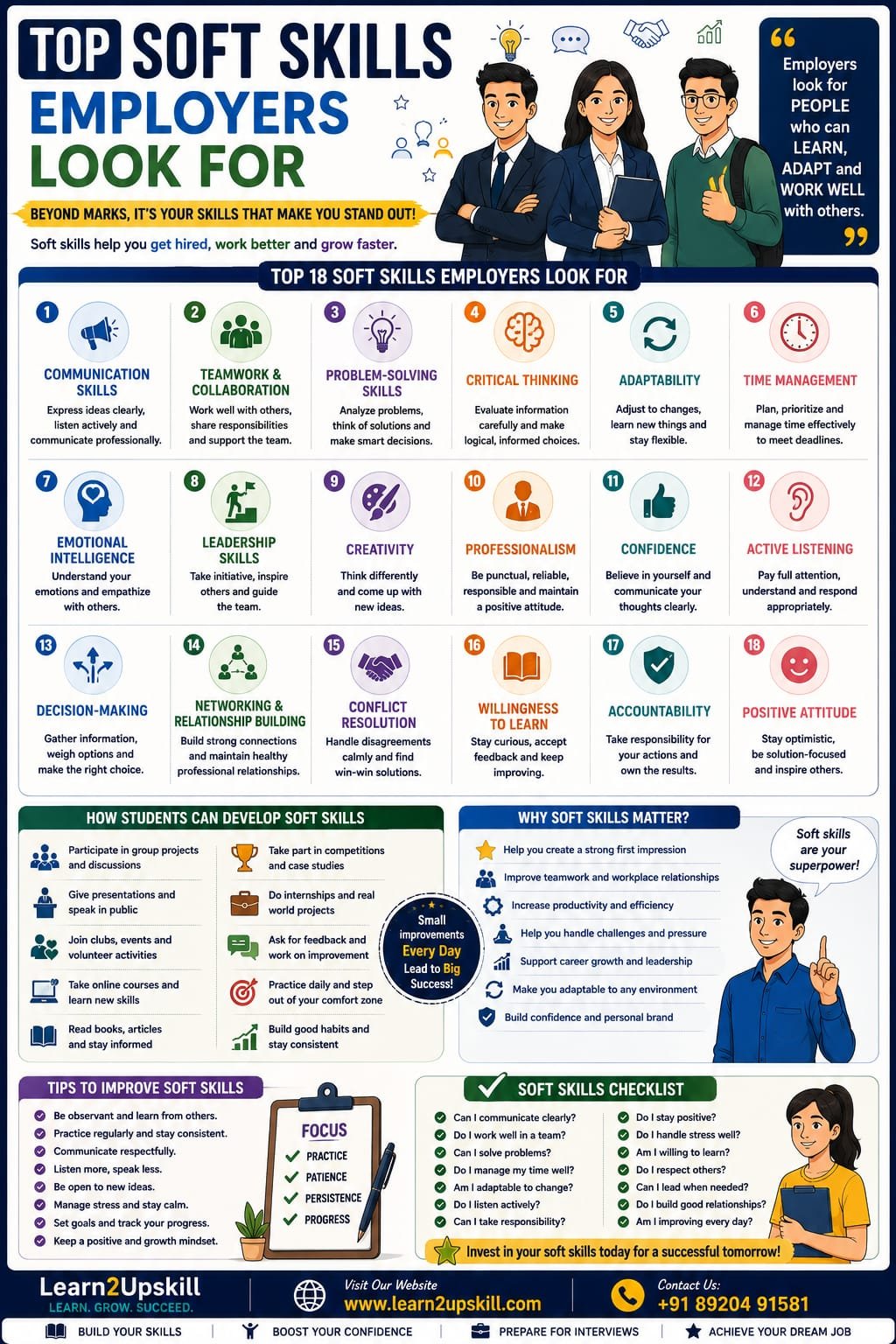
Top Soft Skills Employers Look For in 2026
Introduction
Getting a job is no longer only about having good academic qualifications or technical knowledge. Employers increasingly look for candidates who can communicate effectively, work with others, solve problems, adapt to change, and handle professional situations confidently.
These qualities are known as soft skills.
Soft skills are especially important for students and freshers because they help bridge the gap between academic learning and the workplace. A candidate may have excellent technical knowledge, but the ability to communicate ideas, collaborate with colleagues, manage time, and respond positively to challenges can make a significant difference in career growth.
The good news is that soft skills can be developed through practice and real-life experience.
At Learn2Upskill, we help students and job seekers develop communication, personality, professional grooming, interview skills, and other workplace-ready abilities.
What Are Soft Skills?
Soft skills are personal, interpersonal, and professional abilities that influence how you interact with people and handle different situations.
Unlike technical skills, which are usually related to a particular job or profession, soft skills are useful across almost every career.
Examples include:
Communication
Teamwork
Leadership
Problem-solving
Adaptability
Time management
Critical thinking
Emotional intelligence
Creativity
Professionalism
A successful professional usually needs a combination of technical skills and soft skills.
Why Are Soft Skills Important?
Employers want people who can not only perform their job responsibilities but also work effectively with others.
Strong soft skills can help you:
Perform better in interviews.
Build professional relationships.
Work effectively in teams.
Handle workplace challenges.
Communicate with clients and colleagues.
Manage deadlines.
Adapt to changing situations.
Take responsibility.
Grow into leadership roles.
For students, developing these skills early can provide a significant advantage when entering the workplace.
- Communication Skills
Communication is one of the most important soft skills employers look for.
It includes:
Speaking clearly
Writing professionally
Listening actively
Explaining ideas
Asking appropriate questions
Communicating respectfully
Good communication does not mean speaking continuously. It means expressing your thoughts clearly while also understanding what others are saying.
How Students Can Improve
Read regularly.
Practice speaking.
Participate in Group Discussions.
Give presentations.
Improve vocabulary.
Practice professional writing.
Listen carefully during conversations.
- Teamwork and Collaboration
Most jobs require employees to work with other people.
Employers value candidates who can:
Share responsibilities.
Respect different opinions.
Help teammates.
Communicate effectively.
Handle disagreements professionally.
Work toward a common goal.
How to Develop Teamwork
Participate in:
Group projects
College clubs
Sports
Volunteer activities
Student events
Team competitions
These experiences can teach you how to cooperate with different personalities.
- Problem-Solving Skills
Workplaces frequently involve unexpected problems.
Employers appreciate candidates who don’t immediately give up when something goes wrong.
Strong problem-solvers can:
Understand the problem.
Identify possible causes.
Think of different solutions.
Evaluate the options.
Choose an appropriate solution.
Learn from the outcome.
How to Improve
Practice puzzles, case studies, real-world scenarios, coding challenges, business problems, and analytical exercises.
- Critical Thinking
Critical thinking means analyzing information carefully instead of accepting everything immediately.
It involves:
Asking questions.
Checking facts.
Comparing options.
Identifying assumptions.
Understanding different perspectives.
Making logical conclusions.
Critical thinking is useful in almost every profession.
How Students Can Practice
When reading an article or watching a discussion, ask:
What is the main argument?
What evidence supports it?
Are there other possible viewpoints?
This simple habit can strengthen analytical thinking.
- Adaptability
The workplace is constantly changing.
New technologies, tools, processes, and responsibilities can appear quickly. Employers therefore value people who can adapt.
An adaptable employee is willing to:
Learn new skills.
Accept new responsibilities.
Adjust to changing priorities.
Learn from mistakes.
Work with different people.
Try new approaches.
How to Develop Adaptability
Don’t avoid unfamiliar situations. Treat them as opportunities to learn.
Take new courses, try different projects, learn new software, and step outside your comfort zone.
- Time Management
Employees often have multiple tasks and deadlines.
Time management helps you:
Prioritize important tasks.
Meet deadlines.
Avoid last-minute stress.
Organize your workload.
Maintain productivity.
Simple Time Management Techniques
Try:
Daily to-do lists
Weekly planning
Calendar reminders
Task prioritization
Time blocking
Breaking large tasks into smaller steps
Good time management is a habit, not a one-time technique.
- Emotional Intelligence
Emotional intelligence is the ability to understand and manage your own emotions while recognizing and responding appropriately to the emotions of others.
It includes:
Self-awareness
Self-control
Empathy
Social awareness
Relationship management
Emotional intelligence can help you handle disagreements, feedback, stressful situations, and teamwork more effectively.
- Leadership Skills
Leadership is not limited to managers.
Even students and freshers can demonstrate leadership by:
Taking initiative.
Accepting responsibility.
Helping teammates.
Organizing activities.
Making decisions.
Supporting others.
Taking ownership of tasks.
You don’t need a job title to demonstrate leadership.
- Creativity
Creativity is the ability to think of new ideas and different approaches to problems.
It is valuable not only in design or media but also in:
Marketing
Business
Technology
Education
Management
Product development
Problem-solving
How to Develop Creativity
Try:
Brainstorming.
Creative writing.
Designing projects.
Exploring new hobbies.
Finding multiple solutions to one problem.
Don’t always look for the first answer. Ask yourself:
“Is there another way to do this?”
- Professionalism
Professionalism is reflected in how you behave and take responsibility at work.
It includes:
Punctuality
Respect
Reliability
Appropriate communication
Professional appearance
Accountability
Positive attitude
A professional employee understands that small behaviors can affect the entire team.
- Confidence
Confidence helps you communicate your abilities effectively.
Employers often look for candidates who can:
Express their ideas.
Ask questions.
Participate in discussions.
Present information.
Handle interviews.
Accept responsibility.
However, confidence is different from overconfidence.
Confidence says: “I can learn and contribute.”
Overconfidence says: “I already know everything.”
Stay confident while remaining open to learning.
- Active Listening
Listening is often overlooked when people discuss communication.
Active listening means paying attention to what someone is saying instead of simply waiting for your turn to speak.
It involves:
Maintaining attention.
Avoiding unnecessary interruptions.
Asking relevant questions.
Clarifying doubts.
Remembering important information.
Good listeners often become better communicators and team members.
- Decision-Making
Employees regularly need to make decisions.
Good decision-making involves:
Understanding the situation.
Gathering relevant information.
Considering alternatives.
Evaluating risks.
Making a decision.
Taking responsibility for the outcome.
Students can develop decision-making through projects, leadership activities, competitions, and real-life responsibilities.
- Networking and Relationship-Building
Career opportunities often come through professional relationships.
Networking means building genuine connections with:
Teachers
Mentors
Classmates
Alumni
Industry professionals
Colleagues
Students can begin networking by attending workshops, career events, seminars, internships, and professional events.
Remember: networking is not simply asking people for jobs. It is about building meaningful professional relationships.
- Conflict Resolution
Differences of opinion are normal in workplaces.
Employers value people who can handle disagreements professionally.
Good conflict-resolution skills involve:
Listening to both sides.
Remaining calm.
Avoiding personal attacks.
Understanding the actual issue.
Finding common ground.
Looking for practical solutions.
The goal should be to solve the problem, not to “win” the argument.
- Willingness to Learn
One of the most valuable qualities for students and freshers is a willingness to learn.
No graduate knows everything when they enter their first job.
Employers appreciate candidates who:
Ask questions.
Accept feedback.
Learn from mistakes.
Take training seriously.
Stay curious.
Keep developing their skills.
A learning mindset can help you grow throughout your career.
- Accountability
Accountability means taking responsibility for your actions and results.
An accountable person:
Completes assigned tasks.
Accepts mistakes.
Doesn’t constantly blame others.
Communicates problems early.
Takes corrective action.
Learns from experience.
Employers value people they can trust with responsibility.
- Positive Attitude
A positive attitude does not mean pretending that every situation is perfect.
It means approaching challenges constructively.
For example, instead of saying:
“I can’t do this.”
Try:
“I haven’t done this before, but I’ll learn how to do it.”
A positive and realistic mindset can help you handle workplace challenges more effectively.
Soft Skills vs. Technical Skills
Both are important.
Technical Skills
Soft Skills
Excel
Communication
Coding
Teamwork
Data Analytics
Problem-solving
SEO
Adaptability
Programming
Leadership
Accounting
Time Management
Graphic Design
Emotional Intelligence
Technical skills may help you qualify for a job, while soft skills can influence how effectively you perform, collaborate, and grow in that role.
How Students Can Build Soft Skills
You don’t need to wait until you get a job.
Start developing soft skills during school or college.
Participate in Group Projects
Learn teamwork and communication.
Give Presentations
Build confidence and public-speaking skills.
Join Clubs
Develop leadership and collaboration.
Volunteer
Build responsibility and interpersonal skills.
Take Online Courses
Learn structured approaches to communication, productivity, and professional development.
Participate in Competitions
Develop problem-solving and decision-making abilities.
Take Internships
Gain practical workplace experience.
How to Demonstrate Soft Skills in an Interview
Don’t simply tell recruiters:
“I have excellent leadership skills.”
Give an example.
Instead, say:
“During my college event, I coordinated a team of five students, divided responsibilities, and helped ensure that the event was completed on schedule.”
Examples provide evidence of your skills.
A useful approach is:
Situation → Action → Result
Explain:
What was the situation?
What did you do?
What happened as a result?
Soft Skills Employers Look for During Interviews
Recruiters may evaluate your soft skills through:
Your communication.
Body language.
Answers to behavioral questions.
Group Discussions.
Case studies.
Situational questions.
Questions about teamwork.
Questions about challenges and failures.
Your behavior throughout the selection process can demonstrate your soft skills.
A 30-Day Soft Skills Development Plan
Week 1: Communication
Read for 20 minutes daily.
Practice speaking for 10 minutes.
Learn new professional vocabulary.
Record yourself answering interview questions.
Week 2: Confidence and Teamwork
Participate in a Group Discussion.
Give a short presentation.
Join a team activity.
Practice active listening.
Week 3: Problem-Solving and Leadership
Solve practical problems.
Take responsibility for a small project.
Organize an activity.
Practice making decisions.
Week 4: Professional Skills
Practice mock interviews.
Improve your resume.
Work on professional etiquette.
Ask someone for feedback.
Review your progress.
Small improvements every day can create significant changes over time.
Soft Skills Checklist for Students
Before entering the workplace, ask yourself:
✔ Can I communicate my ideas clearly?
✔ Can I listen without interrupting?
✔ Can I work effectively in a team?
✔ Can I manage deadlines?
✔ Can I solve problems independently?
✔ Can I accept constructive feedback?
✔ Can I adapt to change?
✔ Can I handle disagreements professionally?
✔ Can I take responsibility for mistakes?
✔ Am I willing to keep learning?
If some answers are “no,” don’t worry. These are skills you can develop.
Conclusion
The modern workplace requires more than academic qualifications. Employers look for people who can communicate, collaborate, solve problems, adapt, learn, and take responsibility.
Soft skills are not something you either have or don’t have. They can be developed through practice, experience, feedback, and continuous learning.
For students and freshers, the best time to start developing these skills is now. Participate in activities, take on responsibilities, practice communication, learn from mistakes, and actively seek opportunities to grow.
Your technical knowledge may help you get noticed, but strong soft skills can help you work effectively, build relationships, and grow throughout your career.
At Learn2Upskill, we help students and job seekers become career-ready through communication skills, personality development, interview preparation, professional grooming, career counselling, and practical skill-development programs.
Contact Learn2Upskill
Website: www.coral-kudu-326218.hostingersite.com
Contact Us: +91-89204 91581
Learn2Upskill – Learn. Grow. Succeed.
Leave a Reply