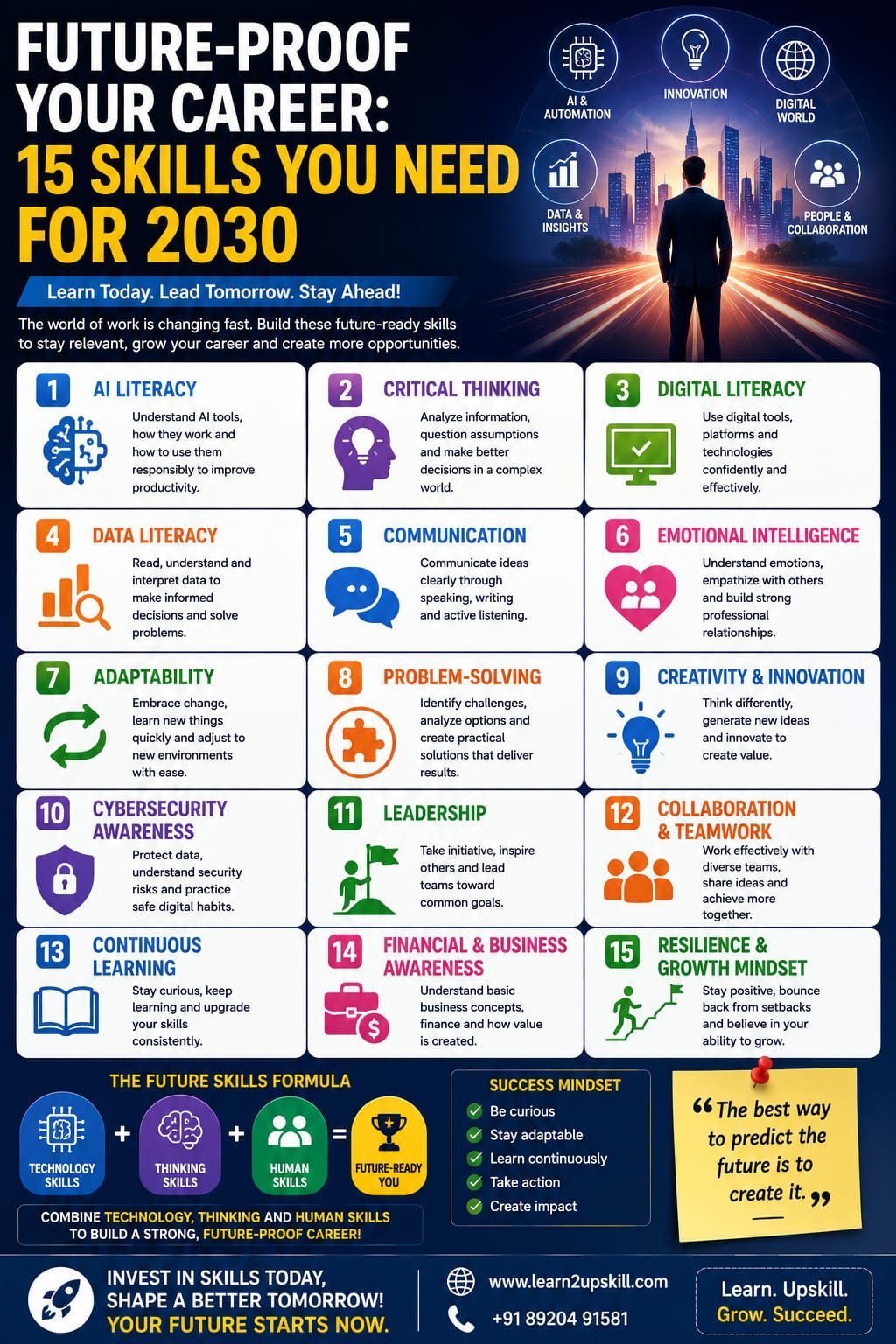
Future-Proof Your Career: 15 Skills You Need for 2030
Description: Discover the 15 essential skills you need for 2030 to future-proof your career. Learn about AI, digital literacy, communication, critical thinking, leadership and other future-ready skills.
Suggested URL Slug:
“/future-proof-your-career-skills-you-need-2030/”
—
Future-Proof Your Career: 15 Skills You Need for 2030
The world of work is changing faster than ever.
Artificial Intelligence is transforming industries.
Automation is changing job responsibilities.
New technologies are creating entirely new career opportunities.
At the same time, many traditional skills are evolving.
This creates an important question for students and professionals:
«Are your current skills preparing you for the future—or only helping you succeed today?»
The truth is that no one can predict every job that will exist in 2030.
However, we can prepare for the direction in which the workplace is moving.
The professionals who will remain valuable are unlikely to be those who simply learn one skill and stop.
They will be the people who can:
– Learn continuously
– Adapt to change
– Work with technology
– Think critically
– Communicate effectively
– Solve complex problems
Future-proofing your career does not mean guaranteeing that your job will never change.
It means developing the ability to adapt when change happens.
This article explores 15 essential skills you should develop for 2030 to build a stronger, more future-ready career.
—
What Does It Mean to Future-Proof Your Career?
Future-proofing your career means preparing yourself for changes in:
– Technology
– Jobs
– Industries
– Business models
– Workplace expectations
It means becoming someone who can learn new skills when required.
Instead of saying:
«”I already know enough.”»
A future-ready professional says:
«”What do I need to learn next?”»
This mindset may be one of the most valuable career advantages of the future.
—
Why Skills Will Matter More Than Ever
In the past, people often learned a profession and followed a relatively predictable career path.
Today, careers can change much faster.
New technologies can:
– Create new jobs
– Change existing jobs
– Automate repetitive tasks
– Increase demand for new skills
This means education and learning should not end after school or college.
The future workplace will increasingly reward:
«Continuous Learning + Adaptability + Practical Skills»
—
- Artificial Intelligence (AI) Literacy 🤖
AI literacy will be one of the most important future skills.
You don’t necessarily need to become an AI engineer.
But professionals in many industries should understand:
– What AI can do
– What AI cannot do
– How to use AI tools responsibly
– How to write effective prompts
– How to verify AI-generated information
AI literacy can help professionals work more efficiently.
However, responsible use is essential.
The goal should be:
«Use AI to improve your work—not to stop thinking.»
—
- Critical Thinking 🧠
As AI generates more information, the ability to evaluate information becomes increasingly valuable.
Critical thinkers ask:
– Is this accurate?
– What evidence supports this?
– What assumptions are being made?
– What information is missing?
– Are there alternative explanations?
AI may provide answers quickly.
Critical thinking helps you decide whether those answers should be trusted.
—
- Digital Literacy 💻
Digital literacy is no longer optional in most careers.
Future professionals should be comfortable using:
– Digital collaboration tools
– Cloud platforms
– Productivity software
– Online communication systems
– Data and information tools
You don’t need to master every technology.
But you should be comfortable learning new digital tools.
—
- Data Literacy 📊
Organizations increasingly use data to make decisions.
Professionals who can understand basic data concepts may have a significant advantage.
Data literacy includes:
– Understanding charts
– Reading reports
– Identifying trends
– Asking questions about data
– Making informed decisions
You don’t have to become a data scientist.
But understanding data can make you a better professional in almost any field.
—
- Communication Skills 💬
Technology is changing—but communication remains essential.
Future professionals will need to:
– Explain ideas
– Write professionally
– Present information
– Collaborate with teams
– Communicate with clients
The ability to explain complex ideas simply will become especially valuable.
Remember:
«Having a great idea is important. Being able to communicate it is equally important.»
—
- Emotional Intelligence ❤️
Technology can process information.
But workplaces are still made of people.
Emotional intelligence includes:
– Self-awareness
– Empathy
– Understanding emotions
– Managing reactions
– Building relationships
Professionals with emotional intelligence can often communicate and collaborate more effectively.
—
- Adaptability 🔄
One of the biggest future skills is the ability to adapt.
New tools.
New responsibilities.
New industries.
New ways of working.
Instead of fearing every change, future-ready professionals learn how to respond.
Adaptability means:
– Being open to learning
– Trying new approaches
– Recovering from setbacks
– Adjusting to change
The future may belong less to those who know everything and more to those who can learn anything necessary.
—
- Problem-Solving 🔍
AI can suggest solutions.
But humans are often responsible for identifying the right problem.
Strong problem-solvers can:
– Understand challenges
– Analyze causes
– Explore options
– Evaluate solutions
– Take appropriate action
Problem-solving becomes especially valuable when situations are complex and unclear.
—
- Creativity and Innovation 💡
AI can generate ideas quickly.
But human creativity remains important.
Creativity is not limited to artists or designers.
Professionals use creativity to:
– Solve problems
– Improve processes
– Develop strategies
– Create new ideas
The ability to think differently can create new opportunities.
—
- Cybersecurity Awareness 🔐
As work becomes increasingly digital, cybersecurity awareness is essential.
Every employee should understand basic practices such as:
– Recognizing phishing attempts
– Protecting passwords
– Handling information responsibly
– Avoiding suspicious links
Cybersecurity is no longer only the responsibility of IT teams.
Human mistakes can create major security risks.
—
- Leadership Skills 👥
Leadership is not only for managers.
Leadership skills can include:
– Taking responsibility
– Making decisions
– Supporting others
– Communicating clearly
– Solving problems
Future organizations will need people who can take initiative.
You can develop leadership skills at any stage of your career.
—
- Collaboration and Teamwork 🤝
The future of work will continue to involve collaboration.
Teams may include:
– Employees
– Remote workers
– International colleagues
– Technology specialists
– AI systems
Successful professionals will need to work effectively with people from different backgrounds and disciplines.
Good collaboration requires:
– Respect
– Communication
– Listening
– Accountability
—
- Continuous Learning 📚
Perhaps the most important future skill is the ability to keep learning.
The half-life of skills is becoming shorter in many industries.
This means you should regularly ask:
«What skills will I need next?»
Continuous learners:
– Take courses
– Read
– Practice
– Follow industry developments
– Learn from experience
Your ability to learn may become more valuable than any single skill you currently have.
—
- Financial and Business Awareness 💼
Even professionals outside finance can benefit from understanding basic business concepts.
Future-ready professionals should understand:
– Revenue
– Costs
– Profit
– Customers
– Business goals
Understanding how your organization creates value can help you make better decisions.
—
- Resilience and Growth Mindset 🌱
Careers involve challenges.
You may experience:
– Rejections
– Failed projects
– Job changes
– Career transitions
Resilience helps you recover and continue.
A growth mindset encourages you to see challenges as opportunities to learn.
Instead of saying:
«”I can’t do this.”»
Try:
«”I can’t do this yet.”»
That small word can change your approach to learning.
—
The Future Skills Formula
The strongest professionals of 2030 may combine three categories of skills:
🤖 Technology Skills
– AI literacy
– Digital literacy
– Data literacy
– Cybersecurity awareness
🧠 Thinking Skills
– Critical thinking
– Problem-solving
– Creativity
🤝 Human Skills
– Communication
– Emotional intelligence
– Leadership
– Collaboration
Together:
«Technology + Thinking + Human Skills = Future-Ready Professional»
—
Which Skills Should Students Focus On First?
Students may feel overwhelmed by a list of 15 skills.
You don’t need to learn everything at once.
Start with a strong foundation.
Focus first on:
- Communication
- Digital Literacy
- Critical Thinking
- AI Literacy
- Problem-Solving
Then continue building specialized skills related to your career.
—
Which Skills Should Working Professionals Focus On?
Working professionals should begin by asking:
«Which parts of my job are changing?»
Then identify:
– Skills becoming more important
– Technologies affecting your industry
– Skills your organization needs
A good approach is to combine:
Your Current Professional Expertise
with
Future-Focused Skills
For example:
Finance + AI + Data Skills
Marketing + Analytics + AI
HR + Digital Tools + Communication
Business + Data + Leadership
—
How to Build Future-Ready Skills
Step 1: Identify Your Career Goal
Where do you want to be in the future?
—
Step 2: Identify Skill Gaps
What skills do you currently lack?
—
Step 3: Create a Learning Plan
Choose one or two skills at a time.
—
Step 4: Learn Through Practice
Don’t only watch videos.
Apply what you learn.
—
Step 5: Build Projects
Projects demonstrate practical skills.
—
Step 6: Keep Updating Your Knowledge
Make learning a regular habit.
—
A Simple 12-Month Future Skills Plan
You can create a personal learning journey.
Months 1–2
Improve communication and digital skills.
Months 3–4
Learn AI tools relevant to your career.
Months 5–6
Develop data literacy and analytical thinking.
Months 7–8
Work on a practical project.
Months 9–10
Develop leadership and collaboration skills.
Months 11–12
Review your progress and identify the next skills to learn.
The goal is not to learn everything.
The goal is to keep moving forward.
—
Common Mistakes to Avoid
❌ Learning Only One Skill
Career growth often requires a combination of skills.
—
❌ Ignoring Technology
Even non-technical professionals need digital awareness.
—
❌ Learning Without Practicing
Knowledge becomes valuable when you can apply it.
—
❌ Collecting Certificates Without Building Skills
Certificates can be useful—but practical ability matters.
—
❌ Waiting Until Your Job Changes
Start preparing before you are forced to change.
—
❌ Ignoring Human Skills
Technology is important, but communication and collaboration remain essential.
—
Frequently Asked Questions
What are the most important skills for 2030?
Important future skills include AI literacy, critical thinking, digital literacy, data literacy, communication, emotional intelligence, adaptability and problem-solving.
How can I future-proof my career?
Focus on continuous learning, develop digital and AI skills, strengthen human skills and stay informed about changes in your industry.
Will AI replace jobs by 2030?
AI is expected to change many jobs and automate some tasks, while also creating new roles and changing skill requirements. The best strategy is to develop the ability to work effectively alongside new technologies.
Is communication still important in the future?
Yes. Communication remains important because professionals need to collaborate, explain ideas and build relationships.
Should I learn AI even if I am not in a technical career?
Basic AI literacy can be useful across many professions. The specific tools and knowledge you need will depend on your career.
—
Conclusion
Nobody knows exactly what the workplace will look like in 2030.
But one thing is clear:
Change will continue.
The best way to prepare is not to predict every future job.
It is to become adaptable enough to learn and grow with change.
Develop your:
🤖 Technology Skills
🧠 Thinking Skills
🤝 Human Skills
And most importantly:
📚 Never stop learning.
Your future career may require skills you haven’t even heard of yet.
But if you know how to learn, adapt, communicate and solve problems, you will be better prepared for whatever comes next.
Remember:
«Don’t prepare for one job. Prepare for a future of continuous change and opportunity.»
—
🚀 Future-Proof Your Career With Learn2Upskill
The future belongs to people who are ready to learn, adapt and grow.
Build practical, career-focused skills in:
– Artificial Intelligence
– Data and Analytics
– Digital Skills
– Communication
– Leadership
– Business
– Professional Development
with Learn2Upskill.
🌐 www.coral-kudu-326218.hostingersite.com
📞 Contact Us: +91 89204 91581
Learn. Upskill. Grow. Succeed.
—
Leave a Reply