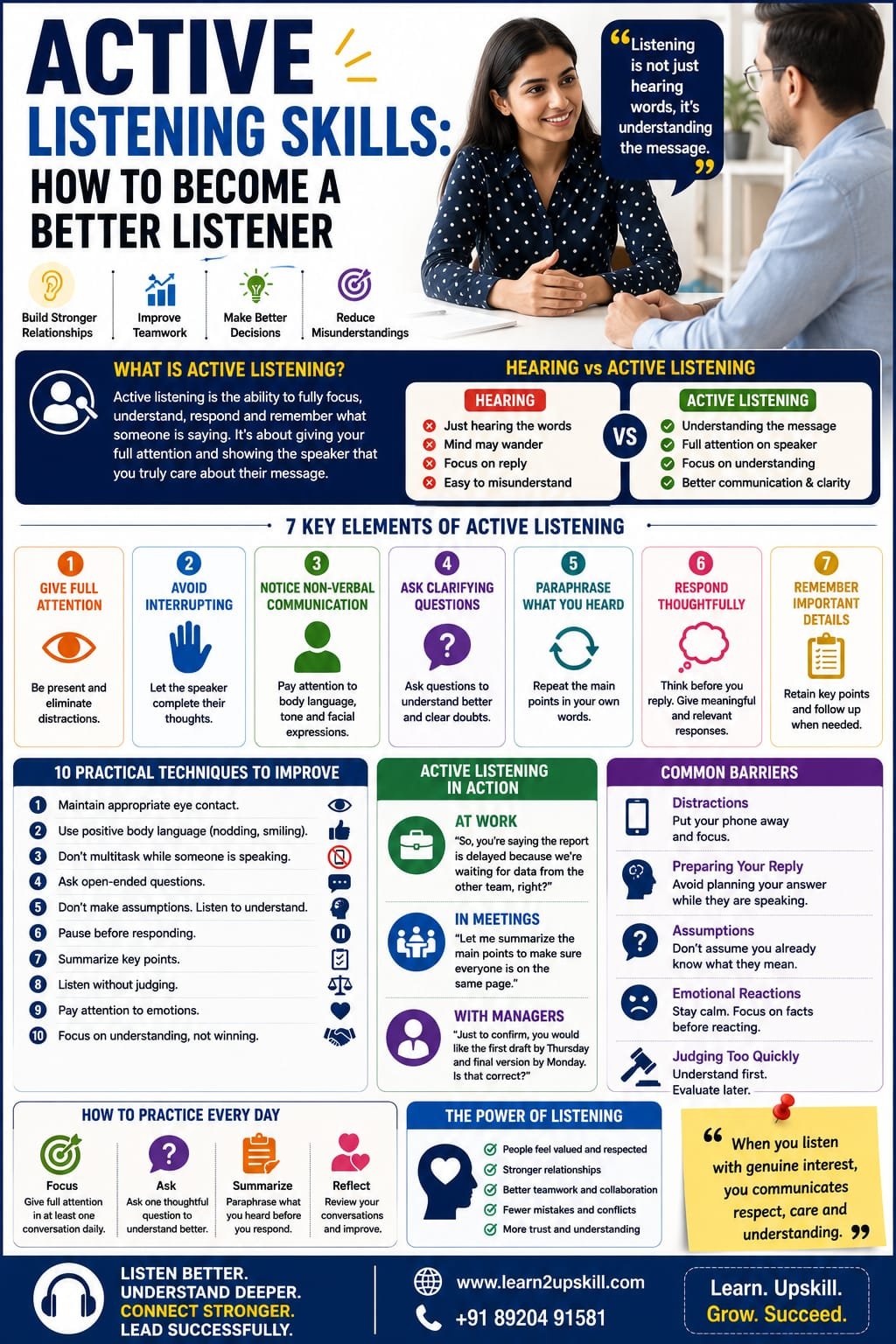
Active Listening Skills: How to Become a Better Listener
Learn what active listening is and how to become a better listener. Discover essential active listening skills, practical techniques, examples and tips to improve communication at work and in everyday life.
Suggested URL Slug:
“/active-listening-skills-how-to-become-a-better-listener/”
—
Active Listening Skills: How to Become a Better Listener
When people think about communication skills, they often think about speaking.
They focus on:
– Speaking confidently
– Giving presentations
– Explaining ideas
– Improving vocabulary
But there is another communication skill that is equally important—and often overlooked:
«Listening.»
The ability to listen effectively can improve your relationships, workplace performance, teamwork and communication skills.
Unfortunately, hearing and listening are not the same thing.
You may hear someone speaking while your mind is thinking about something completely different.
You may hear the words but fail to understand the real message.
That is where active listening becomes important.
Active listening means giving your full attention to the speaker, understanding their message and responding thoughtfully.
It is not simply waiting for your turn to speak.
It is about genuinely trying to understand.
In this guide, you will learn what active listening is, why it matters and how you can become a better listener in both your professional and personal life.
—
What Is Active Listening?
Active listening is the process of fully concentrating on what someone is saying and making an effort to understand their message.
A good listener does not simply hear words.
They pay attention to:
– The message
– The speaker’s tone
– Important details
– Emotions
– Context
Active listening also involves responding in a way that shows the speaker that you understand them.
For example, instead of immediately giving your opinion, you might say:
«So, if I understand correctly, the main problem is the deadline. Is that right?»
This shows that you are paying attention and checking your understanding.
—
Hearing vs Active Listening: What’s the Difference?
Hearing
Hearing is a physical process.
Your ears receive sound.
You may hear someone talking without paying attention.
Active Listening
Active listening requires mental effort.
You focus on the speaker and try to understand the message.
Hearing:
«I heard the words.»
Active Listening:
«I understood what the person meant.»
This difference is extremely important in professional communication.
—
Why Are Active Listening Skills Important?
Strong listening skills can help you:
🤝 Build Better Relationships
People feel valued when they feel heard.
💼 Perform Better at Work
Listening carefully helps you understand instructions and expectations.
👥 Improve Teamwork
Good listeners understand different perspectives.
🧠 Make Better Decisions
You can make better decisions when you understand all relevant information.
⚠️ Reduce Misunderstandings
Listening carefully can prevent costly mistakes.
❤️ Improve Emotional Intelligence
Listening helps you understand other people’s thoughts and emotions.
In many situations, communication problems happen not because people cannot speak clearly—but because someone did not listen carefully.
—
The 7 Key Elements of Active Listening
To become a better listener, focus on these important elements.
—
- Give Your Full Attention
One of the most important rules of active listening is simple:
«Be present.»
When someone is speaking, avoid distractions.
This means:
– Don’t constantly check your phone.
– Don’t look around the room.
– Don’t work on something else.
– Don’t prepare your response while they are still speaking.
Giving attention communicates respect.
—
- Avoid Interrupting
Interrupting can make people feel ignored.
Sometimes we interrupt because:
– We are excited to share an idea.
– We think we already know the answer.
– We disagree.
– We want to finish the person’s sentence.
Try to allow the speaker to complete their thoughts.
Pause before responding.
You may discover that the person has more important information to share.
—
- Pay Attention to Non-Verbal Communication
Communication is not only about words.
Pay attention to:
– Facial expressions
– Tone of voice
– Body language
For example, someone might say:
«”Everything is fine.”»
But their tone and body language may suggest that something is wrong.
Active listening involves understanding both verbal and non-verbal communication.
—
- Ask Clarifying Questions
Good listeners do not pretend to understand something they don’t understand.
They ask questions.
For example:
«Could you explain what you mean by that?»
«Can you give me an example?»
«Just to confirm, is the deadline Friday?»
Clarifying questions can prevent misunderstandings.
—
- Paraphrase What You Heard
Paraphrasing means repeating the main idea in your own words.
For example:
«So, you’re saying that the customer is unhappy because the delivery was delayed.»
The speaker can then confirm or correct your understanding.
This is especially useful in:
– Meetings
– Team discussions
– Client conversations
– Problem-solving situations
—
- Respond Thoughtfully
Don’t rush to give advice.
Sometimes people simply want to be understood.
Before responding, ask yourself:
«What is the most helpful response right now?»
A thoughtful response is often more valuable than a quick response.
—
- Remember Important Details
Active listening includes remembering important information.
If your manager explains a task, take notes.
If a client shares a concern, remember the important details.
Remembering information demonstrates attention and professionalism.
—
10 Active Listening Techniques You Can Practice
Here are practical techniques to improve your listening skills.
- Maintain Appropriate Eye Contact
Natural eye contact shows attention.
Avoid staring, but don’t constantly look away.
—
- Use Positive Body Language
Simple actions can show that you are engaged.
Examples include:
– Nodding naturally
– Maintaining good posture
– Facing the speaker
—
- Don’t Multitask
You cannot fully listen while focusing on five other things.
Give important conversations your attention.
—
- Ask Open-Ended Questions
Instead of asking questions that require only “yes” or “no,” try asking:
«What happened after that?»
«How do you think we should approach this problem?»
Open-ended questions encourage meaningful conversation.
—
- Don’t Make Assumptions
Listen to the complete message before deciding what the speaker means.
—
- Pause Before Responding
A short pause gives you time to think.
You don’t need to answer immediately.
—
- Summarize Important Points
At the end of a discussion, summarize:
«So, we agreed on these three next steps…»
This helps everyone remain aligned.
—
- Listen Without Immediately Judging
Try to understand before deciding whether you agree.
You can disagree respectfully after listening.
—
- Pay Attention to Emotions
Sometimes the emotional message is as important as the factual message.
—
- Focus on Understanding, Not Winning
Communication is not always a competition.
The goal should often be understanding and solving problems.
—
Active Listening in the Workplace
Active listening can make you a stronger professional.
Imagine your manager gives you instructions for a project.
A poor listener might:
– Assume they understand everything.
– Forget important details.
– Start working immediately.
A good listener might:
– Listen carefully.
– Take notes.
– Ask questions.
– Confirm the deadline.
For example:
«Just to confirm, you would like the first draft completed by Thursday and the final version ready by Monday. Is that correct?»
This small step can prevent mistakes.
—
Active Listening During Meetings
Meetings can become ineffective when participants are distracted.
Good active listening during meetings includes:
Preparing Before the Meeting
Understand the purpose and agenda.
Paying Attention
Focus on the discussion.
Taking Notes
Record important decisions and action items.
Asking Relevant Questions
Ask questions that help clarify important points.
Summarizing
Confirm the next steps.
Good listeners often become valuable team members because they understand what needs to happen.
—
Active Listening and Teamwork
Teams often include people with different:
– Experiences
– Opinions
– Working styles
– Perspectives
Listening helps teams understand these differences.
When team members feel heard, they may be more willing to:
– Share ideas
– Participate
– Collaborate
– Solve problems
Good teamwork begins with communication.
And good communication begins with listening.
—
Active Listening and Leadership
Strong leaders are not simply good speakers.
They are also good listeners.
Leaders need to understand:
– Employee concerns
– Team challenges
– Customer feedback
– Different perspectives
A leader who never listens may make decisions without understanding the real situation.
Listening helps leaders gather better information.
Better information can lead to better decisions.
—
Common Barriers to Active Listening
Several things can prevent effective listening.
—
- Distractions 📱
Phones, notifications and multitasking can reduce attention.
Solution:
Remove unnecessary distractions during important conversations.
—
- Preparing Your Response Too Early
Sometimes people stop listening because they are thinking about what they want to say next.
Solution:
Focus on understanding first.
—
- Assumptions
You may believe you already know what the person is going to say.
Solution:
Listen to the complete message.
—
- Emotional Reactions
Strong emotions can make it difficult to listen.
Solution:
Pause and focus on the facts before responding.
—
- Judging Too Quickly
You may disagree before fully understanding the other person’s perspective.
Solution:
Understand first.
Evaluate later.
—
How to Improve Your Listening Skills Every Day
You can improve active listening through small habits.
Practice 1: The 5-Minute Focus Challenge
During one conversation every day:
– Put your phone away.
– Give the person your full attention.
– Don’t interrupt.
– Ask one thoughtful question.
—
Practice 2: Summarize Before Responding
Before sharing your opinion, summarize what the other person said.
For example:
«If I understand correctly, you are suggesting that…»
—
Practice 3: Ask Better Questions
Try asking questions that help you understand more deeply.
—
Practice 4: Notice Your Interruptions
Pay attention to how often you interrupt.
Try to reduce unnecessary interruptions.
—
Active Listening Examples
Example 1: At Work
Your colleague says:
«I’m struggling to finish this project because I’m waiting for information from another department.»
Instead of saying:
«You should just finish it somehow.»
Try:
«It sounds like the missing information is delaying your work. Is there anything we can do to help get the information faster?»
This response demonstrates understanding.
—
Example 2: During a Team Meeting
A team member explains a problem.
You say:
«So, the main issue is that the current process is taking too much time. Is that correct?»
This confirms understanding.
—
Example 3: With a Manager
Your manager provides several instructions.
You respond:
«Let me summarize the main priorities to make sure I understood everything correctly.»
This shows professionalism and attention.
—
Active Listening and Emotional Intelligence
Active listening is closely connected to emotional intelligence.
Emotionally intelligent people try to understand:
– What people say
– How people feel
– Why they may be reacting in a certain way
This does not mean you must agree with everyone.
It means you make an effort to understand their perspective.
Understanding someone does not require agreement.
You can say:
«I understand why you feel that way, although I see the situation differently.»
This creates more respectful communication.
—
How AI and Digital Communication Affect Listening
Today, communication happens through:
– Video meetings
– Voice calls
– Messaging platforms
– Emails
Digital communication creates new listening challenges.
During a video meeting, it can be tempting to:
– Check emails
– Read messages
– Work on other tasks
But multitasking can reduce understanding.
When possible, treat important online conversations with the same attention you would give an in-person meeting.
—
Active Listening in the AI Era
As technology and AI become more common, human skills are becoming increasingly valuable.
AI can:
– Process information
– Generate responses
– Summarize conversations
But human relationships still depend on:
– Empathy
– Understanding
– Attention
– Emotional intelligence
Active listening is therefore not becoming less important.
It is becoming a powerful human advantage.
The professionals who can combine technology skills with strong human communication skills will be better prepared for the future workplace.
—
7-Day Active Listening Challenge
Want to improve your listening skills?
Try this simple challenge.
Day 1: Eliminate Distractions
Focus completely during one important conversation.
Day 2: Don’t Interrupt
Allow people to finish their thoughts.
Day 3: Ask Clarifying Questions
Ask at least two thoughtful questions.
Day 4: Practice Paraphrasing
Summarize what someone says.
Day 5: Pay Attention to Body Language
Notice non-verbal communication.
Day 6: Listen Without Judging
Try to understand a different opinion.
Day 7: Review Your Progress
Ask yourself:
– Did I interrupt less?
– Did I understand people better?
– Did I become more patient?
Small improvements can create better communication habits.
—
Frequently Asked Questions
What is active listening?
Active listening is the process of giving full attention to a speaker, understanding their message and responding thoughtfully.
Why is active listening important?
It helps improve communication, teamwork, relationships, decision-making and understanding.
What are examples of active listening?
Examples include asking clarifying questions, paraphrasing, maintaining attention, avoiding interruptions and summarizing important points.
How can I become a better listener?
Practice focusing on the speaker, removing distractions, asking questions and avoiding interruptions.
Is active listening important at work?
Yes. Active listening helps professionals understand instructions, collaborate effectively and reduce misunderstandings.
—
Conclusion
Communication is not only about speaking well.
It is also about listening well.
Active listening can help you become:
– A better student
– A stronger professional
– A better teammate
– A more effective leader
– A better communicator
The next time someone is speaking, don’t simply wait for your opportunity to respond.
Focus on understanding.
Ask questions.
Pay attention.
Listen actively.
Because sometimes, one of the most powerful things you can communicate to another person is:
«”I hear you, and I understand.”»
—
🚀 Build Strong Communication Skills With Learn2Upskill
Effective communication is one of the most valuable skills for career and personal growth.
Develop practical, career-focused skills in:
– Communication Skills
– Active Listening
– Professional Email Writing
– Presentation Skills
– Emotional Intelligence
– Workplace Communication
– Career Development
with Learn2Upskill.
🌐 www.coral-kudu-326218.hostingersite.com
📞 Contact Us: +91 89204 91581
Learn. Upskill. Grow. Succeed.
—
Leave a Reply