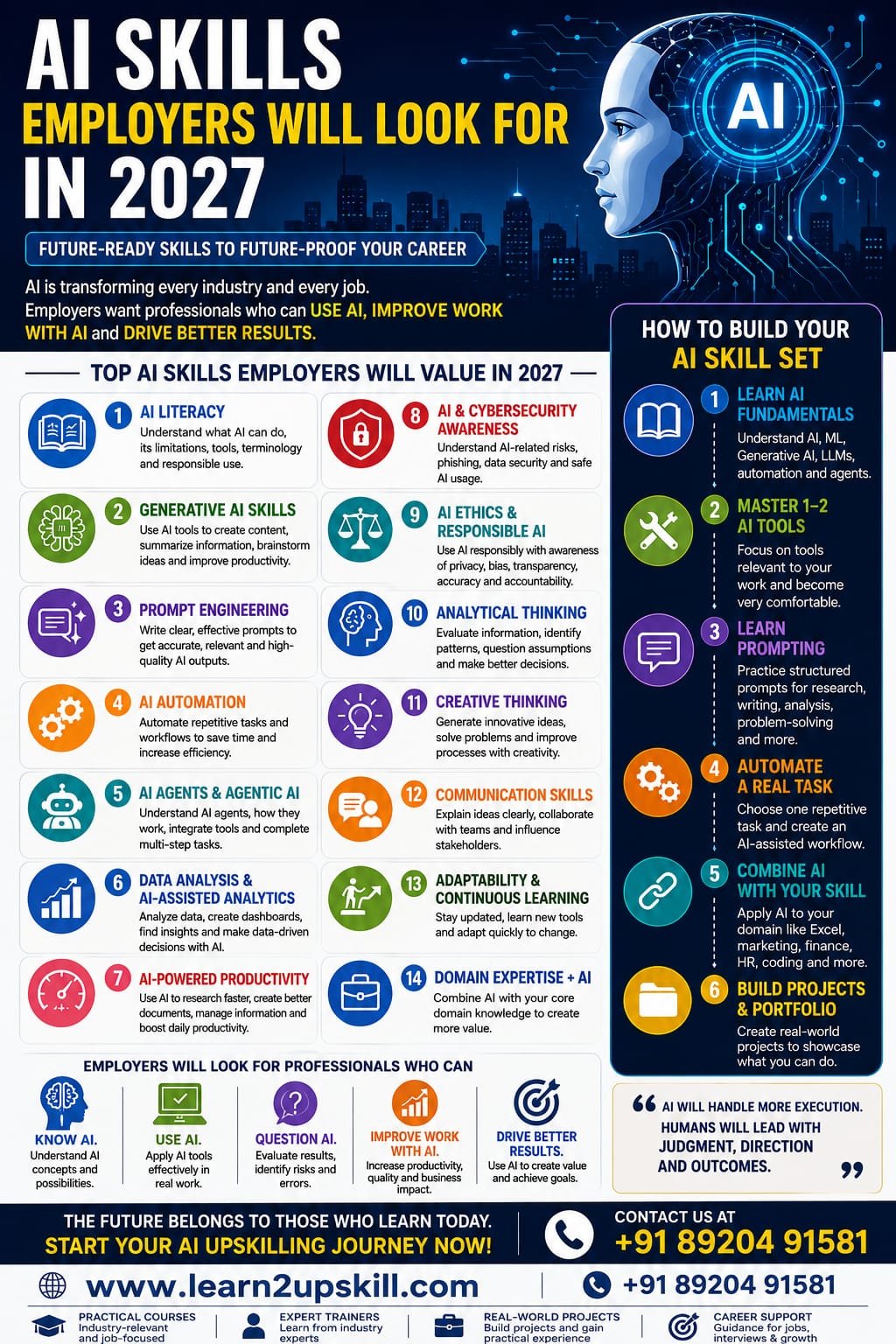
AI Skills Employers Will Look for in 2027
Discover the top AI skills employers will look for in 2027, including AI literacy, prompt engineering, AI automation, data analysis, AI agents, cybersecurity and human skills.
Suggested URL Slug:
“/ai-skills-employers-will-look-for-in-2027/”
Introduction
Artificial intelligence is no longer limited to technology companies or specialist AI teams. It is becoming part of everyday work across marketing, finance, human resources, customer service, education, operations, sales, IT and many other fields.
As we move toward 2027, employers are increasingly looking for professionals who can work effectively with AI—not simply people who know that AI exists.
The most valuable employees of the future are likely to combine AI literacy, technical understanding, business knowledge, analytical thinking and human skills.
According to LinkedIn, AI literacy is already among the fastest-growing skills across regions and job functions, while large language model proficiency is also emerging as an important skill. LinkedIn also estimates that 70% of the skills used in most jobs could change by 2030, with AI acting as a major catalyst.
The World Economic Forum’s Future of Jobs Report 2025 similarly identifies AI and big data as the fastest-growing skill area, alongside networks and cybersecurity and technological literacy. At the same time, analytical thinking, creative thinking, resilience, flexibility and collaboration remain important.
So, what should students, job seekers and working professionals learn now?
Let’s explore the top AI skills employers are likely to value in 2027.
—
- AI Literacy
The first and most important skill is AI literacy.
You don’t necessarily need to become an AI engineer to benefit from artificial intelligence. Professionals in almost every department can benefit from understanding:
– What AI can and cannot do
– How Generative AI works at a basic level
– How to use AI tools responsibly
– How to evaluate AI-generated information
– How AI can improve everyday workflows
– Basic AI terminology
– AI risks and limitations
– Data privacy and responsible AI use
AI literacy is increasingly becoming a workplace skill rather than a niche technical capability.
LinkedIn reported in 2025 that AI literacy was one of the most in-demand skills employers were seeking across jobs, while more C-suite executives were adding AI-related skills to their profiles.
Why employers value it
An employee who understands AI can identify opportunities to:
– Reduce repetitive work
– Improve productivity
– Analyze information faster
– Generate first drafts
– Automate routine processes
– Support decision-making
AI literacy should therefore be the foundation of your 2027 skill set.
—
- Generative AI Skills
Generative AI tools can create text, images, presentations, code, summaries and other forms of content.
By 2027, employers are likely to expect professionals to understand how to use Generative AI appropriately within their jobs.
Useful capabilities include:
– Writing effective AI instructions
– Generating and improving content
– Summarizing documents
– Brainstorming ideas
– Research assistance
– Creating presentations
– Analyzing information
– Generating basic code
– Automating repetitive knowledge work
However, simply knowing how to open ChatGPT is not enough.
The real advantage comes from understanding how to integrate Generative AI into your workflow.
—
- Prompt Engineering
Prompt engineering remains a useful AI skill, particularly when it is combined with strong domain knowledge.
A good prompt can help an AI system understand:
– The objective
– The context
– The desired format
– The target audience
– Constraints
– Examples
– Evaluation criteria
For example, instead of asking:
«”Write a report.”»
A professional might specify the audience, business objective, data, structure, tone and expected output.
Why prompt engineering matters
Professionals who can communicate clearly with AI systems can potentially obtain more useful and consistent results.
LinkedIn has reported significant growth in professionals adding AI skills such as prompt engineering and Generative AI tools to their profiles.
By 2027, however, prompt engineering is likely to be most valuable when combined with business, technical or industry expertise.
—
- AI Automation
One of the biggest opportunities for professionals is learning how to use AI to automate repetitive work.
AI automation can support tasks such as:
– Email processing
– Data entry
– Report generation
– Customer support
– Lead management
– Document processing
– Meeting summaries
– Content workflows
– Research
– Administrative tasks
The key skill isn’t simply knowing an automation tool.
It is knowing how to identify a repetitive business process and determine:
What should be automated?
What should remain human-controlled?
How should the workflow be monitored?
This combination of AI knowledge and process thinking can become extremely valuable.
—
- AI Agents and Agentic AI
A major development heading into 2027 is the growth of AI agents.
Unlike a basic chatbot that responds to individual prompts, AI agents can be designed to perform multi-step tasks, interact with tools and work toward defined objectives.
Microsoft’s 2026 Work Trend Index describes a workplace where AI and agents increasingly take on execution while humans focus more on directing work, making decisions and owning outcomes.
Professionals should therefore begin understanding:
– What AI agents are
– How agentic workflows operate
– How agents use tools
– Human oversight
– Agent evaluation
– Workflow design
– AI governance
– Business applications of agents
You don’t necessarily need to build sophisticated agents immediately.
Understanding how businesses can use AI agents will itself become a valuable capability.
—
- Data Analysis and AI-Assisted Analytics
AI is changing how people work with data.
Professionals who combine data literacy + AI skills can become more valuable because they can use AI to accelerate parts of the analytical process while still applying human judgment.
Important skills include:
– Excel
– Power BI
– Data visualization
– Data cleaning
– Basic statistics
– SQL
– Dashboard creation
– AI-assisted data analysis
– Interpreting business data
– Communicating insights
The World Economic Forum identifies AI and big data among the fastest-growing skill areas through 2030.
For many professionals, learning AI + Excel + Power BI may be more immediately useful than trying to become a machine-learning engineer.
—
- AI-Powered Productivity
Employers don’t simply want employees who know AI tools.
They want employees who can get better results with them.
AI-powered productivity skills can include:
– Faster research
– Better document creation
– Meeting summarization
– Email assistance
– Presentation creation
– Information organization
– Task prioritization
– Knowledge management
– Workflow optimization
Microsoft’s 2026 Work Trend Index found that nearly half of analyzed Copilot conversations supported cognitive work such as analysis, problem-solving, evaluation and creative thinking.
This suggests an important shift:
AI skills are increasingly connected to how people think and work, not just how they use technology.
—
- AI and Cybersecurity Awareness
As organizations adopt AI, cybersecurity becomes even more important.
Professionals should understand risks such as:
– Phishing powered by AI
– Deepfakes
– AI-generated scams
– Data leakage
– Prompt injection
– Unsafe use of confidential information
– Malicious AI-generated content
– Identity impersonation
The World Economic Forum expects networks and cybersecurity to remain among the fastest-growing skill areas alongside AI and big data.
Even non-technical employees should understand basic AI-related security practices.
—
- AI Ethics and Responsible AI
AI can produce inaccurate, biased or inappropriate results.
Professionals therefore need to understand responsible AI principles such as:
– Privacy
– Transparency
– Bias
– Accuracy
– Human oversight
– Data security
– Accountability
– Appropriate AI use
This will become increasingly important as organizations integrate AI into business processes.
Employers will not only ask:
“Can you use AI?”
They may also ask:
“Can you use AI responsibly?”
—
- Analytical Thinking
AI does not eliminate the need for human thinking.
In fact, the ability to evaluate AI output may become even more important.
Employees need to be able to:
– Identify problems
– Evaluate information
– Compare alternatives
– Question assumptions
– Interpret results
– Make decisions
– Identify errors
The World Economic Forum’s Future of Jobs research identifies analytical thinking as a leading core skill, while AI and big data rank among the fastest-growing technical skill areas.
This creates an important combination:
AI capability + analytical thinking = stronger workplace performance.
—
- Creative Thinking
AI can generate many ideas quickly, but humans still need to determine which ideas are useful.
Creative thinking can help professionals:
– Develop new products
– Create marketing campaigns
– Solve business problems
– Improve processes
– Develop new services
– Find new opportunities
The World Economic Forum expects creative thinking to remain an important skill as technology changes the workplace.
—
- Communication Skills
One of the biggest mistakes people make when discussing future skills is assuming that technical skills will replace communication skills.
The opposite may be closer to reality.
As AI handles more routine work, employees may spend more time:
– Explaining ideas
– Presenting recommendations
– Collaborating with teams
– Managing stakeholders
– Communicating with customers
– Making decisions
LinkedIn’s research on India highlights the continuing importance of communication, creative thinking, innovative thinking, adaptability and collaboration alongside AI literacy.
So don’t build an AI-only skill set.
Build an AI + human skills combination.
—
- Adaptability and Continuous Learning
AI tools are changing rapidly.
A tool that is popular today may be replaced or significantly changed tomorrow.
That’s why one of the most valuable career skills for 2027 may be the ability to learn continuously.
Professionals should develop a habit of:
- Learning new tools
- Testing them
- Understanding their limitations
- Applying them to real work
- Measuring the results
- Updating their skills
The ability to learn may become more valuable than memorizing a particular AI tool.
—
- Domain Expertise + AI
Here’s an important career lesson:
You don’t have to compete with AI. Learn how to combine AI with your existing expertise.
For example:
Finance + AI
Marketing + AI
HR + AI
Excel + AI
Cybersecurity + AI
Business Analysis + AI
Education + AI
Software Development + AI
This combination can create a powerful professional profile.
AI knowledge by itself is useful.
AI knowledge combined with real-world domain expertise can be even more valuable.
—
—
How to Build Your AI Skill Set Before 2027
You don’t need to learn everything at once.
Follow this simple progression.
Step 1: Learn AI Fundamentals
Understand:
– Artificial intelligence
– Machine learning
– Generative AI
– Large language models
– AI agents
– Automation
Step 2: Master One or Two AI Tools
Don’t try to learn every tool available.
Become highly comfortable with tools relevant to your work.
Step 3: Learn Prompting
Practice creating structured prompts for:
– Research
– Writing
– Analysis
– Brainstorming
– Productivity
– Problem-solving
Step 4: Automate a Real Task
Choose one repetitive task and create an AI-assisted workflow.
Step 5: Combine AI With Your Career Skill
For example:
Excel + AI
Marketing + AI
Finance + AI
HR + AI
Coding + AI
Step 6: Build Projects
Don’t just collect certificates.
Create practical examples that demonstrate what you can actually do.
For example:
– AI-powered report
– Automated workflow
– Excel dashboard
– AI chatbot
– Data analysis project
– AI-assisted marketing campaign
Projects can make your skills easier to demonstrate during interviews.
—
What Employers Will Really Want in 2027
The biggest misconception is that employers will simply hire people who know the most AI tools.
That’s unlikely to be enough.
The strongest candidates will increasingly combine:
AI Skills + Business Knowledge + Data Skills + Human Skills
Think of it as:
«Know AI. Use AI. Question AI. Improve work with AI.»
That’s a much stronger professional profile than simply listing “ChatGPT” on a resume.
—
Final Thoughts
The workplace is changing quickly, and professionals who wait until 2027 to start learning AI skills may find themselves playing catch-up.
Current research already points toward a growing importance of AI literacy, AI and big data, technological literacy and cybersecurity, while analytical thinking, creativity, communication, adaptability and other human skills remain critical.
At the same time, Microsoft’s 2026 research points toward a future where AI agents take on more execution while humans increasingly focus on judgment, direction and outcomes.
The message is clear:
Don’t prepare for a future where AI replaces every skill. Prepare for a future where people who know how to work effectively with AI have an advantage.
Start learning today, practice with real projects, combine AI with your professional expertise and keep updating your skills.
2027 isn’t far away. Your AI upskilling journey should start now.
—
—
Learn2Upskill: Build Skills for the Future
The future belongs to professionals who continuously upgrade their skills.
At Learn2Upskill, you can develop practical skills in areas such as AI, Generative AI, productivity, technology, data and career development.
Don’t wait for the job market to change. Start preparing for it today.
🌐 www.coral-kudu-326218.hostingersite.com
Learn. Upskill. Grow.
Leave a Reply