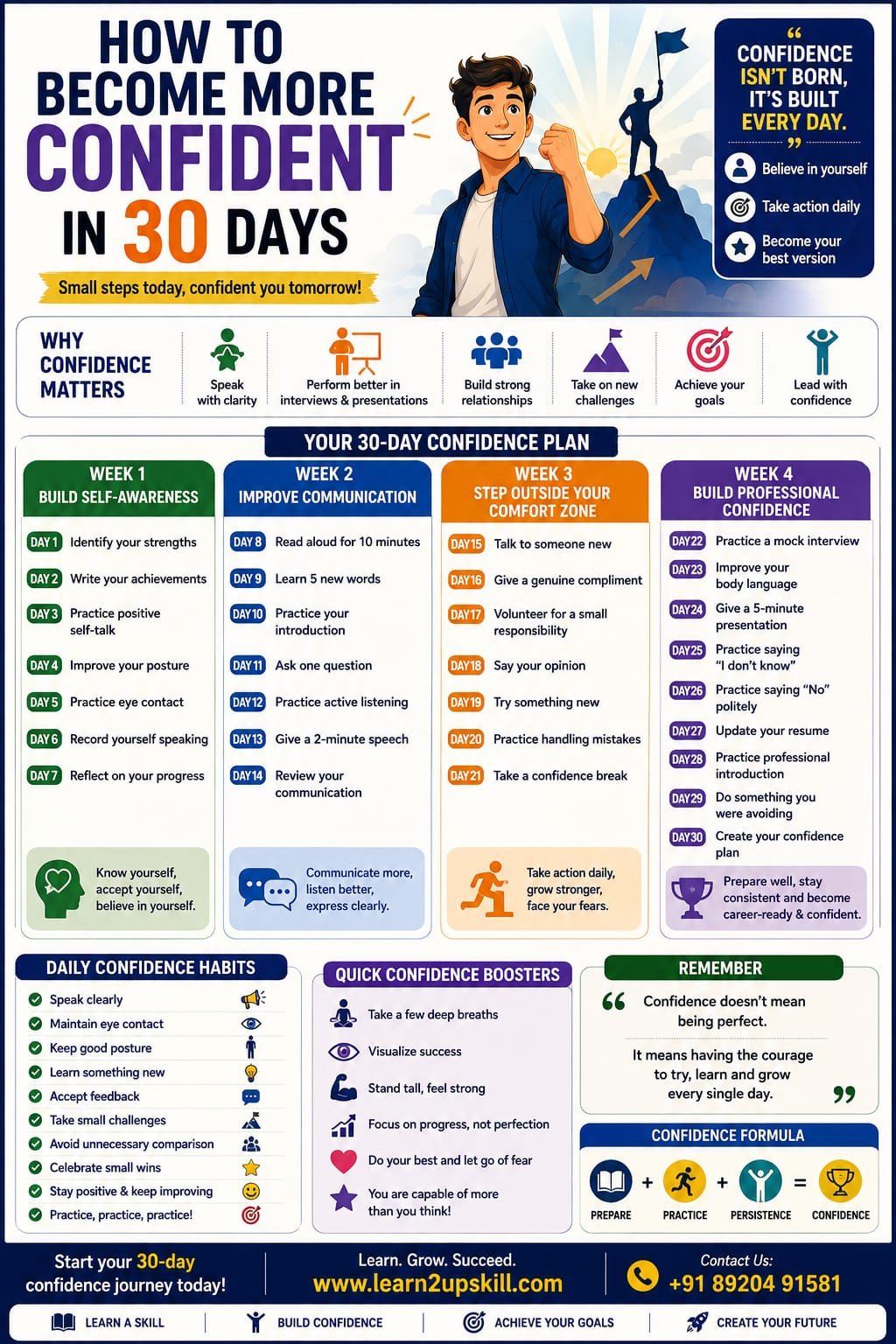
How to Become More Confident in 30 Days
Introduction
Confidence is one of the most valuable qualities a student can develop. It can help you speak clearly, participate in discussions, give presentations, attend interviews, meet new people, and handle challenges with a positive mindset.
But confidence is not something that only a few people are naturally born with. It is a skill that can be developed through practice, preparation, experience, and self-awareness.
If you currently feel shy, nervous while speaking, uncomfortable in social situations, or afraid of making mistakes, don’t worry. You can start improving gradually.
This 30-day confidence-building challenge is designed to help students and freshers develop confidence through small, practical daily activities.
At Learn2Upskill, we believe confidence grows when you take action, learn from experience, and become comfortable stepping outside your comfort zone.
What Is Confidence?
Confidence is the belief that you can handle a situation, learn something new, or take action even when you don’t know exactly what will happen.
Confidence does not mean:
Knowing everything.
Never making mistakes.
Being the loudest person in the room.
Always feeling comfortable.
Thinking you are better than everyone else.
Real confidence means being able to say:
“I may not be perfect, but I am willing to try, learn, and improve.”
Why Is Confidence Important for Students?
Confidence can help students:
Participate in class.
Speak in front of others.
Give presentations.
Attend interviews.
Make new connections.
Ask questions.
Express opinions.
Take leadership responsibilities.
Handle criticism.
Try new opportunities.
Confidence can also influence how you communicate your skills and abilities during job interviews and professional situations.
Confidence vs. Overconfidence
It is important to understand the difference.
Confidence
“I have prepared well, and I will give my best.”
Overconfidence
“I don’t need to prepare because I already know everything.”
Confidence combines self-belief with preparation and humility.
The 30-Day Confidence Challenge
The following plan is divided into four stages:
Week 1 – Build Self-Awareness
Week 2 – Improve Communication
Week 3 – Step Outside Your Comfort Zone
Week 4 – Build Professional Confidence
Let’s begin.
WEEK 1: Build Self-Awareness
Day 1 – Identify Your Strengths
Write down at least five things you are good at.
They could include:
Communication
Creativity
Mathematics
Sports
Organization
Helping others
Technology
Leadership
Writing
Don’t focus only on academic skills.
Your personal qualities also matter.
Today’s Goal
Write:
“My five strengths are…”
Day 2 – Identify Your Achievements
Think about things you have accomplished.
They don’t have to be huge achievements.
Examples:
Completing a difficult project.
Improving your grades.
Winning a competition.
Learning a new skill.
Helping someone.
Organizing an event.
Write down at least five achievements.
This exercise reminds you that you have already overcome challenges.
Day 3 – Practice Positive Self-Talk
Pay attention to how you speak to yourself.
Replace:
“I can’t do this.”
with:
“I can learn how to do this.”
Replace:
“Everyone will judge me.”
with:
“I will focus on doing my best.”
Replace:
“I’m not good enough.”
with:
“I am improving every day.”
Positive self-talk doesn’t mean ignoring your weaknesses. It means approaching them constructively.
Day 4 – Improve Your Posture
Your physical presence can influence how you feel and communicate.
Practice:
Standing upright.
Relaxing your shoulders.
Keeping your head naturally raised.
Walking at a comfortable pace.
Maintaining a relaxed facial expression.
Spend five minutes practicing good posture.
Day 5 – Practice Eye Contact
Eye contact can help communicate attentiveness and confidence.
Practice making natural eye contact while speaking with:
Parents
Friends
Teachers
Classmates
Don’t stare continuously.
The goal is comfortable, natural eye contact.
Day 6 – Record Yourself Speaking
Choose a simple topic such as:
“My favourite hobby.”
Speak for two minutes and record yourself.
Then watch the recording.
Notice:
Your posture.
Voice.
Eye contact.
Facial expressions.
Speaking speed.
Repeated words.
Don’t criticize yourself.
Use the recording to identify areas for improvement.
Day 7 – Reflect on Week 1
Write answers to these questions:
What did I learn about myself?
What am I already good at?
What makes me nervous?
Which confidence habit improved?
What do I want to improve next?
Celebrate your progress.
Confidence grows through noticing improvement—not demanding perfection.
WEEK 2: Improve Communication
Day 8 – Read Aloud
Read a page from a book, article, or educational material aloud for 10 minutes.
Focus on:
Clear pronunciation.
Natural pauses.
Appropriate speed.
Expression.
This simple exercise can improve speaking confidence.
Day 9 – Learn Five New Words
Choose five useful English words.
Learn:
Meaning
Pronunciation
Example sentence
Then try using them in conversation or writing.
Don’t focus on using complicated vocabulary. Focus on communicating clearly.
Day 10 – Practice Your Introduction
Prepare a 30–60 second introduction.
Include:
Your name.
Your education.
Your interests.
Your strengths.
Your career goal.
Practice until you can say it naturally rather than memorizing every word.
Day 11 – Ask One Question
Today, ask a thoughtful question during a class, workshop, meeting, or conversation.
If you usually remain silent because you are worried about what others may think, this is your opportunity to take a small step.
Remember:
Asking a question is a sign of curiosity, not weakness.
Day 12 – Practice Active Listening
Have a conversation with someone and focus entirely on listening.
Don’t interrupt unnecessarily.
Ask follow-up questions.
Try to understand what the other person is saying rather than preparing your next response.
Good listening is an important part of confident communication.
Day 13 – Give a Two-Minute Speech
Choose a simple topic:
My favourite subject
A book I enjoyed
A career I am interested in
The importance of education
A skill I want to learn
Speak for two minutes.
Record yourself if possible.
Day 14 – Review Your Communication
Compare today’s speaking with your Day 6 recording.
Ask:
Am I clearer?
Am I speaking more naturally?
Is my posture better?
Have I reduced unnecessary movements?
Am I more comfortable hearing myself speak?
Recognizing progress can strengthen confidence.
WEEK 3: Step Outside Your Comfort Zone
This week is about action.
Confidence grows when you gradually do things that make you uncomfortable.
Day 15 – Talk to Someone New
Start a short conversation with someone you don’t usually speak to.
It could be:
A classmate
A colleague
A student from another class
Someone at a workshop
Keep it simple.
A simple “Hi, how are you?” is enough to begin.
Day 16 – Give Someone a Genuine Compliment
Give someone a sincere and specific compliment.
For example:
“Your presentation was very well organized.”
or
“I liked the way you explained that topic.”
Positive interactions can help you become more comfortable socially.
Day 17 – Volunteer for a Small Responsibility
Take responsibility for something.
For example:
Helping organize an activity.
Leading part of a group project.
Managing registrations.
Giving instructions.
Presenting one section of a project.
Small responsibilities can gradually build leadership confidence.
Day 18 – Say Your Opinion
During a discussion, respectfully express your viewpoint.
You don’t have to convince everyone.
The goal is to become comfortable saying:
“I think…”
and explaining why.
Day 19 – Try Something New
Do something outside your normal routine.
Examples:
Attend a workshop.
Try a new activity.
Join a club.
Learn a new skill.
Participate in a competition.
New experiences expand your comfort zone.
Day 20 – Practice Handling Mistakes
Think about a mistake you made recently.
Write:
What happened?
What did I learn?
What will I do differently next time?
Don’t define yourself by your mistakes.
Use them as feedback.
Day 21 – Take a Confidence Break
Spend some time reflecting on your progress.
Write down:
Three things I am more confident about now.
You may be surprised by how much can change in three weeks.
WEEK 4: Build Professional Confidence
The final week focuses on situations students commonly face in academic and professional life.
Day 22 – Practice a Mock Interview
Ask a friend, teacher, parent, or mentor to ask you common interview questions.
Examples:
Tell me about yourself.
What are your strengths?
What are your weaknesses?
Why should we select you?
What are your career goals?
Practice answering calmly.
Day 23 – Improve Your Body Language
Practice:
Upright posture.
Natural eye contact.
Relaxed hands.
Appropriate facial expressions.
Controlled movements.
Body language should support your words.
Day 24 – Give a Five-Minute Presentation
Prepare a short presentation.
Choose any topic you know well.
Focus on:
Strong opening.
Clear structure.
Eye contact.
Natural gestures.
Good voice projection.
Clear conclusion.
Day 25 – Practice Saying “I Don’t Know”
Confident people don’t pretend to know everything.
Practice responding professionally:
“I’m not sure about that, but I’d be happy to learn more.”
This demonstrates honesty and a willingness to learn.
Day 26 – Practice Saying “No” Politely
Confidence also means understanding your limits.
Instead of:
“I can’t do it.”
try:
“I appreciate you asking, but I won’t be able to take this on right now.”
Learning to set respectful boundaries is an important life and workplace skill.
Day 27 – Update Your Resume
Review your resume.
Highlight:
Skills
Projects
Certifications
Achievements
Internships
Extracurricular activities
A well-prepared resume can increase your confidence when applying for opportunities.
Day 28 – Practice Your Professional Introduction
Imagine you are meeting a recruiter or professional for the first time.
Introduce yourself confidently.
Keep it:
Short
Clear
Professional
Relevant
Practice until it feels natural.
Day 29 – Do Something You Were Avoiding
Think about one small activity you have been avoiding because of nervousness.
Examples:
Asking a question.
Giving a presentation.
Speaking to someone new.
Joining a group activity.
Applying for an opportunity.
Take action.
This may be one of the most important days of the challenge.
Day 30 – Create Your Confidence Plan
Congratulations—you’ve completed the 30-day challenge.
Now create a long-term plan.
Write:
Three strengths I discovered
Three areas I want to improve
Three confidence habits I will continue
Your goal is not to become confident for only 30 days.
Your goal is to build habits that continue beyond the challenge.
10 Daily Habits That Can Build Confidence
Even after completing the 30-day challenge, continue these habits:
Speak clearly.
Maintain natural eye contact.
Keep good posture.
Learn something new.
Practice self-reflection.
Accept constructive feedback.
Take small challenges.
Celebrate progress.
Avoid unnecessary comparison.
Keep practicing.
Small actions repeated consistently can create significant improvement.
Common Reasons Students Lack Confidence
Fear of Failure
You may avoid opportunities because you’re afraid of making mistakes.
Remember:
Failure can provide feedback.
Comparing Yourself With Others
Someone else’s journey is not a measurement of your worth.
Compare yourself with your previous self.
Lack of Preparation
Sometimes what feels like a confidence problem is actually a preparation problem.
Practice can make unfamiliar situations feel easier.
Negative Self-Talk
Constantly telling yourself that you are not capable can affect your behavior.
Replace harsh self-criticism with realistic, constructive thinking.
Fear of Judgment
You cannot control what everyone thinks about you.
Focus on your actions, preparation, and growth.
Confidence-Building Tips for Interviews
Before an interview:
Research the company.
Prepare common questions.
Practice your introduction.
Review your resume.
Dress appropriately.
Arrive on time.
Take a few slow breaths.
During the interview:
Listen carefully.
Maintain natural eye contact.
Sit comfortably.
Speak clearly.
Give specific examples.
Don’t rush your answers.
Remember:
Confidence comes from preparation + practice + self-belief.
Confidence-Building Tips for Presentations
Before presenting:
Know your topic.
Organize your points.
Practice your opening.
Practice your conclusion.
Prepare for questions.
During the presentation:
Look at your audience.
Speak at a comfortable pace.
Use natural gestures.
Avoid reading every word from slides.
Pause after important points.
Don’t panic if you make a small mistake.
Your audience usually cares more about your message than minor mistakes.
What If You Still Feel Nervous?
Feeling nervous does not mean you lack confidence.
Even experienced speakers can feel nervous before an important presentation or interview.
The goal is not to eliminate nervousness completely.
Instead, learn to manage it.
Try:
Slow breathing.
Preparation.
Positive self-talk.
Practice.
Arriving early.
Focusing on the task rather than your fear.
You can feel nervous and still perform well.
Final Thoughts
Confidence is not built in one day, and it does not require you to become a completely different person.
It develops through small actions:
Try → Practice → Learn → Improve → Repeat
Over the next 30 days, focus on taking one small step every day. Speak a little more, try something new, improve your posture, practice communication, accept feedback, and challenge yourself gradually.
Most importantly, remember that confidence does not mean being perfect.
It means trusting yourself enough to try, learn, recover from mistakes, and keep moving forward.
At Learn2Upskill, we help students and freshers build confidence, communication skills, personality, professional grooming, interview readiness, and career-ready skills.
Start your 30-day confidence journey today.
Contact Learn2Upskill
Website: www.coral-kudu-326218.hostingersite.com
Contact Us: +91-89204 91581
Learn2Upskill – Learn. Grow. Succeed.
Leave a Reply