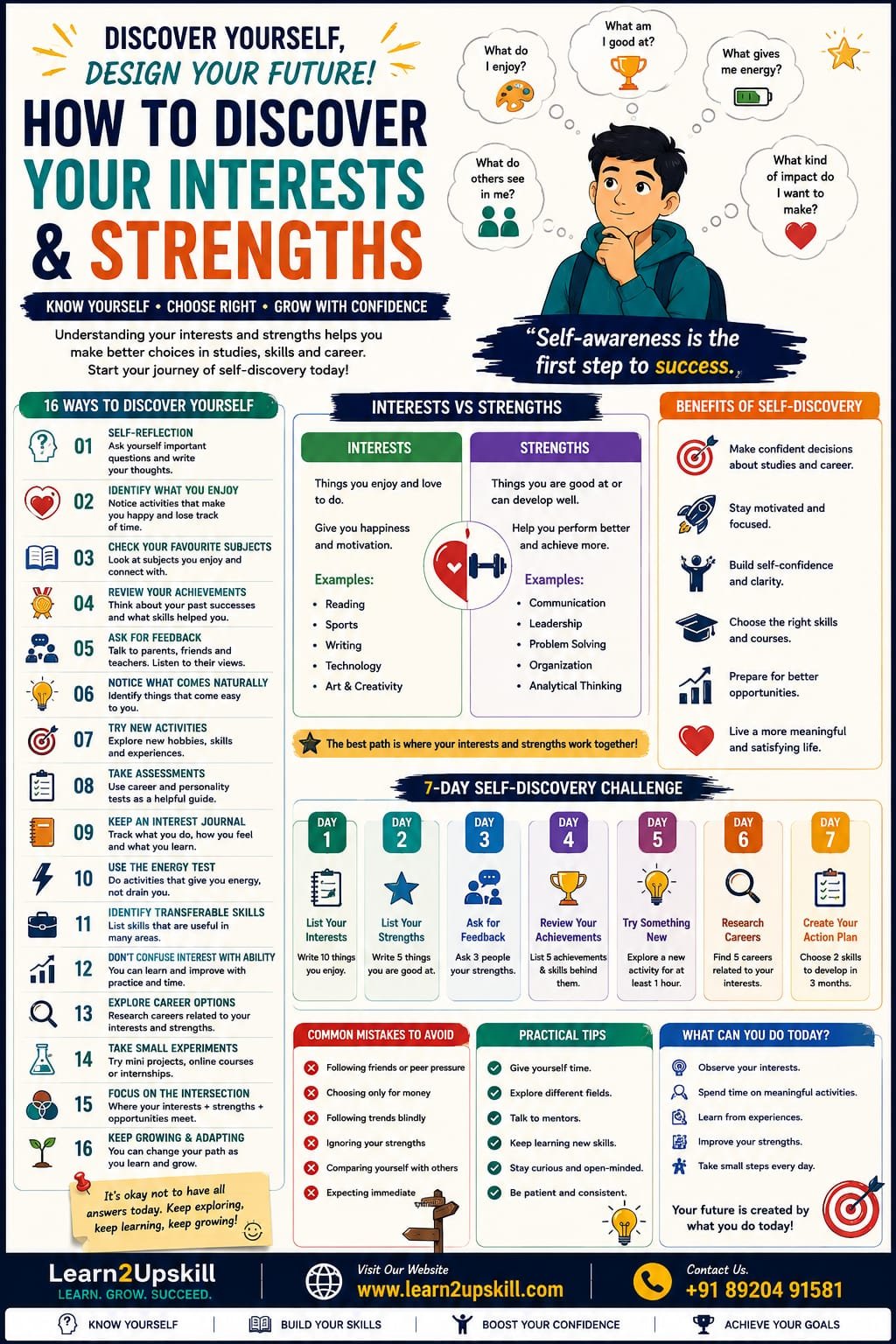
How to Discover Your Interests and Strengths
Introduction
Choosing the right course, career, or skill can be difficult when you are not sure what you are good at or what you genuinely enjoy. Many students choose careers because of peer pressure, family expectations, popular trends, or what their friends are doing. Later, they may realize that their interests and abilities are different.
Understanding your interests and strengths can help you make better academic and career decisions. It can also improve your confidence, motivation, and overall personality development.
The good news is that you do not need to have everything figured out at a young age. Your interests and strengths can be discovered gradually through self-reflection, experimentation, feedback, and new experiences.
At Learn2Upskill, we believe that self-awareness is the first step toward building a successful academic and career journey.
What Are Interests and Strengths?
Before discovering them, it is important to understand the difference.
Interests
Interests are activities, subjects, topics, or areas that naturally attract your attention.
For example, you may enjoy:
Reading
Drawing
Technology
Sports
Writing
Teaching others
Organizing events
Working with numbers
Creating videos
Solving puzzles
Learning about business
Strengths
Strengths are abilities or qualities that you perform well or can develop effectively with practice.
Examples include:
Communication
Creativity
Leadership
Problem-solving
Organization
Analytical thinking
Teamwork
Adaptability
Time management
Attention to detail
Your interests and strengths may overlap, but they do not always have to be the same.
For example, you may love photography but discover that your strongest skill is communication. Exploring both can help you identify interesting career possibilities.
Why Is It Important to Discover Your Interests and Strengths?
Self-awareness can help students:
Choose subjects more confidently.
Select suitable courses.
Explore career options.
Build useful skills.
Improve motivation.
Develop self-confidence.
Make better decisions.
Avoid following trends blindly.
Prepare for future opportunities.
When you understand yourself better, career planning becomes more meaningful.
- Start With Self-Reflection
The easiest place to begin is by asking yourself some honest questions.
Ask:
What activities do I enjoy?
Which subjects interest me most?
What do I enjoy learning about?
What activities make me lose track of time?
What do people often ask me for help with?
What tasks feel easier to me than they seem to others?
What achievements am I proud of?
What activities do I naturally take initiative in?
Write your answers in a notebook.
You may begin noticing patterns that you had not previously recognized.
- Identify Activities You Enjoy
Pay attention to what you naturally choose to do during your free time.
For example:
If you enjoy creating posters, designing presentations, or editing videos, you may have an interest in creative work.
If you enjoy solving puzzles, analyzing information, or working with numbers, analytical fields may interest you.
If you enjoy explaining concepts to classmates, teaching, training, or counselling could be areas worth exploring.
Your everyday choices can provide valuable clues.
- Look at Your Favourite Subjects
Your favourite subjects can offer useful insights, but don’t treat them as the only factor.
For example:
Mathematics
You may enjoy:
Problem-solving
Logic
Data
Analysis
Potential areas to explore include data analytics, finance, engineering, economics, or technology.
English
You may enjoy:
Writing
Communication
Storytelling
Public speaking
You could explore content creation, communication, journalism, teaching, marketing, or public relations.
Science
You may enjoy:
Experiments
Research
Understanding how things work
Critical thinking
This could lead to exploration of scientific, healthcare, engineering, or technology-related fields.
Your interests can cross multiple subjects, so don’t limit yourself too early.
- Think About Your Past Achievements
Your achievements can reveal your strengths.
Think about situations where you:
Won a competition.
Completed a difficult project.
Helped organize an event.
Improved your grades.
Led a team.
Helped someone solve a problem.
Received positive feedback from a teacher.
Successfully learned a new skill.
Ask yourself:
“What did I do that contributed to this success?”
For example, if you successfully organized a college event, your strengths may include planning, communication, teamwork, and leadership.
- Ask Others for Feedback
Sometimes other people notice our strengths before we do.
Ask trusted people such as:
Parents
Teachers
Mentors
Friends
Coaches
Career counsellors
Ask them:
“What do you think I am naturally good at?”
Don’t simply accept every opinion. Look for patterns.
If several people independently mention that you are good at explaining things, organizing tasks, or communicating with others, that may be an important clue.
- Pay Attention to What Comes Naturally to You
Some activities may feel easier to you than they do to others.
For example:
You may naturally:
Explain complicated topics simply.
Organize group activities.
Notice small mistakes.
Come up with creative ideas.
Solve technical problems.
Make people feel comfortable.
Lead group projects.
These natural abilities can become valuable strengths when developed further.
- Try New Activities
You cannot discover everything about yourself by thinking alone.
Experiment.
Try:
Public speaking
Coding
Digital marketing
Graphic design
Sports
Writing
Volunteering
Photography
Video editing
Entrepreneurship
Debates
Theatre
Music
Leadership activities
You may discover an interest you never knew you had.
- Use Interest and Strength Assessments
Career and personality assessments can provide useful starting points.
They may help you explore:
Interests
Personality preferences
Work styles
Skills
Career areas
However, don’t treat the result as a final career decision.
An assessment should be a guide, not a label.
Your actual experiences, skills, values, and goals should also be considered.
- Create an Interest Journal
Maintain a simple weekly journal.
Write down:
Activity
What did I do?
Enjoyment
Did I enjoy it?
Performance
How well did I perform?
Energy
Did the activity energize me or make me feel exhausted?
Learning
What did I learn about myself?
After several weeks, review your answers.
You may discover clear patterns.
- Use the “Energy Test”
Pay attention to how different activities make you feel.
After completing an activity, ask:
Did this activity give me energy or drain me?
For example, you might discover that:
Speaking to people energizes you.
Working alone for long periods drains you.
Designing content excites you.
Analyzing data keeps you engaged.
This does not automatically determine your career, but it provides useful information about your preferences.
- Identify Your Transferable Skills
Some skills are useful across many careers.
These are called transferable skills.
Examples include:
Communication
Leadership
Teamwork
Problem-solving
Critical thinking
Time management
Adaptability
Creativity
Organization
For example, organizing a college event can develop communication, teamwork, planning, and leadership skills.
These skills can become valuable additions to your resume.
- Don’t Confuse Interest With Ability
You can be interested in something without being good at it yet.
For example, you may love photography but have limited technical knowledge.
That does not mean you should give up.
Instead, ask:
“Am I interested enough to improve?”
Interest combined with consistent practice can develop into a strong skill.
- Don’t Confuse Current Performance With Potential
A student may perform poorly in a subject because of:
Weak fundamentals
Lack of practice
Poor teaching methods
Exam anxiety
Lack of interest in the current learning method
One poor grade does not necessarily mean you lack ability.
Give yourself opportunities to learn in different ways before making permanent conclusions about your strengths.
- Explore Careers Before Choosing One
Once you identify your interests and strengths, research careers connected to them.
For example:
Interest: Technology
Strength: Problem-solving
Explore:
Software development
Data analytics
Cybersecurity
AI
Cloud computing
Interest: Communication
Strength: Creativity
Explore:
Digital marketing
Content creation
Advertising
Public relations
Media
Interest: Helping People
Strength: Communication and Empathy
Explore:
Teaching
Counselling
Human resources
Training
Customer success
The goal is to explore possibilities—not immediately choose one.
- Take Small Experiments Before Making Big Decisions
Before committing to a career path, try a small experiment.
For example:
If you are interested in digital marketing:
Take a beginner course.
Create a sample social media campaign.
Learn basic SEO.
Write a blog.
Analyze website traffic.
If you enjoy the process and want to learn more, that’s valuable information.
Small experiments can prevent major career decisions based purely on assumptions.
- Focus on the Intersection of Interest and Strength
A useful way to think about career exploration is:
What do I enjoy? + What am I good at? + What can I become good at? + What opportunities exist?
The intersection can reveal promising areas to explore.
For example:
Enjoys writing + strong communication + creativity
→ Content writing, marketing, journalism, communications, or media.
Enjoys numbers + analytical thinking + technology
→ Data analytics, finance, business analysis, or technology.
- Don’t Compare Your Journey With Others
One of the biggest mistakes students make is comparing themselves with classmates.
Someone may discover their career interest at 16.
Another person may discover it at 21.
Someone may change careers at 30.
There is no single timetable for discovering yourself.
Focus on your own progress.
- Keep Developing Your Strengths
Discovering a strength is only the beginning.
If you identify communication as a strength, improve it through:
Presentations
Public speaking
Group discussions
Debates
Writing
Leadership activities
If creativity is your strength, develop it through:
Design
Content creation
Photography
Video editing
Creative projects
Strength becomes valuable when it is developed consistently.
A Simple 7-Day Self-Discovery Challenge
Try this exercise.
Day 1 – List Your Interests
Write down 10 things you enjoy.
Day 2 – List Your Strengths
Write down five things you believe you are good at.
Day 3 – Ask for Feedback
Ask three people what they think your strengths are.
Day 4 – Review Your Achievements
Write down five achievements and identify the skills behind them.
Day 5 – Try Something New
Spend at least one hour exploring a new activity.
Day 6 – Research Careers
Find five careers connected to your interests and strengths.
Day 7 – Create Your Action Plan
Choose two skills you want to develop over the next three months.
This simple exercise can be the beginning of a much clearer career journey.
Common Mistakes Students Should Avoid
Following Friends
Your friend’s ideal career may not be right for you.
Choosing Only for Salary
Income matters, but career satisfaction also depends on interests, skills, growth opportunities, and values.
Following Trends Blindly
A popular career today may not necessarily be the right choice for every student.
Ignoring Your Strengths
Don’t focus only on weaknesses. Your strengths can become your biggest career advantages.
Expecting Immediate Clarity
Self-discovery takes time.
How Parents and Teachers Can Help Students
Parents and teachers can support students by:
Encouraging exploration.
Listening without immediately judging.
Providing opportunities to try different activities.
Recognizing individual strengths.
Avoiding constant comparisons.
Encouraging questions.
Supporting informed career decisions.
Students need guidance, but they also need space to discover themselves.
Benefits of Understanding Your Interests and Strengths
Self-awareness can help students:
Choose courses more confidently.
Set meaningful goals.
Improve motivation.
Build self-confidence.
Develop relevant skills.
Make better career decisions.
Prepare for interviews.
Build a stronger resume.
Become more adaptable.
Develop a clearer sense of direction.
Conclusion
Discovering your interests and strengths is not a one-time activity. It is an ongoing process of exploring, learning, experimenting, reflecting, and improving.
Don’t worry if you don’t have your entire career planned today. Start by understanding what you enjoy, what you do well, what you want to improve, and what opportunities you would like to explore.
Try new things. Ask for feedback. Learn from experiences. Most importantly, give yourself permission to change your mind as you learn more about yourself.
The better you understand yourself, the better prepared you will be to make thoughtful decisions about your education, skills, and career.
At Learn2Upskill, we are committed to helping students develop self-awareness, communication skills, confidence, personality, career readiness, and practical skills for the future.
Contact Learn2Upskill
Website: www.coral-kudu-326218.hostingersite.com
Contact Us: +91-89204 91581
Learn2Upskill – Learn. Grow. Succeed.
Leave a Reply